Kirjojen hintavertailu. Mukana 12 390 323 kirjaa ja 12 kauppaa.

Kirjahaku

Etsi kirjoja tekijän nimen, kirjan nimen tai ISBN:n perusteella.

1000 tulosta hakusanalla Keith G. Feit

The Superstition of Divorce (1920).By: Gilbert Keith Chesterton: (classic book)

The Superstition of Divorce (1920).By: Gilbert Keith Chesterton: (classic book)

G. K. Chesterton

Createspace Independent Publishing Platform
2017
nidottu
The earlier part of this book appeared in the form of five articles which came out in the "New Witness" at the crisis of the recent controversy in the Press on the subject of divorce. Crude and sketchy as they confessedly were, they had a certain rude plan of their own, which I find it very difficult to recast even in order to expand. I have therefore decided to reprint the original articles as they stood, save for a few introductory words; and then, at the risk of repetition, to add a few further chapters, explaining more fully any conceptions that may seem to have been too crudely assumed or dismissed. I have set forth the original matter as it appeared, under a general heading, without dividing it into chapters. Gilbert Keith Chesterton, KC*SG (29 May 1874 - 14 June 1936), better known as G. K. Chesterton, was an English writer, poet, philosopher, dramatist, journalist, orator, lay theologian, biographer, and literary and art critic. Chesterton is often referred to as the "prince of paradox". Time magazine has observed of his writing style: "Whenever possible Chesterton made his points with popular sayings, proverbs, allegories-first carefully turning them inside out." Chesterton is well known for his fictional priest-detective Father Brown, and for his reasoned apologetics. Even some of those who disagree with him have recognised the wide appeal of such works as Orthodoxy and The Everlasting Man.Chesterton, as a political thinker, cast aspersions on both Progressivism and Conservatism, saying, "The whole modern world has divided itself into Conservatives and Progressives. The business of Progressives is to go on making mistakes. The business of the Conservatives is to prevent the mistakes from being corrected."Chesterton routinely referred to himself as an "orthodox" Christian, and came to identify this position more and more with Catholicism, eventually converting to Catholicism from High Church Anglicanism. George Bernard Shaw, Chesterton's "friendly enemy" according to Time, said of him, "He was a man of colossal genius."Biographers have identified him as a successor to such Victorian authors as Matthew Arnold, Thomas Carlyle, Cardinal John Henry Newman, and John Ruskin.
The Club of Queer Trades Gilbert Keith Chesterton

The Club of Queer Trades Gilbert Keith Chesterton

G. K. Chesterton

Createspace Independent Publishing Platform
2017
nidottu
A collection of related short stories by British author G. K. Chesterton. Each story is centered on a person who is making his living by some novel and extraordinary means (a "queer trade"). To gain admittance to the Club, one must have a unique queer trade as principal source of income. "Cherub" Swinburne describes his quest for The Club of Queer Trades with his friend Basil Grant, a retired judge, and Rupert Grant, a private detective who is Basil's younger brother. Each of the stories describes their encounter with one of the trades. In the final story, Rupert Grant rescues a lady from her kidnappers but cannot understand why she refuses to be rescued. The answer leads to the unveiling of the mystery of The Club of Queer Trades. First published by Harper & Brothers, London, 1905.
The Flying Inn (1914) NOVEL by: Gilbert Keith Chesterton

The Flying Inn (1914) NOVEL by: Gilbert Keith Chesterton

G. K. Chesterton

Createspace Independent Publishing Platform
2017
nidottu
The Flying Inn is the final novel by G. K. Chesterton, first published in 1914. It is set in a future England where the Temperance movement has allowed a bizarre form of "Progressive" Islam to dominate the political and social life of the country. Because of this, alcohol sales to the poor are effectively prohibited, while the rich can get alcoholic drinks "under a medical certificate". The plot centres on the adventures of Humphrey Pump and Captain Patrick Dalroy, who roam the country in their cart with a barrel of rum in an attempt to evade Prohibition, exploiting loopholes in the law to temporarily prevent the police taking action against them. Eventually the heroes and their followers foil an attempted coup by an Islamic military force.
George Bernard Shaw (1910) by: Gilbert Keith Chesterton

George Bernard Shaw (1910) by: Gilbert Keith Chesterton

G. K. Chesterton

Createspace Independent Publishing Platform
2017
nidottu
Gilbert Keith Chesterton (29 May 1874 - 14 June 1936), better known as G. K. Chesterton, was an English writer, poet, philosopher, dramatist, journalist, orator, lay theologian, biographer, and literary and art critic. Chesterton is often referred to as the "prince of paradox." Time magazine has observed of his writing style: "Whenever possible Chesterton made his points with popular sayings, proverbs, allegories-first carefully turning them inside out."Chesterton was born in Campden Hill in Kensington, London, the son of Marie Louise, n e Grosjean, and Edward Chesterton.He was baptised at the age of one month into the Church of England, though his family themselves were irregularly practising Unitarians. According to his autobiography, as a young man Chesterton became fascinated with the occult and, along with his brother Cecil, experimented with Ouija boards.
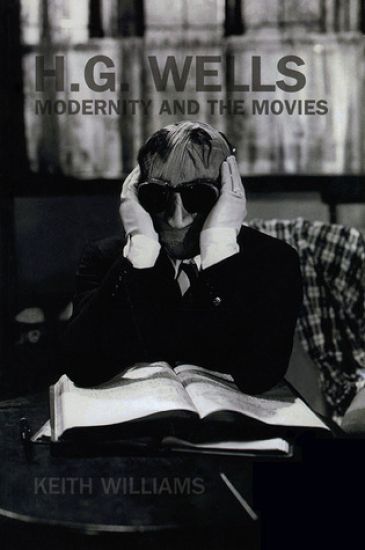
H. G. Wells, Modernity and the Movies

H. G. Wells, Modernity and the Movies

Williams Keith

Liverpool University Press
2007
nidottu
This book investigates Wells’s interest in cinema and related media technologies, by placing it back into the contemporary cultural and scientific contexts giving rise to them. It plugs a gap in understanding Wells’s contribution to exploring and advancing the possibilities of cinematic narrative and its social and ideological impacts in the modern period. Previous studies concentrate on adaptations: this book accounts for the specifically (proto)cinematic techniques and concerns of Wells’s texts. It also focuses on contemporary film-making ‘in dialogue’ with his ideas. Alongside Hollywood’s later transactions, it gives equal weight to neglected British and continental European dimensions. Chapter 1 shows how early writings (The Time Machine and short stories) feature many kinds of radically defamiliarised vision. These constitute imaginative speculations about the forms and potentials of moving image and electronic media. Chapter 2 discusses the power of voyeurism, ‘absent presence’ and the disjunction of sound-image reproduction implied in The Invisible Man and its topical politics, updated in notable screen versions. Chapter 3 extends this to dystopian warnings of systematic surveillance, broadcasting of celebrity personae and ‘post-literate’ video culture in When the Sleeper Wakes, a crucial template for urban futures on film. Chapter 4 analyses Wells’s belated return to screenwriting in the 1930s. It accounts for his ‘broadbrow’ ambition of mediating between popular and avant-garde tendencies to promote his cause and its mixed results in Things to Come, The Man Who Could Work Miracles, etc. Chapter 5 finally surveys Wells’s legacy on both small and large screens. It considers whether, as well as being raided for scenarios for spectacular effects, his subtexts still nourish an evolving tradition of alternative SF, which duly critiques the innovations and applications of its host media.
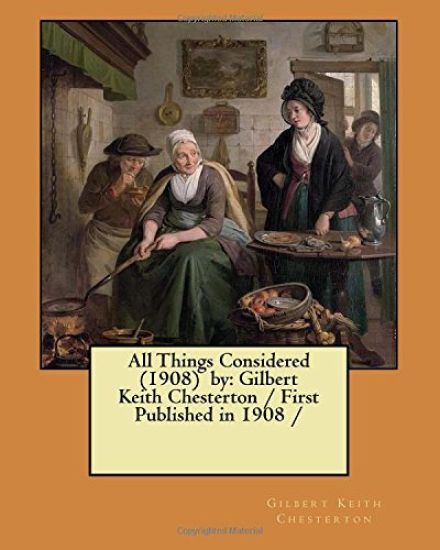
All Things Considered (1908) by: Gilbert Keith Chesterton / First Published in 1908 /

All Things Considered (1908) by: Gilbert Keith Chesterton / First Published in 1908 /

G. K. Chesterton

Createspace Independent Publishing Platform
2017
nidottu
Gilbert Keith Chesterton, (29 May 1874 - 14 June 1936), better known as G. K. Chesterton, was an English writer, poet, philosopher, dramatist, journalist, orator, lay theologian, biographer, and literary and art critic. Chesterton is often referred to as the "prince of paradox". Time magazine has observed of his writing style: "Whenever possible Chesterton made his points with popular sayings, proverbs, allegories-first carefully turning them inside out
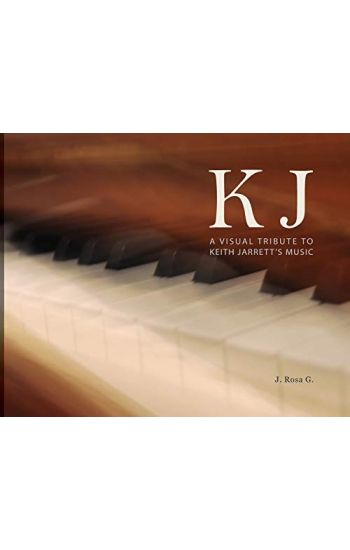
KJ - A Visual Tribute to Keith Jarrett's Music
Taking the sequence of 88 piano keys as a reference, from the bass to treble, J. Rosa G. pays tribute to Keith Jarrett's music in the same number of images, meant to evoke the musical universe of the pianist.For the author Keith Jarrett replaces a missing link of primeval pantheism through an harmonious inner rhythm, not convertible to musical notation: spiritual union of Man with the enchantment of each moment in Life and with Nature, sublime and sacred place of the act of living.
The Defendant . By: Gilbert Keith Chesterton

The Defendant . By: Gilbert Keith Chesterton

G. K. Chesterton

Createspace Independent Publishing Platform
2016
nidottu
Gilbert Keith Chesterton, KC*SG (29 May 1874 - 14 June 1936), better known as G. K. Chesterton, was an English writer, poet, philosopher, dramatist, journalist, orator, lay theologian, biographer, and literary and art critic. Chesterton is often referred to as the "prince of paradox". Time magazine has observed of his writing style: "Whenever possible G.K. Chesterton's collected essays on subjects ranging from detective stories and penny dreadfuls to heraldry and patriotism. The essays originally appeared in "The Speaker" but were edited and revised for republication.
Manalive (1912). By Gilbert Keith Chesterton: Mystery novel

Manalive (1912). By Gilbert Keith Chesterton: Mystery novel

G. K. Chesterton

Createspace Independent Publishing Platform
2017
nidottu
Manalive (1912) is a book by G. K. Chesterton detailing a popular theme both in his own philosophy, and in Christianity, of the "holy fool", such as in Dostoevsky's The Idiot and Cervantes' Don Quixote.This is a book in two parts. The first, "The Enigma of Innocent Smith", concerns the arrival of a new tenant at Beacon House, a London boarding establishment. Like Mary Poppins, this man (who is tentatively identified by lodger Arthur Inglewood as an ex-schoolmate named Innocent Smith) is accompanied by a great wind, and he breathes new life into the household with his games and antics. During his first day in residence the eccentric Smith creates the High Court of Beacon; arranges to elope with Mary Gray, paid companion to heiress Rosamund Hunt; inspires Inglewood to declare his love for Diana Duke, the landlady's niece; and prompts a reconciliation between jaded journalist Michael Moon and Rosamund. However, when the household is at its happiest two doctors appear with awful news: Smith is wanted on charges of burglary, desertion of a spouse, polygamy, and attempted murder. The fact that Smith almost immediately fires several shots from a revolver at Inglewood's friend Dr. Herbert Warner seems to confirm the worst. Before Smith can be taken to a jail or an asylum, Michael Moon declares that the case falls under the purview of the High Court of Beacon and suggests that the household investigate the matter before involving the authorities or the press. The second part, "The Explanations of Innocent Smith", follows the trial. The prosecution consists of Moses Gould, a merrily cynical Jew who lives at Beacon House and considers Smith at best a fool and at worst a scoundrel, and Dr. Cyrus Pym, an American criminal specialist called in by Dr. Warner; Michael Moon and Arthur Inglewood act for the defence. The evidence consists of correspondence from people who witnessed or participated in the exploits that led to the charges against Smith. In every case, the defendant is revealed to be, as his first name states, innocent. He fires bullets near people to make them value life; the house he breaks into is his own; he travels around the world only to return with renewed appreciation for his house and family; and the women he absconded with are actually his wife Mary, posing as a spinster under different aliases so they may repeatedly re-enact their courtship.Smith is, needless to say, acquitted on all charges.... Gilbert Keith Chesterton, KC*SG (29 May 1874 - 14 June 1936), better known as G. K. Chesterton, was an English writer, poet, philosopher, dramatist, journalist, orator, lay theologian, biographer, and literary and art critic. Chesterton is often referred to as the "prince of paradox". Time magazine has observed of his writing style: "Whenever possible Chesterton made his points with popular sayings, proverbs, allegories-first carefully turning them inside out." Chesterton is well known for his fictional priest-detective Father Brown, and for his reasoned apologetics. Even some of those who disagree with him have recognised the wide appeal of such works as Orthodoxy and The Everlasting Man.Chesterton, as a political thinker, cast aspersions on both Progressivism and Conservatism, saying, "The whole modern world has divided itself into Conservatives and Progressives. The business of Progressives is to go on making mistakes. The business of the Conservatives is to prevent the mistakes from being corrected."Chesterton routinely referred to himself as an "orthodox" Christian, and came to identify this position more and more with Catholicism, eventually converting to Catholicism from High Church Anglicanism. George Bernard Shaw, Chesterton's "friendly enemy" according to Time, said of him, "He was a man of colossal genius."Biographers have identified him as a successor to such Victorian authors as Matthew Arnold, Thomas Carlyle, Cardinal John Henry Newman, and John Ruskin....
Orthodoxy (1909). By: Gilbert Keith Chesterton: Christian Apologetics

Orthodoxy (1909). By: Gilbert Keith Chesterton: Christian Apologetics

G. K. Chesterton

Createspace Independent Publishing Platform
2017
nidottu
Orthodoxy (1908) is a book by G. K. Chesterton that has become a classic of Christian apologetics. Chesterton considered this book a companion to his other work, Heretics, writing it expressly in response to G.S. Street's criticism of the earlier work, "that he was not going to bother about his theology until I had really stated mine". 1] In the book's preface Chesterton states the purpose is to "attempt an explanation, not of whether the Christian faith can be believed, but of how he personally has come to believe it." In it, Chesterton presents an original view of Christian religion. He sees it as the answer to natural human needs, the "answer to a riddle" in his own words, and not simply as an arbitrary truth received from somewhere outside the boundaries of human experience. The book was written when Chesterton was an Anglican. He converted to Catholicism 14 years later. Chesterton chose the title, Orthodoxy, to focus instead on the plainness of the Apostles' Creed, though he admitted the general sound of the title was "a thinnish sort of thing". Gilbert Keith Chesterton, KC*SG (29 May 1874 - 14 June 1936), better known as G. K. Chesterton, was an English writer, poet, philosopher, dramatist, journalist, orator, lay theologian, biographer, and literary and art critic. Chesterton is often referred to as the "prince of paradox". Time magazine has observed of his writing style: "Whenever possible Chesterton made his points with popular sayings, proverbs, allegories-first carefully turning them inside out." Chesterton is well known for his fictional priest-detective Father Brown, and for his reasoned apologetics. Even some of those who disagree with him have recognised the wide appeal of such works as Orthodoxy and The Everlasting Man.Chesterton, as a political thinker, cast aspersions on both Progressivism and Conservatism, saying, "The whole modern world has divided itself into Conservatives and Progressives. The business of Progressives is to go on making mistakes. The business of the Conservatives is to prevent the mistakes from being corrected."Chesterton routinely referred to himself as an "orthodox" Christian, and came to identify this position more and more with Catholicism, eventually converting to Catholicism from High Church Anglicanism. George Bernard Shaw, Chesterton's "friendly enemy" according to Time, said of him, "He was a man of colossal genius."Biographers have identified him as a successor to such Victorian authors as Matthew Arnold, Thomas Carlyle, Cardinal John Henry Newman, and John Ruskin.
The Man Who Was Thursday: a Nightmare Gilbert Keith Chesterton

The Man Who Was Thursday: a Nightmare Gilbert Keith Chesterton

G. K. Chesterton

Createspace Independent Publishing Platform
2017
nidottu
The Man Who Was Thursday: A Nightmare is a novel by G. K. Chesterton, first published in 1908. The book has been referred to as a metaphysical thriller. Although it deals with anarchists, the novel is not an exploration or rebuttal of anarchist thought; Chesterton's ad hoc construction of "Philosophical Anarchism" is distinguished from ordinary anarchism and is referred to several times not so much as a rebellion against government but as a rebellion against God. The novel has been described as "one of the hidden hinges of twentieth-century writing, the place where, before our eyes, the nonsense-fantastical tradition of Lewis Carroll and Edward Lear pivots and becomes the nightmare-fantastical tradition of Kafka and Borges."
The Club of Queer Trades (1905) by: Gilbert Keith Chesterton

The Club of Queer Trades (1905) by: Gilbert Keith Chesterton

G. K. Chesterton

Createspace Independent Publishing Platform
2017
nidottu
The Club of Queer Trades is a collection of stories by G. K. Chesterton first published in 1905. Each story in the collection is centered on a person who is making his living by some novel and extraordinary means (a "queer trade", using the word "queer" in the sense of "peculiar"). To gain admittance one must have invented a unique means of earning a living and the subsequent trade being the main source of income.The framing narrative by "Cherub" Swinburne describes his quest for The Club of Queer Trades with his friend Basil Grant, a retired judge, and Rupert Grant, a private detective who is Basil's younger brother. Each of the stories describes their encounter with one of the trades.
The Man Who Knew Too Much (1922) by: Gilbert Keith Chesterton

The Man Who Knew Too Much (1922) by: Gilbert Keith Chesterton

G. K. Chesterton

Createspace Independent Publishing Platform
2017
nidottu
The Man Who Knew Too Much A prolific and popular writer, G. K. Chesterton (1874-1936) is best known as the creator of detective-priest Father Brown (even though Chesterton's mystery stories constitute only a small fraction of his writings). The eight adventures in this classic British mystery trace the activities of Horne Fisher, the man who knew too much, and his trusted friend Harold March. Although Horne's keen mind and powerful deductive gifts make him a natural sleuth, his inquiries have a way of developing moral complications. Notable for their wit and sense of wonder, these tales offer an evocative portrait of upper-crust society in pre-World War I England.