
Kirjahaku
Etsi kirjoja tekijän nimen, kirjan nimen tai ISBN:n perusteella.
1000 tulosta hakusanalla Kenneth A Kidd

Fitch Gazetteer of Washington County, New York, Volume 2
Kenneth A Perry
Heritage Books
2013
pokkari

Fitch Gazetteer of Washington County, New York, Volume 3
Kenneth A Perry
Heritage Books
2009
pokkari

Fitch Gazetteer of Washington County, New York, Volume 4
Kenneth A Perry
Heritage Books
2009
pokkari
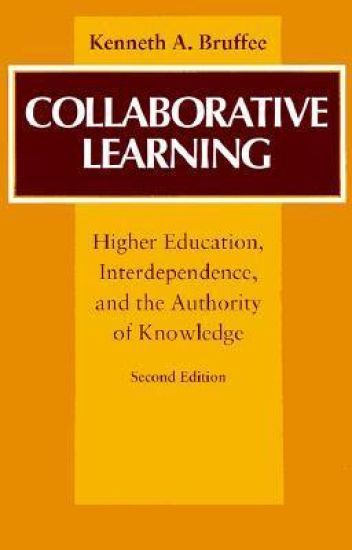
In Collaborative Learning, Kenneth Bruffee advocates a far-reaching change in the relations we assume between college and university professors and their students, between the learned and the learning. He argues that the nature and source of the authority of college and university professors is the central issue in college and university education in our time, and that if college and university professors continue to teach exclusively in the stand-up-and-tell-'em way, their students will miss the opportunity to learn mature, effective interdependence-and this, Bruffee maintains, is the most important lesson we should expect students to learn. The book makes three related points. First, we should begin thinking about colleges and universities, and they should begin thinking about themselves, not as stores of information but as institutions of reacculturation. Second, we should think of college and university professors not as purveyors of information but as agents of cultural change who foster reacculturation by marshaling interdependence among student pers. And third, colleges and universities should revise longstanding assumptions about the nature and authority of knowledge and about classroom authority. To accomplish this, the author maintains, both college students and their professors must learn collaboratively. Describing the practical value of the activities encouraged by a collaborative approach-students working in consensus groups and research teams, tutoring peers, and helping each other with editing and revision-Bruffee concludes that, in the short run, collaborative learning helps students learn better-more thoroughly, more deeply, more efficiently-than learning alone. In the long run, collaborative learning is the best possible preparation for the real world, as students look beyond the authority of teachers, practice the craft of interdependence, and construct knowledge in the very way that academic disciplines and the professions do. With no loss of respect for the value of expertise, students learn to depend on one another, rather than depending exclusively on the authority of experts and teachers. In the second edition of this widely respected work, the argument is sharply focused on the need to change college and university education top to bottom, and the need to understand knowledge differently in order to accomplish that change. Several chapters, including that on collaborative learning and computers, have been throughly revised, and three new chapters have been added: on differences between collaborative learning and cooperative learning; on literary study and teaching literature; and on postgraduate education. From COLLABORATIVE LEARNING, second edition: ON THE CURRICULUM: Behind every public debate about college curriculum today lie comfortably unchallenged traditional assumptions. When we become fully aware of how deeply and irremediably these traditional assumptions have been challenged by twentieth-century thought, we see that a potentially more serious, and perhaps more rancorous and divisive, educational debate lies in wait for us. ON THE SOCIAL CONSTRUCTION OF KNOWLEDGE: Remember the time Aunty Molly sat on the Thanksgiving turkey? Tell such a story at a family party and family members follow the story easily and get the point, because they are all members of the same small knowledge community. They know the people and the situation thoroughly, and they understand the family's private references. But try to tell the same story to neighbors or colleagues. For them to follow the story and get the point, you have to explain a lot of obscure details about family events and personalities that they're not familiar with. That is, when a smaller community sets out to integrate itsuelf into a larger one, the level of discourse has to change. The story changes and even its meaning changes as it becomes a constituting narrative of a larger and more complex community. The main purpose of college or university education is to help older adolescents and adults renegotiate their membership in that encompassing common culture. The foundational knowledge that shapes us as children sooner or later circumscribes our lives. We never entirely outgrow the local, foundational knowledge communities into which we are born. But for most people, the need to cope to one degree or another with the diversity and complexity of human life beyond the local and familiar does outgrow knowledge that is familiar and (locally) foundational. ON POSTGRADUATE EDUCATION: The problem is not that graduate professors do not know what they need to know. The problem is that most of them have learned what they know entirely under the traditional social conditions of academic alienation and aggression. Indeed, the problem is that mmbers of current graduate faculties were selected into the profession in part because they evidenced those traits. As a result, their fine education and superb reputations as scholars and critics may in some cased actually subvert their ability to understand knowledge as a social construct, learinng as an adult social process, and teaching as a role of leadership among adults.
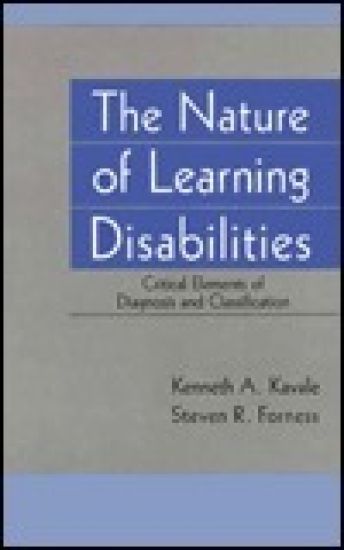
The Nature of Learning Disabilities
Kenneth A. Kavale; Steven R. Forness
Routledge Member of the Taylor and Francis Group
1995
sidottu
The category of learning disabilities continues to be among the most contentious in special education. Much of the debate and dissent emanates from a lack of understanding about its basic nature. The failure to evolve a comprehensive and unified perspective about the nature of learning disabilities has resulted in the concept being lost. The loss is best illustrated through the failure to answer this seemingly simple question: What is a learning disability? Using historical, empirical, theoretical, conceptual, and philosophical analyses, this volume explores a number of problems and issues facing the field of learning disabilities. The chapters cover historical influences, definitional problems, primary characteristics, assessment practices, theoretical development, major themes, research and measurement models, and long-term outcomes. The goal is to explicate the nature of learning disabilities by analyzing what it was supposed to be, what it has become, and what it might be. A predominant theme running through this text is the necessity for the field of learning disabilities to regain integrity by recapturing its essence.
The Nature of Learning Disabilities
Kenneth A. Kavale; Steven R. Forness
Routledge Member of the Taylor and Francis Group
1995
nidottu
The category of learning disabilities continues to be among the most contentious in special education. Much of the debate and dissent emanates from a lack of understanding about its basic nature. The failure to evolve a comprehensive and unified perspective about the nature of learning disabilities has resulted in the concept being lost. The loss is best illustrated through the failure to answer this seemingly simple question: What is a learning disability? Using historical, empirical, theoretical, conceptual, and philosophical analyses, this volume explores a number of problems and issues facing the field of learning disabilities. The chapters cover historical influences, definitional problems, primary characteristics, assessment practices, theoretical development, major themes, research and measurement models, and long-term outcomes. The goal is to explicate the nature of learning disabilities by analyzing what it was supposed to be, what it has become, and what it might be. A predominant theme running through this text is the necessity for the field of learning disabilities to regain integrity by recapturing its essence.
The Ethics of School Administration
Kenneth A. Strike; Emil J. Haller; Jonas F. Soltis
Teachers' College Press
2005
nidottu
This popular text features a rigorous yet practical approach to the difficult dilemmas that so often arise in school administration. Using case studies to illustrate particular ethical issues, the authors cover such topics as: standards; assessment and evaluation; equal opportunity; multiculturalism; religious differences; due process; freedom of expression; personal liberty; and authority. The Ethics of School Administration, Third Edition is one of a set of books in the Teachers College Press series, Professional Ethics in Education. All of the books in this series will help educators and administrators to examine and reflect on the ethical dilemmas and controversies that are a normal and routine part of educational practice.
This bestselling text has been expanded to include the most important ethical issues in contemporary schooling. The Fifth Edition features a reconsideration of Equal Treatment of Students and an updated list of Recommendations for Further Reading.Written in a style that speaks directly to today’s teacher, The Ethics of Teaching, Fifth Edition uses realistic case studies of day-to-day ethical dilemmas. The book covers such topics as: punishment and due process • intellectual freedom • equal treatment of students • multiculturalism • religious differences • democracy • teacher burnout • professional conduct • parental rights • child abuse/neglect • sexual harassment.The Ethics of Teaching is one of the five books in the highly regarded Teachers College Press THINKING ABOUT EDUCATION SERIES, now in its Fifth Edition. All of the books in this series are designed to help pre- and in-service teachers bridge the gap between theory and practice.
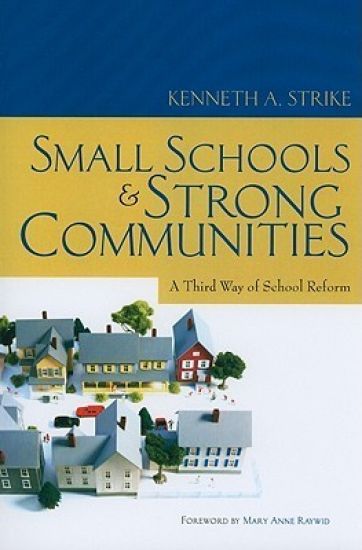
In this insightful book, Professor Strike develops a new vision of school reform. Arguing that good schools are strong communities, Strike maintains that the small schools movement is the best hope to create schools that are strong communities. He shows how the core assumptions that characterize the ""community paradigm"" are preferable to those of standards-based reform and choice. Part I examines student disengagement as an issue largely unaddressed by current views of school reform. It shows that belonging is essential to authentic learning and that good schools create a sense that we are all in this together. They have a ""shared educational project"" and exhibit the four Cs of community: coherence, cohesion, care, and connectivity. Part II discusses the small schools movement, recognizing the importance of community but also acknowledging that small size is not sufficient to create good educational communities. We cannot just downsize and hope that something good will happen. Looking at three different school models, Strike discusses the requirements for creating successful small schools and develops a view of accountability appropriate for building educational communities.

"A brilliant . . . analysis of the fragile hegemony and identities of colonial Virginia's elite men. . . . On the Sources of Patriarchal Rage compellingly illuminates the ragged edge where masculinity and colonial identity meet. . . . [the book] will undoubtedly send Jefferson scholars scurrying back to their notes. . . . Most significant, by being among the first to tackle the subject of masculinity in early America, Lockridge forces colonial scholars to reexamine the lives of men they thought they already knew too well." ?William and Mary Quarterly Two of the greatest of Virginia gentlemen, William Byrd II and Thomas Jefferson, each kept a commonplace book--in effect, a journal where men were to collect wisdom in the form of anecdotes and quotations from their readings with a sense of detachment and scholarship. Writing in these books, each assembled a prolonged series of observations laden with fear and hatred of women. Combining ignorance with myth and misogyny, Byrd's and Jefferson's books reveal their deep ambivalence about women, telling of women's lascivious nature and The Female Creed and invoking the fallible, repulsive, and implicitly corruptible female body as a central metaphor for all tales of social and political corruption. Were these private outbursts meaningless and isolated incidents, attributable primarily to individual pathology, or are they written revelations of the forces working on these men to maintain patriarchal control? Their hatred for women draws upon a kind of misogynistic reserve found in the continental and English intellectual traditions, but it also twists and recontextualizes less misogynistic excerpts to intensified effect. From this interplay of intellectual traditions and the circumstances of each man's life and later behavior arises the possibility one or more specific politics of misogyny is at work here. Kenneth Lockridge's work, replete with excerpts from the books themselves, leads us through these texts, exploring the structures, contexts, and significance of these writings in the wider historical context of gender and power. His book convincingly illustrates the ferocity of early American patriarchal rage; its various meanings, however suggestively explored here, must remain contestable.

"A brilliant . . . analysis of the fragile hegemony and identities of colonial Virginia's elite men. . . . On the Sources of Patriarchal Rage compellingly illuminates the ragged edge where masculinity and colonial identity meet. . . . [the book] will undoubtedly send Jefferson scholars scurrying back to their notes. . . . Most significant, by being among the first to tackle the subject of masculinity in early America, Lockridge forces colonial scholars to reexamine the lives of men they thought they already knew too well." ?William and Mary Quarterly Two of the greatest of Virginia gentlemen, William Byrd II and Thomas Jefferson, each kept a commonplace book--in effect, a journal where men were to collect wisdom in the form of anecdotes and quotations from their readings with a sense of detachment and scholarship. Writing in these books, each assembled a prolonged series of observations laden with fear and hatred of women. Combining ignorance with myth and misogyny, Byrd's and Jefferson's books reveal their deep ambivalence about women, telling of women's lascivious nature and The Female Creed and invoking the fallible, repulsive, and implicitly corruptible female body as a central metaphor for all tales of social and political corruption. Were these private outbursts meaningless and isolated incidents, attributable primarily to individual pathology, or are they written revelations of the forces working on these men to maintain patriarchal control? Their hatred for women draws upon a kind of misogynistic reserve found in the continental and English intellectual traditions, but it also twists and recontextualizes less misogynistic excerpts to intensified effect. From this interplay of intellectual traditions and the circumstances of each man's life and later behavior arises the possibility one or more specific politics of misogyny is at work here. Kenneth Lockridge's work, replete with excerpts from the books themselves, leads us through these texts, exploring the structures, contexts, and significance of these writings in the wider historical context of gender and power. His book convincingly illustrates the ferocity of early American patriarchal rage; its various meanings, however suggestively explored here, must remain contestable.
This supplement to ""The International Leader"" offers new information and practical advice on the art and science of leadership, allowing readers to stay current with the latest developments in leadership thinking. In addition, it provides a purposeful and structured way to learn about leadership principles and skills through the viewing of more than thirty movies. The text also reinforces these principles and skills many times over, until they become a part of the serious student's everyday thinking and behavior.
"America's interstate highway system is deteriorating, and traffic congestion in most urban centers is worsening. Because of the many strong and conflicting interests, policy discussions about the road system are also in gridlock. The only consensus that seems to have emerged is that public spending must be increased.Improving our highway system and its financing will not be easy. Road Work proposes a comprehensive highway pricing and investment policy to meet the goals of efficiency, equity, and financial stability.In this study, Kenneth A. Small, Clifford Winston, and Carol A. Evans base their policy on two economic principles: efficient pricing to regulate demand for highway services and efficient investment to minimize the total public and private costs of providing them. Policy recommendations include a set of pavement-wear taxes for heavy trucks, a set of congestion taxes for all vehicles, and a program of optimal investments in road durability. Their proposals should be especially attractive to policymakers because they can be implemented with current technology, offer little threat to the major interest group, and in the long run will reduce the strain on state and local governments' highway budgets."
Joseph Conrad at Mid-Century
Kenneth A. Lohf; Eugene P. Sheehy
University of Minnesota Press
1957
nidottu
Joseph Conrad at Mid-Century was first published in 1957. Minnesota Archive Editions uses digital technology to make long-unavailable books once again accessible, and are published unaltered from the original University of Minnesota Press editions.Published in the centennial year of Joseph Conrad's birth, this is the first comprehensive bibliography of the writings by and about this important author. Though there is a current revival of interest in Conrad's work, criticism and scholarship devoted to this celebrated novelist and short story writer have lagged behind that of other major twentieth-century authors. This compendium of data about the growing body of Conrad literature should stimulate further interest by bringing together a vast amount of reference information that has been widely scattered until now.The bibliography lists works by Conrad, including serializations, significant translations, and film adaptations, and writings about Conrad, including book and periodical material in western languages, appearing from 1895, the year of publication of Almayer's Folly, through 1955. There are a total of 1200 numbered entries containing approximately 3000 items.In the first section, devoted to Conrad's works, the enumeration of English and American editions is followed by the listing of translations. Most of Conrad's essays and many of his novels were serialized before they appeared in book form, and these serializations are listed here also.The second section lists the studies of Conrad's life and works, as published in books, pamphlets, periodical articles, and reviews. Data are included on bibliographies, commemorative issues of periodicals, criticism of individual works and of Conrad's work in general, and parodies and other miscellany.

Environment in the Global Arena
Kenneth A. Dahlberg; Marvin S. Soroos; Anne Thompson Feraru; James E. Harf; B. Thomas Trout
Duke University Press
1985
pokkari
Volumes in the Global Issues series address the problems of energy and environment as matters of international concern, and a forthcoming volume provides an overview of all these areas.The issues in the series are each considered within a systematic framework common to all. Each volume begins with a historical background and then the issues are placed in their contemporary context. Four distinct perspectives are presented: (1) Who are the "global actors" involved in the issue, and what are the linkages among them? (2) What prevailing values are operating, and how have the relevant actors responded to those values? (3) What policies are applied by these actors at the global level, and how are these policies determined? (4) What are the possible results of the values and policies of these global actors?
Stick ball, stoop sitting, pickle barrel colloquys: The neighborhood occupies a warm place in our cultural memory-a place that Kenneth A. Scherzer contends may have more to do with ideology and nostalgia than with historical accuracy. In this remarkably detailed analysis of neighborhood life in New York City between 1830 and 1875, Scherzer gives the neighborhood its due as a complex, richly textured social phenomenon and helps to clarify its role in the evolution of cities.After a critical examination of recent historical renderings of neighborhood life, Scherzer focuses on the ecological, symbolic, and social aspects of nineteenth-century community life in New York City. Employing a wide array of sources, from census reports and church records to police blotters and brothel guides, he documents the complex composition of neighborhoods that defy simple categorization by class or ethnicity. From his account, the New York City neighborhood emerges as a community in flux, born out of the chaos of May Day, the traditional moving day. The fluid geography and heterogeneity of these neighborhoods kept most city residents from developing strong local attachments. Scherzer shows how such weak spatial consciousness, along with the fast pace of residential change, diminished the community function of the neighborhood. New Yorkers, he suggests, relied instead upon the "unbounded community," a collection of friends and social relations that extended throughout the city.With pointed argument and weighty evidence, The Unbounded Community replaces the neighborhood of nostalgia with a broader, multifaceted conception of community life. Depicting the neighborhood in its full scope and diversity, the book will enhance future forays into urban history.

Sanctions Beyond Borders tests the assumption that economic globalization and the decline of U.S. hegemony give overseas corporate behavior a free reign in defying U.S. imposed sanctions abroad. It examines the use of sanctions from the early Cold War era through the sanctions decade of the 1990s, including the Helms-Burton Law and the Iran-Libya Sanctions Act. On the one hand, the book shows that multinationals are often susceptible to U.S. influence because they fear political fallout. At the same time, the book demonstrates that even though the use of sanctions has been widely promoted by interest groups, Congress, and the general public, the effect of sanctions has fallen short on many counts. Especially when it comes to preventing economically significant transactions with proscribed nations by key multinational corporations, sanctions are shown to be weak and costly measures that damage diplomatic relations.

A comprehensive reference guide to beryllium, its history, and its chemical, mechanical, and physical properties.The 29 chapters include the mineralogy of beryllium and the preferred global sources of ore bodies. The identification and specifics of the industrial metallurgical processes used to form oxide from the ore and then metal from the oxide are thoroughly described. The special features of beryllium chemistry are introduced, including analytical chemical practices. Beryllium compounds of industrial interest are identified and discussed. Alloying, casting, powder processing, forming, metal removal, joining and other manufacturing processes are covered.The effect of composition and process on the mechanical and physical properties of beryllium alloys assists the reader in material selection. The physical metallurgy chapter brings conformity between chemical and physical metallurgical processing of beryllium, metal, alloys, and compounds. The environmental degradation of beryllium and its alloys both in aqueous and high temperature condition are presented. The health and environmental issues are thoroughly presented the current requirements and established practices for handling beryllium in the workplace are available. A thorough list of references will assist the user of this book.