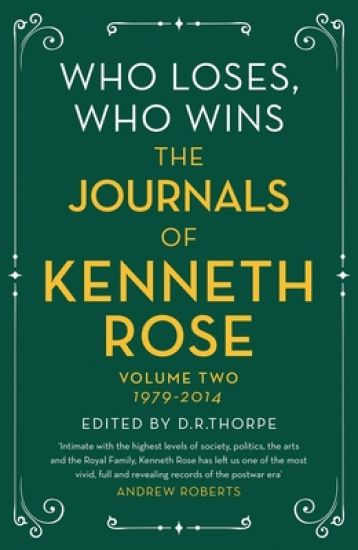
Kenneth Rose was one of the most astute observers of the post-war Establishment. The wry and amusing journals of the royal biographer and historian made objective observation a sculpted craft. His impeccable social placement located him within the beating heart of the national elite for decades. He was capable of writing substantial history, such as his priceless material on the abdication crisis from conversations with both the Duke of Windsor and the Queen Mother. Yet he maintained sufficient distance to achieve impartial documentation while working among political, clerical, military, literary and aristocratic circles. Relentless observation and a self-confessed difficulty 'to let a good story pass me by' made Rose a legendary social commentator, while his impressive breadth of interests was underpinned by tremendous respect for the subjects of his enquiry. Brilliantly equipped as Rose was to witness, detail and report, the second volume of his journals vividly portrays some of the most important events and people of the last century, from the election of Margaret Thatcher as Prime Minister in 1979 to Kenneth Rose's death in 2014.
Kenneth Rose was one of the most astute observers of the post-war Establishment. The wry and amusing journals of the royal biographer and historian made objective observation a sculpted craft. His impeccable social placement located him within the beating heart of the national elite for decades. He was capable of writing substantial history, such as his priceless material on the abdication crisis from conversations with both the Duke of Windsor and the Queen Mother. Yet he maintained sufficient distance to achieve impartial documentation while working among political, clerical, military, literary and aristocratic circles. Relentless observation and a self-confessed difficulty 'to let a good story pass me by' made Rose a legendary social commentator, while his impressive breadth of interests was underpinned by tremendous respect for the subjects of his enquiry. Brilliantly equipped as Rose was to witness, detail and report, the second volume of his journals vividly portrays some of the most important events and people of the last century, from the election of Margaret Thatcher as Prime Minister in 1979 to Kenneth Rose's death in 2014.
This book is a compilation of seriously exciting short stories which has been written by the same author of, 'In The Pulse of Time.'The short stories deal with the depth of the human condition from: old age, to sadness, greed, philosophy and hate... Secondly the last two short stories are humorous rewrites of history.
Becoming a Master Musician is an introspective view of what it really takes to become a highly skilled musician. Kenneth Hollins gives you several effective techniques that will cause you to break out of mediocrity and into musical excellence.
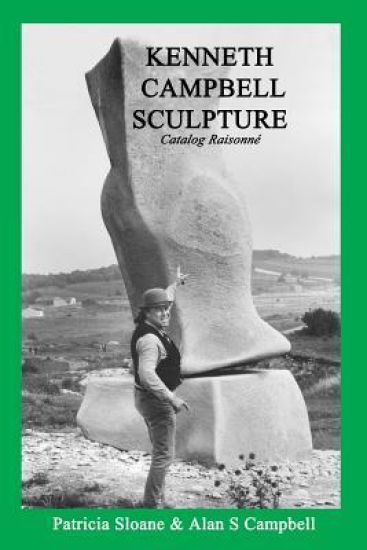
This catalog raisonn provides pictures and descriptions of the works of American sculptor Kenneth Campbell (1913-1986). Campbell's stone carvings are abstract expressions of motion and balance. They aim for a refinement of line which is essentially classical, but which also reflects the artist's interest in Oriental art and philosophy. Campbell worked directly, with hand tools, in American marbles from Georgia, Vermont, Tennessee, and Alabama. Many pieces are in a laminated technique that facilitates combining and contrasting stones of various colors. Campbell's smaller marble carvings are monolithic pieces twenty to forty inches high. Larger pieces, which can be disassembled, are from six to ten feet high, and consist of stacked units secured by concealed stainless steel pins. Campbell, a student of the three-dimensional arts of Egypt, India, and China, but also of megaliths, called the stacking technique Stone on Stone, the title used for most of his exhibitions. The artist executed four monumental site works, including the one pictured on this book cover in Austria, and envisioned most of his works being made on a monumental scale. Museums that have included Campbell's pieces in their collections are Whitney Museum of American Art, National Museum of American Art at the Smithsonian, Walker Art Center, Brooklyn Museum, Kalamazoo Art Institute, and Storm King Art Center.
This inspirational collection presents the sermons given by the Reverend Dr. Kenneth Ruge at the Reformed Church of Bronxville, New York, where he serves as Senior Minister. Sermon topics include: Discover Your Gifts . . . God's Power to Free Us . . . God's Healing Touch . . . Giving Yourself Away . . . Walking the Path of Peace . . . This Is My Friend . . . Finding Deep Peace . . . How to Be Fearless . . . God's Bodyguards . . . Love: A More Excellent Way, Parts I, II and III . . . Finding Light in the Darkness . . . Living a Radiant Life, Parts I, II and III . . . Do Not Hide, Confide . . . The Eye of the Needle . . . Tap into God's Power . . . Count Your Blessings . . . There Are Angels in Your Life . . . Finding Joy . . .
I am 74-years-old this year and I have just updated my autobiography. I have had a rather long life and many things have happened while I've been here on earth. If we could go back in time, we would make many different choices. However, those choices could also be as bad as or even worse than the first choices, we made. We are therefore stuck with the choices and decisions we make through life. We must make the best of what we have chosen or what has befallen us and learn from our mistakes and our trials. I know not many will read this book, except perhaps those that like my writing or a few family members. As I write this, I have lost many in my family, but there could be others that would still enjoy it. I have written dozens of books, but this is the longest I have written. It contains a little over 136,000 words. I have things in this book that I have never told anyone. I believe if we share our trials and tribulations it may help those that have to also struggle or overcome adversity in their lives. Therefore, I hope you enjoy looking deep into my heart, the heart of a man - the heart of a writer. Thank you.
Kenneth Grahame 8 March 1859 - 6 July 1932) was a British writer, most famous for The Wind in the Willows (1908), one of the classics of children's literature. He also wrote The Reluctant Dragon; both books were later adapted into Disney films Kenneth Grahame was born on 8 March (1859) in Edinburgh, Scotland. When he was a little more than a year old, his father, an advocate, received an appointment as sheriff-substitute in Argyllshire at Inveraray on Loch Fyne. Kenneth loved the sea and was happy there, but when he was 5, his mother died from complications of childbirth, and his father, who had a drinking problem, gave over care of Kenneth, his brother Willie, his sister Helen and the new baby Roland to Granny Ingles, the children's grandmother, in Cookham Dean in the village of Cookham in Berkshire. There the children lived in a spacious, if dilapidated, home, "The Mount", on spacious grounds in idyllic surroundings, and were introduced to the riverside and boating by their uncle, David Ingles, curate at Cookham Dean church. This delightful ambiance, particularly Quarry Wood and the River Thames, is believed, by Peter Green, his biographer, to have inspired the setting for The Wind in the Willows. He was an outstanding pupil at St Edward's School in Oxford. During his early years at St. Edwards, a sports regimen had not been established and the boys had freedom to explore the old city with its quaint shops, historic buildings, and cobblestone streets, St Giles' Fair, the idyllic upper reaches of the River Thames, and the nearby countryside.
Dream Days is a collection of children's fiction and reminiscences of childhood written by Kenneth Grahame. A sequel to Grahame's 1895 collection The Golden Age (some of its selections feature the same family of five children), Dream Days was first published in 1898 under the imprint John Lane: The Bodley Head. (The first six selections in the book had been previously published in periodicals of the day-in The Yellow Book, the New Review, and in Scribner's Magazine in the United States.)The book is best known for its inclusion of Grahame's classic story The Reluctant Dragon. Like its precursor volume, Dream Days received strong approval from the literary critics of the day. In the decades since, the book has perhaps suffered a reputation as a thinner and weaker sequel to The Golden Age-except for its single hit story. In one modern estimation, both books "paint a convincingly unsentimental picture of childhood, with the adults in these sketches totally out of touch with the real concerns of the young people around them, including their griefs and rages." As with The Golden Age, the first edition of Dream Days was un-illustrated; again like the prior volume, a subsequent edition of Dream Days was published with illustrations by Maxfield Parrish. The publisher's first intention was to print color plates; however, John Lane was not satisfied with the color reproductions of Parrish's pictures. Lane instead chose a new photogravure reproduction process that produced black-and-white results superior to the halftone images in the 1899 edition of The Golden Age. The Parrish-illustrated edition of Dream Days was issued by The Bodley Head in London and New York in 1902; it contained ten full-page illustrations (one for each of the eight selections plus frontispiece and title page), and six tailpieces. The quality of the images in Dream Days inspired Lane to issue a matching edition of The Golden Age, with improved photogravure plates, in 1904. Kenneth Grahame ( 8 March 1859 - 6 July 1932) was a British writer, most famous for The Wind in the Willows (1908), one of the classics of children's literature. He also wrote The Reluctant Dragon; both books were later adapted into Disney films.Kenneth Grahame was born on 8 March (1859) in Edinburgh, Scotland. When he was a little more than a year old, his father, an advocate, received an appointment as sheriff-substitute in Argyllshire at Inveraray on Loch Fyne. Kenneth loved the sea and was happy there, but when he was 5, his mother died from complications of childbirth, and his father, who had a drinking problem, gave over care of Kenneth, his brother Willie, his sister Helen and the new baby Roland to Granny Ingles, the children's grandmother, in Cookham Dean in the village of Cookham in Berkshire. There the children lived in a spacious, if dilapidated, home, "The Mount", on spacious grounds in idyllic surroundings, and were introduced to the riverside and boating by their uncle, David Ingles, curate at Cookham Dean church. This delightful ambiance, particularly Quarry Wood and the River Thames, is believed, by Peter Green, his biographer, to have inspired the setting for The Wind in the Willows. He was an outstanding pupil at St Edward's School in Oxford. During his early years at St. Edwards, a sports regimen had not been established and the boys had freedom to explore the old city with its quaint shops, historic buildings, and cobblestone streets, St Giles' Fair, the idyllic upper reaches of the River Thames, and the nearby countryside.Grahame died in Pangbourne, Berkshire, in 1932. He is buried in Holywell Cemetery, Oxford. Grahame's cousin Anthony Hope, also a successful author, wrote his epitaph, which reads: "To the beautiful memory of Kenneth Grahame, husband of Elspeth and father of Alastair, who passed the river on the 6th of July, 1932, leaving childhood and literature through him the more blest for all time"




![Crash Landing into a Field of Outhouses: The [Slightly Embellished] Stories of Kenneth A. Bauer](/covers/9781497453753.jpg)