Kirjojen hintavertailu. Mukana 11 342 296 kirjaa ja 12 kauppaa.

Kirjahaku

Etsi kirjoja tekijän nimen, kirjan nimen tai ISBN:n perusteella.

1000 tulosta hakusanalla Lewis Hutton

Lewis Nordan

Lewis Nordan

The University of Alabama Press
2012
nidottu
Lewis Nordan: Humor, Heartbreak, and Hope examines and celebrates the work of southern writer Lewis "Buddy" Nordan, whose stories reveal his own pain and humanity and in their honesty force us to recognize ourselves within them. Written by scholars and fiction writers who represent a fascinating range of experience--from a Shakespearean scholar to English professors to a former student of Nordan's--this is a rich array of essays, poems, and visual arts in tribute to this increasingly important writer. The collection deepens the base of scholarship on Nordan, and contextualizes his work in relation to other important southern writers such as William Faulkner and Eudora Welty. Nordan was born and raised in Mississippi before moving to Alabama to pursue his Ph.D. at Auburn University. He taught for several years at the University of Arkansas in Fayetteville and retired from the University of Pittsburgh, where he was a professor of English. Nordan has written four novels, three collections of short stories, and a memoir entitled Boy with Loaded Gun. His second novel, Wolf Whistle, won the Southern Book Award, and his subsequent novel, The Sharpshooter Blues, won the Notable Book Award from the American Library Association and the Fiction Award from the Mississippi Institute of Arts and Letters. Nordan is renowned for his distinctive comic writing style, even while addressing more serious personal and cultural issues such as heartbreak, loss, violence, and racism. He transforms tragic characters and events into moments of artistic transcendence, illuminating what he calls the "history of all human beings."
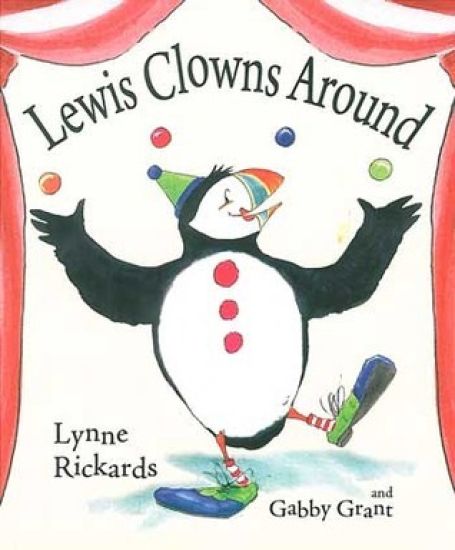
Lewis Clowns Around

Lewis Clowns Around

Lynne Rickards

Kelpies
2011
nidottu
Poor Lewis hates being a puffin. His brother Harris is great at catching fish, flying and doing puffin things, but Lewis just doesn't fit in. He longs for a different life, far away from the crashing waves and tall cliffs of the Firth of Forth. But what else can a puffin do?Then, 'Eureka!' Lewis finds the answer, and heads off to the circus to become a clown. He meets many incredible creatures: Carla Koala, Zorro the Highwire Cat, the Flying Blue Monkeys and Daredevil Pat. But when his act goes terribly wrong, can Lewis overcome his fears, find some confidence and save the day?A charming and hilarious rhyming picture book about a young misfit puffin who learns that it's okay to be different. The story is brought to life with colourful, characterful illustrations by Gabby Grant.
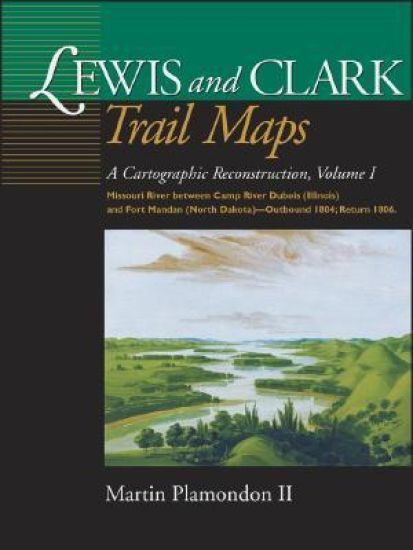
Lewis and Clark Trail Maps

Lewis and Clark Trail Maps

Martin Plamondon II

Washington State University Press
2000
sidottu
The Lewis and Clark Expedition bicentennial is producing an unprecedented flurry of interest in the United States, and an array of commemorative activities are being planned in the regions visited by the Corps of Discovery.During the 28-month trek (1804-06), Captain William Clark dutifully surveyed the expedition's route by taking continual compass readings to determine directions while estimating distances between geographic points. Clark assumed that his painstakingly recorded "surveyed traverse" would be converted into well-crafted, accurate maps by cartographers soon after the journey's completion. For a variety of reasons, this did not occur--until now.By using measurements, notes, maps, and sketches in Clark's records as well as other sources, Martin Plamondon II has accomplished the cartographic reconstruction that Clark expected upon the expedition's return. Volume I is the first of a three-volume set delineating the Corps' journey.The first volume includes 153 full-page maps of the Missouri River from Illinois to North Dakota. In addition to presenting key geographic and historic features, the maps compare the modern beds of rivers to their courses at the time of the exploration. The contrast is striking between what Lewis and Clark saw and what we see today. The ever meandering Missouri River, in particular, has changed its channel hundreds of times since the men of the expedition fought its currents. Even Clark commented on the return trip in 1806 that some sections fo the river were barely recognizable compared to when they passed by two years earlier. Modern America likewise has wrought great change.Of further interest in Volume I are the many excerpts from the expedition diaries, an insightful essay on frontier surveying, and cartographic indexes. Plamondon's years of careful cartographic reconstruction have resulted in a captivating and never-before-seen record of the American West.
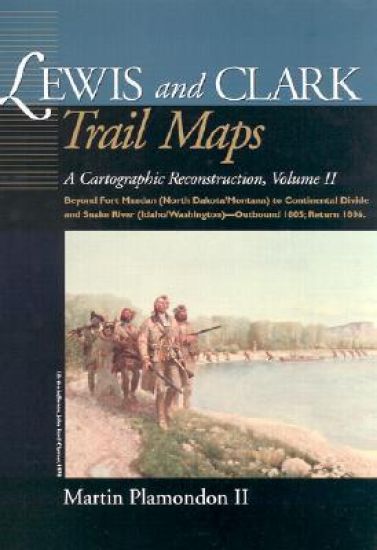
Lewis and Clark Trail Maps

Lewis and Clark Trail Maps

Martin Plamondon II

Washington State University Press
2002
sidottu
In Volume II, Martin Plamondon presents a cartographic reconstruction of the Corps of Discovery's trek across the northwestern United States in 1805-06. Beginning a short distance above Fort Mandan, 190 maps depict the explorers' route on the Missouri River in North Dakota and Montana, over the continental divide to Idaho, and down westward-flowing waters to the Snake-Columbia confluence in central Washington.The maps contrast modern riverbeds to their courses at the time of the exploration. Also included are pertinent excerpts from the journals and depictions of significant geographical features. Plamondon has utilized the actual traverse measurements and notes recorded by William Clark for each day that the expedition was on the move.This is the second of a three-volume set published by the WSU Press delineating the Corps' entire journey, both outbound and return, in 1804-06. Volume I, published in September 2000, includes 153 full-page maps of the explorers' route on the Missouri River from Illinois to North Dakota.
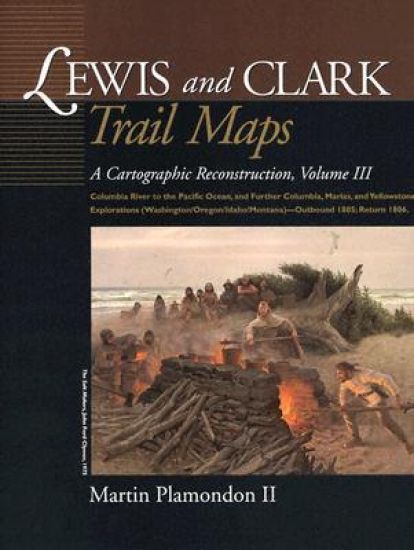
Lewis and Clark Trail Maps

Lewis and Clark Trail Maps

Martin Plamondon II

Washington State University Press
2004
sidottu
After crossing the Bitterroot Range and canoeing down the cataract-filled Snake River, the Corps of Discovery finally reached the long-sought Columbia River in the autumn of 1805. Volume III continues the cartographic reconstruction of the explorers' trek as they set out from the Snake-Columbia junction, October 18, 1805, on the final leg of their journey to the sea. In addition to intricately mapping the Columbia's great rapids, desert and rain-forest shorelines, spectacular mountain gorge, and broad estuary, Volume III reveals the vast number of Native American villages that lined the River of the West in Lewis and Clark's time. Additional maps and illustrations depict the Fort Clatsop winter quarters, Cascade volcanoes, coastal explorations, compares the modern beds of streams to their courses at the time of the exploration, and more. Though having reached their primary goal, the Pacific Ocean, the expedition's investigation of new terrain in western North America was far from over. Volume III outlines the significant discoveries recorded as they returned eastward in 1806 through the broad Columbia, Marias, and Yellowstone watersheds. Volume III concludes when the Corps of Discovery, long given up for dead by most Americans, paddled up to the St. Louis waterfront on September 23, 1806, to an arousing reception by the local population. Of further special interest in this volume are the many excerpts from the expedition diaries. This careful cartographic reconstruction is a captivating and never-before-seen record of the American West. Martin Plamondon II of Vancouver, Washington, is a former chairman of the Governor's Washington Lewis and Clark Trail Committee. His long-term research in exploration history and twenty-eight years of experience as a professional cartographer have provided the unique set of skills required to complete the trail maps.
Lewis & Clark Lexicon of Discovery

Lewis & Clark Lexicon of Discovery

Alan H. Hartley

Washington State University Press
2004
pokkari
What is a cataplasm, and what do you do with one? Would you be insulted if someone called you a higgler? Would you want someone to give you a basilicon? What does it mean when a canoe flacks? Would you eat wapato? Familiar to Meriwether Lewis and William Clark, these words were penned by expedition members in their journals but are not commonly spoken, written, or understood today.Now the Lewis and Clark Lexicon of Discovery is available to help modern readers better understand the language of two centuries ago. A special emphasis on pronunciation will be exceptionally valuable to historical re-enactors. The result of five years of research on the history, people, and physical world of the expedition, this new reference work features over 1,100 entries and more than 2,000 illustrative quotations, as well as considerable background material on the English (and other languages) of the expedition.
Lewis & Clark Reframed

Lewis & Clark Reframed

David L. Nicandri; Clay S. Jenkinson

Washington State University Press
2020
pokkari
Spanish, British, and French explorers reached the Pacific Northwest before Meriwether Lewis and William Clark. The American captains benefited from those predecessors, even carrying with them copies of their published accounts. James Cook, George Vancouver, and Alexander Mackenzie--and to a lesser extent fur traders John Meares and Robert Gray--directly and indirectly influenced the expedition. Based on new material as well as revised essays from popular history journals, Lewis and Clark Reframed examines several curious and seemingly inexplicable aspects of the journey after the Corps of Discovery crossed the Rocky Mountains.The captains' journals demonstrate that they relied on Mackenzie's 1801 Voyages from Montreal as a trail guide. They borrowed field techniques and favorite literary expressions--at times plagiarizing entire paragraphs. Cook's literature also informed the pair, and his naming conventions evoke fresh ideas about an enduring expedition mystery--the identity of the two or three journalists whose records are now missing. Additional journal text analysis dispels the notion that the captains were equals, despite expedition lore. Lewis claimed all the epochal discoveries for himself, and in one of his more memorable passages, drew on Mackenzie for inspiration. Parallels between Cook's and other exploratory accounts offer evidence that like many long-distance voyagers, Lewis grappled with homesickness. His friendship with Mahlon Dickerson lends insights into Lewis's shortcomings and eventual undoing. As secretary of the navy, Dickerson drew from Lewis's troubled past to impede the 1840s ocean expedition set to emulate Cook and solidify America's claim, through Lewis and Clark, to the region.
Lewis and Clark Among the Nez Perce

Lewis and Clark Among the Nez Perce

Allen V. Pinkham; Steven R. Evans; Frederick E. Hoxie

Washington State University Press
2022
pokkari
Lewis and Clark Among the Nez Perce is a generous and careful re-evaluation of Lewis and Clark west of the Bitterroot Mountains. An extraordinary new look at their extended visit--approximately four months of daily interchange with a community the white visitors regarded as especially friendly, hospitable, and helpful to their success--the book represents a breakthrough in Lewis and Clark studies. Many incidents suddenly take on a new light when the historical lens is reversed.In 1984, James Ronda's groundbreaking Lewis and Clark Among the Indians looked broadly at the Lewis and Clark expedition from the Native American perspective. Nearly three decades later, Nez Perce historians Allen V. Pinkham and Steven Ross Evans examined the journals of Lewis and Clark with painstaking care to tease out new insights from what Lewis and Clark wrote about their Nez Perce hosts. Pinkham and Evans evaluate both what Lewis and Clark understood and what they misunderstood in the Nez Perce (Nimiipuu) lifeway and political structure. More particularly, they have scoured the journals for clues about how the Nez Perce reacted to the bearded strangers, gathering and putting into print for the first time the stands of a surprisingly rich Nez Perce oral tradition.The first richly detailed exploration of the relationship between Mr. Jefferson's Corps of Discovery and a single tribe, this volume also serves as a template for a Lewis and Clark expedition tribal history series.
One Foot Out the Door: The Collected Stories of Lewis Warsh
Fiction. Over 20 Years of Stories. "What a pleasure to have all these stories by Lewis Warsh in one volume They tend to be low-key, almost off- hand, but each with a poetic kernel that infects and defuses throughout, which makes them (though it is a critical cliche to say it this way) haunting. But that's what they do. They haunt. That's what the best writing does, often without excessive flashiness or even letting us know, as the narrative drifts through the material from which each is constructed, how it's done. These are extraordinary tales." Samuel R. Delany "Lewis Warsh's narrative always speaks to itself from a lyric threshold. A postmodern Delmore Schwartz yearning, mordant, suspenseful." Gloria Frym "Lewis Warsh moves through the crowded street, a reporter, pad in hand and pencil behind ear. The sentences hold the simple truths of his heart. That amidst the nearly incomprehensible violence of daily life one reality is a singular desire love. The purity of love, the essence of love. Recalling the quiet resonance of Salinger, drawing the curtain on the horror of inhumanity, settling down on rumpled sheets, alone or in reach of salvation, Lewis reports with poet- investigator eye that love has come to save the day." Thurston Moore "The straight-from- the-shoulder idiom that powers Lewis Warsh's writing is a marvel of economy. Evoking memory without nostalgia, moving the reader without sentimentality, the stories in ONE FOOT OUT THE DOOR are lucid, formally adventurous, and emotionally complex. Like Stephen Dixon and Leonard Michaels, two other masters of plainspoken cosmopolitanism and rueful reflection, Lewis Warsh uses ordinary language as a means to an extraordinary inventiveness." Christopher Sorrentino"
The Pamphlets of Lewis Carroll

The Pamphlets of Lewis Carroll

Lewis Carroll

Carroll (Lewis) Society of North America
2015
sidottu
Charles Lutwidge Dodgson, ""Lewis Carroll,"" was not only the author of the beloved Alice tales but an inveterate and talented creator of puzzles and games in both the recreational mathematics and wordplay fields. Collected together for the first time in this book, his charming and humorous creations are no longer hidden in obscure Victorian magazines, rare antiquarian books, and sporadic, incomplete collections.This fully annotated volume features such delights as Carroll’s word games Doublets (word ladders) and Syzygies (a more elaborate form of the word ladder), a board game called Lanrick, and other games and puzzles, including Circular Billiards, Castle Croquet, String Wrapped Round a Cube, Backgammon variations, Mirror Writing, Arithmetical Croquet, a Number Guessing Puzzle, and much more. The volume has been edited, annotated, and compiled by Christopher Morgan, who has added a section on modern-day puzzles inspired by Carroll, and features an introduction by Jeremiah Farrell. This is a fascinating and delightful collection for lovers of wordplay, puzzles, and the wit of Lewis Carroll.Distributed for the Lewis Carroll Society of North America.
The Complete Pamphlets of Lewis Carroll Volume 6

The Complete Pamphlets of Lewis Carroll Volume 6

Lewis Carroll

Carroll (Lewis) Society of North America
2021
sidottu
The final volume in the Pamphlets of Lewis Carroll series collects more than one hundred of his works on the Alice books, the theater, religion and morality, science and mathematics, photography, letters and postage, humor, stories, poetry, undergraduate papers, circular letters, and miscellaneous others. Each pamphlet is accompanied by editorial commentary placing it in its historical context and frequently quoting from contemporary responses to these works.This volume shows the remarkable variety of topics about which Carroll expressed himself in print. It includes many pieces never before reprinted and more than a dozen newly discovered. Many of these items have previously been available only in a few rare book libraries. Originals have been carefully examined and transcribed to provide definitive texts. The commentary provides a close look at how Lewis Carroll used his pen to interact with the world around him. The editorial notes reveal the provocations of his writing—what reactions his writing drew and how he engaged with others in print.
Lewis Carroll

Lewis Carroll

Edward Guiliano

Carroll (Lewis) Society of North America
2024
sidottu
This is the first book on the history and culture of collecting the works of Lewis Carroll as well as the worldwide industry of items and art based on Carroll’s works in popular culture. Ten large, major private collections from around the world are profiled, telling the story of each collection and collector, with color illustrations of objects from the collections. The volume, which also covers smaller specialized collections and includes a comprehensive introduction to the history and characteristics of collecting Carrolliana, will appeal to Carroll enthusiasts and rare book and memorabilia collectors alike.
Lewis Carroll and "Alice" on Stage

Lewis Carroll and "Alice" on Stage

Carroll (Lewis) Society of North America
2025
sidottu
In August 1886, Lewis Carroll (Charles Lutwidge Dodgson) received a letter asking permission to dramatize Alice's Adventures in Wonderland and Through the Looking-Glass. This book presents and annotates 103 letters from Carroll to the playwright Henry Savile Clarke (of which six are to Savile Clarke's daughters). Carroll tells Savile Clarke in detail exactly what he would like to see in the stage performance. Savile Clarke wrote the script for the first full dramatization of the Alice books, which was staged at the Prince of Wales's Theatre in London in 1886–87, and revived at the Globe Theatre, also in London, in 1888–89. This is the largest body of focused Carroll correspondence to which we have access. It is deeply revealing of Carroll's personality and his relationship to his most brilliant writings, the two Alice books. The book includes a posthumous essay, "Lewis Carroll in the Wings," by the eminent Carroll biographer Morton N. Cohen. The book also includes supplementary materials on British theatre in the late Victorian period and the child-acting controversy.
Lewis Grassic Gibbon's Sunset Song

Lewis Grassic Gibbon's Sunset Song

Douglas Young

Association For Scottish Liter
1999
pokkari
The SCOTNOTES booklets are a series of study guides to major Scottish writers and texts frequently used within literature courses, aimed at senior secondary school pupils and students in further education. This title covers the novel Sunset Song, by Lewis Grassic Gibbon.
Lewis Turco and His Work

Lewis Turco and His Work

Cloudbank Creations
2004
sidottu
Lewis Turco, Professor Emeritus of English Writing Arts, is perhaps the most widely respected poet-scholar in the United States. He took his B.A. from the University of Connecticut in 1959 and his M.A. from the University of Iowa in 1962. In 2000 he received an honorary degree, Doctor of Humane Letters, from Ashland University. Lewis Turco's classic THE BOOK OF FORMS: A HANDBOOK OF POETICS has been called "the poet's Bible" since its original publication in 1968. Turco has won many awards, including the Melville Cane Award of the Poetry Society of America in 1986 and the John Ciardi Award for lifetime achievement in poetry. This volume is a collection of essays by some this nation's leading poets, presented in honor of Dr. Turco's retirement in 1996. Tributes from students are also included in this Festschrift.