Kirjojen hintavertailu. Mukana 11 717 486 kirjaa ja 12 kauppaa.

Kirjahaku

Etsi kirjoja tekijän nimen, kirjan nimen tai ISBN:n perusteella.

1000 tulosta hakusanalla Ludwig Duncker

Ludwig Wittgenstein: Writings on Mathematics and Logic, 1937-1944: Volume 4, June 5, 1941-January 6, 1943
This five-volume German-English edition presents, for the first time, new translations of all of Wittgenstein's mature 1937-1944 writings on mathematics and logic. The 1st (1956) and 3rd (1978) editions of Wittgenstein's Remarks on the Foundations of Mathematics omitted, unsystematically, more than half of Wittgenstein's later writings on mathematics; for that reason, the reader will here read some entire manuscripts for the first time, and other manuscripts for the first time as unabridged, sustained pieces of writing. Philosophers and other interested readers will gain fresh insight into Wittgenstein's perspectives on a wide range of topics, from Goedelian propositions and the Cantorian conception of real numbers, to the nature of mathematical propositions and the diversity of proof techniques. Other subjects covered include: mathematical sense; axioms and self-evidence; prudish proofs; the functionality of extra-mathematical application; undecided mathematical conjectures; rule-governed unwinding; and G. H. Hardy's conceptions and claims.
Ludwig Wittgenstein - A Cultural Point of View
In the preface to his Philosophical Investigations Ludwig Wittgenstein expresses pessimism about the culture of his time and doubts as to whether his ideas would be understood in such a time: 'I make them public with doubtful feelings. It is not impossible that it should fall to the lot of this work, in its poverty and in the darkness of this time, to bring light into one brain or another - but, of course, it is not likely'. In this book William James DeAngelis develops a deeper understanding of Wittgenstein's remark and argues that it is an expression of a significant cultural component in Wittgenstein's later thought which, while latent, is very much intended. DeAngelis focuses on the fascinating connection between Wittgenstein and Oswald Spengler and in particular the acknowledged influence of Spengler's Decline of the West. His book shows in meticulous detail how Spengler's dark conception of an ongoing cultural decline resonated deeply for Wittgenstein and influenced his later work. In so doing, the work takes into account discussions of these matters by major commentators such as Malcolm, Von Wright, Cavell, Winch, and Clack among others. A noteworthy feature of this book is its attempt to link Wittgenstein's cultural concerns with his views on religion and religious language. DeAngelis offers a fresh and original interpretation of the latter.
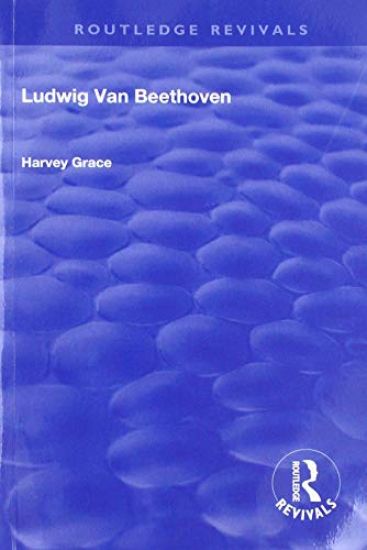
Ludwig van Beethoven (1927)

Ludwig van Beethoven (1927)

Harvey Grace

Routledge
2018
sidottu
This volume was first published in 1927, on the centenary of Beethoven’s death, as part of the Masters of Music series. The author was an established biographer of organ composers, such as The Organ Works of Bach. Attributing Beethoven’s disagreeable demeanour to his childhood, the author embarks on a passionate defence of Beethoven’s essential nobility of character, hoping to assuage the then-prevalent anti-Beethoven chill and to encourage readers to discover Beethoven anew. The volume covers an overview of Beethoven’s life, followed by his personality and an assessment of his works in an exploration of the most important characteristics of Beethoven’s works and their influence on his successors.
Ludwig van Beethoven (1927)

Ludwig van Beethoven (1927)

Harvey Grace

Routledge
2020
nidottu
This volume was first published in 1927, on the centenary of Beethoven’s death, as part of the Masters of Music series. The author was an established biographer of organ composers, such as The Organ Works of Bach. Attributing Beethoven’s disagreeable demeanour to his childhood, the author embarks on a passionate defence of Beethoven’s essential nobility of character, hoping to assuage the then-prevalent anti-Beethoven chill and to encourage readers to discover Beethoven anew. The volume covers an overview of Beethoven’s life, followed by his personality and an assessment of his works in an exploration of the most important characteristics of Beethoven’s works and their influence on his successors.
Ludwig Klages and the Philosophy of Life
This book provides a unique overview of and introduction to the work of the German psychologist and philosopher Ludwig Klages (1872-1956), an astonishing figure in the history of German ideas. Central to intellectual life in turn-of-the-century Munich, he went on to establish a reputation for himself as an original and provocative thinker. Nowadays he is often overlooked, partly because of the absence of an accessible and authoritative introduction to his thought; this volume offers just such a point of entry. With an emphasis on applicability and utility, Paul Bishop reinvigorates the discourse surrounding Klages, providing a neutral and compact account of his intellectual development and his impact on psychology and philosophy.Part 1 offers an overview of Klages’s life, visiting the major stations of his intellectual development. Part 2 examines in turn nine major conceptual ‘tools’ found in Klages’s extensive writings, aiming to clarify Klages’s terminology, to demystify his discourse, and to sift through Klages’s credentials as a psychological thinker. Part 3 consists of extracts from Klages’s writings, thematically oriented; these showcase the aphoristic and lyrical, as well as psychological and philosophical, qualities of Klages’s writing, including his interest in aesthetics. Taken together, all three parts constitute a vitalist ‘toolkit’ — to build a fuller, richer life.Drawing on previous studies of Klages that have only been available in German, Ludwig Klages and the Philosophy of Life provides a non-polemical account of Klages’s life and work, with explanations and commentaries to guide the reader through extracts from his writings. The book accessibly explains the most important ideas and concepts found in Klages’s work, including soul, spirit, character, expression, will, and consciousness, and it reveals Klages to be a serious figure whose thought remains relevant to many disciplines today. It will stimulate interest in his work and create a new readership for his remarkable worldview.