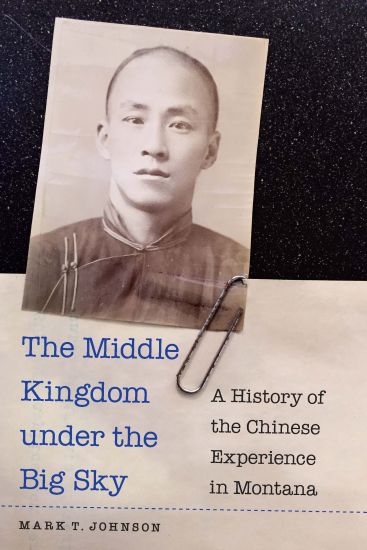
Winner of the Denver Public Library's 2023 Caroline Bancroft History Prize Winner of the 2023 W. Turrentine Jackson Award From the earliest days of non-Native settlement of Montana, when Chinese immigrants made up more than 10 percent of the territory’s population, Chinese pioneers played a key role in the region’s development. But this population, so crucial to Montana’s history, remains underrepresented in historical accounts, and popular attention to the Chinese in Montana tends to focus on sensational elements-exoticizing Chinese Montanans and distancing their lived experiences from our modern understanding. The Middle Kingdom under the Big Sky seeks to recover the stories of Montana’s Chinese population in their own words and deepen understanding of Chinese experiences in Montana by using a global lens. Mark T. Johnson has mined several large collections of primary documents left by Chinese pioneers, translated into English here for the first time. These collections, spanning the 1880s through the 1950s, provide insight into the pressures the Chinese community faced-from family members back in China and from non-Chinese Montanans-as economic and cultural disturbances complicated acceptance of Chinese residents in the state. Through their own voices Johnson reveals the agency of Chinese Montanans in the history of the American West and China.
Winner of the Denver Public Library's 2023 Caroline Bancroft History Prize Winner of the 2023 W. Turrentine Jackson Award From the earliest days of non-Native settlement of Montana, when Chinese immigrants made up more than 10 percent of the territory’s population, Chinese pioneers played a key role in the region’s development. But this population, so crucial to Montana’s history, remains underrepresented in historical accounts, and popular attention to the Chinese in Montana tends to focus on sensational elements-exoticizing Chinese Montanans and distancing their lived experiences from our modern understanding. The Middle Kingdom under the Big Sky seeks to recover the stories of Montana’s Chinese population in their own words and deepen understanding of Chinese experiences in Montana by using a global lens. Mark T. Johnson has mined several large collections of primary documents left by Chinese pioneers, translated into English here for the first time. These collections, spanning the 1880s through the 1950s, provide insight into the pressures the Chinese community faced-from family members back in China and from non-Chinese Montanans-as economic and cultural disturbances complicated acceptance of Chinese residents in the state. Through their own voices Johnson reveals the agency of Chinese Montanans in the history of the American West and China.
These five short Science Fiction stories are related to each other by the conflicts between species, machinery and / or technology. Located on the Earth, the moon, Io and two distant worlds orbiting very different stars, politics, religion, ignorance and greed make them seem all too familiar.In "All the King's Men" a Marine Gunnery Sergeant stationed on an alien world uncovers a conspiracy that could take not only her life and the lives of her men, but could change the complexion of the rest of the known galaxy.Torn from the pages of the news, "Dog Tags" describes a new technology becoming abusive. Instead of freeing mankind from the fear of kidnapping, the need to carry money or personal information, it is being used to control lives.What is the common link between a volcano in the green jungles of South America and its namesake on the sulfur-yellow plains of Io? In "Tapan Patera" a man discovers that chants, incantations and sacrifice to appease the gods can still be used today as in the olden days.When foreign objects come crashing down on the heads of unsuspecting, peaceful beings, the stage is set for belligerent rulers to fight back and get more than even. Caution In "Let He Who is Innocent Cast the First Stone", throwing rocks can be detrimental to your health.In "The Pirate, the Queen and the Apprentice" a story is uncovered on a far away, dead planet, about a pirate king braving the wild, bounding sea to wrest a life away from the authority of conflicting religious leaders. He sings songs of lost loves and found hates for the entertainment of his crew.
"More Parallel Lines" contains five, science fiction, short stories. Each story explores some facet of our potential future or our possible past.In "It Is About Time" a young boy discovers friendship for an old physics teacher and a love for physics, while the old man learns that things aren't always what they seem."The Juggler" tells us about how our world might have come to be. Truth and lies, love and hate, courage and cowardice all play a role in the political intrigue of four worlds, as they spin in their orbits.An Air Force fighter pilot, forced into retirement, in the bayous of Louisiana, comes to terms with his mortality. In "The Venus Flytrap and the Martian Flyer" he finds something quite unlike anything he has confronted before."Crystals of Life" tells about the fall and rise of a lifeform searching for a new home and finding paradise along the beaches of the Gulf of Mexico. The Ri'il find an opportunity as they present mankind with a mysterious problem.In "The Troubadour" a boy and his father find hope in the songs of a space hobo. With Earth in its final battles with pollution and population, they think of heading out to where the grass might actually be green.
Mysteries abound in Fairburn, Georgia, as Spec Bailey and his boy, Peter, pedal around solving crime and saving the day. In "The Case of the Missing Flag," a Civil War relic is taken and the finger of blame is pointing toward the wrong guys. Peter, Spec and Bob, their next door neighbor, have to sort it out before the authorities arrest them. This 4th of July might be the best yet.In "The Case of the Itsy Bitsy Spider," Spec Bailey helps keep the littlest member of the family, Velvet, from having a bad first Halloween. Then he can concentrate on helping solve the crime that is rocking Fairburn: the killing of farm animals for no apparent reason. Peter and Bob get involved, despite warnings from the local police, and save the next victim.
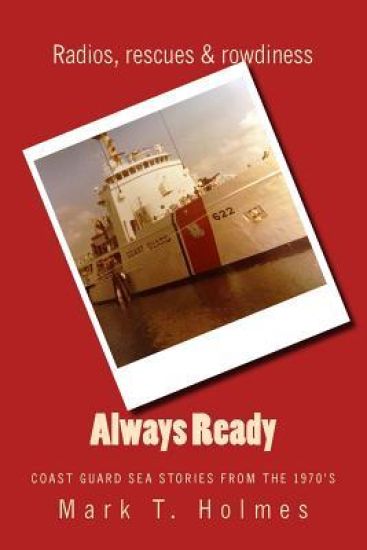
Always Ready - Coast Guard Sea Stories from the 1970s chronicles the experiences and adventures of the author during his eight years of service in the U.S. Coast Guard. In his book, author Mark Holmes recounts fact-based tales of rescues at sea, liberty calls by energetic crew members, rowdy behavior and some raunchy antics by his shipmates, all with a unique perspective on the Coast Guard during the evolving 1970's. You'll read about life during boot camp, a daring rescue in mountainous seas, a miraculous recovery of a man overboard, and the inner struggles and successes of Mr. Holmes during the course of his two enlistments. Some dates and some names of people, places, and institutions have been fictionalized, but the stories themselves are inspired by actual events.
The impulse to write Iter Tolkienensis came from a book by Steve Ponty: Middle-earth in Magic Mirror Maps of Wales ... of the Wilderness in Wales ... of the Shire in England (Matador, 2014). The insight of Ponty's book is that the maps in The Hobbit are the mirror images of the maps of Wales. Ponty's insight prompted me to return to a question that I had raised in my article "The Linguistic Landscape of Tolkien's Shire" in A Tolkienian Mathomium (2006), where I equated the real-world Bredon with Bree Hill of Middle-earth due to both a correlation of meaning and of location. "The suggestion is intriguing," I noted, "and certainly begs to be followed up on, but that is another story." Iter Tolkienensis is the story that I should have told, but didn't after my article. It starts in Buckland (near Evesham), proceeds west (Middle-earth east) to Bredon Hill, and then follows the road into Wales that is known in its latest incarnation as the M50 and the A40. The name Iter Tolkienensis is an echo of the book title Iter Britanniarum, an extract of the Roman Roads of Britain from the Antonine Itinerary, a famous itinerarium, or list of the Roman stations and the distances between them along the various roads of the Roman Empire. Though the selection of the route is admittedly arbitrary, it nevertheless offers a good assortment of real-world place names that can profitably be viewed through a Tolkienian lens, which is a linguistic perspective that begins with a name or a word, and then looks for its story in the real world with which Tolkien was familiar. Iter Tolkienensis will, therefore, look at the meanings and stories of the place names that the route passes along the way, place names that might be translations or corruptions of those on a map of Middle-earth. Iter Tolkienensis passes places that could be Minhiriath, and the family estates of the Gamgee-s and Boffin-s; the Black Country, a rope-walk, and a lookout post; Rivendell, Esgaroth, and Eryn Vorn; before reaching The Carrock, Dol Guldur, and the Ivy Bush; to name but a few. Also from this author: Tolkien Through Russian Eyes (Walking Tree Publishers, 2003), published simultaneously in Russian "Frodo's Batman," Tolkien Studies, No. 1 (2004) The Hobbitonian Anthology (Llyfrawr, 2009) "Reading John Buchan in Search of Tolkien," Tolkien and the Study of His Sources, Jason Fisher (ed.). (McFarland, 2011) Tolkien and Welsh (Llyfrawr, 2012) The Tolkienaeum (Llyfrawr, 2014) Iter Tolkienensis (Llyfrawr, 2016) Tolkien and Sanskrit (Llyfrawr, 2016) An American Forger in Wales (Llyfrawr, 2017) The Tolkiennymicon (Llyfrawr, 2018)
How did the Cold War really get started? Why did Winston Churchill absolutely hate the Soviets? How did a B-24 bomber pilot from rural Connecticut become embroiled in a hazardous mission to Ukraine in the company of his lovely and adventurous bed-mate who just happened to be a spy for Britain's MI5 and the architect of a lust-driven love triangle? This novel of WWII begins with the chance discovery of an old flight log and piece of shrapnel in a Florida antique store that compelled a former B-24 ball turret gunner to finally reveal the long-forgotten secret mission to Ukraine in the fall of 1944... a mission that helped start what became known as the Cold War. Artifact follows in the tradition of World War II spy novelists like Ken Follett and Jack Higgins, bringing to life a fast-paced adventure smack dab in the middle of "Operation Frantic." Inspired by the author's father who flew 35 missions as a B-24 pilot, Mark Holmes uncovered the little-known operation, a disastrous and short-lived shuttle-bombing program that formed the backdrop for revealing how an unusual war artifact became the good-luck charm for all but one member of the crew.
An aging FBI agent (Harry Watson) from the Phoenix office is sent into a deep cover operation in an adult (55+) community in the Chicago suburbs where it is feared a group of ex-mobsters in the Witness Protection Program have begun to discover each other and "reorganize." As Harry is on his own, when the gangsters he is supposed to be observing begin to die, he reaches out to his friend, Chicago-based Private Investigator Justinian Kase for assistance and technical support. Between them they find unexpected twists as they solve the mystery of the Oldest Don.
This is a collection of 5 short stories each of which describe a piece of someone's life. The tales are told by a long-time resident of an Alexandria, Virginia cemetery and are "historical" in nature; almost docudramas. Turn of the century figures are met and the main characters move along with them. In "Son, Brother, Patriot" a soldier becomes a spy for Teddy Roosevelt as he searches for oil in the Middle East. An ex-rough rider becomes a ranch hand and then a rodio clown as he searches for his lost love in "Stubborn To The End." A Washington Post reporter searches for the truth about the Japanese Internment camps in "Fit To Print" and he find more than he bargains for on his journey. Our hero of "A Kindred Soul" begins her quest for women's rights while trying to raise her family. In "My Turn" the story is told about how one man met his psychological future.