

Kirjahaku
Etsi kirjoja tekijän nimen, kirjan nimen tai ISBN:n perusteella.
1000 tulosta hakusanalla Rachel Morgan

A powerful look at the changing cultural understanding of postpartum depression in America. New motherhood is often seen as a joyful moment in a woman’s life; for some women, it is also their lowest moment. For much of the twentieth century, popular and medical voices blamed women who had emotional and mental distress after childbirth for their own suffering. By the end of the century, though, women with postpartum mental illnesses sought to take charge of this narrative. In Blue: A History of Postpartum Depression in America, Rachel Louise Moran explores the history of the naming and mainstreaming of postpartum depression. Coalitions of maverick psychiatrists, psychologists, and women who themselves had survived substantial postpartum distress fought to legitimize and normalize women’s experiences. They argued that postpartum depression is an objective and real illness and fought to avoid it being politicized alongside other fraught medical and political battles over women’s health. Based on insightful oral histories and in-depth archival research, Blue reveals a secret history of American motherhood, women’s political activism, and the rise of postpartum depression advocacy amid an often-censorious conservative culture. By breaking new ground with the first book-length history of postpartum mental illness in the twentieth century, Moran brings mothers’ battles with postpartum depression out of the shadows and into the light.

Americans are generally apprehensive about what they perceive as big government-especially when it comes to measures that target their bodies. Soda taxes, trans fat bans, and calorie counts on menus have all proven deeply controversial. Such interventions, Rachel Louise Moran argues, are merely the latest in a long, albeit often quiet, history of policy motivated by economic, military, and familial concerns. In Governing Bodies, Moran traces the tension between the intimate terrain of the individual citizen's body and the public ways in which the federal government has sought to shape the American physique over the course of the twentieth century. Distinguishing her subject from more explicit and aggressive government intrusion into the areas of sexuality and reproduction, Moran offers the concept of the "advisory state"-the use of government research, publicity, and advocacy aimed at achieving citizen support and voluntary participation to realize social goals. Instituted through outside agencies and glossy pamphlets as well as legislation, the advisory state is government out of sight yet intimately present in the lives of citizens. The activities of such groups as the Civilian Conservation Corps, the Children's Bureau, the President's Council on Physical Fitness, and the Special Supplemental Nutrition Program for Women, Infants, and Children (WIC) implement federal body projects in subtle ways that serve to mask governmental interference in personal decisions about diet and exercise. From advice-giving to height-weight standards to mandatory nutrition education, these tactics not only empower and conceal the advisory state but also maintain the illusion of public and private boundaries, even as they become blurred in practice. Weaving together histories of the body, public policy, and social welfare, Moran analyzes a series of discrete episodes to chronicle the federal government's efforts to shape the physique of its citizenry. Governing Bodies sheds light on our present anxieties over the proper boundaries of state power.

At 1.45am on New Year's Day, Rachel Moran left her mother's house to make the 20 minute walk back to her own flat. She never arrived. Rachel was just like many women of her age, loved by her family, adored by her boyfriend and with a bright future ahead of her. Her fatal mistake was to walk the mile or so alone to feed the kittens she and her boyfriend kept. She was taken from the street and brutally murdered by Michael Little. Her body wasn't discovered for a month. In an attempt to make sense of what happened that night and in the months that followed, her mother kept a diary of what happened.

As late as the 1960s, states could legally punish minorities who either had sex with or married persons outside of their racial groups. In this first comprehensive study of the legal regulation of interracial relationships, Rachel Moran grapples with the consequences of that history, candidly confronting its profound effects on not only conceptions of race and identity, but on ideas about sex, marriage and family.

Botanical Books, Prints and Drawings from the Collection of Mrs. Roy Arthur Hunt
Rachel McMasters Miller Hunt; Elizabeth Mongan
Literary Licensing, LLC
2013
nidottu

What's in a Name?
Morgan Gassert; Rachael Wakefield; Natalie Albracht
Pupcup Publishing
2018
pokkari
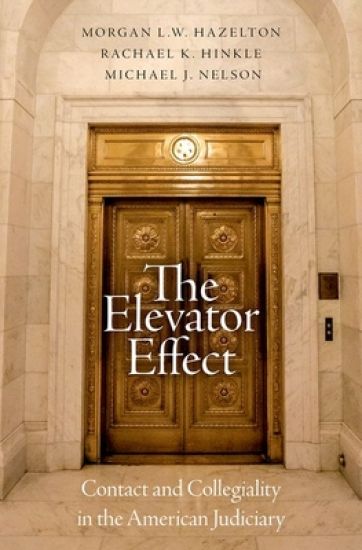
The Elevator Effect
Morgan L.W. Hazelton; Rachael K. Hinkle; Michael J. Nelson
OXFORD UNIVERSITY PRESS INC
2023
sidottu
Appellate judges wield enormous influence in the United States. Their decisions define the scope of legislative and executive power, adjudicate relationships between the federal government and the states, and determine the breadth of individuals' rights and liberties. But, compared to their colleagues on trial courts, they face a significant constraint on their power: their colleagues. The Elevator Effect: Contact and Collegiality in the American Judiciary presents a comprehensive, first of its kind examination of the importance of interpersonal relationships among judges for judicial decision-making and legal development. Regarding decision-making, the authors demonstrate that more frequent interpersonal contact among judges diminishes the role of ideology in judicial decision-making to the point where it is both substantively and statistically imperceptible. This finding stands in stark contrast to judicial decision-making accounts that present ideology as an unwavering determinant of judicial choice. With regard to legal development, the book shows that collegiality affects both the language that judges use to express their disagreement with one another and the precedents they choose to support their arguments. Thus, the overriding argument of The Elevator Effect is that collegiality affects nearly every aspect of judicial behavior. The authors draw on an impressive and unique original collection of data to untangle the relationship between judges' interpersonal relationships and the law they produce. The Elevator Effect presents a clear and highly readable narrative backed by analysis of judicial behavior throughout the U.S. federal judicial hierarchy to demonstrate that the institutional structure in which judges operate substantially tempers judicial behavior. Written in a broad and accessible style, this book will captivate students across a range of disciplines, such as law, political sciences, and empirical legal studies, and also policymakers and the public.
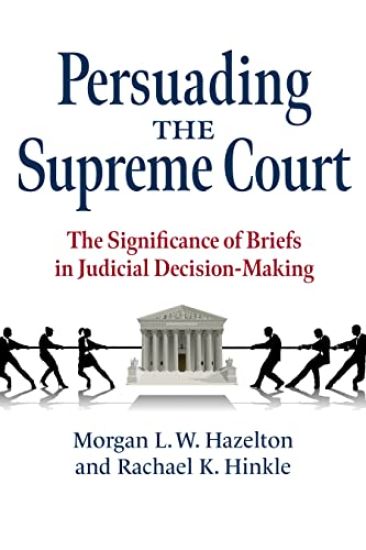
Persuading the Supreme Court
Morgan L. W. Hazelton; Rachael K. Hinkle
UNIVERSITY PRESS OF KANSAS
2022
nidottu
Each year the public, media, and government wait in anticipation for the Supreme Court to announce major decisions. These opinions have shaped legal policy in areas as important as healthcare, marriage, abortion, and immigration. It is not surprising that parties and outside individuals and interest groups invest an estimated $25 million to $50 million a year to produce roughly one thousand amicus briefs to communicate information to the justices, seeking to impact these rulings. Despite the importance of the Court and the information it receives, many questions remain unanswered regarding the production of such information and its relationship to the Court’s decisions. Persuading the Supreme Court leverages the very written arguments submitted to the Court to shed light on both their construction and impact.Drawing on more than 25,000 party and amicus briefs led between 1984 and 2015 and the text of the related court opinions, as well as interviews with former Supreme Court clerks and attorneys who have prepared and led briefs before the Supreme Court, Morgan Hazelton and Rachael Hinkle have shed light on one of the more mysterious and consequential features of Supreme Court decision-making. Persuading the Supreme Court offers new evidence that the resource advantage enjoyed by some parties likely stems from both the ability of their experienced attorneys to craft excellent briefs and their reputations with the justices. The analyses also reveal that information operates differently in terms of influencing who wins and what policy is announced.Using those original interviews and quantitative analyses of a rich original dataset of tens of thousands of briefs, with measures built using sophisticated natural language processing tools, Hazelton and Hinkle investigate the factors that influence what information litigants and their attorneys provide to the Supreme Court and what the justices and their clerks do with that information in deciding cases that set legal policy for the entire country.

To Root Somewhere Beautiful
Katalina Watt; Amparo Ortiz; Laura Galn-Wells; Daphne Dador; Nicholas Perez; Morgan Spraker; Laura G. Southern; SJ Whitby; Isa Arsen; Rien Gray; Alyssa Grant; RJ Joseph; Wen-yi Lee; Mallory Jones; Alex Brown; Sam Elyse; Darci Meadows; Rachal Marquez Jones; C.M. Leyva; R. M. Virtues
Outland Entertainment
2024
pokkari
Imagine a world in which nature has lost patience with humanity. The wild is done waiting for humans to change their ways. Nature is ready to take matters into her own hands… And she is angry.In this new anthology, twenty two diverse authors explore what nature's vengeance might be like, and how humanity could adapt and change, giving these stories of climate change and disasters a center of hope. Within these pages, you will meetA grandmother who promises both bitterness and love.A desperate husband seeking to supernaturally win back his wife.Cafe patrons facing down vigilante trees.The last remaining flight attendants in Singapore after a climate apocalypse.The recipient of a mysterious gift, who might change or doom the future.And many more.Here, nature has a voice; what will you do once you hear what she says?





Torn from her mother soon after she was born, lost to a world of deprivation and poverty, she grew up hard and fast, using any means necessary to escape from her broken childhood. Rachel became a product of her environment: a tenacious, spirited, forthright young woman with a sharp mind and a mission to accomplish. Armed only with a faded photograph, she embarks on a quest to reunite herself with her mother and leave the world of prostitution behind her once and for all. When she discovers there is more to her family than expected, Rachel is dragged back into a world of drugs, crime and murder. Although not unfamiliar with the criminal underworld, it's a place to which she would rather not return. Unfortunately for Rachel, she's in it up to her neck. Contains Adult content


Rachel's journey from Chipola Roads, the rural community in northwest Florida where she was born in the mid-ninteen-twenties, was so much further than the few miles it took to arrive in the small town where the highschool was located Her naC/ve approach to life was a result of her plain-spoken, down to earth poor farm family's upbringing, where life's rules came mostly from their understanding of the Good Book as handed down to them.
