
Kirjahaku
Etsi kirjoja tekijän nimen, kirjan nimen tai ISBN:n perusteella.
1000 tulosta hakusanalla Rashed Hasan Faap
Estimation of Hedonic Regression Models with Missing Observations
Rashed Mohamed
LAP Lambert Academic Publishing
2014
pokkari
A Study on Fuzzy Topological Spaces in Sostak's Sence
Rashed Islam Mohamed Taha
LAP Lambert Academic Publishing
2012
pokkari
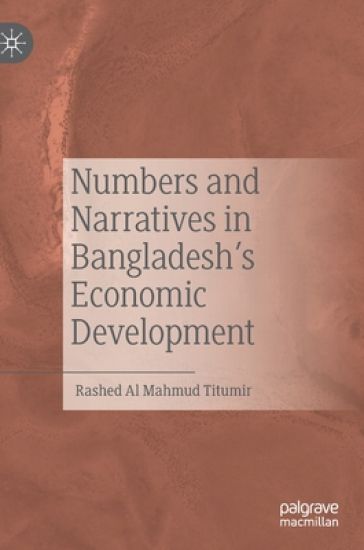
Numbers and Narratives in Bangladesh's Economic Development
Rashed Al Mahmud Titumir
Palgrave Macmillan
2021
sidottu
This book focuses on socio-economic developments of Bangladesh by challenging the dominant international narrative of the case being termed as “development surprise”, “development paradox” or “development conundrum,” given the absence of good governance. In doing so, the book examines the political economic dynamics and offers valuable insights into the current state of the Bangladeshi economy in light of stability, transformability and sustainability.Pointing to the ‘high’ rate of growth in gross domestic product (GDP) in Bangladesh, there is wide belief that economic growth can be obtained even without functioning institutions, and is more important than an inclusive political system. Advocates go on to argue that authoritarianism may be condoned as long as a steady course of development is perused. However, the inadequacy of comparative analysis in to the state of the economy of Bangladesh vis-à-vis other relevant economies makes such claims myopic and parochial.This book thus investigates the numbers and narratives to ascertain the validity of such assertions and lamentations by looking at the necessary and sufficient conditions of development. The necessary conditions imply an incisive inquiry into the factors of economic growth— land, labour, capital and technology while sufficient conditions warrant a penetrating incisive inquiry into the factors of economic growth— land, labour, capital and technology. As such, the book explores development by drawing variables of politics and economics to find out a causal relationship, and interjects these variables have on themes such as growth, agriculture, manufacturing industry, financial sector, health, education, poverty and inequality.
Numbers and Narratives in Bangladesh's Economic Development
Rashed Al Mahmud Titumir
SPRINGER VERLAG, SINGAPORE
2022
nidottu
This book focuses on socio-economic developments of Bangladesh by challenging the dominant international narrative of the case being termed as “development surprise”, “development paradox” or “development conundrum,” given the absence of good governance. In doing so, the book examines the political economic dynamics and offers valuable insights into the current state of the Bangladeshi economy in light of stability, transformability and sustainability.Pointing to the ‘high’ rate of growth in gross domestic product (GDP) in Bangladesh, there is wide belief that economic growth can be obtained even without functioning institutions, and is more important than an inclusive political system. Advocates go on to argue that authoritarianism may be condoned as long as a steady course of development is perused. However, the inadequacy of comparative analysis in to the state of the economy of Bangladesh vis-à-vis other relevant economies makes such claims myopic and parochial.This book thus investigates the numbers and narratives to ascertain the validity of such assertions and lamentations by looking at the necessary and sufficient conditions of development. The necessary conditions imply an incisive inquiry into the factors of economic growth— land, labour, capital and technology while sufficient conditions warrant a penetrating incisive inquiry into the factors of economic growth— land, labour, capital and technology. As such, the book explores development by drawing variables of politics and economics to find out a causal relationship, and interjects these variables have on themes such as growth, agriculture, manufacturing industry, financial sector, health, education, poverty and inequality.
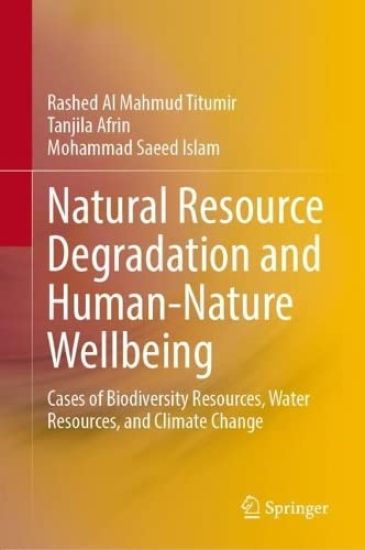
Natural Resource Degradation and Human-Nature Wellbeing
Rashed Al Mahmud Titumir; Tanjila Afrin; Mohammad Saeed Islam
SPRINGER VERLAG, SINGAPORE
2023
sidottu
The book addresses the gaps in the body of knowledge from two grounds. Firstly, it adds value through explaining the dynamics of natural resource governance by focusing on the particular arenas of biodiversity resources, water resources and climate change in developing country context. Secondly, it critically scrutinizes the market-centric perspectives on one hand and combines political economy questions that are generally overlooked in discussions of current resource governance framework, on the other. It develops a new framework to examine the reasons behind the degradations of natural resources to offer sustainable solutions to the problems. It shows that the natural resources have been exploited beyond sustainable limits due to the structural rigidities, embedded in, and reproduced by, fragile institutions and unequal power-sharing arrangements under the market-centric economic system. The book formulates a new understanding of sustainability in case of usage and management of natural resources by incorporating the idea of human sociality. It highlights the importance of the well-being of nature, and human beings must go side by side; one without the other is not a sustainable option. The book contains key learnings for scholars and researchers working in the field of development studies who wish to gain a deeper understanding on the sustainable natural resource governance specifically in the contexts of developing countries. For policymakers and policy advocates, the book serves as the groundwork on policies regarding biodiversity resources, water resources, and climate change, specific to the context of developing countries, providing more relevant contents in terms of laying out justification for policy objectives.
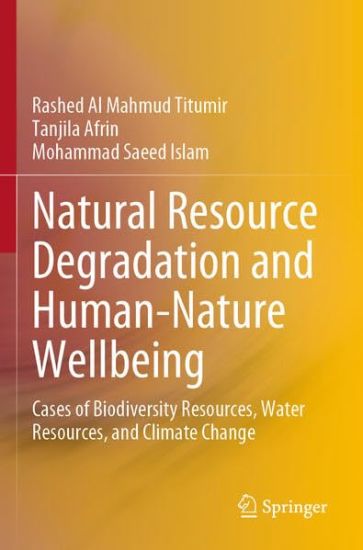
Natural Resource Degradation and Human-Nature Wellbeing
Rashed Al Mahmud Titumir; Tanjila Afrin; Mohammad Saeed Islam
SPRINGER VERLAG, SINGAPORE
2024
nidottu
The book addresses the gaps in the body of knowledge from two grounds. Firstly, it adds value through explaining the dynamics of natural resource governance by focusing on the particular arenas of biodiversity resources, water resources and climate change in developing country context. Secondly, it critically scrutinizes the market-centric perspectives on one hand and combines political economy questions that are generally overlooked in discussions of current resource governance framework, on the other. It develops a new framework to examine the reasons behind the degradations of natural resources to offer sustainable solutions to the problems. It shows that the natural resources have been exploited beyond sustainable limits due to the structural rigidities, embedded in, and reproduced by, fragile institutions and unequal power-sharing arrangements under the market-centric economic system. The book formulates a new understanding of sustainability in case of usage and management of natural resources by incorporating the idea of human sociality. It highlights the importance of the well-being of nature, and human beings must go side by side; one without the other is not a sustainable option. The book contains key learnings for scholars and researchers working in the field of development studies who wish to gain a deeper understanding on the sustainable natural resource governance specifically in the contexts of developing countries. For policymakers and policy advocates, the book serves as the groundwork on policies regarding biodiversity resources, water resources, and climate change, specific to the context of developing countries, providing more relevant contents in terms of laying out justification for policy objectives.
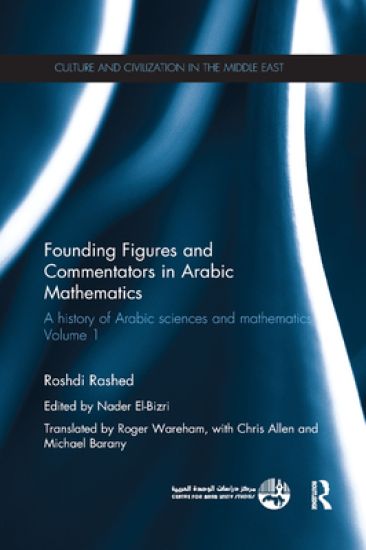
In this unique insight into the history and philosophy of mathematics and science in the mediaeval Arab world, the eminent scholar Roshdi Rashed illuminates the various historical, textual and epistemic threads that underpinned the history of Arabic mathematical and scientific knowledge up to the seventeenth century. The first of five wide-ranging and comprehensive volumes, this book provides a detailed exploration of Arabic mathematics and sciences in the ninth and tenth centuries.Extensive and detailed analyses and annotations support a number of key Arabic texts, which are translated here into English for the first time. In this volume Rashed focuses on the traditions of celebrated polymaths from the ninth and tenth centuries ‘School of Baghdad’ - such as the Banu Musa, Thabit ibn Qurra, Ibrahim ibn Sinan, Abu Ja´far al-Khazin, Abu Sahl Wayjan ibn Rustam al-Quhi - and eleventh-century Andalusian mathematicians like Abu al-Qasim ibn al-Samh, and al-Mu’taman ibn Hud. The Archimedean-Apollonian traditions of these polymaths are thematically explored to illustrate the historical and epistemological development of ‘infinitesimal mathematics’ as it became more clearly articulated in the eleventh-century influential legacy of al-Hasan ibn al-Haytham (‘Alhazen’). Contributing to a more informed and balanced understanding of the internal currents of the history of mathematics and the exact sciences in Islam, and of its adaptive interpretation and assimilation in the European context, this fundamental text will appeal to historians of ideas, epistemologists, mathematicians at the most advanced levels of research.
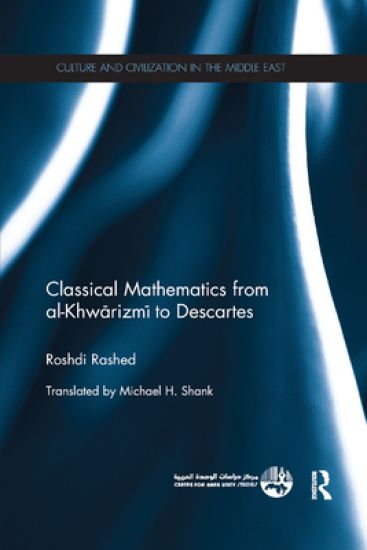
This book follows the development of classical mathematics and the relation between work done in the Arab and Islamic worlds and that undertaken by the likes of Descartes and Fermat.‘Early modern,’ mathematics is a term widely used to refer to the mathematics which developed in the West during the sixteenth and seventeenth century. For many historians and philosophers this is the watershed which marks a radical departure from ‘classical mathematics,’ to more modern mathematics; heralding the arrival of algebra, geometrical algebra, and the mathematics of the continuous. In this book, Roshdi Rashed demonstrates that ‘early modern,’ mathematics is actually far more composite than previously assumed, with each branch having different traceable origins which span the millennium. Going back to the beginning of these parts, the aim of this book is to identify the concepts and practices of key figures in their development, thereby presenting a fuller reality of these mathematics.This book will be of interest to students and scholars specialising in Islamic science and mathematics, as well as to those with an interest in the more general history of science and mathematics and the transmission of ideas and culture.
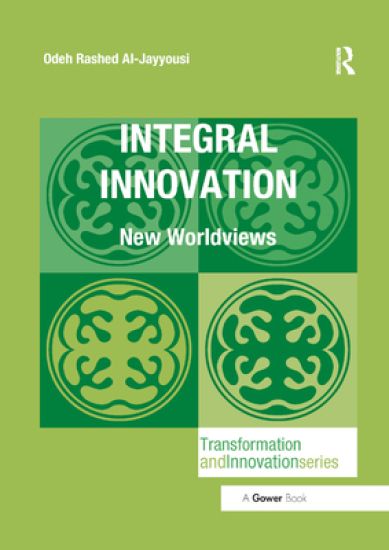
Technology plays a critical role in transforming societies and economies through enhancing efficiency, connectivity and access to resources and services. The challenge remains how to harness technologies to achieve sustainable development without causing harm to human and natural capitals.Professor Odeh Rashed Al-Jayyousi argues that science, technology and innovation (STI) are underpinned by social choices and, hence, a transition to a sustainable green economy is defined by individuals’ and institutions’ decisions on how to use and apply these STI developments. It is, therefore, important to examine closely the ways in which social institutions and processes in the “integral worlds” (the different perspectives of reality) shape the priorities of technologies and the conditions under which their potential benefits can be reaped. He states that in order for technological innovation to provide a guarantee of sustainable economic development, it is necessary that a transfer of technology to developing countries becomes a basic principle of national development policies, and that they, in turn, are open to adopting an explicit long-term application of technological innovation.Integral Innovation: New Worldviews presents a conceptual framework for the evolution of technology and innovation from a historical and cultural perspective. It provides an analysis of the role of innovation and technology in sustainable development and introduces a number of international case studies, which shed light on the social learning processes for knowledge co-creation and innovation culture. It is essential reading for those interested in innovation and technology management.
The Arabic contribution is fundamental to the history of science, mathematics and technology, but until now no single publication has offered an up-to-date synthesis of knowledge in this area. In three fully-illustrated volumes the Encyclopedia of the History of Arabic Science documents the history and philosophy of Arabic science from the earliest times to the present day. The set as a whole covers seven centuries. Thirty chapters, written by an international team of specialists from Europe, America, the Middle East and Russia cover such areas as astronomy, mathematics, music, engineering, nautical science and scientific institutions.
Ever since the history of science emerged as a discipline at the heart of the Age of Enlightenment in the eighteenth century, Arabic science or at least certain sectors of it - have constantly been cited by the philosophers and historians of science. In this book the editors have tried to restore to Arabic science its true aspect and place by emphasizing the analysis of ancient sources and by devoting some chapters to its extensions in Latin and Hebrew. The book as a whole covers the history of Arabic science over about seven centuries.
Ibn al-Haytham's Theory of Conics, Geometrical Constructions and Practical Geometry
Roshdi Rashed
Routledge
2013
sidottu
Theory of Conics, Geometrical Constructions and Practical Geometry: A History of Arabic Sciences and Mathematics Volume 3, provides a unique primary source on the history and philosophy of mathematics and science from the mediaeval Arab world. The present text is complemented by two preceding volumes of A History of Arabic Sciences and Mathematics, which focused on founding figures and commentators in the ninth and tenth centuries, and the historical and epistemological development of ‘infinitesimal mathematics’ as it became clearly articulated in the oeuvre of Ibn al-Haytham. This volume examines the increasing tendency, after the ninth century, to explain mathematical problems inherited from Greek times using the theory of conics. Roshdi Rashed argues that Ibn al-Haytham completes the transformation of this ‘area of activity,’ into a part of geometry concerned with geometrical constructions, dealing not only with the metrical properties of conic sections but with ways of drawing them and properties of their position and shape.Including extensive commentary from one of world’s foremost authorities on the subject, this book contributes a more informed and balanced understanding of the internal currents of the history of mathematics and the exact sciences in Islam, and of its adaptive interpretation and assimilation in the European context. This fundamental text will appeal to historians of ideas, epistemologists and mathematicians at the most advanced levels of research.
This volume provides a unique primary source on the history and philosophy of mathematics and science from the mediaeval Arab world. The fourth volume of A History of Arabic Sciences and Mathematics is complemented by three preceding volumes which focused on infinitesimal determinations and other chapters of classical mathematics.This book includes five main works of the polymath Ibn al-Haytham (Alhazen) on astronomy, spherical geometry and trigonometry, plane trigonometry and studies of astronomical instruments on hour lines, horizontal sundials and compasses for great circles.In particular, volume four examines: the increasing tendency to mathematize the inherited astronomy from Greek sources, namely Ptolemy's Almagest; the development of celestial kinematics; new research in spherical geometry and trigonometry required by the new kinematical theory; the study on astronomical instruments and its impact on mathematical research. These new historical materials and their mathematical and historical commentaries contribute to rewriting the history of mathematical astronomy and mathematics from the 11th century on.Including extensive commentary from one of the world’s foremost authorities on the subject, this fundamental text is essential reading for historians and mathematicians at the most advanced levels of research.
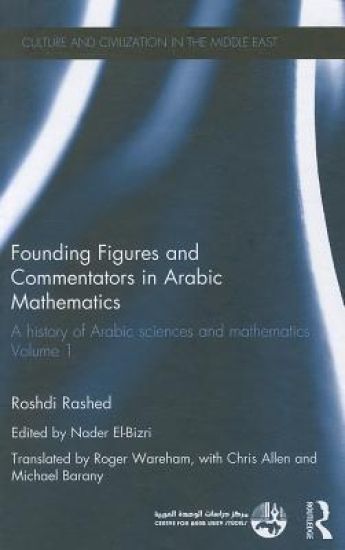
In this unique insight into the history and philosophy of mathematics and science in the mediaeval Arab world, the eminent scholar Roshdi Rashed illuminates the various historical, textual and epistemic threads that underpinned the history of Arabic mathematical and scientific knowledge up to the seventeenth century. The first of five wide-ranging and comprehensive volumes, this book provides a detailed exploration of Arabic mathematics and sciences in the ninth and tenth centuries.Extensive and detailed analyses and annotations support a number of key Arabic texts, which are translated here into English for the first time. In this volume Rashed focuses on the traditions of celebrated polymaths from the ninth and tenth centuries ‘School of Baghdad’ - such as the Banu Musa, Thabit ibn Qurra, Ibrahim ibn Sinan, Abu Ja´far al-Khazin, Abu Sahl Wayjan ibn Rustam al-Quhi - and eleventh-century Andalusian mathematicians like Abu al-Qasim ibn al-Samh, and al-Mu’taman ibn Hud. The Archimedean-Apollonian traditions of these polymaths are thematically explored to illustrate the historical and epistemological development of ‘infinitesimal mathematics’ as it became more clearly articulated in the eleventh-century influential legacy of al-Hasan ibn al-Haytham (‘Alhazen’). Contributing to a more informed and balanced understanding of the internal currents of the history of mathematics and the exact sciences in Islam, and of its adaptive interpretation and assimilation in the European context, this fundamental text will appeal to historians of ideas, epistemologists, mathematicians at the most advanced levels of research.
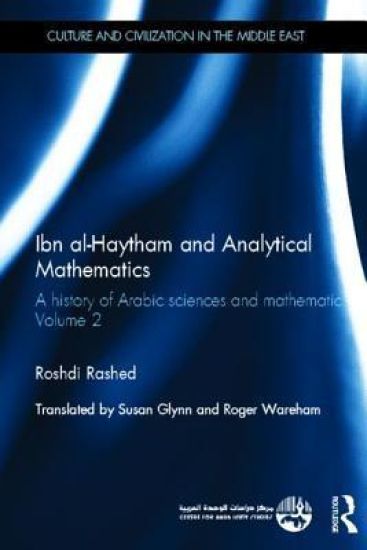
This volume provides a unique primary source on the history and philosophy of mathematics and the exact sciences in the mediaeval Arab world. The second of five comprehensive volumes, this book offers a detailed exploration of Arabic mathematics in the eleventh century as embodied in the legacy of the celebrated polymath al-Hasan ibn al-Haytham. Extensive analyses and annotations from the eminent scholar, Roshdi Rashed, support a number of key Arabic texts from Ibn al-Haytham’s treatises in infinitesimal mathematics, translated here into English for the first time. Rashed shows how Ibn al-Haytham’s works demonstrate a remarkable mathematical competence in mathematical subjects like the quadrature of the circle and of lunes, the calculation of the volumes of paraboloids, the problem of isoperimetric plane figures and solid figures with equal surface areas, along with the extraction of square and cubic roots. The present text is complemented by the first volume of A History of Arabic Sciences and Mathematics, which focused on founding figures and commentators in the ninth and tenth centuries Archimedean-Apollonian mathematical ‘School of Baghdad’. This constellation of works illustrates the historical and epistemological development of ‘infinitesimal mathematics’ as it became clearly articulated in the oeuvre of Ibn al-Haytham.Contributing to a more informed and balanced understanding of the internal currents of the history of mathematics and the exact sciences in Islam, and of its adaptive interpretation and assimilation in the European context, this fundamental text will appeal to historians of ideas, epistemologists and mathematicians at the most advanced levels of research.

This book follows the development of classical mathematics and the relation between work done in the Arab and Islamic worlds and that undertaken by the likes of Descartes and Fermat.‘Early modern,’ mathematics is a term widely used to refer to the mathematics which developed in the West during the sixteenth and seventeenth century. For many historians and philosophers this is the watershed which marks a radical departure from ‘classical mathematics,’ to more modern mathematics; heralding the arrival of algebra, geometrical algebra, and the mathematics of the continuous. In this book, Roshdi Rashed demonstrates that ‘early modern,’ mathematics is actually far more composite than previously assumed, with each branch having different traceable origins which span the millennium. Going back to the beginning of these parts, the aim of this book is to identify the concepts and practices of key figures in their development, thereby presenting a fuller reality of these mathematics.This book will be of interest to students and scholars specialising in Islamic science and mathematics, as well as to those with an interest in the more general history of science and mathematics and the transmission of ideas and culture.
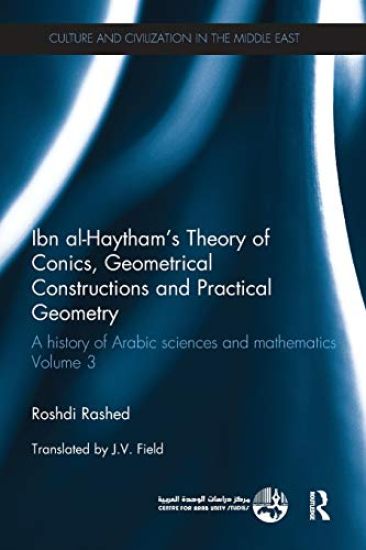
Ibn al-Haytham's Theory of Conics, Geometrical Constructions and Practical Geometry
Roshdi Rashed
CRC Press Inc
2018
nidottu
Theory of Conics, Geometrical Constructions and Practical Geometry: A History of Arabic Sciences and Mathematics Volume 3, provides a unique primary source on the history and philosophy of mathematics and science from the mediaeval Arab world. The present text is complemented by two preceding volumes of A History of Arabic Sciences and Mathematics, which focused on founding figures and commentators in the ninth and tenth centuries, and the historical and epistemological development of ‘infinitesimal mathematics’ as it became clearly articulated in the oeuvre of Ibn al-Haytham. This volume examines the increasing tendency, after the ninth century, to explain mathematical problems inherited from Greek times using the theory of conics. Roshdi Rashed argues that Ibn al-Haytham completes the transformation of this ‘area of activity,’ into a part of geometry concerned with geometrical constructions, dealing not only with the metrical properties of conic sections but with ways of drawing them and properties of their position and shape.Including extensive commentary from one of world’s foremost authorities on the subject, this book contributes a more informed and balanced understanding of the internal currents of the history of mathematics and the exact sciences in Islam, and of its adaptive interpretation and assimilation in the European context. This fundamental text will appeal to historians of ideas, epistemologists and mathematicians at the most advanced levels of research.