Kirjojen hintavertailu. Mukana 11 699 587 kirjaa ja 12 kauppaa.

Kirjahaku

Etsi kirjoja tekijän nimen, kirjan nimen tai ISBN:n perusteella.

1000 tulosta hakusanalla Robert C Locke

A Better Way to Think About Business

A Better Way to Think About Business

Robert C. Solomon

Oxford University Press Inc
2003
nidottu
Is business ethics a contradiction in terms? Absolutely not, says Robert Solomon. In fact, he maintains that sound ethics is a necessary precondition of any long-term business enterprise, and that excellence in business must exist on the foundation of values that most of us hold dear. Drawing on twenty years of experience consulting with major corporations on ethics, Solomon clarifies the difficult ethical choices all people in business face. He uses an "Aristotelian" approach to remind readers that a corporation--like an individual--is embedded in a community, and that corporate values such as fairness and honesty are meaningless until transformed into action. Without a base of shared values, trust and mutual benefits, today's national and international business world would fall apart. In keeping with his conviction that virtue and profit must thrive together, Solomon both examines the ways in which deficient values actually destroy businesses, and debunks the pervasive myths that encourage unethical business practices. Complete with a working catalog of virtues designed to illustrate the importance of integrity in any business situation, this compelling handbook contains a gold mine of wisdom for either the small business manager or the corporate executive struggling with ethical issues.
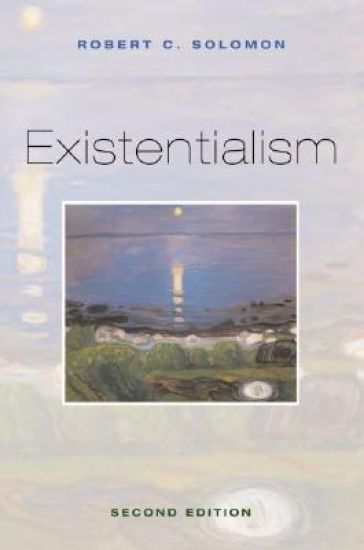
Existentialism

Existentialism

Robert C. Solomon

Oxford University Press Inc
2004
nidottu
Existentialism, Second Edition concentrates on the "big four" existentialists - Kierkegaard, Nietzsche, Heidegger, and Sartre - while providing a strong sense of the breadth and variety of existentialist thought. In this edition, Solomon provides new translations of Kierkegaard, even more extensive Heidegger and Sartre selections, and a bit more Nietzsche. He retains a sense of the rich variety of existentialist thought and writing by adding such world figures as Miguel de Unamuno, Rainer Marie Rilke, Luis Borges, Gabriel Marquez, Keiji Nishitani, Milan Kundera, and a scene from one particularly existentialist film screenplay, Casablanca. In addition, there are new selections from Hazel Barnes, Colin Wilson, and Fyodor Dostoevsky's Brothers Karamazov. The resulting volume is an excellent introduction to the richness of existentialist thought and an outstanding sourcebook for the classic existentialist thought and an outstanding sourcebook for the classic existentialist texts.
Not Passion's Slave

Not Passion's Slave

Robert C. Solomon

Oxford University Press Inc
2007
nidottu
The idea that we are in some significant sense responsible for our emotions is an idea that Robert Solomon has developed for almost three decades. Here, in a single volume, he traces the development of this theory of emotions and elaborate it in detail. Two themes run through his work: the first presents a "cognitive" theory of emotions in which emotions are construed primarily as evaluative judgments. The second proposes an "existentialist" perspective in which he defends the idea that, as we are responsible for our emotions. Indeed, sometimes it even makes sense to say that we "choose" them. While the first claim has gained increasing currency in the literature, his claim about responsibility for emotions has continued to meet with considerable resistance and misinterpretation. The new emphasis on evolutionary biology and neurology has (mistakenly) reinforced the popular prejudice that emotions "happen" to us and are entirely beyond our control. This volume is also a kind of intellectual memoir of Solomon¹s own development as a thinker. The essays written in the 1980s elaborate the themes of the "intentionality" of emotion and the claim that emotions are "judgments"; in this period, he is also increasingly preoccupied with how emotions vary and are identified in a variety of cultures. In the 1990's, his interests evolve to consider the social and political role of emotions and theories about emotion. The final section presents his current philosophical position on the seeming "passivity" of the passions. Despite his own critical assessment of his earlier work, he continues to argue that, in the final analysis, we are responsible for our emotions and existential quality of our lives.
Dark Feelings, Grim Thoughts

Dark Feelings, Grim Thoughts

Robert C. Solomon

Oxford University Press Inc
2006
sidottu
In the same spirit as his most recent book, Living With Nietzsche, and his earlier study In the Spirit of Hegel, Robert Solomon turns to the existential thinkers Albert Camus and Jean-Paul Sartre, in an attempt to get past the academic and political debates and focus on what is truly interesting and valuable about their philosophies. Solomon makes the case that--despite their very different responses to the political questions of their day--Camus and Sartre were both fundamentally moralists, and their philosophies cannot be understood apart from their deep ethical commitments. He focuses on Sartre's early, pre-1950 work, and on Camus's best known novels The Stranger, The Plague, and The Fall. Throughout Solomon makes the important point that their shared interest in phenomenology was much more important than their supposed affiliation with "existentialism." Solomon's reappraisal will be of interest to anyone who is still or ever has been fascinated by these eccentric but monumental figures.
Living with Nietzsche

Living with Nietzsche

Robert C. Solomon

Oxford University Press Inc
2006
nidottu
Friedrich Nietzsche is one of the most popular and controversial philosophers of the last 150 years. Narcissistic, idiosyncratic, hyperbolic, irreverent--never has a philosopher been appropriated, deconstructed, and scrutinized by such a disparate array of groups, movements, and schools of thought. Adored by many for his passionate ideas and iconoclastic style, he is also vilified for his lack of rigor, apparent cruelty, and disdain for moral decency. In Living with Nietzsche, Solomon suggests that we read Nietzsche from a very different point of view, as a provocative writer who means to transform the way we view our lives. This means taking Nietzsche personally. Rather than focus on the "true" Nietzsche or trying to determine "what Nietzsche really meant" by his seemingly random and often contradictory pronouncements about "the Big Questions" of philosophy, Solomon reminds us that Nietzsche is not a philosopher of abstract ideas but rather of the dazzling personal insight, the provocative challenge, the incisive personal probe. He does not try to reveal the eternal verities but he does powerfully affect his readers, goading them to see themselves in new and different ways. It is Nietzsche's compelling invitation to self-scrutiny that fascinates us, engages us, and guides us to a "rich inner life." Ultimately, Solomon argues, Nietzsche is an example as well as a promulgator of "passionate inwardness," a life distinguished by its rich passions, exquisite taste, and a sense of personal elegance and excellence.
Spirituality for the Skeptic

Spirituality for the Skeptic

Robert C. Solomon

Oxford University Press Inc
2006
nidottu
Is it possible to be spiritual and yet not believe in the supernatural? Can a person be spiritual without belonging to a religious group or organization? In Spirituality for the Skeptic, philosopher Robert Solomon philosopher Robert Solomon explores what it means to be spiritual in today's pluralistic world. Based on Solomon's own struggles to reconcile philosophy with religion, this book offers a model of a vibrant, fulfilling spirituality that embraces the complexities of human existence and acknowledges the joys and tragedies of life. Soloman has forged an enlightened new path that synthesizes spirituality with emotions, intellect, science, and common sense. His new paradigm, "naturalized" spirituality, establishes as its cornerstone the "thoughtful love of life"--a passionate concern for the here-and-now, and not the by-and-by. Being spiritual doesn't mean being holed up as a recluse, spending hours in meditation and contemplation, Solomon argues. It demands involvement and emotional engagement with others in the struggle to find meaning in our lives. As such, this modern-day spirituality encompasses a passionate enthusiasm for the world, the transformation of self, cosmic trust and rationality, coming to terms with fate, and viewing life as a gift, all of which are explored in depth throughout this book. Spirituality for the Skeptic answers the need for a non-institutional, non-dogmatic spirituality that leads to personal fulfillment and satisfaction. By examining the ideas of great thinkers from Socrates and Nietzsche to Buddha to Kafka, Solomon arrives at a practical vision of spirituality that should appeal to many seekers looking to make sense of the human condition.
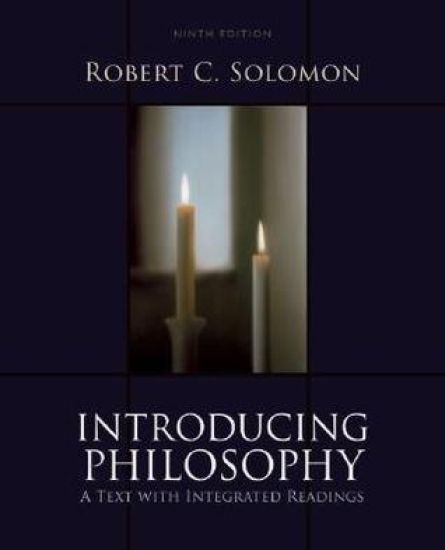
Introducing Philosophy

Introducing Philosophy

Robert C. Solomon

Oxford University Press Inc
2007
nidottu
Introducing Philosophy: A Text with integrated Readings , ninth edition, is an engaging introduction to the basic philosophical problems and their potential alternative solutions. It is a topically organized hybrid that includes Soloman's own discussion along with excerpts from prominent thinkers of the last 2500 years on topics such as the nature of reality, the existence and nature of God, the possibility of human knowledge, the mystery of the self, the nature of truth, and the essence of freedom.
True to Our Feelings

True to Our Feelings

Robert C. Solomon

Oxford University Press Inc
2008
nidottu
We live our lives through our emotions, writes Robert Solomon, and it is our emotions that give our lives meaning. What interests or fascinates us, who we love, what angers us, what moves us, what bores us--all of this defines us, gives us character, constitutes who we are. In True to Our Feelings , Solomon illuminates the rich life of the emotions--why we don't really understand them, what they really are, and how they make us human and give meaning to life. Emotions have recently become a highly fashionable area of research in the sciences, with brain imaging uncovering valuable clues as to how we experience our feelings. But while Solomon provides a guide to this cutting-edge research, as well as to what others--philosophers and psychologists--have said on the subject, he also emphasizes the personal and ethical character of our emotions. He shows that emotions are not something that happen to us, nor are they irrational in the literal sense--rather, they are judgements we make about the world, and they are strategies for living in it. Fear, anger, love, guilt, jealousy, compassion--they are all essential to our values, to living happily, healthily, and well. Solomon highlights some of the dramatic ways that emotions fit into our ethics and our sense of the good life, how we can make our emotional lives more coherent with our values and be more 'true to our feelings' and cultivate emotional integrity.
Spirituality in the Flesh

Spirituality in the Flesh

Robert C. Fuller

Oxford University Press Inc
2008
sidottu
It is now generally accepted that the nature of human thought has much to do with the structure and function of the human body. In Spirituality in the Flesh, Robert C. Fuller investigates how our sensory organs, emotional programs, sexual sensibilities, and neural structures shape religious phenomena. Why is it that some religious traditions assign spiritual currency to pain? How do neurochemically-driven emotions such as fear shape our religious actions? What is the relationship between chemically altered states of consciousness and religious innovation? The body has recently become a subject of investigation among scholars of religion. Many such studies focus on the concept of the body as a cultural construct. Whereas these treatments helpfully demonstrate how cultures construct ideas about the body, Fuller asks how the body itself influences religious concepts. Seeking to establish a middle ground between purely materialistic or humanistic arguments, he skillfully pairs scientific findings with religious truths. Both perspectives could learn from the other: Fuller takes scientific interpreters to task for failing to understand the inherently cultural aspects of embodied experience even as he chides most religion scholars for ignoring new knowledge about the biological substrates of human behavior. Comfortable with the language of scientific analysis and sympathetic to the inherently subjective aspects of religious events, Fuller introduces the biological study of religion by joining our unprecedented understanding of bodily states with an experts knowledge of religious phenomena. Culling insights from scientific observations, historical allusions, and literary references, Spirituality in the Flesh provides fresh understandings that promise to enrich our appreciation of the embodied religious experience.
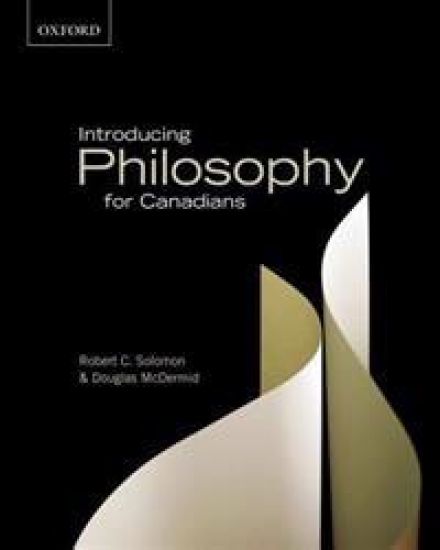
Introducing Philosophy for Canadians

Introducing Philosophy for Canadians

Robert C. Solomon; Douglas McDermid

Oxford University Press, Canada
2011
nidottu
Introducing Philosophy: A Text with Integrated Readings, Canadian edition, introduces beginning philosophy students to the core philosophical queries that have shaped our ways of thinking. The authors introduce students to classic and often complex problems by integrating carefully selected excerpts from primary source readings with accessible commentary. By combining readings that span the history of philosophy from ancient times to the present-day, Introducing Philosophy chronicles how philosophical thought has developed across the ages. The text is organized into seven topical chapters that cover the major areas of philosophy: the nature of reality, religion, knowledge, mind and body, self and freedom, ethics, and justice. In each chapter, students will encounter selections that present a diverse range of positions and concerns, both Western and Eastern. Building on the solid foundation laid out in the ninth US edition of Robert C. Solomon's Introducing Philosophy, this new edition successfully adapts the content to the needs of Canadian students.While retaining the focus on the work of the pillars of philosophical thought-from Plato to Descartes to Freud and beyond-the new edition also highlights major contributions from key Canadian thinkers, including Jean Vanier, Tommy Douglas, Pierre Trudeau, and Lorraine Code. In addition, seven new pieces-commissioned specifically for this text and written by notable Canadian academics-present contemporary analyses of classic problems within the Canadian context. This book has an accompanying Student Resource Website and Instructor Resource Website (with Instructor's manual).
Where the Evidence Leads

Where the Evidence Leads

Robert C. Johansen

OXFORD UNIVERSITY PRESS INC
2022
sidottu
By shifting American security policy away from maximizing military power for the United States and toward maximizing human security for all, policymakers and citizens can also maximize national security for the United States and sustainable peace for the world. Why do war and political violence persist? Political realists argue that violent conflict and the struggle for power are inherent in the international system, and there is little we can do but manage it. However, as Robert Johansen argues in this path-breaking work, there are other ways forward. In Where the Evidence Leads, Johansen develops an "empirical realist" theory to enable the United Sates to respond more effectively to rising security threats. Together, peace research and security studies show that more security benefits are likely to result from maximizing the "causes" or correlates of peace than from maximizing military power. Ironically, a global grand strategy for human security, with national security folded into it, is likely to produce more security for the United States than a national security strategy. Peace reigns when states implement peace correlates, which range from addressing all nations' security fears to making life more predictable through better global governance. This approach, respectful of forgotten insights from Hans Morgenthau and others, revolutionizes thinking about national security policy by bringing it into a human security framework. The analysis shows that the anarchic, militarized balance-of-power system can be gradually changed with help from enhanced lawmaking, enforcement, and governance capacities. This thought-provoking book builds bridges between past policies-many of which have failed-and more deft ways of handling new realities that focus on building peace. In a world of threats, this book opens doors onto a future of sustainable peace, security, and hope.
Where the Evidence Leads

Where the Evidence Leads

Robert C. Johansen

OXFORD UNIVERSITY PRESS INC
2022
nidottu
By shifting American security policy away from maximizing military power for the United States and toward maximizing human security for all, policymakers and citizens can also maximize national security for the United States and sustainable peace for the world. Why do war and political violence persist? Political realists argue that violent conflict and the struggle for power are inherent in the international system, and there is little we can do but manage it. However, as Robert Johansen argues in this path-breaking work, there are other ways forward. In Where the Evidence Leads, Johansen develops an "empirical realist" theory to enable the United Sates to respond more effectively to rising security threats. Together, peace research and security studies show that more security benefits are likely to result from maximizing the "causes" or correlates of peace than from maximizing military power. Ironically, a global grand strategy for human security, with national security folded into it, is likely to produce more security for the United States than a national security strategy. Peace reigns when states implement peace correlates, which range from addressing all nations' security fears to making life more predictable through better global governance. This approach, respectful of forgotten insights from Hans Morgenthau and others, revolutionizes thinking about national security policy by bringing it into a human security framework. The analysis shows that the anarchic, militarized balance-of-power system can be gradually changed with help from enhanced lawmaking, enforcement, and governance capacities. This thought-provoking book builds bridges between past policies-many of which have failed-and more deft ways of handling new realities that focus on building peace. In a world of threats, this book opens doors onto a future of sustainable peace, security, and hope.
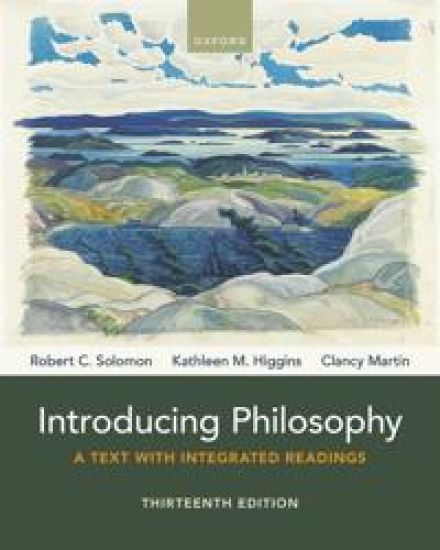
Introducing Philosophy

Introducing Philosophy

Robert C. Solomon; Kathleen M. Higgins; Clancy Martin

OXFORD UNIVERSITY PRESS INC
2024
nidottu
Introducing Philosophy: A Text with Integrated Readings, Thirteenth Edition, is an exciting, accessible, and thorough introduction to the core questions of philosophy and the many ways in which they are, and have been, answered. The authors combine substantial selections from significant works in the history of philosophy with excerpts from current philosophy, clarifying the readings and providing context with their own detailed commentary and explanation. Spanning 2,500 years, the selections range from the oldest known fragments to cutting-edge contemporary essays. Organized topically, the chapters present alternative perspectives--including analytic, continental, feminist, and non-Western viewpoints--alongside the historical works of major Western philosophers. DIGITAL LEARNING AND TEACHING TOOLS Oxford Learning Link, accessible to adopting instructors, will provide a Test Bank with about thirty multiple-choice, ten essay/discussion, twenty true/false, and ten fill-in-the-blank questions per chapter; PowerPoint lecture outlines; an Instructor's Manual; and a glossary A free, open-access Companion Website for students will include interactive flashcards of key terms from the text and self-quizzes with about fifteen multiple-choice, ten true/false, and five fill-in-the-blank questions per chapter
Context and Content

Context and Content

Robert C. Stalnaker

Clarendon Press
1999
nidottu
In Context and Content Robert Stalnaker develops a philosophical picture of the nature of speech and thought and the relations between them. Two themes in particular run through these collected essays: the role that the context in which speech takes place plays in accounting for the way language is used to express thought, and the role of the external environment in determining the contents of our thoughts. Stalnaker argues against the widespread assumption of the priority of linguistic over mental representation, which he suggests has had a distorting influence on our understanding. The first part of the book develops a framework for representing contexts and the way they interact with the interpretation of what is said in them. This framework is used to help to explain a range of linguistic phenomena concerning presupposition and assertion, conditional statements, the attribution of beliefs, and the use of names, descriptions, and pronouns to refer. Stalnaker then draws out the conception of thought and its content that is implicit in this framework. He defends externalism about thought--the assumption that our thoughts have the contents they have in virtue of the way we are situated in the world--and explores the role of linguistic action and linguistic structure in determining the contents of our thoughts. Context and Content offers philosophers and cognitive scientists a summation of Stalnaker's important and influential work in this area. His new introduction to the volume gives an overview of this work and offers a convenient way in for those who are new to it. The Oxford Cognitive Science series is a new forum for the best contemporary work in this flourishing field, where various disciplines--cognitive psychology, philosophy, linguistics, cognitive neuroscience, and computational theory--join forces in the investigation of thought, awareness, understanding, and associated workings of the mind. Each book constitutes an original contribution to its subject, but will be accessible beyond the ranks of specialists, so as to reach a broad interdisciplinary readership. The series will be carefully shaped and steered with the aim of representing the most important developments in the field and bringing together its constituent disciplines.
Context and Content

Context and Content

Robert C. Stalnaker

Clarendon Press
1999
sidottu
In Context and Content Robert Stalnaker develops a philosophical picture of the nature of speech and thought and the relations between them. Two themes in particular run through these collected essays: the role that the context in which speech takes place plays in accounting for the way language is used to express thought, and the role of the external environment in determining the contents of our thoughts. Stalnaker argues against the widespread assumption of the priority of linguistic over mental representation, which he suggests has had a distorting influence on our understanding. The first part of the book develops a framework for representing contexts and the way they interact with the interpretation of what is said in them. This framework is used to help to explain a range of linguistic phenomena concerning presupposition and assertion, conditional statements, the attribution of beliefs, and the use of names, descriptions, and pronouns to refer. Stalnaker then draws out the conception of thought and its content that is implicit in this framework. He defends externalism about thought--the assumption that our thoughts have the contents they have in virtue of the way we are situated in the world--and explores the role of linguistic action and linguistic structure in determining the contents of our thoughts. Context and Content offers philosophers and cognitive scientists a summation of Stalnaker's important and influential work in this area. His new introduction to the volume gives an overview of this work and offers a convenient way in for those who are new to it. The Oxford Cognitive Science series is a new forum for the best contemporary work in this flourishing field, where various disciplines--cognitive psychology, philosophy, linguistics, cognitive neuroscience, and computational theory--join forces in the investigation of thought, awareness, understanding, and associated workings of the mind. Each book constitutes an original contribution to its subject, but will be accessible beyond the ranks of specialists, so as to reach a broad interdisciplinary readership. The series will be carefully shaped and steered with the aim of representing the most important developments in the field and bringing together its constituent disciplines.
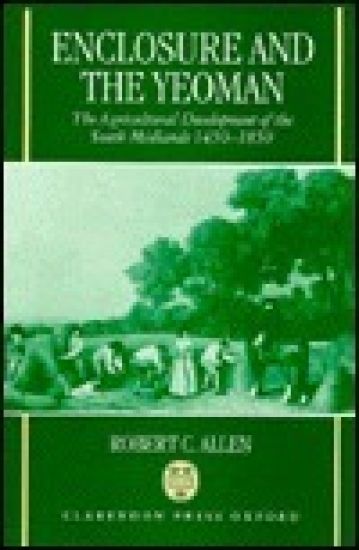
Enclosure and the Yeoman

Enclosure and the Yeoman

Robert C. Allen

Clarendon Press
1992
sidottu
This book traces the shift from medieval to modern institutions in English agriculture. It explores their importance for productivity growth, income distribution, and the contribution of agriculture to British economic development. Robert C. Allen's pioneering study shows that, contrary to the assumption of many historians, small-scale farmers in the open-field system were responsible for a considerable proportion of the productivity growth achieved between the middle ages and the nineteenth century. The process of enclosure and the replacement of these yeomen by large-scale tenant farming relying on wage labour had relatively little impact on the agricultural contribution to economic development during the industrial revolution. Enclosures and large farms enriched landowners without benefiting consumers, workers, or farmers. Thoroughly grounded in the archival sources, and underpinned by rigorous economic analysis, Enclosure and the Yeoman is a scholarly and challenging reassessment of the history of English agriculture. It will be indispensable reading for all historians concerned with the making of modern Britain.
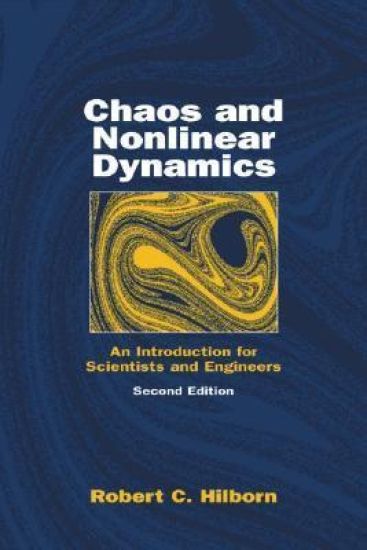
Chaos and Nonlinear Dynamics

Chaos and Nonlinear Dynamics

Robert C. Hilborn

Oxford University Press
2000
nidottu
Chaos and Nonlinear Dynamics introduces students, scientists, and engineers to the full range of activity in the rapidly growing field on nonlinear dynamics. Using a step-by-step introduction to dynamics and geometry in state space as the central focus of understanding nonlinear dynamics, this book includes a thorough treatment of both differential equation models and iterated map models (including a derivation of the famous Feigenbaum numbers). It is the only book at this level to include the increasingly important field of pattern formation and a survey of the controversial questions of quantum chaos. Important tools such as Lyapunov exponents and fractal dimensions are treated in detail. With over 200 figures and diagrams, and analytic and computer exercises for every chapter, the book can be used as a course-text or for self-instruction. This second edition has been restructured to make the book even more useful as a course text:many of the more complex examples and derivations have been moved to appendices. The extensive collection of annotated references has been updated through January 2000 and now includes listings of World Wide Web sites at many of the major nonlinear dynamics research centers. From reviews on the 1/e: 'What has been lacking is a single book that takes the reader with nothing but a knowledge of elementary calculus and physics all the way to the frontiers of research in chaos and nonlinear dynamics in all its facets. [...] a serious student, teacher, or researcher would be delighted to have this book on the shelf as a reference and as a window to the literature in this exciting and rapidly growing new field of chaos.' J.C. Sprott, American Journal of Physics, September 19944 'I congratulate the author on having managed to write an extremely thorough, comprehensive, and entertaining introduction to the fascinating field of nonlinear dynamics. His book is highly self- explanatory and ideally suited for self-instruction. There is hardly any question that the author does not address in an exceptionally readable manner. [...] I strongly recommend it to those looking for a comprehensive, practical, and not highly mathematical approach to the subject.' E.A. Hunt, IEEE Spectrum, December 1994
The Industrial Revolution

The Industrial Revolution

Robert C. Allen

Oxford University Press
2017
nidottu
The 'Industrial Revolution' was a pivotal point in British history that occurred between the mid-eighteenth and mid-nineteenth centuries and led to far reaching transformations of society. With the advent of revolutionary manufacturing technology productivity boomed. Machines were used to spin and weave cloth, steam engines were used to provide reliable power, and industry was fed by the construction of the first railways, a great network of arteries feeding the factories. Cities grew as people shifted from agriculture to industry and commerce. Hand in hand with the growth of cities came rising levels of pollution and disease. Many people lost their jobs to the new machinery, whilst working conditions in the factories were grim and pay was low. As the middle classes prospered, social unrest ran through the working classes, and the exploitation of workers led to the growth of trade unions and protest movements. In this Very Short Introduction, Robert C. Allen analyzes the key features of the Industrial Revolution in Britain, and the spread of industrialization to other countries. He considers the factors that combined to enable industrialization at this time, including Britain's position as a global commercial empire, and discusses the changes in technology and business organization, and their impact on different social classes and groups. Introducing the 'winners' and the 'losers' of the Industrial Revolution, he looks at how the changes were reflected in evolving government policies, and what contribution these made to the economic transformation. ABOUT THE SERIES: The Very Short Introductions series from Oxford University Press contains hundreds of titles in almost every subject area. These pocket-sized books are the perfect way to get ahead in a new subject quickly. Our expert authors combine facts, analysis, perspective, new ideas, and enthusiasm to make interesting and challenging topics highly readable.
Knowledge and Conditionals

Knowledge and Conditionals

Robert C. Stalnaker

Oxford University Press
2019
sidottu
Robert C. Stalnaker presents a set of essays on the structure of inquiry. In the first part he focuses on the concepts of knowledge, belief, and partial belief, and on the rules and procedures we use - or ought to use - to determine what to believe, and what to claim that we know. In the second part he examines conditional statements and conditional beliefs, their role in epistemology, and their relations to causal and explanatory concepts, such as dispositions, objective chance, relations of dependence, and independence. A central concern of the book is the interaction of different cognitive perspectives - the ways in which the attitudes of rational agents are or should be influenced by critical reflection on their present cognitive situation, on their own cognitive situations at other times, and on the cognitive situations of others with whom they interact. The general picture that is developed is naturalistic, following Hume in rejecting a substantive role for pure reason in the defense of inductive rules, and in giving causal concepts a central role in the description and explanation of our cognitive practices. However, Stalnaker rejects the side of Hume that aims to reduce concepts involving natural necessity to more basic descriptive concepts. Instead, he argues that the development of inductive rules and practices takes place in interaction with the development of concepts for giving a theoretical description of the world.