Kirjojen hintavertailu. Mukana 11 244 527 kirjaa ja 12 kauppaa.

Kirjahaku

Etsi kirjoja tekijän nimen, kirjan nimen tai ISBN:n perusteella.

1000 tulosta hakusanalla Robert D. Lesslie

Surrender Or Starve

Surrender Or Starve

Robert D Kaplan

Routledge
2019
sidottu
Famine in the Horn is both a tool and an aspect of ethnic conflict, with the Ethiopian Amharas of the central highlands pitted against the Eritreans and Tigreans of the north. The overwhelming majority of U.S. journalists have reported on Ethiopia from one side only-that of the Amharas in Addis Ababa. The author wants to show the story from the other side, in order to redress a grievous imbalance in news coverage. To get people excited, you sometimes have to light a fire, and that was the author’s intention. This book covers the period from late 1984 to the early part of 1987. In late 1987, the famine returned, mainly for the very reasons cited inside.
Surrender Or Starve

Surrender Or Starve

Robert D Kaplan

Routledge
2021
nidottu
Famine in the Horn is both a tool and an aspect of ethnic conflict, with the Ethiopian Amharas of the central highlands pitted against the Eritreans and Tigreans of the north. The overwhelming majority of U.S. journalists have reported on Ethiopia from one side only-that of the Amharas in Addis Ababa. The author wants to show the story from the other side, in order to redress a grievous imbalance in news coverage. To get people excited, you sometimes have to light a fire, and that was the author’s intention. This book covers the period from late 1984 to the early part of 1987. In late 1987, the famine returned, mainly for the very reasons cited inside.
Contemporary Continental Philosophy

Contemporary Continental Philosophy

Robert D'amico

Routledge
2019
sidottu
Contemporary Continental Philosophy steps back from current debates comparing Continental and analytic philosophy and carefully, yet critically outlines the tradition's main philosophical views on epistemology and ontology. Forgoing obscure paraphrases, D'Amico provides a detailed, clear account and assessment of the tradition from its founding by Husserl and Heidegger to its challenge by Derrida and Foucault. Though intended as a survey of this tradition throughout the twentieth century, this study's focus is on the philosophical problems which gave it birth and even now continue to shape it.The book reexamines Husserl as an early critic of epistemological naturalism whose grasp of the philosophical importance of the theory of meaning was largely ignored. Heidegger's contrasting effort to revive ontology is examined in terms of his distinction between ontic and ontological questions. In contrast with many earlier studies, the author outlines confusions engendered by the misappropriation of the distinct philosophical agendas of Husserl and Heidegger by such famous figures as Sartre and Merleau-Ponty. The book is also original in its emphasis on how social externalism in epistemology, inspired by Karl Mannheim, influenced this tradition's structuralist and Marxist phases. The philosophical defenses of a theory of interpretation by Gadamer and Habermas are closely examined and assessed and the study concludes with a a probing yet balanced account of Foucault and Derrida as critics of philosophical autonomy. The book concludes by reassessing this century-long divide between the analytic and Continental traditions and its implication for the future of philosophy.
Overcoming Tradition And Modernity

Overcoming Tradition And Modernity

Robert D. Lee

Routledge
2019
sidottu
?Authenticity? has begun to rival ?development? as a key to understanding the political aspirations of the Islamic world. Almost everywhere modernity has laid waste to tradition, those habits and practices deemed to be timeless and true. Imperialism carried European notions of progress into Muslim-dominated parts of the globe, and subsequently Musl
Dumping In Dixie

Dumping In Dixie

Robert D. Bullard

Routledge
2019
sidottu
This book provides the major economic, social, and psychological impacts associated with the siting of noxious facilities and their significance in mobilizing the African American community. It explores the barriers to environmental and social justice experienced by African Americans.
The Wounded Researcher

The Wounded Researcher

Robert D. Romanyshyn

Routledge
2020
sidottu
The Wounded Researcher addresses the crises of epistemological violence when we fail to consider that a researcher is addressed by and drawn into a work through his or her complexes. Using a Jungian-Archetypal perspective, this book argues that the bodies of knowledge we create degenerate into ideologies, which are the death of critical thinking, if the complexity of the research process is ignored. Writing with soul in mind invites us to consider how we might write down the soul in writing up our research.
The Wounded Researcher

The Wounded Researcher

Robert D. Romanyshyn

Routledge
2020
nidottu
The Wounded Researcher addresses the crises of epistemological violence when we fail to consider that a researcher is addressed by and drawn into a work through his or her complexes. Using a Jungian-Archetypal perspective, this book argues that the bodies of knowledge we create degenerate into ideologies, which are the death of critical thinking, if the complexity of the research process is ignored. Writing with soul in mind invites us to consider how we might write down the soul in writing up our research.
Zipper

Zipper

Robert D. Friedel

WW Norton Co
1996
nidottu
It is almost impossible to imagine modern life without this device; yet for the first thirty years or so, from its patent in the late nineteenth century, it represented no real advantage over traditional fasteners like the hook-and-eye or the old-fashioned button. The zipper was mechanically awkward, liable to rust, liable to fail (i.e., snag or burst open), and so expensive that it doubled the retail price of a skirt or a pair of pants. But from the beginning the zipper had an allure, a mystery, a kind of sex appeal that would be echoed in songs, poems, and popular novels. Robert Friedel has written a fascinating history—full of strange twists, paradoxes, and interesting characters—of this signature gadget of the twentieth century. Inventor Whitcomb Judson (whose efforts lay mostly in patenting a doomed undertaking known as the Pneumatic Streetcar) gave the zipper life; businessman Colonel Lewis Walker had the capital and the faith to back it for forty years; and cultural icons such as Marlon Brando, Erica Jong, and the Rolling Stones helped to turn it into a symbol for sexuality and style. Not just the story of a distinctive technology, Zipper is an entertaining, informative examination of how new things become part of our daily lives, shaping how we think and act.
Positive Aging

Positive Aging

Robert D. Hill

WW Norton Co
2006
sidottu
Retirement, senility, disability, and death were all notions previously associated with growing old. Today, with the average life span of men and women in the United States exceeding 76 years, the words successful, optimal, and positive dominate the lexicon of scientists and, increasingly, the general public. We not only plan to live longer, but expect to enjoy a superior standard of physical and emotional health for longer than any previous generation. Leading an active and purposeful life no longer stops at the outdated 65-year mark of retirement, but continues well into what was once termed "old age." With these changing attitudes comes the need for new conceptualizations of what it means to grow old. In a groundbreaking book, Robert Hill, a psychologist, professor, and leading researcher in geriatric care, rethinks the traditional ideas we have of aging by offering us a new framework from which to understand the nature of growing old. Positive Aging offers a more innovative model of old age that focuses on achieving and fostering a positive mindset. In doing so, Hill not only explores the social and psychological trends of aging in the 21st century, but offers an illuminating examination of how advances in the science of gerontology influence the phenomenology of growing old. Written for all those concerned about their own course of aging as well as the practitioner who provides mental health services to older adults, Positive Aging begins with a review of the term "aging" itself, its history and its changing meaning. Hill then delves into the many lifestyle choices we can make to improve our happiness as we grow older. Traditional theories of adult development and how Positive Aging plays into them are examined; successful, normal, impaired, and diseased trajectories of age-related decline are defined and explored; and useful strategies are provided for coping with common old-age issues—including cognitive deficits, depression, anxiety, and psychological barriers to happiness. Hill also covers important late-life concerns such as the role Positive Aging plays in physical disability, caregiving, grief, bereavement, death, and spirituality and meaning-based counseling. Along the way, poignant case studies help elucidate and contextualize the arguments, and keep the discussion rooted in very tangible, human terms. Ushering in an era of new understanding of what it means to grow older, Positive Aging is an enlightening guidebook for consumers navigating such uncertain, and often worrisome terrain, as well as an invaluable resource for clinicians working with this growing population. By combining a novel approach to human aging in the contemporary world with specific suggestions and ideas to optimize that process, this book promises to help all of us cope with the vicissitudes of growing older to continue to get the most out of living.
Seven Strategies for Positive Aging

Seven Strategies for Positive Aging

Robert D. Hill

WW Norton Co
2008
nidottu
A practical companion to Robert Hill’s Positive Aging: A Guide for Mental Health Professionals and Consumers, Seven Strategies for Positive Aging presents essential tactics that encourage the development of positive aging skills. In Positive Aging, Dr. Hill challenged traditional conceptions about aging and offered a new theoretical framework for understanding the nature of aging. He argued that “Positive Agers” can be found everywhere, and come from all walks of life. They find satisfaction in life regardless of their personal circumstances. By adopting affirmative lifestyle choices and positive spirituality, they are able to age well. In his new book, Robert Hill explains how anyone can adopt and develop positive aging skills. Dr. Hill has drawn upon the theoretical perspective first presented in Positive Aging to develop practical exercises and techniques that are easily accessible to the reader interested in discovering how best to adapt to the aging process. The reader will discover meaning through lifespan learning, learn how to transform age-related decline, and find out how to employ the principles of continuity in order to feel good about oneself, even during challenging times. The reader will also learn how to apply “meaning-centered” techniques of belonging, altruism, gratitude, and forgiveness in his or her own life, in order to enhance emotional health. These techniques are organized into seven distinct chapters: Learning, Meaning, Wisdom, Belonging, Helping, Gratitude, and Forgiveness.
Earning the Rockies

Earning the Rockies

Robert D. Kaplan

Random House Trade Paperbacks
2017
pokkari
An incisive portrait of the American landscape that shows how geography continues to determine America's role in the world Book Club Pick for Now Read This, from PBS NewsHour and The New York Times - "There is more insight here into the Age of Trump than in bushels of political-horse-race journalism."--The New York Times Book Review (Editors' Choice) At a time when there is little consensus about who we are and what we should be doing with our power overseas, a return to the elemental truths of the American landscape is urgently needed. In Earning the Rockies, New York Times bestselling author Robert D. Kaplan undertakes a cross-country journey, traversing a rich and varied landscape that still remains the primary source of American power. Traveling west, in the same direction as the pioneers, Kaplan witnesses both prosperity and decline, and reexamines the history of westward expansion in a new light: as a story not just of genocide and individualism but also of communalism and a respect for the limits of a water-starved terrain. Concluding at the edge of the Pacific Ocean with a gripping description of an anarchic world, Earning the Rockies shows how America's foreign policy response ought to be rooted in its own geographical situation. Praise for Earning the Rockies "Unflinchingly honest . . . a lens-changing vision of America's role in the world . . . a jewel of a book that lights the path ahead."--Secretary of Defense James Mattis "A sui generis writer . . . America's East Coast establishment has only one Robert Kaplan, someone as fluently knowledgeable about the Balkans, Iraq, Central Asia and West Africa as he is about Ohio and Wyoming."--Financial Times "Kaplan has pursued stories in places as remote as Yemen and Outer Mongolia. In Earning the Rockies, he visits a place almost as remote to many Americans: these United States. . . . The author's point is a good one: America is formed, in part, by a geographic setting that is both sanctuary and watchtower."--The Wall Street Journal "A brilliant reminder of the impact of America's geography on its strategy. . . . Kaplan's latest contribution should be required reading."--Henry A. Kissinger "A text both evocative and provocative for readers who like to think ... In his final sections, Kaplan discusses in scholarly but accessible detail the significant role that America has played and must play in this shuddering world."--Kirkus Reviews
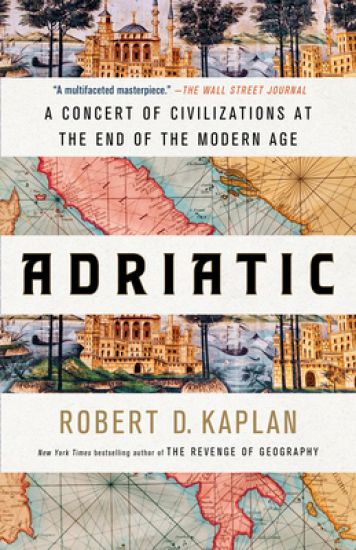
Adriatic

Adriatic

Robert D. Kaplan

RANDOM HOUSE USA INC
2022
sidottu
A vital and deeply personal exploration of a historically volatile region that is once again a global crossroads--the Adriatic Sea, including Italy, Croatia, Albania, and Greece--and what that says about the future, from the bestselling author of Balkan Ghosts and The Revenge of Geography. In this insightful travelogue, geopolitical expert Robert D. Kaplan turns his perceptive eye to the Adriatic Sea, a region that has always been a crossroads in trade, culture, and ideas. Kaplan undertakes a journey through Italy and the Balkan countries lining the Adriatic to reveal much more to the region than news stories about resurgent populism or the refugee crisis let on. As he travels, the stark truth emerges that the age of populism is merely an epiphenomenon--a swan song for the age of nationalism itself--and that the future of Europe lies in a different direction entirely as he observes a breaking down of the distinctions between East and West, a return to alignments of an earlier era. Traveling the coastline from Italy to Slovenia and Croatia, to Montenegro to Albania and to Greece, he engages in perceptive cultural criticism and an urgent study of Europe as a whole with a close reading of his personal library and examination of his own career, contrasting his visits to the Adriatic region through the years. He finds clues to what the future may hold in history as he reflects on contemporary issues like the refugee crisis, the return of populist nationalism, battles over the control of fossil fuel resources, and how the Adriatic will once again be a global trading hub. With a cross-pollination of history, literature, art, architecture, and current events, Kaplan demonstrates how Europe is distilled within the geography of the Adriatic, an often-overlooked region rich with answers and insights about the fate of the continent.
Adriatic

Adriatic

Robert D. Kaplan

RANDOM HOUSE USA INC
2023
nidottu
" An] elegantly layered exploration of Europe's past and future . . . a multifaceted masterpiece."--The Wall Street Journal "A lovely, personal journey around the Adriatic, in which Robert Kaplan revisits places and peoples he first encountered decades ago."--Peter Frankopan, author of The Silk Roads ONE OF THE BEST BOOKS OF THE YEAR: The New Yorker In this insightful travelogue, Robert D. Kaplan, geopolitical expert and bestselling author of Balkan Ghosts and The Revenge of Geography, turns his perceptive eye to a region that for centuries has been a meeting point of cultures, trade, and ideas. He undertakes a journey around the Adriatic Sea, through Italy, Slovenia, Croatia, Montenegro, Albania, and Greece, to reveal that far more is happening in the region than most news stories let on. Often overlooked, the Adriatic is in fact at the center of the most significant challenges of our time, including the rise of populist politics, the refugee crisis, and battles over the control of energy resources. And it is once again becoming a global trading hub that will determine Europe's relationship with the rest of the world as China and Russia compete for dominance in its ports. Kaplan explores how the region has changed over his three decades of observing it as a journalist. He finds that to understand both the historical and contemporary Adriatic is to gain a window on the future of Europe as a whole, and he unearths a stark truth: The era of populism is an epiphenomenon--a symptom of the age of nationalism coming to an end. Instead, the continent is returning to alignments of the early modern era as distinctions between East and West meet and break down within the Adriatic countries and ultimately throughout Europe. With a brilliant cross-pollination of history, literature, art, architecture, and current events, in Adriatic, Kaplan demonstrates that this unique region that exists at the intersection of civilizations holds revelatory truths for the future of global affairs.
Personal Transformations in Small Groups
The theoretical propositions of analytical psychology are difficult to verify and usually rest on the empirical evidence of reported case material. In this book, Robert D. Boyd and his colleagues break new ground by subjecting case material to a rigorous analysis in their report of a research programme which has focused on the expansion of consciousness in the small group and the interrelated phenomenon of personal transformation.A matrix model, conceptualizing the small group as a dynamic structural system, frames the empirical studies in the book. These include the exploration of symbolic archetypal themes and the observation of influential members who play crucial roles in group transitions. The book describes a new methodology for studying the social grieving brought about at times of transition, and the small group personal transformations that occur as individuals work through episodic themes of individuation. It also shows how personal transformations are affected by behaviours evoked by the anima and animus. Each chapter contains case materials and an extensive review of the relevant literature.These are pioneer studies in the field, reflecting more than twenty years of research. The different ways put forward of analyzing small group dynamics have practical implications for group leaders, and the methodologies described in the book can serve as both a model for research and as a source of research tools.Personal Transformations in Small Groups is the first book to look at small group functioning from an empirical perspective of analytical psychology and will be of considerable value to all those working with small groups or interested in group research.
The Louisiana Purchase

The Louisiana Purchase

Robert D. Bush

Routledge
2013
sidottu
In 1803, the United States purchased 828,000 square miles of land from France at a price of approximately three cents per acre, dramatically altering the young nation’s geography and its political future. President Thomas Jefferson had struggled for three years over the purchase, which many believed to be unconstitutional, during which time the land changed hands between the French and the Spanish. In perhaps the nation's most formative development since the Revolutionary War, the deal secured the U.S. territory that would become fifteen new states, sparked intense public argument about the American Frontier, and ensured Jefferson a complicated legacy in American history.With special attention to the diplomatic and constitutional background of the purchase, The Louisiana Purchase examines the event in the context of the Atlantic world, including the impact of the French Revolution and Napoleonic wars in Europe, colonial revolutions in the Caribbean, and the westward expansion of the U.S. population. In five concise chapters bolstered by primary documents including treaties, letters, and first-hand observations, Robert D. Bush introduces students to the political history of this momentous land acquisition.
The Louisiana Purchase

The Louisiana Purchase

Robert D. Bush

Routledge
2013
nidottu
In 1803, the United States purchased 828,000 square miles of land from France at a price of approximately three cents per acre, dramatically altering the young nation’s geography and its political future. President Thomas Jefferson had struggled for three years over the purchase, which many believed to be unconstitutional, during which time the land changed hands between the French and the Spanish. In perhaps the nation's most formative development since the Revolutionary War, the deal secured the U.S. territory that would become fifteen new states, sparked intense public argument about the American Frontier, and ensured Jefferson a complicated legacy in American history.With special attention to the diplomatic and constitutional background of the purchase, The Louisiana Purchase examines the event in the context of the Atlantic world, including the impact of the French Revolution and Napoleonic wars in Europe, colonial revolutions in the Caribbean, and the westward expansion of the U.S. population. In five concise chapters bolstered by primary documents including treaties, letters, and first-hand observations, Robert D. Bush introduces students to the political history of this momentous land acquisition.
World, Affectivity, Trauma

World, Affectivity, Trauma

Robert D. Stolorow

Routledge
2011
nidottu
Stolorow and his collaborators' post-Cartesian psychoanalytic perspective – intersubjective-systems theory – is a phenomenological contextualism that illuminates worlds of emotional experience as they take form within relational contexts. After outlining the evolution and basic ideas of this framework, Stolorow shows both how post-Cartesian psychoanalysis finds enrichment and philosophical support in Heidegger's analysis of human existence, and how Heidegger's existential philosophy, in turn, can be enriched and expanded by an encounter with post-Cartesian psychoanalysis. In doing so, he creates an important psychological bridge between post-Cartesian psychoanalysis and existential philosophy in the phenomenology of emotional trauma.