Kirjojen hintavertailu. Mukana 11 342 296 kirjaa ja 12 kauppaa.

Kirjahaku

Etsi kirjoja tekijän nimen, kirjan nimen tai ISBN:n perusteella.

1000 tulosta hakusanalla Rodolfo Ratto

Remedies & Tragedies

Remedies & Tragedies

Rodolfo Eduardo

Mesa Publishing
2017
nidottu
Remedies & Tragedies is the first poetry collection by Rodolfo Eduardo. Whether you're dealing with heartbreak or want to feel inspired, inside there's a poem for the mood you're in. Philosophical musings abound in this work, along with haikus, rhymes, and other poetic forms that meditate on love and loss. Remedies & Tragedies is also about the pursuit of personal success, exemplified in the author's own life after he quit his corporate career to chase his dream of becoming a writer.
Loops, Knots, Gauge Theories and Quantum Gravity

Loops, Knots, Gauge Theories and Quantum Gravity

Rodolfo Gambini; Jorge Pullin; Abhay Ashtekar

Cambridge University Press
2023
pokkari
This volume provides a self-contained introduction to applications of loop representations, and the related topic of knot theory, in particle physics and quantum gravity. These topics are of considerable interest because they provide a unified arena for the study of the gauge invariant quantization of Yang-Mills theories and gravity, and suggest a promising approach to the eventual unification of the four fundamental forces. The book begins with a detailed review of loop representation theory and then describes loop representations in Maxwell theory, Yang-Mills theories as well as lattice techniques. Applications in quantum gravity are then discussed, with the following chapters considering knot theories, braid theories and extended loop representations in quantum gravity. A final chapter assesses the current status of the theory and points out possible directions for future research. First published in 1996, this title has been reissued as an Open Access publication on Cambridge Core.
Loops, Knots, Gauge Theories and Quantum Gravity

Loops, Knots, Gauge Theories and Quantum Gravity

Rodolfo Gambini; Jorge Pullin; Abhay Ashtekar

Cambridge University Press
2023
sidottu
This volume provides a self-contained introduction to applications of loop representations, and the related topic of knot theory, in particle physics and quantum gravity. These topics are of considerable interest because they provide a unified arena for the study of the gauge invariant quantization of Yang-Mills theories and gravity, and suggest a promising approach to the eventual unification of the four fundamental forces. The book begins with a detailed review of loop representation theory and then describes loop representations in Maxwell theory, Yang-Mills theories as well as lattice techniques. Applications in quantum gravity are then discussed, with the following chapters considering knot theories, braid theories and extended loop representations in quantum gravity. A final chapter assesses the current status of the theory and points out possible directions for future research. First published in 1996, this title has been reissued as an Open Access publication on Cambridge Core.
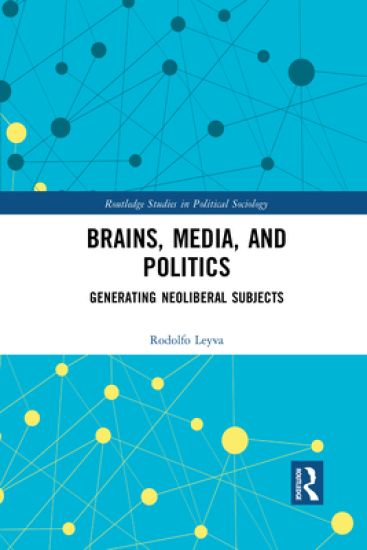
Brains, Media and Politics

Brains, Media and Politics

Rodolfo Leyva

Taylor Francis Ltd
2021
nidottu
Following the 2007–2008 global financial crisis, a number of prominent academics, journalists, and activists were quick to pronounce the demise of neoliberal capitalism and governance. This rather optimistic prediction, however, underestimated the extent to which neoliberalism has shaped the 21st-century world order and become entrenched in our sociopolitical and cognitive fabric. Indeed, 11 years after the crisis, and in spite of the significant levels of socioeconomic inequality, psychological distress, and environmental destruction generated by neoliberal policies and corresponding business and cultural practices, the ideological hegemony of neoliberalism has not been supplanted, nor has it really faced any serious unsettling. How, then, has neoliberalism inflected and shaped our “common-sense” understandings of what is politically, economically, and culturally viable? To help answer this question, this book combines leading theories from sociology, media-communication research, developmental psychology, and cognitive science, and draws on primary evidence from a unique mix of ethnographic, survey, and experimental studies – of young people’s leisure practices and educational experiences, of young adults’ political socialisation processes in relation to exposure to social networking sites, and of the effects of commercial media viewing on material values and support for social welfare. In doing so, it provides a nuanced and robustly empirically tested account of how the conscious and non-conscious cognitive dimensions of people’s subjectivities and everyday social practices become interpellated through and reproductive of neoliberal ideology. As such, this book will appeal to scholars across the social and behavioural sciences with interests in neoliberalism, political engagement, enculturation, social reproduction, and media effects.
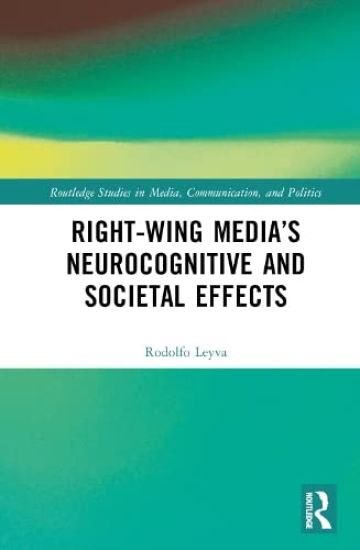
Right-Wing Media’s Neurocognitive and Societal Effects
This book empirically tests, compares, and explains the effects of British and American legacy conservative press and far-right websites, on accordant political views and behavioural intentions.Correspondingly, the 2016 Brexit Referendum and American Presidential election results are often attributed to the spread of fake news through social media, Russian Bots, and alt-right news websites. This has raised concerns about the impact of digital disinformation on democracy, as well as the rise of nativist parties and movements worldwide. However, this book argues that these causal attributions are largely based on unproven assumptions and deflect attention from the more influential and harmful role of traditional conservative media.To support this argument, Leyva incorporates insights from various fields such as neurocognitive science, media-communication research, cross-cultural psychology, and sociology. Additionally, the book presents primary evidence from a series of experiments that examined the effects of candidate-related fake news and immigration coverage from both old and new media right-wing sources. These experiments focused on how such content influences anti-immigrant attitudes and voter preferences. By doing so, the book provides a nuanced and robustly tested theoretical account of how right-wing media affects political beliefs, sentiments, and practices at the neuronal level, and of how this can in turn negatively impact democratic multicultural societies.Given its interdisciplinary approach, this book will be of interest to scholars in the social, behavioural, and cognitive sciences who are studying media psychology, online misinformation, authoritarian populism, political sociology, new media, and journalism.
Right-Wing Media’s Neurocognitive and Societal Effects
This book empirically tests, compares, and explains the effects of British and American legacy conservative press and far-right websites, on accordant political views and behavioural intentions.Correspondingly, the 2016 Brexit Referendum and American Presidential election results are often attributed to the spread of fake news through social media, Russian Bots, and alt-right news websites. This has raised concerns about the impact of digital disinformation on democracy, as well as the rise of nativist parties and movements worldwide. However, this book argues that these causal attributions are largely based on unproven assumptions and deflect attention from the more influential and harmful role of traditional conservative media.To support this argument, Leyva incorporates insights from various fields such as neurocognitive science, media-communication research, cross-cultural psychology, and sociology. Additionally, the book presents primary evidence from a series of experiments that examined the effects of candidate-related fake news and immigration coverage from both old and new media right-wing sources. These experiments focused on how such content influences anti-immigrant attitudes and voter preferences. By doing so, the book provides a nuanced and robustly tested theoretical account of how right-wing media affects political beliefs, sentiments, and practices at the neuronal level, and of how this can in turn negatively impact democratic multicultural societies.Given its interdisciplinary approach, this book will be of interest to scholars in the social, behavioural, and cognitive sciences who are studying media psychology, online misinformation, authoritarian populism, political sociology, new media, and journalism.