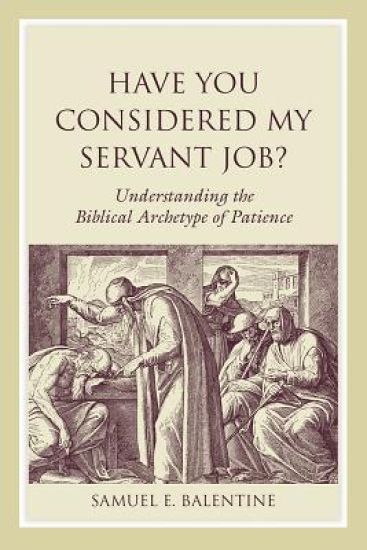
The question that launches Job’s story is posed by God at the outset of the story: “Have you considered my servant Job?” (1:8; 2:3). By any estimation the answer to this question must be yes. The forty-two chapters that form the biblical story have in fact opened the story to an ongoing practice of reading and rereading, evaluating and reevaluating. Early Greek and Jewish translators emphasized some aspects of the story and omitted others; the Church Fathers interpreted Job as a forerunner of Christ, while medieval Jewish commentators debated conservative and liberal interpretations of God’s providential love. Artists, beginning at least in the Greco-Roman period, painted and sculpted their own interpretations of Job. Novelists, playwrights, poets, and musicians - religious and irreligious, from virtually all points of the globe - have added their own distinctive readings.In Have You Considered My Servant Job?, Samuel E. Balentine examines this rich and varied history of interpretation by focusing on the principal characters in the story - Job, God, the satan figure, Job’s wife, and Job’s friends. Each chapter begins with a concise analysis of the biblical description of these characters, then explores how subsequent readers have expanded or reduced the story, shifted its major emphases or retained them, read the story as history or as fiction, and applied the morals of the story to the present or dismissed them as irrelevant.Each new generation of readers is shaped by different historical, cultural, and political contexts, which in turn require new interpretations of an old yet continually mesmerizing story. Voltaire read Job one way in the eighteenth century, Herman Melville a different way in the nineteenth century. Goethe’s reading of the satan figure in Faust is not the same as Chaucer’s in The Canterbury Tales, and neither is fully consonant with the Testament of Job or the Qur’an. One need only compare the descriptions of God in the biblical account with the imaginative renderings by Herman Melville, Walt Whitman, and Franz Kafka to see that the effort to understand why God afflicts Job “for no reason” (2:3) continues to be both compelling and endlessly complicated.
What are we supposed to see when we behold this innocent man, beaten and condemned? What are we supposed to feel when Jesus shows us his wounds and says, "Look at my hands and feet . . . . Touch me and see"? More importantly, what are we supposed to do in response to the ethical imperatives of the Lenten journey? How we answer these questions will define both the journey we are making toward the empty tomb and the affirmations we will speak as our own on Easter morn.The Lenten journey is mapped by an imperative, twice spoken, from different perspectives. The first perspective is that of Pilate, who presents Jesus-bound, scourged, crowned with thorns, and wearing a purple robe-with the words, "Behold the man" (John 19:5). The second is that of the resurrected Christ who says to the disciples, "Look at my hands and feet . . . . Touch me and see" (Luke 24:39). Pilate offers the perspective of the onlooker, one whose power and privilege make it possible to endorse the abuse of another person and to look on their suffering from a safe distance. Christ's words, on the other hand, convey the experience of one whose first-hand experience with suffering makes it impossible to ignore the reality of brokenness and loss The Lenten journey requires that we understand what it means to view suffering from both perspectives.Samuel E. Balentine is Professor of Old Testament and Director of Graduate Studies at Union Presbyterian Seminary in Richmond, Virginia. He is the author of numerous books, including Job in the Smyth & Helwys Bible Commentary series, for which hs serves as Old Testament General Editor. He is Series Editor of Interpretation: Resources for the Use of Scripture in the Church, Editor-in-Chief of The Oxford Encylopedia of the Bible and Theology, and Editor-in-Chief of The Oxford Handbook of Ritual and Theology in the Hebrew Bible.
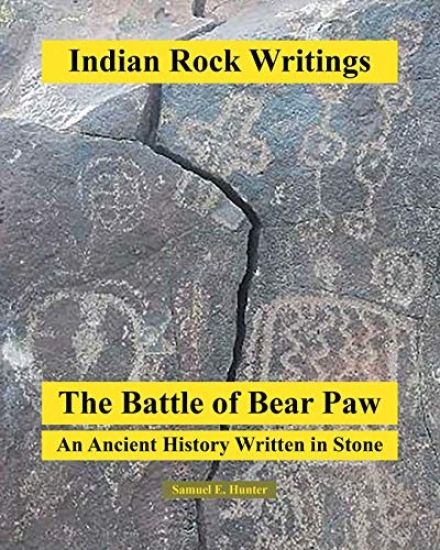
Effigy Hill, Inscription Canyon, Black Mountain Complex, Superior Valley, Barstow, California 05/2018Indian Rock Writings represents a paradigm shift in American Indian studies, from illegally contrived cultural obscuration to actual documented historical fact For seven thousand years, the history surrounding the Battle of Bear Paw, in the Black Mountain Complex, Superior Valley of Southern California, was taught to oot (proto-Uto-Aztecan) children using Indian rock writings. This Native American history is confirmed by Southern Ute Elder Dr. James Jefferson, PhD, and representatives from countless Ute enclaves throughout the United States, Central and South America. We already know all these things, stipulates Dr. Jefferson, confirming the contents of the book in accordance with Indian law. In the 1850s, this battle and all Indian history were stolen from the Native Americans by an attorney for the railroads, mining and banking industries.Here within these covers is a preliminary primer, dictionary, and thesaurus with which to supplement a small portion of recorded Indian history. A history recovered from Indian rock writings spanning several thousand years and two thousand miles from Southern California to Illinois, Texas to Montana. Perhaps the contents will inspire more field research and unmask Indian truths obscured by design for more than one hundred sixty-five years
Jesus was given instruction by the Holy Ghost to go to the other side of the Sea of Galilee. It is not revealed in the Bible whether He knew what His assignment was once He arrived-He simply knew that He was to go. As a violent storm came, the disciples feared for their lives while Jesus slept. When Jesus cleared the storm, He told His disciples that they were going to the other side no matter what happened-the disciples did not share His faith as strongly. It's essential to believe God's Word and walk by faith, not by sight. Jesus said that the Bible and the works that He did, and the greater works we shall do, teach us how to walk in power as He did. Going to the Other Side by Samuel Taylor addresses how we can walk in spiritual power as Jesus intended. Understanding the power that we have when we allow faith and patience to work together, and discovering the power of the spoken word, compassion, Jesus's death, communion, and baptism in the Holy Ghost are essential for believers to walk in spiritual power as God intended. Through this book, an unbeliever can come to the Lord and a believer can walk in the power of the Word. Taylor's wish is to help those who read his book to better understand these powerful, spiritual principles and inspire them to walk in power, making a difference in their lives and the lives of others. Sam Taylor is the Founder and Pastor of Vision Church in Martinsburg, West Virginia. He is also an attorney and has earned degrees from Ohio Wesleyan University and the University of Baltimore School of Law. His greatest pleasure is being with family and he also enjoys watching his favorite teams: the Orioles, Ravens, Capitals, and Buckeyes. Sam and Bonnie, his wife, have seven children and seven grandchildren.
Theological education has historically placed a strong emphasis on Scripture as the source of principle and practice for ministry. However, when it comes to the arena of counseling, this has largely not been the case. Focusing on the significant influence of Wayne Edward Oates (1917-1999), the author seeks to explore how and why the American Protestant church arrived at the place where psychological counseling has become the norm and biblical counseling is treated as novel. A detailed study of Oates' anthropology, which served as the heart of his counseling theory and practice, demonstrates that it was shaped and informed by secular concepts, values, and principles instead of what God has to say about who we are as people, what plagues our souls, and where we find our true hope and healing. This subtle shift from the theological to the therapeutic has contributed to a much broader view from many in the church that counseling is more of a clinical and professional service rather than a personal or pastoral ministry of the Scriptures. Through these unsettling warnings and implications, the author hopes that the church will see the importance of once again engaging with the God-glorifying, Christ-honoring, and Spirit-empowering ministry of counseling.
This book is the second instalment in Dr Waldron's groundbreaking work, "The End Times Made Simple", in which he deftly dismantled the interpretive view that dispensationalists have of prophecy in general. This book goes a step further, arguing that there are consequences to our eschatological (i.e., End Times) views. The reader will find powerful and cogent arguments for a strictly biblical hermeneutic, free from forced interpretations and presuppositions that have little to do with the actual Word of God. Some of the topics covered are how we approach biblical interpretation in general and prophetic interpretation in particular, and whether there is a distinction between Israel and the church, or is the church the 'Israel of God'. This book will change the way the reader approaches the great prophecies of the Bible, and will give the reader a renewed appreciation for the Lord Jesus Christ and His plan for His church.
""Every word has gone through endless exacting rehearsals to shine. These are poems not only to be read, but to be memorized."" John-Ivan Palmer, author of 'Motels of Burning Madness' ""Captures sentiment and observance in cunning detail, wit, and elegance."" Marge Barrett, author of 'My Memoir Dress' ""The very finest of wordsmith sizzle."" Ted King, author of 'New Beat' and 'Coyote' ""The seismic deluge continues, page after page, until the very final word crashes in and spreads across the sand."" 'The Write Launch Literary Magazine' Find preview snippets of 'Dollhouse Masquerade' here: https: //truthserumpress.net/tastesof/a-taste-of-dollhouse-masquerade/ Find 'Dollhouse Masquerade' at Truth Serum Press here: https: //truthserumpress.net/catalogue/fiction/dollhouse-masquerade/
A mid-thirties couple uses the internet to define, and redefine, their marriage. Marla struggles to sell her dead teenage son's Audi. A nine-year-old Bohra Girl from India has no control of a burgeoning body predetermined to suffer by other people's hands. A family riddled with obscurities and lies lose everything, and then a little more. A disparate woman can't stop the inner voices. A little boy goes to great lengths to engender a father figure. Brothers take comfort in each other's demise. Braden comes home for Thanksgiving from college and finds an unexpected distraction from familial angst and ruination. Gender is confronted on a death bed and a secret adoption is revealed by an old man in a booth at Perkin's. At the dinner table, our parent's one request, Connie sat hunchback and tight-lipped, growling at the bread rolls, squinting at the glasses of lemonade, and rearranging the silverware into an X. No one queried her thoughts or asked for an opinion. But I could hear her--screaming--smoothness, you stupid mother fuckers, is meant for those who haven't yet been sliced apart. -- The Seconds after Living Wounds At its heart, siren stitches seeks to find inroads of belonging on a fitful path scattered with (dis)entanglements and (mis)applications.
A gay, homeless man, who gives shelter tours, crashes quite unexpectedly into a former lover. A sailboat captain hates, and loves, his daily routine. Burgeoning sexual orientation erupts between two teenage boys on a road trip to Alabama. A father takes extraordinary lengths to see his son. A man travels to Whitefish, Montana in July to give Christmas gifts to three little girls. A mother shows up at her son's nursing home and demands to be seen. A couple, after a dinner party, debates the nuance and missteps of a long, parsimonious marriage. A middle-aged man, due to a breakup, drives to and stops at a town in which he has never been and meets a man who challenges his secrets and lies. Ettrick, whose parents don't believe in God, wants to be baptized in the pond behind the farmhouse. Beatrice A. Muddler finds a career, and builds a life, in a most unlikely place. A Latino man works a most unusual job for the most powerful man in the world. Marvin, who suffers with dilated cardiomyopathy, grooms a young man from the gym for a journey neither are equipped to take. Young Thieves in a Growing Orchard is a 30,000 word literary fiction short-story collection grounded in contemporary middle class American life revealed in lucid tones of melancholy, grit, poetry, and surprising wonder. At its core, Young Thieves in a Growing Orchard is a journey of securing belonging through discovery, exploration, and oftentimes failure.
The ancestry of the Hargadine lineage covered in this book span from the mid-1700s in Maryland to modern day across all of North America. Sam Hargadine has used every kind of record available, from family Bibles, court documents, birth and death records, to church rolls and grave records, and including newspaper reports and oral histories. At some point in his thirty-plus endeavor, the Internet became a viable and mostly reliable source of information. Data retrieval has been changing throughout the time this information was gathered, and doubtless will continue to be a challenge, and we can feel fortunate that people like Sam Hargadine and those whose passion for family lineage drive them to seek out the knowledge that exists, and write it all down for our easy access
The information in this geneological effort came from many sources in addition to those shown in footnotes. Since contributions came from many individuals, some of the original source materials were not noted, but are believed to be true, thus are included with documented material. These may include: Oral interviews of family members, Federal, state, county, city, and township census records, public court records, military records, Church records, funeral and crematory service records, cemetery records, Family records including family Bibles, birth certificates, marriage certificates, death certificates, estate documents.
This is the story of Bill, a 10 year old boy who discovers, by accident, that he has secret powers. His power is one of the rarest known to mankind. The initial installment tells the story of Bill's crazy first year at 'The House for Gifted Kids. .