Kirjojen hintavertailu. Mukana 12 083 983 kirjaa ja 12 kauppaa.

Kirjahaku

Etsi kirjoja tekijän nimen, kirjan nimen tai ISBN:n perusteella.

1000 tulosta hakusanalla Stephen G Perry

Building a House Divided

Building a House Divided

Stephen G. Hyslop

UNIVERSITY OF OKLAHOMA PRESS
2023
sidottu
By the time Abraham Lincoln asserted in 1858 that the nation could not “endure permanently half slave and half free,” the rift that would split the country in civil war was well defined. The origins and evolution of the coming conflict between North and South can in fact be traced back to the early years of the American Republic, as Stephen G. Hyslop demonstrates in Building a House Divided, an exploration of how the incipient fissure between the Union’s initial slave states and free states—or those where slaves were gradually being emancipated—lengthened and deepened as the nation advanced westward. Hyslop focuses on four prominent slaveholding expansionists who were intent on preserving the Union but nonetheless helped build what Lincoln called a house divided: Presidents Thomas Jefferson, Andrew Jackson, and James K. Polk and Senator Stephen A. Douglas of Illinois, who managed a plantation in Mississippi bequeathed by his father-in-law. Hyslop examines what these men did, collectively and individually, to further what Jefferson called an “empire of liberty,” though it kept millions of Black people in bondage. Along with these major figures, in all their conflicts and contradictions, he considers other American expansionists who engaged in and helped extend slavery—among them William Clark, Stephen Austin, and President John Tyler—as well as examples of principled opposition to the extension of slavery by northerners such as John Quincy Adams and southerners like Henry Clay and Thomas Hart Benton, who held slaves but placed preserving the Union above extending slavery across the continent. The long view of the path to the Civil War, as charted through the Jeffersonian and Jacksonian eras in this book, reveals the critical fault in the nation’s foundation, exacerbated by slaveholding expansionists like Jefferson, Jackson, Polk, and Douglas, until the house they built upon it could no longer stand for two opposite ideas at once.
The Presidency of John Adams

The Presidency of John Adams

Stephen G. Kurtz

University of Pennsylvania Press
1957
sidottu
This book is a volume in the Penn Press Anniversary Collection. To mark its 125th anniversary in 2015, the University of Pennsylvania Press rereleased more than 1,100 titles from Penn Press's distinguished backlist from 1899-1999 that had fallen out of print. Spanning an entire century, the Anniversary Collection offers peer-reviewed scholarship in a wide range of subject areas.
Frontsoldaten

Frontsoldaten

Stephen G. Fritz

The University Press of Kentucky
1997
nidottu
Alois Dwenger, writing from the front in May of 1942, complained that people forgot "the actions of simple soldiers?.I believe that true heroism lies in bearing this dreadful everyday life." In exploring the reality of the Landser, the average German soldier in World War II, through letters, diaries, memoirs, and oral histories, Stephen G. Fritz provides the definitive account of the everyday war of the German front soldier.The personal documents of these soldiers, most from the Russian front, where the majority of German infantrymen saw service, paint a richly textured portrait of the Landser that illustrates the complexity and paradox of his daily life. Although clinging to a self-image as a decent fellow, the German soldier nonetheless committed terrible crimes in the name of National Socialism. When the war was finally over, and his country lay in ruins, the Landser faced a bitter truth: all his exertions and sacrifices had been in the name of a deplorable regime that had committed unprecedented crimes.With chapters on training, images of combat, living conditions, combat stress, the personal sensations of war, the bonds of comradeship, and ideology and motivation, Fritz offers a sense of immediacy and intimacy, revealing war through the eyes of these self-styled "little men." A fascinating look at the day-to-day life of German soldiers, this is a book not about war but about men. It will be vitally important for anyone interested in World War II, German history, or the experiences of common soldiers throughout the world.
Ostkrieg

Ostkrieg

Stephen G. Fritz

The University Press of Kentucky
2011
sidottu
On June 22, 1941, Germany launched the greatest land assault in history on the Soviet Union, an attack that Adolf Hitler deemed crucial to ensure German economic and political survival. As the key theater of the war for the Germans, the eastern front consumed enormous levels of resources and accounted for 75 percent of all German casualties. Despite the significance of this campaign to Germany and to the war as a whole, few English-language publications of the last thirty-five years have addressed these pivotal events.In Ostkrieg: Hitler's War of Extermination in the East, Stephen G. Fritz bridges the gap in scholarship by incorporating historical research from the last several decades into an accessible, comprehensive, and coherent narrative. His analysis of the Russo-German War from a German perspective covers all aspects of the eastern front, demonstrating the interrelation of military events, economic policy, resource exploitation, and racial policy that first motivated the invasion. This in-depth account challenges accepted notions about World War II and promotes greater understanding of a topic that has been neglected by historians.
Ostkrieg

Ostkrieg

Stephen G. Fritz

The University Press of Kentucky
2015
nidottu
On June 22, 1941, Germany launched the greatest land assault in history on the Soviet Union, an attack that Adolf Hitler deemed crucial to ensure German economic and political survival. As the key theater of the war for the Germans, the eastern front consumed enormous levels of resources and accounted for 75 percent of all German casualties. Despite the significance of this campaign to Germany and to the war as a whole, few English-language publications of the last thirty-five years have addressed these pivotal events.In Ostkrieg: Hitler's War of Extermination in the East, Stephen G. Fritz bridges the gap in scholarship by incorporating historical research from the last several decades into an accessible, comprehensive, and coherent narrative. His analysis of the Russo-German War from a German perspective covers all aspects of the eastern front, demonstrating the interrelation of military events, economic policy, resource exploitation, and racial policy that first motivated the invasion. This in-depth account challenges accepted notions about World War II and promotes greater understanding of a topic that has been neglected by historians.
Physics, the Human Adventure

Physics, the Human Adventure

Stephen G. Brush; Gerald Holton

Rutgers University Press
2001
nidottu
Winner of the 2001 Joseph Hazen Education Prize of the History of Science Society?Physics, the Human Adventure is the third edition of the classic text Introduction to Concepts and Theories in Physical Science. Authored by Gerald Holton, the text was a landmark in science education. It was the first modern textbook in physics (or in any other science) to make full and effective use of the history and philosophy of science in presenting for both the general and the science-oriented student an account of the nature of physical science. A second edition, prepared by Stephen G. Brush, brought the book up to date by increasing the coverage of topics in modern physics and by taking account of recent scholarly research in the history of science. In the new book Physics, The Human Adventure, each of the chapters has been reworked to further clarify the physics concepts and to incorporate recent physical advances and research. The book shows the unifying power of science by bringing in connections to chemistry, astronomy, and geoscience. In short, the aid of the new edition is to teach good physics while presenting physical science as a human adventure that has become a major force in our civilization. New chapters discuss theories of the origin of the solar system and the expanding universe; fission, fusion, and the Big Bang–Steady State Controversy; and thematic elements and styles in scientific thought. New topics include:• Theories of vision: does the eye send out rays or receive them?• Distances in the solar system• The prediction of the return of Halley’s comet and analysis of deviations from Kepler’s laws• Angular momentum conservation and Laplace’s nebular hypothesis• Relation between symmetries and conservation laws: Emmy Noether’s theorem• First estimates of atomic sizes• Consequences of the indistinguishability of elementary particles of the same kind• Applications of quantum mechanics to many-particle systems• Dirac’s prediction of anti-matter• The anthropic principle and other controversial issues on the frontiers of research
Inside the Writer's Mind

Inside the Writer's Mind

Stephen G. Bloom

Iowa State University Press
2002
nidottu
Inside the Writer's Mind propels readers into 30 very different stories, written for magazines, newspapers and the Internet. Among the stories Stephen G. Bloom dissects are profiles of accused murderers, a Little League umpire, a husband and wife who sign a suicide pact, a world-famous Brazilian plastic surgeon, and a notorious abortionist. Bloom writes about his job canning fruit cocktail, a disaster of a Caribbean cruise vacation, a lethal family of professional wrestlers, and an afternoon spent with Dr. Ruth.
Beyond Atlanta

Beyond Atlanta

Stephen G. N. Tuck

University of Georgia Press
2003
pokkari
This sweeping history of the civil rights movement in the South's largest state tells of many Georgias. On one extreme is Atlanta, a metropolitan center of relative black prosperity and training ground of many movement leaders. On another is Albany. A city deep in the "black belt" of the plantation South, it is the site of Martin Luther King Jr.'s greatest civil rights setback. Somewhere in between is yet another Georgia, a Georgia whose communities once constituted hundreds of Jim Crow fiefdoms. In places like "Bad" Baker County near the southern border, or in the relatively moderate town of Rome in the northern hills, black-white relations were as crude or as nuanced as the outlook of the local sheriff.Beyond Atlanta draws on interviews with almost two hundred people—black and white—who worked for, or actively resisted, the freedom movement. Among the topics Stephen Tuck covers are the absence of consistent support from the movement's national leadership and the frustration and innovation it alternately inspired at the local level. In addition, Tuck reveals friction, along urban-rural and poor-prosperous lines, about movement goals and tactics, and he highlights the often unheralded roles played by African American women, veterans, masons, unions, neighborhood clubs, and local NAACP branches.Tuck's narrative begins before, and continues after, the well-documented years of direct action protest in the 1960s. Though grounded in local and state matters, it is attuned to such national developments as World War II, the 1954 Brown decision, the Civil Rights Acts of 1964-65, and the growth of the Black Power movement. Perhaps most important, Beyond Atlanta makes clear the exorbitant cost of racial oppression, in terms of hampered economic and social progress, for all Georgians.
Upheaval in Charleston

Upheaval in Charleston

Stephen G. Hoffius; Susan Millar Williams

University of Georgia Press
2012
nidottu
On August 31, 1886, a massive earthquake centered near Charleston, South Carolina, sent shock waves as far north as Maine, down into Florida, and west to the Mississippi River. When the dust settled, residents of the old port city were devastated by the death and destruction.Upheaval in Charleston is a gripping account of natural disaster and turbulent social change in a city known as the cradle of secession. Weaving together the emotionally charged stories of Confederate veterans and former slaves, Susan Millar Williams and Stephen G. Hoffius portray a South where whites and blacks struggled to determine how they would coexist a generation after the end of the Civil War.This is also the story of Francis Warrington Dawson, a British expatriate drawn to the South by the romance of the Confederacy. As editor of Charleston’s News and Courier, Dawson walked a lonely and dangerous path, risking his life and reputation to find common ground between the races. Hailed as a hero in the aftermath of the earthquake, Dawson was denounced by white supremacists and murdered less than three years after the disaster. His killer was acquitted after a sensational trial that unmasked a Charleston underworld of decadence and corruption.Combining careful research with suspenseful storytelling, Upheaval in Charleston offers a vivid portrait of a volatile time and an anguished place.
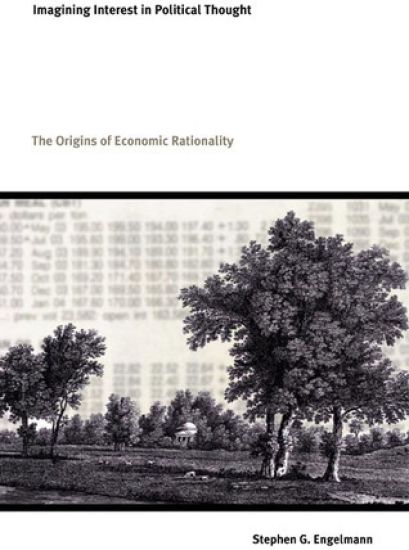
Imagining Interest in Political Thought

Imagining Interest in Political Thought

Stephen G. Engelmann

Duke University Press
2003
pokkari
Imagining Interest in Political Thought argues that monistic interest-or the shaping and coordination of different pursuits through imagined economies of self and public interest-constitutes the end and means of contemporary liberal government. The paradigmatic theorist of monistic interest is the English political philosopher Jeremy Bentham (1748–1832), whose concept of utilitarianism calls for maximization of pleasure by both individuals and the state. Stephen G. Engelmann contends that commentators have too quickly dismissed Bentham’s philosophy as a crude materialism with antiliberal tendencies. He places Benthamite utilitarianism at the center of his account and, in so doing, reclaims Bentham for liberal political theory.Tracing the development of monistic interest from its origins in Reformation political theory and theology through late-twentieth-century neoliberalism, Engelmann reconceptualizes the history of liberalism as consisting of phases in the history of monistic interest or economic government. He describes how monistic interest, as formulated by Bentham, is made up of the individual’s imagined expectations, which are constructed by the very regime that maximizes them. He asserts that this construction of interests is not the work of a self-serving manipulative state. Rather, the state, which is itself subject to strict economic regulation, is only one cluster of myriad "public" and "private" agencies that produce and coordinate expectations. In place of a liberal vision in which government appears only as a protector of the free pursuit of interest, Engelmann posits that the free pursuit of interest is itself a mode of government, one that deploys individual imagination and choice as its agents.
Imagining Interest in Political Thought

Imagining Interest in Political Thought

Stephen G. Engelmann

Duke University Press
2003
sidottu
Imagining Interest in Political Thought argues that monistic interest-or the shaping and coordination of different pursuits through imagined economies of self and public interest-constitutes the end and means of contemporary liberal government. The paradigmatic theorist of monistic interest is the English political philosopher Jeremy Bentham (1748–1832), whose concept of utilitarianism calls for maximization of pleasure by both individuals and the state. Stephen G. Engelmann contends that commentators have too quickly dismissed Bentham’s philosophy as a crude materialism with antiliberal tendencies. He places Benthamite utilitarianism at the center of his account and, in so doing, reclaims Bentham for liberal political theory.Tracing the development of monistic interest from its origins in Reformation political theory and theology through late-twentieth-century neoliberalism, Engelmann reconceptualizes the history of liberalism as consisting of phases in the history of monistic interest or economic government. He describes how monistic interest, as formulated by Bentham, is made up of the individual’s imagined expectations, which are constructed by the very regime that maximizes them. He asserts that this construction of interests is not the work of a self-serving manipulative state. Rather, the state, which is itself subject to strict economic regulation, is only one cluster of myriad "public" and "private" agencies that produce and coordinate expectations. In place of a liberal vision in which government appears only as a protector of the free pursuit of interest, Engelmann posits that the free pursuit of interest is itself a mode of government, one that deploys individual imagination and choice as its agents.
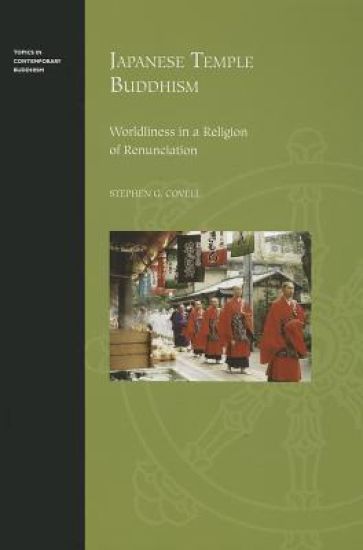
Japanese Temple Buddhism

Japanese Temple Buddhism

Stephen G. Covell

University of Hawai'i Press
2005
nidottu
There have been many studies that focus on aspects of the history of Japanese Buddhism. Until now, none have addressed important questions of organization and practice in contemporary Buddhism, questions such as how Japanese Buddhism came to be seen as a religion of funeral practices; how Buddhist institutions envision the role of the laity; and how a married clergy has affected life at temples and the image of priests. This volume is the first to address fully contemporary Buddhist life and institutions - topics often overlooked in the conflict between the rhetoric of renunciation and the practices of clerical marriage and householding that characterize much of Buddhism in today's Japan. Informed by years of field research and his own experiences training to be a Tendai priest, Stephen Covell skillfully refutes this ""corruption paradigm"" while revealing the many (often contradictory) facets of contemporary institutional Buddhism, or as Covell terms it, temple Buddhism. Covell significantly broadens the scope of inquiry to include how Buddhism is approached by both laity and clerics when he takes into account temple families, community involvement, and the commodification of practice. He considers law and tax issues, temple strikes, and the politics of temple boards of directors to shed light on how temples are run and viewed by their inhabitants, supporters, and society in general. In doing so he uncovers the economic realities that shape ritual practices and shows how mundane factors such as taxes influence the debate over temple Buddhism's role in contemporary Japanese society. In addition, through interviews and analyses of sectarian literature and recent scholarship on gender and Buddhism, he provides a detailed look at priests' wives, who have become indispensable in the management of temple affairs.
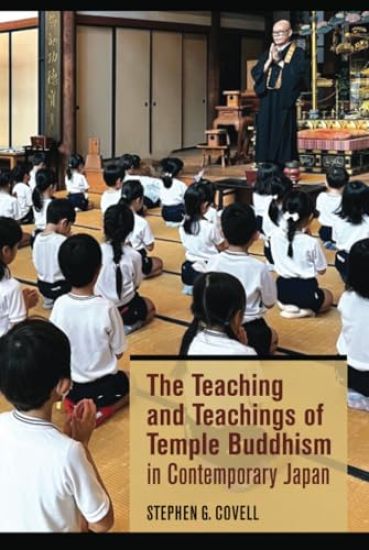
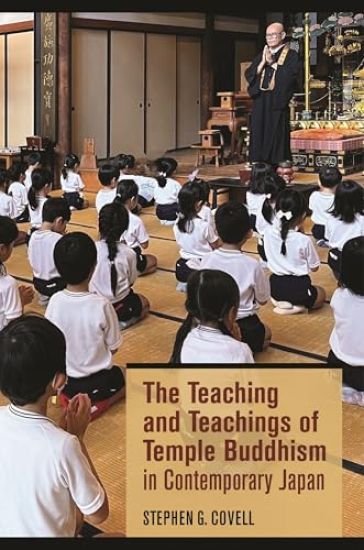
The Teaching and Teachings of Temple Buddhism in Contemporary Japan

The Teaching and Teachings of Temple Buddhism in Contemporary Japan

Stephen G. Covell

UNIVERSITY OF HAWAI'I PRESS
2024
sidottu
How have Buddhist teachings come to be in modern and contemporary Japan and how are they taught? This pioneering work seeks to answer these questions by highlighting the public teachings of Temple Buddhism institutions, in particular Temple Buddhism kindergartens and Buddhist secondary schools and colleges. The community outreach provided by these Buddhist facilities is far greater than any other with the possible exception of funerals yet until now it has received little attention from scholars of Japanese religion. After determining what is taught in Buddhist education and how, Stephen Covell introduces readers to a select group of monks who undergo some of the most grueling practices in Japanese Temple Buddhism to determine if the public-facing teachings of Buddhist education are unique or similar to those of elite Buddhist practitioners. The teachings and sites of teaching examined here include but are not limited to classical doctrinal studies and temples focused on the education of Buddhist clergy. Covell uncovers the arguments made by priests involved in morals education, the dharma talks of famous ascetics, and the ways in which laws and legal codes have changed Buddhist education. He looks at what is taught on the ground, online, and in popular texts to discuss the current teachings embraced as Buddhism within the institutions of Temple Buddhism. Among his numerous findings is such teachings and worldview are remarkably similar to those of New Religions and Buddhist lay movements as outlined by Japan religion scholars and government bodies in charge of education.The Teaching and Teachings of Temple Buddhism in Contemporary Japan will be welcomed by students and scholars in Japanese religious studies and early childhood and higher education as well as those interested in current Buddhist practice and teachings in general.
The Teaching and Teachings of Temple Buddhism in Contemporary Japan

The Teaching and Teachings of Temple Buddhism in Contemporary Japan

Stephen G. Covell

UNIVERSITY OF HAWAI'I PRESS
2025
nidottu
How have Buddhist teachings come to be in modern and contemporary Japan and how are they taught? This pioneering work seeks to answer these questions by highlighting the public teachings of Temple Buddhism institutions, in particular Temple Buddhism kindergartens and Buddhist secondary schools and colleges. The community outreach provided by these Buddhist facilities is far greater than any other with the possible exception of funerals yet until now it has received little attention from scholars of Japanese religion. After determining what is taught in Buddhist education and how, Stephen Covell introduces readers to a select group of monks who undergo some of the most grueling practices in Japanese Temple Buddhism to determine if the public-facing teachings of Buddhist education are unique or similar to those of elite Buddhist practitioners. The teachings and sites of teaching examined here include but are not limited to classical doctrinal studies and temples focused on the education of Buddhist clergy. Covell uncovers the arguments made by priests involved in morals education, the dharma talks of famous ascetics, and the ways in which laws and legal codes have changed Buddhist education. He looks at what is taught on the ground, online, and in popular texts to discuss the current teachings embraced as Buddhism within the institutions of Temple Buddhism. Among his numerous findings is such teachings and worldview are remarkably similar to those of New Religions and Buddhist lay movements as outlined by Japan religion scholars and government bodies in charge of education. The Teaching and Teachings of Temple Buddhism in Contemporary Japan will be welcomed by students and scholars in Japanese religious studies and early childhood and higher education as well as those interested in current Buddhist practice and teachings in general.
The Brazil Chronicles

The Brazil Chronicles

Stephen G. Bloom

UNIVERSITY OF MISSOURI PRESS
2024
sidottu
As a young journalist at the Brazil Herald from 1979-81, Stephen G. Bloom spent his formative years working in Rio’s seedy Lapa district, surrounded by expatriates, drug runners, and pornographers. Bloom shares the wild, untamed history of this Brazil-based English-language newspaper in The Brazil Chronicles. The newspaper was a breeding ground for a different kind of storyteller — audacious risk-takers who told madcap tales of Amazon plantations, Confederate emigres, and lost Indian tribes. Several major journalistic talents cut their teeth at the Brazil Herald, including acclaimed New York Times correspondent Tad Szulc, Huffington Post CEO Eric Hippeau, and the notorious Gonzo journalist Hunter S. Thompson. Drawing from extensive research and over 150 interviews with his former colleagues, Bloom’s exploration of the Brazil Herald is both entertaining and academically rigorous. The book also doubles as a coming-of-age memoir, following the young Bloom as he embarks on his quest to be a reporter, relocating to an entirely new country where he did not speak the local language, to pursue under-the-radar stories. His firsthand experience with the Brazil Herald allows him to provide an insider, eye-witness account of the paper’s colorful history, transporting the reader to its sweltering newsroom and delving into the lives of its staff members. Even as he weaves between personal narrative, history, and accounts from other reporters, it remains clear who the book’s main character is: the trailblazing newspaper itself.
Dominion and Dynasty

Dominion and Dynasty

Stephen G. Dempster

IVP Academic
2003
nidottu
Christian theologians rarely study the Old Testament in its final Hebrew canonical form, even though this was very likely the Bible used by Jesus and the early church. However, once read as a whole, the larger structure of the Hebrew Bible (Tanakh) provides a "wide-angle lens" through which its contents can be viewed.In this stimulating New Studies in Biblical Theology volume, Stephen G. Dempster argues that, despite its undoubted literary diversity, the Hebrew Bible possesses a remarkable structural and conceptual unity. The various genres and books are placed within a comprehensive narrative framework which provides an overarching literary and historical context. The many texts contribute to this larger text, and find their meaning and significance within its story of "dominion and dynasty," which ranges from Adam to the Son of Man, from David to the coming Davidic king.Addressing key issues in biblical theology, the works comprising New Studies in Biblical Theology are creative attempts to help Christians better understand their Bibles. The NSBT series is edited by D. A. Carson, aiming to simultaneously instruct and to edify, to interact with current scholarship and to point the way ahead.
Nbbc, Deuteronomy: A Commentary in the Wesleyan Tradition

Nbbc, Deuteronomy: A Commentary in the Wesleyan Tradition

Stephen G. Green

Beacon Hill Press of Kansas City
2015
nidottu
Deuteronomy, whose name is derived from the Greek word for second law, is one of the most influential books of the Bible. As a narration of the second giving of the law by Moses before Israel enters the Promised Land, Deuteronomy provides the theological vision for Joshua, Judges, 1 & 2 Kings and canonically is the hinge that joins the Torah to these six books of Deuteronomistic History.In this NBBC, Stephen Green calls attention to Deuteronomy's importance, adeptly handling such key passages as the Decalogue, the Shema, and the song of Moses. He highlights the importance of Deuteronomy for the Christian faith, observing Jesus' dependence on it for teaching on faith, love, obedience, and so on. Expertly crafted, this commentary is an essential resouce for anyone wanting a deeper understanding of the Old and New Testaments and the foundational ideas of Christianity.Engaging, perceptive, and academically thorough, the New Beacon Bible Commentary will expand your understanding and deepen your appreciationof the meaning and message of each book of the Bible.Written from the Wesleyan theological perspective, this indispensable commentary provides pastors, professional scholars, teachers, and Bible students with a critical, relevant, and inspiring interpretation of the Word of God in the 21st century.