Kirjojen hintavertailu. Mukana 11 717 486 kirjaa ja 12 kauppaa.

Kirjahaku

Etsi kirjoja tekijän nimen, kirjan nimen tai ISBN:n perusteella.

1000 tulosta hakusanalla THOMAS JEFFERSON

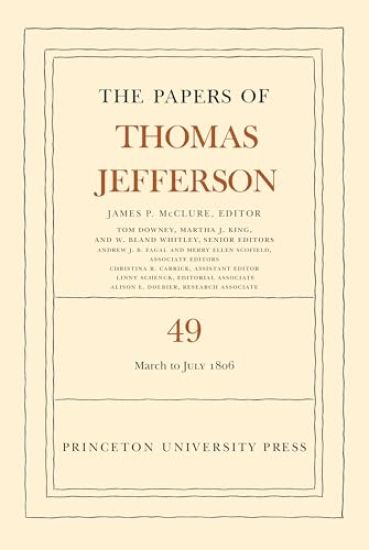
The Papers of Thomas Jefferson, Volume 49

The Papers of Thomas Jefferson, Volume 49

Thomas Jefferson

PRINCETON UNIVERSITY PRESS
2026
sidottu
A definitive scholarly edition of the correspondence and papers of Thomas JeffersonThe Senate confirms John Armstrong and James Bowdoin as commissioners to negotiate with Spain and James Monroe and William Pinkney to do the same with Great Britain. In speeches in the House of Representatives, John Randolph attacks the administration’s measures and declares that the president has lost the confidence of the cabinet. Jefferson shrugs this off, maintaining that Randolph can pull away only a few Republicans. In the approaches to New York harbor, a shot from a British warship causes the death of an American mariner. Jefferson issues a proclamation that calls for the apprehension of Henry Whitby, the captain of the warship, and bars his ship and others with it from American ports and waters. Congress passes an act to limit the navy to 925 seamen, capping the number of ships and raising Jefferson’s concerns in light of a potential war with Tunis. He plans to use gunboats and militia to protect Orleans Territory in the event of conflict with Spain. Aaron Burr calls on him and hints that he could do “much harm.” Jefferson’s mentor George Wythe dies by poisoning, leaving Jefferson his books. Jefferson plans and begins to lay out the large garden for vegetables at Monticello.
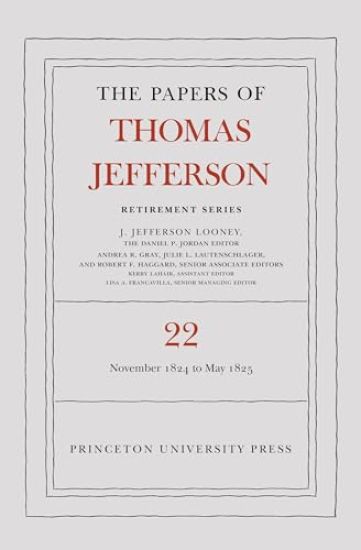
The Papers of Thomas Jefferson, Retirement Series, Volume 22

The Papers of Thomas Jefferson, Retirement Series, Volume 22

Thomas Jefferson

PRINCETON UNIVERSITY PRESS
2026
sidottu
A definitive new volume of the retirement papers of Thomas JeffersonThe 586 documents in this volume begin with Lafayette’s celebrated American tour, during which he spends eleven days at Monticello early in November 1825 and discusses the institution of slavery with Jefferson. During a slightly later visit accompanied by Daniel Webster, George Ticknor describes Jefferson as “very active, lively, and happy,” and “entirely absorbed” with plans for the University of Virginia.Francis W. Gilmer returns, having successfully recruited five European professors for the new school. Two teachers already in America complete the founding faculty. Although Jefferson is “almost in despair” that the law chair remains unfilled, the University of Virginia finally opens its doors on 7 March 1825. Fearing that a plan to move the College of William and Mary to Richmond would draw students and resources away from the university, Jefferson’s allies defeat the proposal. Jefferson drafts a bill to dismantle the college, but it is ultimately not submitted. Potential university students, professors, and hotel keepers seek information and advice.Jefferson congratulates John Adams on the election of his son to the presidency but commiserates with him that aging has left them both “alone amidst a new generation whom we know not, and who know not us.”
Thomas Jefferson

Thomas Jefferson

Alf J. Mapp

Rowman Littlefield Publishers
2008
pokkari
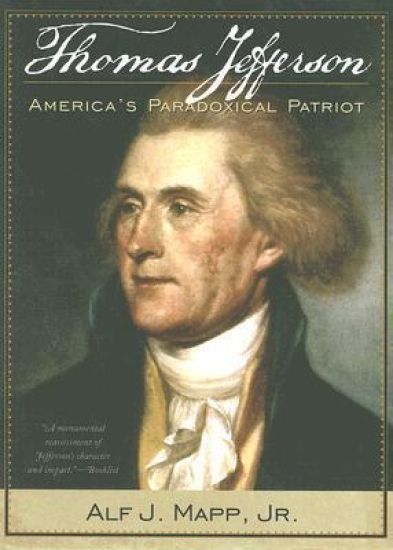
This groundbreaking biography has been universally acclaimed as a landmark work on Thomas Jefferson's early and mature years. Mapp follows Jefferson from his birth in 1743 through the American Revolution and up until his inauguration as President of the United States in 1801. Along the way we rediscover Jefferson the student at William and Mary, the Virginia politician, and the foreign diplomat. In these pages, Mapp sheds new light on Jefferson's career and private life. The portrait is rich and full of a living complexity that defies the simple sketches often offered by those who would either canonize or demonize this reluctant founding father.
Thomas Jefferson

Thomas Jefferson

Jr. Mapp

Rowman Littlefield Publishers
2009
pokkari
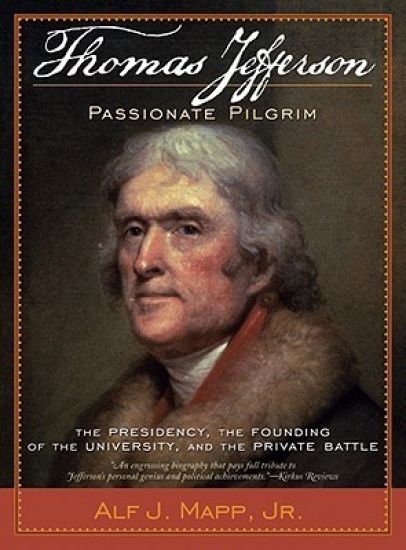
Eagerly awaited by readers of Alf Mapp's best-selling Thomas Jefferson: A Strange Case of Mistaken Identity, this final volume follows Jefferson from his inauguration as President in 1801 to his death at the age of 83 on July 4, 1826. It embraces the eight years as Chief Executive in which he doubled the size of the United States by his daring Louisiana Purchase, sent Meriwether Lewis and William Clark on one of the world's greatest expeditions of exploration, and challenged the formidable Chief Justice John Marshall with a major program of judicial reform. It proves the falseness of the stereotype that Jefferson ignored national defense and tried to keep the Navy weak. The book shows him late in life, with ideas that have relevance today, planning a system of public education and founding the University of Virginia, and it reveals, better than any other biography to date, the intimate details of the lonely private battle he fought during his last tortured, but ultimately triumphant, decade. In Thomas Jefferson: Passionate Pilgrim, Jefferson the human being, passionate in his loves and hates, is never lost in a revealing portrait of the public figure. Witnessing Jefferson's actions in private life as well as in the arena of history, the reader learns why this founding father was abhorred by some but adored by many more. The book not only is enlightening about Jefferson's personality, character, and career, but also enables us to view America and Europe in the first quarter of the nineteenth century through the eyes of the one person best qualified to see them in all phases. His wide acquaintance on both sides of the Atlantic, his richly varied interests, and his life as both scholar and social animal, gave him a unique perspective. Almost as interesting as Jefferson himself are the many other characters ho enliven the narrative. In addition to such accustomed players in his life drama as Madison, Monroe, and Marshall, there is the President's troublesome cousin, John Randolph, majority leader of the U.S. House of Representatives at age twenty-eight, who sometimes entered the chamber in foxhunting togs, followed by a pack of hounds, and gestured with a riding crop as he addressed his colleagues. And there is Margaret Bayard Smith, who boasted that the master of monticello had admitted her to his "sanctum sanctorum" where "any other feet but his own seldom intrude." There was Vice President Aaron Burr, of the hypnotic eyes, who almost founded an empire in the American West. And who could forget Napoleon, completely nude, conducting a conference vital to the fate of both Jefferson and the United States? Read either separately or in conjunction with Mapp's earlier volume on Jefferson, this book offers an illuminating and absorbing view of the person whom columnist George Will describes as the "Man of the Millennium."
Thomas Jefferson

Thomas Jefferson

Francis D. Cogliano

Edinburgh University Press
2006
sidottu
This first major study of Thomas Jefferson's reputation in nearly fifty years is concerned with Jefferson and history--both as something Jefferson made and something that he sought to shape. Jefferson was acutely aware that he would be judged by posterity and he deliberately sought to influence history's judgment of him. He did so, it argues, in order to promote his vision of a global republican future. It begins by situating Jefferson's ideas about history within the context of eighteenth-century historical thought, and then considers the efforts Jefferson made to shape the way the history of his life and times would be written: through the careful preservation of his personal and public papers and his home, Monticello, near Charlottesville, Virginia. The second half of the book considers the results of Jefferson's efforts to shape historical writing by examining the evolution of his reputation since the Second World War. Recent scholarship has examined Jefferson's attitudes and actions with regard to Native Americans, African slaves, women and civil liberties and found him wanting. Jefferson has continued to be a controversial figure; DNA testing proving that he fathered children by his slave Sally Hemings being the most recent example, perhaps encapsulating this best of all. This is the first major study to examine the impact of the Hemings controversy on Jefferson's reputation. Key Features *The first study of Jefferson's reputation to be published since 1960 *Considers the impact of slavery on Jefferson's reputation and Jefferson's relationship with slavery *Explores the history of the Sally Hemings controversy
Thomas Jefferson

Thomas Jefferson

Barbara McEwan

McFarland Co Inc
2011
pokkari
Thomas Jefferson is best known as one of the founders of the United States. His chief love, however, was not politics, but farming. His writings abound with expressions of loathing for the former and perpetual fascination for the latter. "Cultivators of the earth are the most valuable citizens," he wrote to John Jay in 1785. While his contributions to the field of government overshadow his many other accomplishments, he also made many brilliant and expert contributions to the development of sustainable, regenerative methods of farming. The 11 chapters address a variety of issues that shaped Jefferson's farming including his methods, crops, alternative crops he promoted, farm machinery, his workers (overseer, slaves, and free workmen). Monticello, landscaping practices, and his plans for a school of botany at the University of Virginia. This book also brings to the fore the human qualities of the man in relation to both his family and his country and shows that his aspirations for both were habitually put before his own. Here is yet another way to understand that without Thomas Jefferson, America would have become a different nation.
Thomas Jefferson

Thomas Jefferson

Joyce Appleby

TIMES BOOKS
2003
sidottu
An illuminating analysis of the man whose name is synonymous with American democracy Few presidents have embodied the American spirit as fully as Thomas Jefferson. He was the originator of so many of the founding principles of American democracy. Politically, he shuffled off the centralized authority of the Federalists, working toward a more diffuse and minimalist leadership. He introduced the bills separating church and state and mandating free public education. He departed from the strict etiquette of his European counterparts, appearing at state dinners in casual attire and dispensing with hierarchical seating arrangements. Jefferson initiated the Lewis and Clark expedition and seized on the crucial moment when Napoleon decided to sell the Louisiana Territory, thus extending the national development. In this compelling examination, distinguished historian Joyce Appleby captures all of the richness of Jefferson's character and accomplishments.
The Autobiography of Thomas Jefferson, 1743-1790

The Autobiography of Thomas Jefferson, 1743-1790

Thomas Jefferson

University of Pennsylvania Press
2005
pokkari
In 1821, at the age of seventy-seven, Thomas Jefferson decided to "state some recollections of dates and facts concerning myself." His ancestors, Jefferson writes, came to America from Wales in the early seventeenth century and settled in the Virginia colony. Jefferson's father, although uneducated, possessed a "strong mind and sound judgement" and raised his family in the far western frontier of the colony, an experience that contributed to his son's eventual staunch defense of individual and state rights. Jefferson attended the College of William and Mary, entered the law, and in 1775 was elected to represent Virginia at the Continental Congress in Philadelphia, an event that propelled him to all of his future political fortunes. Jefferson's autobiography continues through the entire Revolutionary War period, and his insights and information about persons, politics, and events-including the drafting of the Declaration of Independence, his service in France with Benjamin Franklin, and his observations on the French Revolution-are of immense value to both scholars and general readers. Jefferson ends this account of his life at the moment he returns to New York to become secretary of state in 1790. Complementing the other major autobiography of the period, Benjamin Franklin's, The Autobiography of Thomas Jefferson, reintroduced for this edition by historian Michael Zuckerman, gives us a glimpse into the private life and associations of one of America's most influential personalities. Alongside Jefferson's absorbing narrative of the way compromises were achieved at the Continental Congress are comments about his own health and day-to-day life that allow the reader to picture him more fully as a human being. Throughout, Jefferson states his opinions and ideas about many issues, including slavery, the death penalty, and taxation. Although Jefferson did not carry this autobiography further into his eventual presidency, the foundations for all of his thoughts are here, and it is in these pages that Jefferson lays out what to him was his most important contribution to his country, the creation of a democratic republic.
Thomas Jefferson

Thomas Jefferson

Natalie Bober

University of Virginia Press
2008
nidottu
To many Americans, Thomas Jefferson is the architect of our freedom. And yet the author of the ""Declaration of Independence"" also participated in a society that depended on slavery, and was himself the owner of slaves. How are we to reconcile this contradiction? This new life of Jefferson by Natalie S. Bober does not evade this difficult question.From the first page, we are taken into Jefferson's world, to help us understand what it meant to be a man of his time. He stands before us as a shy, freckle-faced, and, for the eighteenth century, unusually tall young man. We follow him through a life in which he gave words to American independence, journeyed to France as ambassador, and triumphed in a bitter campaign not unlike our recent presidential elections. He served two terms in the White House, but the achievements most important to him were as the author of the ""Declaration of Independence"" and ""The Statute of Virginia for Religious Freedom"", and as architect and founder of the University of Virginia, which stands today as a living monument to his belief in the importance to a democracy of higher education open to everyone. His belief in the ""illimitable freedom of the human mind"" speaks to us even today.Thomas Jefferson taught us the power of the word. He showed us that words beautifully shaped can reshape lives. The Jefferson revealed here is distinguished by his often contradictory nature but also by his optimism, his curiosity, and his exceptional sense of his own place in history.Like Bober's earlier books on Abigail Adams and the American Revolution, ""Thomas Jefferson: Draftsman of a Nation"" will appeal to students of history of all ages. This book faces the fact that Jefferson was a flawed human being - yet insists that this does not disqualify him as a hero.
Thomas Jefferson

Thomas Jefferson

Francis D. Cogliano

University of Virginia Press
2008
nidottu
In his probing new study, Francis Cogliano focuses on Thomas Jefferson's relation to history, both as the context in which he lived, and as something he made considerable, and conscious, efforts to influence. He was acutely aware that he would be judged by posterity, and he believed that the fate of the republican experiment depended to a large extent on how it was rendered by historians.The first half of the book situates Jefferson's ideas about history within the context of eighteenth-century historical thought. It then considers the efforts Jefferson made to shape the way the history of his life and times would be written: through the careful preservation of most of his personal and public papers, and through the institutions he left behind, including his home, Monticello, and the University of Virginia. The second half of the book considers the results of Jefferson's efforts to shape historical writings about himself and his period, which have issued forth in an unbroken stream from his day to our own. Although Jefferson seemed to have achieved apotheosis in the years following World War II, his rise above controversy was short-lived. Earlier political questions were replaced by arguments over race, class, and gender, and recent scholarship has criticized Jefferson's attitudes and actions with regard to civil liberties, Native Americans, slaves, and women, not least in the context of debates surrounding his relationship with his slave, Sally Hemings. Our complex feelings about Jefferson's relation to these issues are a reflection of the man who helped engineer their place in our historical discourse.
Thomas Jefferson

Thomas Jefferson

Lawrence S. Kaplan

Rowman Littlefield
1998
nidottu
This biography of one of America's greatest political figures focuses on Thomas Jefferson's role as a maker of foreign policy. Although he was not the sole formulator of American diplomacy, Jefferson's voice was the most pervasive in the first generation of the republic's history. This text explores how the concept of the United States' westward expansion worked as the moving force in forming Jefferson's judgments and actions in foreign relations. Although much has been written about Jefferson, this volume is one of the few that explores the full range of his positions on foreign relations. Readable and authoritative, Thomas Jefferson: Westward the Course of Empire offers new insight into the man who shaped American foreign policy.
Thomas Jefferson

Thomas Jefferson

David S. Brown

ABC-CLIO
1998
sidottu
Thomas Jefferson advocated a society based on talent and virtue. His belief in the inherent goodness of humankind coupled with his faith in science made him the consummate gentleman-statesman. There was also an ethnocentric side to Jefferson. His agrarian bias led him to combat northern interests that encouraged the expansion of industry, and his legacy lends itself to continual reinterpretation. More than 180 entries in this text cover the significant events, people, philosophies, and legislation associated with Jefferson. Each entry describes and defines the topic and places it in historical context.