Kirjojen hintavertailu. Mukana 11 464 168 kirjaa ja 12 kauppaa.

Kirjahaku

Etsi kirjoja tekijän nimen, kirjan nimen tai ISBN:n perusteella.

1000 tulosta hakusanalla Theodore W. Engstrom

Brain-Computer Interfaces

Brain-Computer Interfaces

Theodore W. Berger; John K. Chapin; Greg A. Gerhardt; Dennis J. McFarland; Jose C. Principe; Walid V. Soussou; Dawn M. Taylor; Patrick A. Tresco

Springer
2010
nidottu
We have come to know that our ability to survive and grow as a nation to a very large degree depends upon our scientific progress. Moreover, it is not enough simply to keep 1 abreast of the rest of the world in scientific matters. We must maintain our leadership. President Harry Truman spoke those words in 1950, in the aftermath of World War II and in the midst of the Cold War. Indeed, the scientific and engineering leadership of the United States and its allies in the twentieth century played key roles in the successful outcomes of both World War II and the Cold War, sparing the world the twin horrors of fascism and totalitarian communism, and fueling the economic prosperity that followed. Today, as the United States and its allies once again find themselves at war, President Truman’s words ring as true as they did a half-century ago. The goal set out in the Truman Administration of maintaining leadership in science has remained the policy of the U. S. Government to this day: Dr. John Marburger, the Director of the Office of Science and Technology (OSTP) in the Executive Office of the President, made remarks to that effect during his 2 confirmation hearings in October 2001. The United States needs metrics for measuring its success in meeting this goal of maintaining leadership in science and technology. That is one of the reasons that the National Science Foundation (NSF) and many other agencies of the U. S.

Hur dog Peter Artedi? : en vetenskapshistorisk gåta
När den unge Peter Artedi och Carl Linnaeus först stöter på var­andra i mars 1729, som studenter vid Uppsala universitet, fattar de omedelbart tycke för varandra och upprättar snart ett livligt intellektuellt utbyte. De delar sina revolutionära idéer om ordning och hierarki i naturvetenskapen, och utvecklar sätt att klassificera växter och djur på sätt som aldrig tidigare skådats: Linnaeus fokuserar på växter och Artedi på fiskar.Men i september 1735, precis innan Artedi ska ge ut sitt livsverk, drunknar han under förbryllande omständigheter. Linnaeus fullföljer sitt löfte till sin förlorade vän genom att publicera hans manu­skript, men innan dess ger han ut sitt eget och slår igenom på storslaget vis: hans verk förändrar hela naturvetenskapen. Den drunknade Artedi, däremot, sjunker snabbt i glömska.Gåtan om Peter Artedis död, och berättelsen om en föga känd händelse från ett viktigt historiskt tidevarv, är en studie i den bortglömda berättelsen bakom Linnaeus och Artedis vänskap, och utforskar vad som kanske egentligen hände mellan dem.Hur dog Peter Artedi? En vetenskapshistorisk gåta är en historisk roman som utforskar gamla Amsterdam och den mystiska bortgången av en ung, svensk vetenskapsman. Berättarrösten är en av upplysnings­tidens starkast lysande stjärnor.
Immensee

Immensee

Theodore W Storm

ALPHA EDITION
2022
pokkari
This book "" Immensee "", has been considered important throughout the human history, and so that this work is never forgotten we have made efforts in its preservation by republishing this book in a modern format for present and future generations. This whole book has been reformatted, retyped and designed. These books are not made of scanned copies and hence the text is clear and readable.
My Heart in My Mouth: Prayers for Our Lives

My Heart in My Mouth: Prayers for Our Lives

Theodore W. Loder

Wipf Stock Publishers
2013
nidottu
What I like best about Loder's prayers is that they are filled with images to send the soul soaring. --Spirituality & Health Ted Loder is the poet of prayer. I know no one who so movingly and honestly brings us before God in prayers that touch the personal and the social dimensions of our lives. I suspect that I will pray from this book the rest of my life. --Tex Sample, Coordinator of The Network for the Study of U. S. Lifestyles, Robert B. and Kathleen Professor Emeritus of Church and Society, Saint Paul School of Theology Does prayer have to be stilted or sentimental? Can it express real feeling without getting weepy? Ted Loder shows how prayer can escape these pitfalls and become authentic. One could well start or end each day with one of these. --Harvey Cox, Professor of Divinity, Harvard University; Author of Fire from Heaven This is a revealing, intensely personal, and wonderful book of prayers, rich and insightful. Loder helps us to stretch our experiences, our emotions, and our imaginations just a little bit more. --Rev. William H. Gray, III, Senior Pastor, Bright Hope Baptist Church; President/CEO, United Negro College Fund Loder is a modern-day psalmist whose prayers are disarmingly honest and refreshingly real. His message: in all of life's beauty and brokenness love is the struggle that tutors the soul. --Julie Neraas, Presbyterian minister, Spiritual Director, and Faculty Member, Hamline University, St. Paul, Minnesota Loder offers thoughtful and well-crafted prayers that are written in the familiar cadence of everyday language but leavened with echoes of the inspired awe, wonder, and praise of the ancient Scriptures. --Dr. Bob Edgar, General Secretary, National Council of the Churches of Christ in the USA; former Congressman from Pennsylvania Ted Loder is a master pastor. In these prayers we see a pastor bringing his people before the throne of God. Good reading. Good praying. --Dr. William H. Willimon, Dean of the Chapel and Professor of Christian Ministry, Duke University, Durham, North Carolina
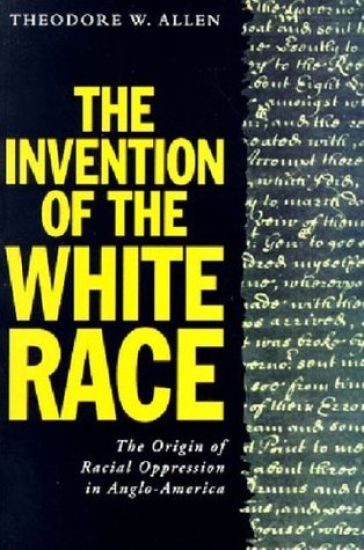
The Invention of the White Race

The Invention of the White Race

Allen Theodore W.

Verso Books
1997
pokkari
On the steps of the Lincoln Memorial in 1963, Martin Luther King declared his dream of a racially integrated, non-discriminatory American society. Some three centuries before, that dream had in many ways been a reality, since white skin privilege was recognized neither in law nor in the social practices of the labouring classes. But by the early decades of the eighteenth century, racial oppression would be the norm in the plantation colonies, and African Americans would continue to suffer under its yoke for more than two centuries. In this second volume of his acclaimed study of the origins of racial oppression, Theodore Allen explores the ways in which African bond-laborers were turned into chattel slaves and were differentiated from their fellow proletarians of European origin. Rocked by the solidarity across racial lines exhibited by the rebellious labouring classes in the wake of the famous Bacon's Rebellion, the plantation Bourgeoisie sought a solution to its labor problems in the creation of a buffer social control stratum of poor whites, who enjoyed little enough privilege in colonial society beyond that of their skin color, which protected them from the enslavement visited upon Africans and African Americans. Such was, as Allen puts it, 'the invention of the white race,' that 'peculiar institution' which continues to haunt social relations in the US down to the present. Allen's two volumes are essential reading for students of US history and politics.
Complex Dynamics

Complex Dynamics

Lennart Carleson; Theodore W. Gamelin

Springer-Verlag New York Inc.
1993
nidottu
Complex dynamics is today very much a focus of interest. Though several fine expository articles were available, by P. Blanchard and by M. Yu. Lyubich in particular, until recently there was no single source where students could find the material with proofs. For anyone in our position, gathering and organizing the material required a great deal of work going through preprints and papers and in some cases even finding a proof. We hope that the results of our efforts will be of help to others who plan to learn about complex dynamics and perhaps even lecture. Meanwhile books in the field a. re beginning to appear. The Stony Brook course notes of J. Milnor were particularly welcome and useful. Still we hope that our special emphasis on the analytic side will satisfy a need. This book is a revised and expanded version of notes based on lectures of the first author at UCLA over several \Vinter Quarters, particularly 1986 and 1990. We owe Chris Bishop a great deal of gratitude for supervising the production of course notes, adding new material, and making computer pictures. We have used his computer pictures, and we will also refer to the attractive color graphics in the popular treatment of H. -O. Peitgen and P. Richter. We have benefited from discussions with a number of colleagues, and from suggestions of students in both our courses.
Peter Artedi

Peter Artedi

Hans L G Aili; Theodore W Pietsch

Stockholm University Press
2024
sidottu
In this attempt to bring together in a single volume all that is known about the Swedish naturalist Peter Artedi, a chronicle of his life is provided, beginning with his early upbringing in the Parish of Anundsj , ngermanland, his school days at H rn sand, his ten years at Uppsala University, his time in England, his life and work in Holland, and ending with his untimely death by drowning in an Amsterdam canal at age 30. Benefiting enormously from an early friendship with the Swedish naturalist Carl Linnaeus, famous for establishing binomial nomenclature, the modern system of naming organisms, the two early on made elaborate plans to classify plants and animals in ways that would later be described as revolutionary. Artedi, being more interested in zoology, took on the fishes, amphibians, and reptiles-as well as the plant family Umbelliferae (Apiaceae), while Linnaeus, who was already by this time working on his sexual system for plants, took all the remaining vegetable kingdom, the insects and birds. Both agreed to work independently on minerals and mammals. Although passing before he had a chance to publish on his part of the plan, Artedi left behind a wealth of material in manuscript, mainly on the biology of fishes but also on quadrupeds, that is here translated into English from the original Latin and analyzed in light of present-day knowledge. In addition to adding details to what is already known, thanks to a number of eminent scholars, about the life of Peter Artedi, an important secondary goal of this work is to formulate a new perspective on the usefulness in practice of Artedi's zoological methods, which no naturalist had heretofore put to paper. Readers will be surprised at the depth and breadth of his contributions, especially his work on fishes, which has earned him the well-deserved title of "Father of Ichthyology."
Future U.S. Security Relationship with Iraq and Afghanistan

Future U.S. Security Relationship with Iraq and Afghanistan

David E. Thaler; Theodore W. Karasik; Dalia Dassa Kaye; Jennifer D. P. Moroney; Frederic M. Wehrey; Obaid Younossi; Farhana Ali; Robert A. Guffey

RAND
2008
pokkari
The authors describe possible regional security structures and bilateral U.S. relationships with Iraq and Afghanistan. They recommend that the United States offer a wide range of security cooperation activities to compatible future governments in Kabul and Baghdad and should also plan to hedge against less-favorable contingencies. They emphasize that the U.S. Air Force should expect to remain heavily tasked for the foreseeable future.This book frames potential long-term U.S. security relationships with Iraq and Afghanistan in a regional context and posits roles of U.S. forces, especially the Air Force, in supporting these relationships under a variety of contingencies.