Kirjojen hintavertailu. Mukana 11 244 527 kirjaa ja 12 kauppaa.

Kirjahaku

Etsi kirjoja tekijän nimen, kirjan nimen tai ISBN:n perusteella.

1000 tulosta hakusanalla Timothy David Mack

Evidence-Based Treatment Planning for Bipolar Disorder Facilitator's Guide

Evidence-Based Treatment Planning for Bipolar Disorder Facilitator's Guide

Timothy J. Bruce; David J. Berghuis

John Wiley Sons Inc
2012
nidottu
This DVD Facilitator's Guide to the Evidence-Based Treatment Planning for Bipolar Disorer (DVD sold separately) is designed to help teachers or trainers conduct lectures or training sessions on the content of the DVD. The guide follows each section of the DVD, providing succinct summaries of key section content, section review test questions and answers, and test questions and answers covering key concepts. The DVD, Companion Workbook, and Facilitator's Guide are designed so that instructors can cover only the content of the DVD or springboard into further coverage of any of the concepts. Designed to be used in conjunction with the DVD and its Companion Workbook, this guide includes: Summary highlights of content shown in the DVDChapter review questions and answers summarizing key conceptsTest questions and answers on selected chapter conceptsOptional topics for further discussion, with talking pointsScripts and critiques of the role-played scenarios demonstrating selected aspects of the ESTsReferences to empirical support, clinical resources, and training opportunities for the treatments discussedOnline links to client homework exercises consistent with the therapeutic techniques described and demonstrated Explanations of correct and incorrect answers to the test-style questions from each chapter
Evidence-Based Treatment Planning for Eating Disorders and Obesity Facilitator?s Guide
This DVD Facilitator's Guide to the Evidence-Based Treatment Planning for Eating Disorders and Obesity (DVD sold separately) is designed to help teachers or trainers conduct lectures or training sessions on the content of the DVD. The guide follows each section of the DVD, providing succinct summaries of key section content, section review test questions and answers, and test questions and answers covering key concepts. The DVD, Companion Workbook, and Facilitator's Guide are designed so that instructors can cover only the content of the DVD or springboard into further coverage of any of the concepts. Designed to be used in conjunction with the DVD and its Companion Workbook, this guide includes: Summary highlights of content shown in the DVDChapter review questions and answers summarizing key conceptsTest questions and answers on selected chapter conceptsOptional topics for further discussion, with talking pointsScripts and critiques of the role-played scenarios demonstrating selected aspects of the ESTsReferences to empirical support, clinical resources, and training opportunities for the treatments discussedOnline links to client homework exercises consistent with the therapeutic techniques described and demonstratedExplanations of correct and incorrect answers to the test-style questions from each chapter
Evidence-Based Treatment Planning for Disruptive Child and Adolescent Behavior Facilitator's Guide
This DVD Facilitator's Guide to the Evidence-Based Psychotherapy Treatment Planning for Disruptive Child and Adolescent Behavior (DVD sold separately) is designed to help teachers or trainers conduct lectures or training sessions on the content of the DVD. The guide follows each section of the DVD, providing succinct summaries of key section content, section review test questions and answers, and test-style questions and answers covering key concepts. Online links are provided to client homework exercises consistent with the therapeutic techniques described and demonstrated on the DVD. References to empirical work supporting the treatments, clinical resource materials, and training opportunities are also cited. The DVD,Companion Workbook, andFacilitator’s Guide are designed so that instructors can cover only the content of the DVD or springboard into further coverage of any of the concepts. Optional topics for further discussion, with talking points, are provided in each chapter of the Facilitator’s Guide. Designed to be used in conjunction with the DVD and itsCompanion Workbook, this guide includes: Summary highlights of content shown in the DVDChapter review questions and answers summarizing key conceptsTest-style questions and answers on selected chapter conceptsOptional topics for further discussion, with talking pointsScripts and critiques of the role-played scenarios demonstrating selected aspects of the ESTsReferences to empirical support, clinical resources, and training opportunities for the treatments discussedOnline links to client homework exercises consistent with the therapeutic techniques described and demonstratedExplanations of correct and incorrect answers to the test-style questions from each chapter
Evidence-Based Treatment Planning for Obsessive-Compulsive Disorder Facilitator's Guide
This DVD Facilitator's Guide to the Evidence-Based Psychotherapy Treatment Planning for Obsessive-Compulsive Disorder (DVD sold separately) is designed to help teachers or trainers conduct lectures or training sessions on the content of the DVD. The guide follows each section of the DVD, providing succinct summaries of key section content, section review test questions and answers, and test-style questions and answers covering key concepts. Online links are provided to client homework exercises consistent with the therapeutic techniques described and demonstrated on the DVD. References to empirical work supporting the treatments, clinical resource materials, and training opportunities are also cited. The DVD, Companion Workbook, and Facilitator’s Guide are designed so that instructors can cover only the content of the DVD or springboard into further coverage of any of the concepts. Optional topics for further discussion, with talking points, are provided in each chapter of the Facilitator’s Guide. Designed to be used in conjunction with the DVD and its Companion Workbook, this guide includes: Summary highlights of content shown in the DVDChapter review questions and answers summarizing key conceptsTest-style questions and answers on selected chapter conceptsOptional topics for further discussion, with talking pointsScripts and critiques of the role-played scenarios demonstrating selected aspects of the ESTsReferences to empirical support, clinical resources, and training opportunities for the treatments discussedOnline links to client homework exercises consistent with the therapeutic techniques described and demonstratedExplanations of correct and incorrect answers to the test-style questions from each chapter
Evidence-Based Treatment Planning for Posttraumatic Stress Disorder Facilitator's Guide
This DVD Facilitator's Guide to the Evidence-Based Psychotherapy Treatment Planning for Posttraumatic Stress Disorder (DVD sold separately) is designed to help teachers or trainers conduct lectures or training sessions on the content of the DVD. The guide follows each section of the DVD, providing succinct summaries of key section content, section review test questions and answers, and test-style questions and answers covering key concepts. Online links are provided to client homework exercises consistent with the therapeutic techniques described and demonstrated on the DVD. References to empirical work supporting the treatments, clinical resource materials, and training opportunities are also cited. The DVD, Companion Workbook, and Facilitator’s Guide are designed so that instructors can cover only the content of the DVD or springboard into further coverage of any of the concepts. Optional topics for further discussion, with talking points, are provided in each chapter of the Facilitator’s Guide. Designed to be used in conjunction with the DVD and its Companion Workbook, this guide includes: Summary highlights of content shown in the DVDChapter review questions and answers summarizing key conceptsTest-style questions and answers on selected chapter conceptsOptional topics for further discussion, with talking pointsScripts and critiques of the role-played scenarios demonstrating selected aspects of the ESTsReferences to empirical support, clinical resources, and training opportunities for the treatments discussedOnline links to client homework exercises consistent with the therapeutic techniques described and demonstratedExplanations of correct and incorrect answers to the test-style questions from each chapter
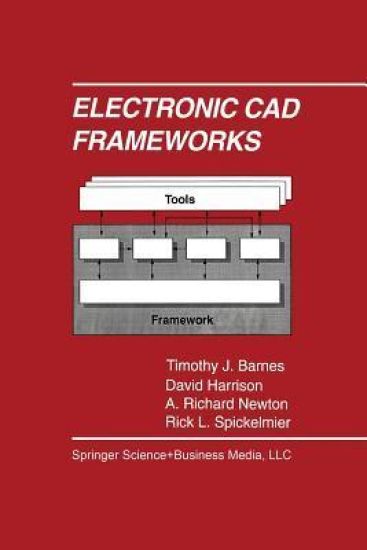
Electronic CAD Frameworks

Electronic CAD Frameworks

Timothy J. Barnes; David Harrison; A. Richard Newton; Rick L. Spickelmier

Springer
1992
sidottu
When it comes to frameworks, the familiar story of the elephant and the six blind philosophers seems to apply. As each philoso­ pher encountered a separate part of the elephant, each pronounced his considered, but flawed judgement. One blind philosopher felt a leg and thought it a tree. Another felt the tail and thought he held a rope. Another felt the elephant's flank and thought he stood before a wall. We're supposed to learn about snap judgements from this alle­ gory, but its author might well have been describing design automation frameworks. For in the reality of today's product development requirements, a framework must be many things to many people. xiv CAD Frameworks: Integration Technology for CAD As the authors of this book note, framework design is an optimi­ zation problem. Somehow, it has to be both a superior rope for one and a tremendous tree for another. Somehow it needs to provide a standard environment for exploiting the full potential of computer-aided engineering tools. And, somehow, it has to make real such abstractions as interoperability and interchangeability. For years, we've talked about a framework as something that provides application-oriented services, just as an operating system provides system-level support. And for years, that simple statement has hid the tremendous complexity of actually providing those services.
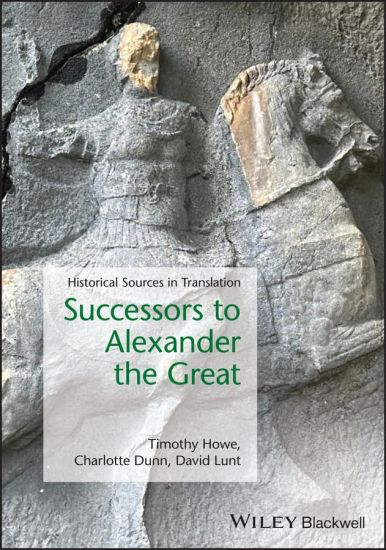
Successors to Alexander the Great

Successors to Alexander the Great

Timothy Howe; Charlotte Dunn; David Lunt

JOHN WILEY AND SONS LTD
2025
nidottu
A comprehensive collection of translated sources on the wars and world of Alexander's successors Successors to Alexander the Great brings together—for the first time in a single collection—the essential translated sources for the tumultuous period following the death of Alexander the Great in 323 BCE. Spanning Greek, Latin, Persian Babylonian, Egyptian, and epigraphic materials, this volume provides direct access to a wide range of documents that illuminate the world and the wars of the Diadochi and the complex efforts to reassemble, rule, and redefine the fragments of Alexander's empire. Organized thematically and geographically, this book allows readers to explore the Successors' ambitions, alliances, propaganda, and political innovation across a sprawling and multi-ethnic landscape. Contextual commentary throughout helps readers navigate the fragmentary nature of source evidence, the biases of ancient authors, and the evolving concepts of legitimacy and kingship. With its thematic structure and source diversity, the book offers an ideal foundation for historical, literary, and historiographical inquiry into the Hellenistic world. The first unified, carefully curated, deeply contextualized collection of primary sources on the post-Alexander Hellenistic world, Successors to Alexander the Great: Features Greek, Latin, Persian, Babylonian, Egyptian, and epigraphic material spanning multiple traditions and viewpoints Includes bibliographies with each chapter for ease of reference and deeper research engagement Highlights the complexity of succession politics, propaganda, and kingship after Alexander's death Illuminates lesser-known figures and regions often excluded from traditional Hellenistic narratives Promotes critical thinking and historiographical awareness through exposure to conflicting ancient perspectives Supports interdisciplinary teaching on identity, authority, and empire-building in the ancient world Presenting a single, coherent, and accessible narrative, Successors to Alexander the Great is ideal for upper-level undergraduate and graduate courses on Alexander the Great, the Hellenistic world, and ancient Greek history. It supports degree programs in Classics, History, Ancient Studies, Middle Eastern Studies, and related disciplines, and serves as a vital reference for scholars, educators, and researchers.
Electronic CAD Frameworks

Electronic CAD Frameworks

Timothy J. Barnes; David Harrison; A. Richard Newton; Rick L. Spickelmier

Springer-Verlag New York Inc.
2012
nidottu
When it comes to frameworks, the familiar story of the elephant and the six blind philosophers seems to apply. As each philoso­ pher encountered a separate part of the elephant, each pronounced his considered, but flawed judgement. One blind philosopher felt a leg and thought it a tree. Another felt the tail and thought he held a rope. Another felt the elephant's flank and thought he stood before a wall. We're supposed to learn about snap judgements from this alle­ gory, but its author might well have been describing design automation frameworks. For in the reality of today's product development requirements, a framework must be many things to many people. xiv CAD Frameworks: Integration Technology for CAD As the authors of this book note, framework design is an optimi­ zation problem. Somehow, it has to be both a superior rope for one and a tremendous tree for another. Somehow it needs to provide a standard environment for exploiting the full potential of computer-aided engineering tools. And, somehow, it has to make real such abstractions as interoperability and interchangeability. For years, we've talked about a framework as something that provides application-oriented services, just as an operating system provides system-level support. And for years, that simple statement has hid the tremendous complexity of actually providing those services.
Harnessing The Dynamics of Public Education

Harnessing The Dynamics of Public Education

Timothy B. Jones; David C. Barrett; James A. Vornberg

Rowman Littlefield
2015
sidottu
Harnessing the Dynamics of Public Education: Preparing for a Return to Greatness is a comprehensive look at the American public education system. Building on the current system, the book takes on the War on Education in an effort to rethink, redesign and develop a new state-of-the-art system of learning that will regain international competiveness and be the “best choice” for parents in a growing system of choice. The authors provide critical analysis of the current system while also offering specific solutions and hope for one of the greatest institutions in America…..as it Return’s to Greatness!
Harnessing The Dynamics of Public Education

Harnessing The Dynamics of Public Education

Timothy B. Jones; David C. Barrett; James A. Vornberg

Rowman Littlefield
2015
nidottu
Harnessing the Dynamics of Public Education: Planning for a Return to Greatness is a comprehensive look at the American public education system. Building on the current system, the book takes on the War on Education in an effort to rethink, redesign and develop a new state-of-the-art system of learning that will regain international competiveness and be the “best choice” for parents in a growing system of choice. The authors provide critical analysis of the current system while also offering specific solutions and hope for one of the greatest institutions in America…..as it Return’s to Greatness!
Rules for Retrogrades: Forty Tactics to Defeat the Radical Left

Rules for Retrogrades: Forty Tactics to Defeat the Radical Left

Timothy J. Gordon; David R. Gordon

Tan Books
2020
sidottu
What is a retrograde? A retrograde calculates, night and day, how to return the world to: the Old Order of moral and sexual decency, classical masculinity, national sovereignty and national borders, faith and hope and charity, goodness and beauty and truth, Christian civic liberty, and most importantly, the social kingship of Christ. In the words of Shakespeare, a retrograde is one of God's spies. The retrograde has the unique capacity for understanding the stark chasm between the degenerate, socialist-infiltrated world of decay on one side and the well-meaning, good-hearted, but clueless Christian world on the other. In a time of such profound decay, being one of God's spies is a last resort and a pure necessity: it involves not "deep cover,"--i.e., acting like the enemy--but rather "half cover" acting as a "contra" in the secular arena, a crypto-Christian counterinsurgent willing to fight like a Navy Seal and to think like a counterintel officer. Retrogrades . . . to the streets: our aim is to reverse the deliberate, deuced machinations of "radicals" like Saul Alinsky who, by penning the rulebook of radicalism, threw down a challenge that has, until now, gone unanswered. Rules for Retrogrades is the handbook men of good will need to win the culture war Here is a sampling from the call to action found within these pages: No truth is "off-limits"; we must never be ashamed to be candid.It is a damnable lie that humility disallows Christians from standing up (for what they believe) in the cultural and political forum Control of language is control of thought; don't let radicals control the language.Never trust a man who is unwilling to have enemies.Radicals form coalitions but retrogrades form fellowships.The root of cultural decay is feminism: end feminism to end radicalism.
Principles of Economics 2e

Principles of Economics 2e

Timothy Taylor; Steven A Greenlaw; David Shapiro

12th Media Services
2017
pokkari
Principles of Economics 2e covers the scope and sequence of most introductory economics courses. The text includes many current examples, which are handled in a politically equitable way. The outcome is a balanced approach to the theory and application of economics concepts. The second edition has been thoroughly revised to increase clarity, update data and current event impacts, and incorporate the feedback from many reviewers and adopters. The text and images in this book are grayscale.The first (previous) edition of Principles of Economics via OpenStax is available via ISBN 9781680920338.
Como Cambia La Gente Guia del Lider: Como Cristo Nos Cambia Por Su Gracia Guia de Lider

Como Cambia La Gente Guia del Lider: Como Cristo Nos Cambia Por Su Gracia Guia de Lider

Timothy S. Lane; Paul David Tripp; David Powlison

New Growth Press
2009
nidottu
A partir de los principios presentados en el libro, Paul David Tripp y Timothy S. Lane ofrecen la Gu a de Estudio C mo Cambian las Personas para su uso en formaci n a nivel de toda la iglesia, grupos peque os, escuela dominical, grupo de j venes o en discipulado individual. Estos materiales ayudan a los participantes a comprender las motivaciones subyacentes de sus acciones y les brindan una ayuda pr ctica y espec fica para cambiar patrones de comportamiento arraigados, de modo que crezcan en amor a Dios y al pr jimo.Cada una de las doce lecciones incluye ense anza, revisi n de tareas, aplicaci n relacional, ilustraciones, una gu a para la discusi n grupal y aplicaciones pr cticas bajo la secci n "Hazlo Real." La gu a autoexplicativa para el facilitador incluye las doce lecciones, instrucciones para guiar a un grupo peque o con esta gu a de estudio, contenido adicional, revisi n de tareas, ilustraciones detalladas y las aplicaciones de "Hazlo Real."
MyLab Accounting with Pearson eText -- Instant Access -- Pearson's Federal Taxation 2021 Corporations, Partnerships, Estates & Trusts
For courses in the principles of taxation. Master the principles of taxation with the latest tax regulations The Rupert/Anderson series is unsurpassed in blending technical aspects of the most recent federal taxation mandates with maximum readability and relevance for students. Containing strong pedagogical tools that enable readers to apply tax principles within the text to real-life situations, and tax information from 2019 and early 2020, Pearson’s Federal Taxation 2021 Comprehensive, 34th Edition provides an up-to-date resource and a better learning experience for students. Personalize learning with MyLab Accounting By combining trusted author content with digital tools and a flexible platform, MyLab personalizes the learning experience and improves results for each student. You are purchasing an access code only. Before purchasing, check with your instructor to confirm the correct ISBN. Several versions of the MyLab™ and Mastering™ platforms exist for each title, and registrations are not transferable. To register for and use MyLab or Mastering, you may also need a Course ID, which your instructor will provide. If purchasing or renting from companies other than Pearson, the access codes for the MyLab platform may not be included, may be incorrect, or may be previously redeemed. Check with the seller before completing your purchase.