

Kirjahaku
Etsi kirjoja tekijän nimen, kirjan nimen tai ISBN:n perusteella.
190 tulosta hakusanalla Vincentius Collesso


F. Vincentii Fassinii In Pisano Athenaeo Sacrarum Litterarum Divinae Libri Apocalypseos Auctoritatis Vindiciae (1778)
Vincenzo Maria Fassini
KESSINGER PUBLISHING, LLC
2009
pokkari
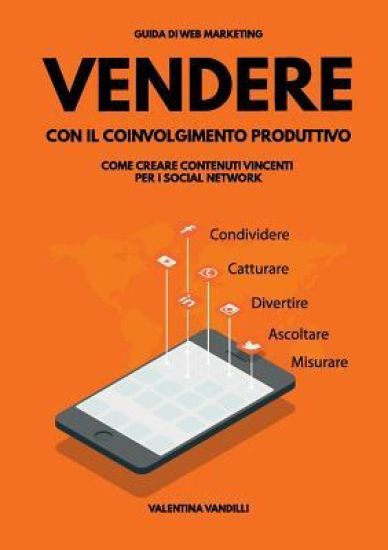
Vendere Con Il Coinvolgimento Produttivo: Come Creare Contenuti Vincenti Per I Social Network
Valentina Vandilli
Lulu.com
2016
nidottu
I contenuti sono il cuore della comunicazione, tanti ne parlano, ma pochi indicano chiaramente come crearli. In questo libro troverai le 5 regole del coinvolgimento produttivo, che ti permetteranno di creare contenuti, applicando i principi di base senza l'utilizzo di particolari strumenti. Impara a trasmettere emozioni attraverso parole e immagini, suoni e colori, comprenderai cosa chiedere ai tuoi collaboratori e le dinamiche del Web per poter finalmente, controllare l'avanzamento del tuo progetto Web con consapevolezza.

Dies ist ein Buch ber die Wirtschaft St. Vincents und der Grenadinen von den 1970er Jahren bis zu den 2010er Jahren. Quelldaten stamen aus den UN-Daten.Gr e. In den 2010er Jahren betrug das BIP St. Vincents und der Grenadinen 745,8 Millionen US-Dollar pro Jahr; der Wert der Landwirtschaft betrug 49,5 Millionen US-Dollar; der Wert des Verarbeitenden Gewerbes betrug 34,8 Millionen US-Dollar. Da der Weltanteil geringer als 0,01% betr gt, wird das Land als eine mikro Wirtschaft eingestuft.Produktivit t. In den 2010er Jahren betrug das BIP pro Kopf 6.831,3 Dollar; in der Landwirtschaft 453,5 Dollar pro Kopf; im verarbeitenden Gewerbe 318,4 Dollar pro Kopf. Da die Produktivit t zwischen dem unteren und mittleren Durchschnittswert liegt, wird die Wirtschaft als sich entwickelnd eingestuft.Wachstum. In den 2010er Jahren betrug das Wachstum des BIP 0,73%; in der Landwirtschaft -0,13%; im verarbeitenden Gewerbe -1,8%. Struktur. In den 2010er Jahren beinhaltete die Wirtschaft in St. Vincent und die Grenadinen die folgenden Bereiche: Dienstleistung (45,0%), Handel (16,1%), Verkehr (13,7%), Industrie (9,7%), Baugewerbe (8,1%), Landwirtschaft (7,8%). Export und Import. In den 2010er Jahren war der Import um 71,9% h her als der Export, der Nettoimport entsprach 23,8% des BIP. Die technologische Struktur des Exports ist nicht besser als die Importstruktur. Verbrauch und Reproduktion. Die Einstellung der Reproduktion zum Konsum ist besser als der globale Durchschnitt, so dass der BIP-Anteil der Welt steigen wird.

Die Kegelschnitte Des Gregorius a St. Vincentio in Vergleichender Bearbeitung ...
Karl Bopp
Nabu Press
2010
pokkari

P. F. Joannis Vincentii Patuzzi Ethica Christiana Sive Theologia Moralis V7 (1770)
Giovanni Vincenzo Patuzzi
KESSINGER PUBLISHING, LLC
2009
pokkari

De Re Sacramentaria Contra Perduelles Haereticos Libri Decen Duobus Tomis Comprehensi ... Itemque Theologorum Praecipuae Contentiones ... Editio Ii Cum Notis Ed Add. P. F. Joannis Vincentii Patuzzi (etc.)...
Renatus Hyacintus Drouven
Hutson Street Press
2025
pokkari

Francisi Xaverii Aynscom Antuerpiani E Societate Iesu, Expositio Ac Deductio Geometrica Quadraturarum Circuli R. P. Gregorii A S. Vincentio (1656)
Francois Xavier Aynscom
KESSINGER PUBLISHING CO
2009
pokkari

Sancti Thomae Summa Suo Auctori Vindicata, Sive De V. F. Vincentii Bellovacensis (1708)
Jacques Echard
KESSINGER PUBLISHING, LLC
2009
pokkari

Communication Breakthrough: How Using Brain Science and Listening to Body Cues Can Transform Your Relationships
Vincentia Schroeter
Vincentia S. Warren
2018
nidottu
Boost your ability to be seen and heard by mastering communication skills Dr. Vin Schroeter has distilled forty years of clinical practice as a somatic (body) psychotherapist into a deep understanding of how stress in the body spoils good communication. Drawing on the latest findings in neuroscience and her knowledge of how the body works, she offers innovative techniques to improve your communication while lowering your stress. An early chapter offers assessments on listening blocks and measuring your assertiveness, while the rest of the book provides easy to understand exerises for how to listen to body signals, shift moods and communicate thoughts, feelings, wants and needs with assertive clarity.


Historia Fungorum Regni Neapolitani (1848)
Vincentio Briganti
KESSINGER PUBLISHING, LLC
2010
pokkari


Recent Advances in Partial Differential Equations and Applications
Vicentiu D. (EDT) Radulescu; Adelia (EDT) Sequeira; Vsevolod A. (EDT) Solonnikov
Amer Mathematical Society
2016
pokkari

Partial Differential Equations with Variable Exponents
Vicentiu D. Radulescu; Dusan D. Repovs
Productivity Press
2015
sidottu
Partial Differential Equations with Variable Exponents: Variational Methods and Qualitative Analysis provides researchers and graduate students with a thorough introduction to the theory of nonlinear partial differential equations (PDEs) with a variable exponent, particularly those of elliptic type. The book presents the most important variational methods for elliptic PDEs described by nonhomogeneous differential operators and containing one or more power-type nonlinearities with a variable exponent. The authors give a systematic treatment of the basic mathematical theory and constructive methods for these classes of nonlinear elliptic equations as well as their applications to various processes arising in the applied sciences.The analysis developed in the book is based on the notion of a generalized or weak solution. This approach leads not only to the fundamental results of existence and multiplicity of weak solutions but also to several qualitative properties, including spectral analysis, bifurcation, and asymptotic analysis. The book examines the equations from different points of view while using the calculus of variations as the unifying theme. Readers will see how all of these diverse topics are connected to other important parts of mathematics, including topology, differential geometry, mathematical physics, and potential theory.

Vocations Explained: Matrimony, virginity, the religious state, and the priesthood
Vincentian Father
Createspace Independent Publishing Platform
2015
nidottu


Revision with unchanged content. Have we entered the era of a new form of Cold War? This book shows that imperialistic tendencies need not only take the form of overt military aggres-sion. Giedraitis crosses disciplinary boundaries to take a fresh look at the multiple ways that post-socialist Russia is exercising geopolitical domination over its former occupied territories. On the front lines of this new battleground are the Baltic countries of Lithuania, Latvia, and Estonia. Due to Western Europe's "addiction" to Russian oil, what happens in Lithuania - the focus of this work - could have far reaching consequences for the rest of Europe's energy supplies - and their economies. Supported by interviews and quantitative data, the dangers of three types of dependency relations - political, economic, and energy - are explored. Gied-raitis illustrates Lithuania's precarious balance between the new Western opportunities of the European Union and NATO, and threats from their former occupier to the East. This book is intended for those interested in neo-colonial dependency rela-tions in post-socialist countries, such as the Baltics. Russia has massive mineral reserves, and fuel-hungry economies surrounding it. Is its aim only to sell energy at market values? Is evidence of Russian political disruption in Lithuania chance, or does Russia have ulterior motives?

The New Cold War in the Post-Socialist Era- Domination through Multi-Dependency in Lithuania
Vincentas R Giedraitis
VDM Verlag Dr. Mueller E.K.
2007
pokkari