Kirjojen hintavertailu. Mukana 11 627 064 kirjaa ja 12 kauppaa.

Kirjahaku

Etsi kirjoja tekijän nimen, kirjan nimen tai ISBN:n perusteella.

1000 tulosta hakusanalla William L Perry

To Tell a Free Story

To Tell a Free Story

William L. Andrews

University of Illinois Press
1988
nidottu
To Tell A Free Story traces in unprecedented detail the history of Black autobiography from the colonial era through Emancipation. Beginning with the 1760 narrative by Briton Hammond, William L. Andrews explores first-person public writings by Black Americans. Andrews includes but also goes beyond slave narratives to analyze spiritual biographies, criminal confessions, captivity stories, travel accounts, interviews, and memoirs. As he shows, Black writers continuously faced the fact that northern whites often refused to accept their stories and memories as sincere, and especially distrusted portraits of southern whites as inhuman. Black writers had to silence parts of their stories or rely on subversive methods to make facts tellable while contending with the sensibilities of the white editors, publishers, and readers they relied upon and hoped to reach.
American Steam Locomotives

American Steam Locomotives

William L. Withuhn

Indiana University Press
2019
sidottu
For nearly half of the nation's history, the steam locomotive was the outstanding symbol for progress and power. It was the literal engine of the Industrial Revolution, and it played an instrumental role in putting the United States on the world stage. While the steam locomotive's basic principle of operation is simple, designers and engineers honed these concepts into 100-mph passenger trains and 600-ton behemoths capable of hauling mile-long freight at incredible speeds. American Steam Locomotives is a thorough and engaging history of the invention that captured public imagination like no other, and the people who brought it to life.
Sartre's Political Theory

Sartre's Political Theory

William L. McBride

Indiana University Press
1991
pokkari
Sartre's Political Theory presents the first detailed study of Jean-Paul Sartre's political philosophy. Taking Sartre's twin ideals of "Socialism and Freedom" as his guiding theme, William L. McBride traces the evolution of Sartre's thinking about history, ethics, politics, and society from his early essays during World War II to the time of his death in 1980. McBride discusses in depth the main moments in the development of Sartre's sociopolitical views, including Cahiers pour une morale, Critique of Dialectical Reason, and the new directions of Sartre's thought during his last years. Sartre's Political Theory is both a historical narrative, connecting Sartre's ideas to the events of his times, and a trenchant philosophical analysis, posing fundamental questions about human society and history and about the appropriate focal points of political philosophy.
Campaign '96

Campaign '96

William L. Benoit; Joseph R. Blaney; P.M. Pier

Praeger Publishers Inc
1998
sidottu
Benoit, Blaney, and Pier apply the functional theory of political campaign discourse to the 1996 presidential campaign. When a citizen casts a vote, he or she makes a decision about which candidate is preferable. There are only three types of rhetorical strategies for persuading voters to believe a candidate is the better choice: acclaiming or self-praise, attacking or criticizing an opponent, and defending or responding to attacks. As they illustrate, acclaims, if accepted by the audience, make the candidate appear better. Attacks can make the opponent seem worse, improving the source's apparent preferability. If attacked, a candidate can attempt to restore—or prevent—lost credibility by defending against that attack.As Benoit, Blaney, and Pier point out, the functional theory of political communication is relatively new, and their book illustrates it with a detailed analysis of the most recent presidential campaign. One of the major strengths of the study is the variety of message forms examined: television spots, debates, talk radio appearances, keynote speeches, acceptance speeches, speeches by spouses, radio addresses, and free television time remarks. It also examines all three parts of the campaign—primary, nominating conventions, and general campaign. This comprehensive analysis of the '96 presidential campaign will be of considerable use to students, scholars, and other researchers dealing with contemporary American electioneering.
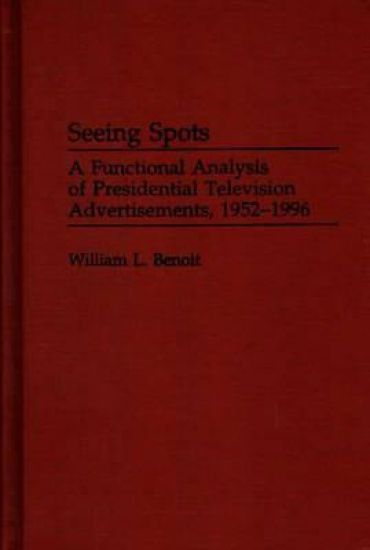
Seeing Spots

Seeing Spots

William L. Benoit

Praeger Publishers Inc
1999
sidottu
Benoit provides a comprehensive analysis of presidential television spots from every campaign that used this important message form, from the 1952 campaign through the last national campaign in 1996. More than 1,600 presidential spots are analyzed, from both primary and general campaigns. Republican, Democratic, and third party candidate advertisements are analyzed. He uses the Functional Theory of Political Campaign Discourse, analyzing themes in spots as acclaims (self-praise), attacks (criticism), and defenses (responses to attacks). Themes are classified according to topic. Each of these topics is broken down further (policy: past deeds, future plans, general goals; character: personal qualities, leadership ability, ideals). Contrasts are made between spots from Republicans and Democrats as well as third parties, incumbents and challengers, and winners and losers. The spots from candidates who led, trailed, or were in close races also are contrasted.Spots are becoming more negative over time, Benoit concludes, in both primary and general campaigns. General campaigns are more negative than primary campaigns, Democrats are more negative than Republicans, and challengers are more negative than incumbents. There are no differences between winners and losers. However, candidates who trailed throughout the campaign were most negative, while candidates in close races were most positive. An important analysis for scholars and researchers in political communication and American presidential politics.
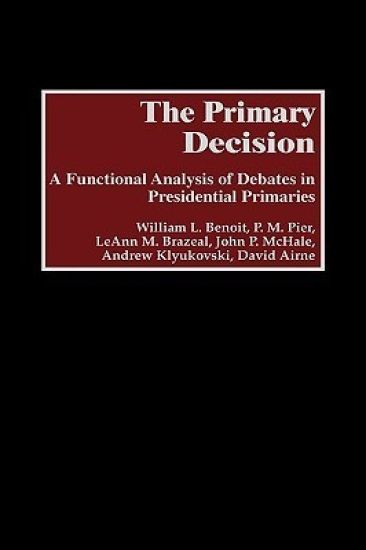
The Primary Decision

The Primary Decision

William L. Benoit

Praeger Publishers Inc
2001
sidottu
Benoit and his colleagues apply the functional theory of political campaign discourse to 25 presidential primary debates beginning with the 1948 American presidential primary campaign. They conclude with the 2000 presidential primaries.They identify the functions, topics, and targets of attacks, and the results are compared with research on primary TV spots and with general debates. An important resource for scholars and students of American presidential and party elections and political communications.
Islam against the West

Islam against the West

William L. Cleveland

University of Texas Press
1985
pokkari
This book gives a unique perspective on the interwar history of the Middle East. By telling the life story of one man, it illuminates the political and cultural struggles of an era. Shakib Arslan (1869–1946) was a leading member of the generation of Ottoman Arabs who came to professional maturity just before the final defeat of the Ottoman Empire. Born to a powerful Lebanese Druze family, Arslan grew up perfectly suited to his time and place in history. He was one of the leading writers of his day and a dexterous, ambitious politician. But, by the end of World War I, Arslan and others of his generation found themselves adrift in a world no longer of their choosing, as the once great Ottoman state lay broken before the West. Rather than retreating from public life in those dark days, however, Arslan emerged militant in his opposition to Western encroachment on Islamic lands and tireless in his crusade to bring the organizing principles of a universalist Islam to the age of emerging nation-states. Organizer, pamphleteer, diplomat, spokesman, and symbol, Arslan became one of the dominant, and most controversial, Muslim political figures in the two decades between the wars. His involvements were so varied and intense that to study his life is to bring into focus all the major political issues and intellectual currents of the era. By the end of his career he was both praised and vilified, but he was arguably the most widely read Arab author of his day. Curiously, Arslan has received relatively little attention in English-language research. This may well be due less to his contemporary importance than to the perspective from which Western scholarship has viewed Middle Eastern intellectual history. Arslan was not one of the winners. For many his evocation of the old imperial ideal and his insistence on the strategic importance of Islamic ideals seemed to be simply archaic protest in a secular age. But this impeccably researched and beautifully written biography demonstrates the power and importance of Arslan’s activist heritage, reinterpreting it for its own time and showing its importance for ours.
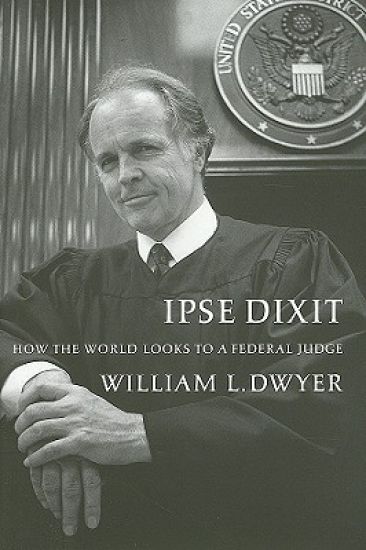
Ipse Dixit

Ipse Dixit

William L. Dwyer; Meade Emory

University of Washington Press
2007
sidottu
During William L. Dwyer's fifteen-year tenure as a U.S. District Court judge, he presided over many complex and groundbreaking cases. In one of his most controversial rulings, he engaged environmentalists and the timber industry in a heavily publicized and emotionally fraught battle over the territory of the northern spotted owl, ultimately approving the bird for "threatened species" status and forcing the Forest Service to substantially reduce logging in owl-habitat areas.Before his appointment to the district court in 1987, Dwyer had spent more than thirty years as a trial lawyer, never shying away from the most difficult cases. He argued the libel suit of accused Communist sympathizer John Goldmark; he represented newspaper employees in the contested proposal for a joint-operating agreement between the Seattle Times and Seattle Post-Intelligencer; and he brought a suit against baseball's American League that resulted in the return of the Mariners to Seattle.The fifteen speeches in this volume cover a span from 1978 to 2002 and reveal the breadth and scope of Dwyer's legal wisdom. He championed libraries as keepers of our language, ideas, and history; he taught students the history and philosophy of litigation; and he challenged members of the legal profession to do more pro bono work. His respect for the rule of law and his belief in the necessary contribution of lawyers to society come through clearly in his own words, whether he was speaking to the American Library Association, the Federal Bar Association, or first-year law students. The volume includes several speeches that express Dwyer's hopes for the American legal system. "If we use our heads," Dwyer avers, "we have the collective ability to survive and to let the rest of life survive with us."
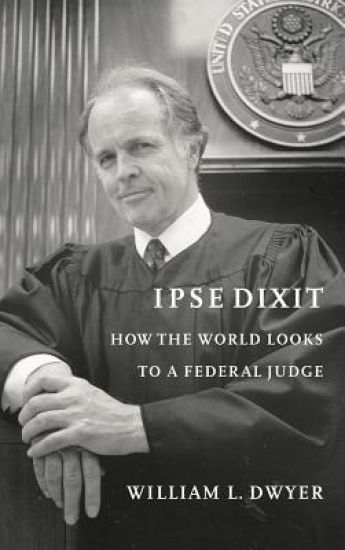
Ipse Dixit

Ipse Dixit

William L. Dwyer

University of Washington Press
2012
pokkari
During William L. Dwyer's fifteen-year tenure as a U.S. District Court judge, he presided over many complex and groundbreaking cases. In one of his most controversial rulings, he engaged environmentalists and the timber industry in a heavily publicized and emotionally fraught battle over the territory of the northern spotted owl, ultimately approving the bird for "threatened species" status and forcing the Forest Service to substantially reduce logging in owl-habitat areas.Before his appointment to the district court in 1987, Dwyer had spent more than thirty years as a trial lawyer, never shying away from the most difficult cases. He argued the libel suit of accused Communist sympathizer John Goldmark; he represented newspaper employees in the contested proposal for a joint-operating agreement between the Seattle Times and Seattle Post-Intelligencer; and he brought a suit against baseball's American League that resulted in the return of the Mariners to Seattle.The fifteen speeches in this volume cover a span from 1978 to 2002 and reveal the breadth and scope of Dwyer's legal wisdom. He championed libraries as keepers of our language, ideas, and history; he taught students the history and philosophy of litigation; and he challenged members of the legal profession to do more pro bono work. His respect for the rule of law and his belief in the necessary contribution of lawyers to society come through clearly in his own words, whether he was speaking to the American Library Association, the Federal Bar Association, or first-year law students. The volume includes several speeches that express Dwyer's hopes for the American legal system. "If we use our heads," Dwyer avers, "we have the collective ability to survive and to let the rest of life survive with us."
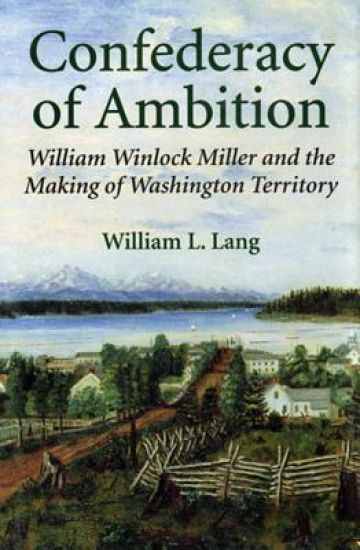
Confederacy of Ambition

Confederacy of Ambition

William L. Lang

University of Washington Press
2014
pokkari
The promise of opportunity drew twenty-seven-year-old Illinois schoolteacher William Winlock Miller west to the future Washington Territory in 1850. Like so many other Oregon Trail emigrants Miller arrived cash-poor and ambitious, but unlike most he fulfilled his grandest ambitions. By the time of his death in 1876, Miller had amassed one of the largest private fortunes in the territory and had used it creatively in developing the region's assets, leaving a significant mark on the territory's political and economic history.Appointed Surveyor of Customs at the newly created Port of Nisqually in 1851, Miller was the first federal official north of the Columbia River. Two years later he helped organize the new territory's Democratic Party and quickly became a political and financial confidant of governor Isaac Stevens. His involvement in the Indian conflict in 1855–56, a term in the territorial legislature, and his bankrolling of key politicians made him the territory's most effective political networker. His role as a "hip-pocket banker" in a region without established banks made him a powerful financial broker and a major player in territorial affairs.But in his pursuit of success Miller compromised another ambition he carried west from Illinois. He postponed marriage and family until only a few years before his death and agonized about relationships with his family in Illinois. His experience reminds us that the pioneer settlement era was a period of social dislocation and that public economic and political success could mask personal disappointment.Lang's biography takes readers into the heart of Washington territorial politics, where alliances often hinged more on mutual economic interest than political principles and nearly all agreed that government should encourage ambitious and energetic men. In this world, Lang argues, Miller succeeded because he parlayed his talents in camaraderie politics and sharp-pencil business affairs with an unabashed mining of governmental opportunities. William Lang's account of William Winlock Miller and the first quarter century of Washington's history offers a new view of the pioneer era, emphasizing that the West was developed in large measure by men like Miller who manipulated government and its resources to their own and the region's advantage.
The Goldmark Case

The Goldmark Case

William L. Dwyer

University of Washington Press
2017
pokkari
In 1962 John Goldmark, cattle rancher, Harvard Law School graduate, and distinguished three-term state legislator for a lightly populated area in north central Washington, was overwhelmingly defeated in his bid for reelection. He and his wife, Sally, had been accused of being communists by a small group of right-wing extremists. The Goldmarks sued their accusers for libel and when their case came to trial in the winter of 1963-64 it has become a cause celebre throughout the country.Witnesses of national reputation crossed the country to testify, the eastern press covered the case, and issues of civil liberties, the communist challenge to the values of American society, and the radical right movement were fought out before a rural jury. The charge that the American Civil Liberties Union was a communist front, among other issues, was litigated for the first time. Today the Goldmark trial can still tell us much about democracy, civil liberties, and trial by jury.William Dwyer was the Goldmarks' chief counsel. His gripping story of their nightmare and ultimate vindication is a classic of American trial court history. He provides a vivid picture of the political climate and its effect on everyone involved--plaintiffs, defendants, and counsel for both sides. In addition he gives us a fascinating description of the courtroom drama itself, revealed in the extensively quoted testimony, and a fascinating account of the way trial lawyers plan the strategy of a case: from jury selection, the questioning and cross-examination of witnesses, to final arguments.
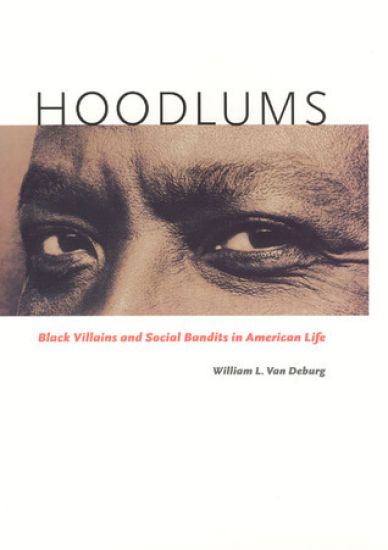
Slavery and Race in American Popular Culture

Slavery and Race in American Popular Culture

William L.Van Deburg

University of Wisconsin Press
1984
nidottu
In this ambitious work, William L. Van Deburg offers the first inter-disciplinary survey of American popular culture and its historical attitudes toward slavery and race. Spanning more than three centuries, from the colonial era to the present, Van Deburg's overview analyzes the works of American historians, dramatists, novelists, poets, lyricists, and filmmakers, and exposes, through those artists' often disquieting perceptions, the cultural underpinnings of our current racial attitudes and divisions. Anyone interested in American history, Afro-American studies, slavery, mass culture, or literature will find this work to be essential reading, both as far-ranging cultural history and as an important study of how we came to be a nation still enslaved by popular stereotypes,
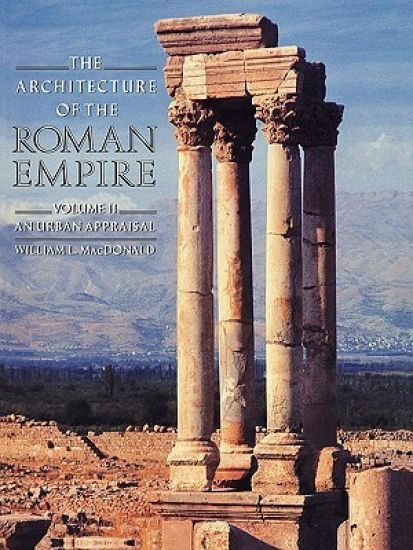
The Architecture of the Roman Empire

The Architecture of the Roman Empire

William L. MacDonald

Yale University Press
1988
pokkari
The author of a classic work on the architecture of imperial Rome here broadens his focus to present an original study of urban architecture in Roman market towns, port cities, veterans’ colonies, and major metropolitan centers throughout the empire.“Simply the best book on Roman urbanism [that] I know. . . . A formidable breakthrough. It brings to life the genius of Roman urbanism and reveals its continuing relevance for present urban planning and architecture.”—Leon Krier, Architects Journal“In this very fine book—the successor to his Introductory Study—William L. MacDonald lays before the reader the physical evidence of what a Roman city was like for its inhabitants. . . . The illustrations in An Urban Appraisal, this second volume of The Architecture of the Roman Empire, are superbly chosen, illuminating the text as well as being interesting in themselves. . . . It is a joy to find a book so attractively designed, worthy of both its author and his subject.”—Martin Henig, The Times Literary SupplementWinner of the 1986 Alice Davis Hitchcock Award of the Society of Architectural Historians for the most distinguished work of scholarship in architectural history.
Hebrews 1-8, Volume 47A

Hebrews 1-8, Volume 47A

William L. Lane

Zondervan
2015
sidottu
The Word Biblical Commentary delivers the best in biblical scholarship, from the leading scholars of our day who share a commitment to Scripture as divine revelation. This series emphasizes a thorough analysis of textual, linguistic, structural, and theological evidence. The result is judicious and balanced insight into the meanings of the text in the framework of biblical theology. These widely acclaimed commentaries serve as exceptional resources for the professional theologian and instructor, the seminary or university student, the working minister, and everyone concerned with building theological understanding from a solid base of biblical scholarship.Overview of Commentary OrganizationIntroduction—covers issues pertaining to the whole book, including context, date, authorship, composition, interpretive issues, purpose, and theology.Each section of the commentary includes:Pericope Bibliography—a helpful resource containing the most important works that pertain to each particular pericope.Translation—the author’s own translation of the biblical text, reflecting the end result of exegesis and attending to Hebrew and Greek idiomatic usage of words, phrases, and tenses, yet in reasonably good English.Notes—the author’s notes to the translation that address any textual variants, grammatical forms, syntactical constructions, basic meanings of words, and problems of translation.Form/Structure/Setting—a discussion of redaction, genre, sources, and tradition as they concern the origin of the pericope, its canonical form, and its relation to the biblical and extra-biblical contexts in order to illuminate the structure and character of the pericope. Rhetorical or compositional features important to understanding the passage are also introduced here.Comment—verse-by-verse interpretation of the text and dialogue with other interpreters, engaging with current opinion and scholarly research.Explanation—brings together all the results of the discussion in previous sections to expose the meaning and intention of the text at several levels: (1) within the context of the book itself; (2) its meaning in the OT or NT; (3) its place in the entire canon; (4) theological relevance to broader OT or NT issues.General Bibliography—occurring at the end of each volume, this extensive bibliographycontains all sources used anywhere in the commentary.
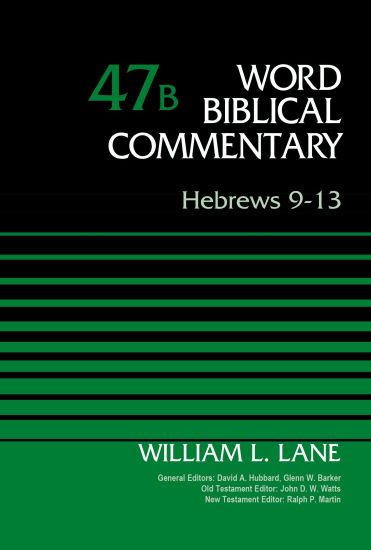
Hebrews 9-13, Volume 47B

Hebrews 9-13, Volume 47B

William L. Lane

Zondervan
2015
sidottu
The Word Biblical Commentary delivers the best in biblical scholarship, from the leading scholars of our day who share a commitment to Scripture as divine revelation. This series emphasizes a thorough analysis of textual, linguistic, structural, and theological evidence. The result is judicious and balanced insight into the meanings of the text in the framework of biblical theology. These widely acclaimed commentaries serve as exceptional resources for the professional theologian and instructor, the seminary or university student, the working minister, and everyone concerned with building theological understanding from a solid base of biblical scholarship.Overview of Commentary OrganizationIntroduction—covers issues pertaining to the whole book, including context, date, authorship, composition, interpretive issues, purpose, and theology.Each section of the commentary includes:Pericope Bibliography—a helpful resource containing the most important works that pertain to each particular pericope.Translation—the author’s own translation of the biblical text, reflecting the end result of exegesis and attending to Hebrew and Greek idiomatic usage of words, phrases, and tenses, yet in reasonably good English.Notes—the author’s notes to the translation that address any textual variants, grammatical forms, syntactical constructions, basic meanings of words, and problems of translation.Form/Structure/Setting—a discussion of redaction, genre, sources, and tradition as they concern the origin of the pericope, its canonical form, and its relation to the biblical and extra-biblical contexts in order to illuminate the structure and character of the pericope. Rhetorical or compositional features important to understanding the passage are also introduced here.Comment—verse-by-verse interpretation of the text and dialogue with other interpreters, engaging with current opinion and scholarly research.Explanation—brings together all the results of the discussion in previous sections to expose the meaning and intention of the text at several levels: (1) within the context of the book itself; (2) its meaning in the OT or NT; (3) its place in the entire canon; (4) theological relevance to broader OT or NT issues.General Bibliography—occurring at the end of each volume, this extensive bibliographycontains all sources used anywhere in the commentary.
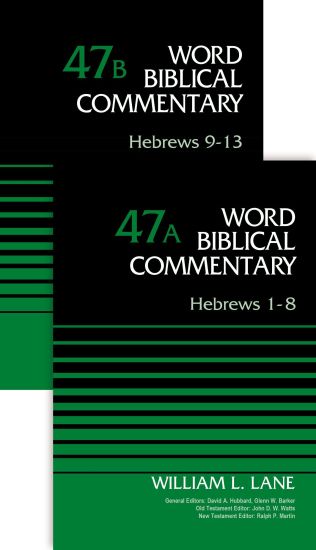
Hebrews (2-Volume Set---47A and 47B)

Hebrews (2-Volume Set---47A and 47B)

William L. Lane

Zondervan
2017
sidottu
The Word Biblical Commentary delivers the best in biblical scholarship, from the leading scholars of our day who share a commitment to Scripture as divine revelation. This series emphasizes a thorough analysis of textual, linguistic, structural, and theological evidence. The result is judicious and balanced insight into the meanings of the text in the framework of biblical theology. These widely acclaimed commentaries serve as exceptional resources for the professional theologian and instructor, the seminary or university student, the working minister, and everyone concerned with building theological understanding from a solid base of biblical scholarship.Overview of Commentary OrganizationIntroduction—covers issues pertaining to the whole book, including context, date, authorship, composition, interpretive issues, purpose, and theology.Each section of the commentary includes:Pericope Bibliography—a helpful resource containing the most important works that pertain to each particular pericope.Translation—the author’s own translation of the biblical text, reflecting the end result of exegesis and attending to Hebrew and Greek idiomatic usage of words, phrases, and tenses, yet in reasonably good English.Notes—the author’s notes to the translation that address any textual variants, grammatical forms, syntactical constructions, basic meanings of words, and problems of translation.Form/Structure/Setting—a discussion of redaction, genre, sources, and tradition as they concern the origin of the pericope, its canonical form, and its relation to the biblical and extra-biblical contexts in order to illuminate the structure and character of the pericope. Rhetorical or compositional features important to understanding the passage are also introduced here.Comment—verse-by-verse interpretation of the text and dialogue with other interpreters, engaging with current opinion and scholarly research.Explanation—brings together all the results of the discussion in previous sections to expose the meaning and intention of the text at several levels: (1) within the context of the book itself; (2) its meaning in the OT or NT; (3) its place in the entire canon; (4) theological relevance to broader OT or NT issues.General Bibliography—occurring at the end of each volume, this extensive bibliographycontains all sources used anywhere in the commentary.
Fifty Miles from Tomorrow: A Memoir of Alaska and the Real People
A NEW YORK TIMES BOOK REVIEW EDITORS' CHOICE An alternately charming and harrowing account of over 50 years of one remarkable native Alaskan's life - from living off the land north of the Arctic Circle, to the Alaskan senate, Hensely is a huge hero to his community. Born twenty-nine miles north of the arctic circle, William L. Iggiagruk Hensley was raised to live the seminomadic life that his I upiaq ancestors had lived for thousands of years. In this stirring memoir, he offers us a rare firsthand account of growing up Native Alaskan, and later, in the lower forty-eight, as a fearless advocate for Native land rights. In 1971, after years of tirelessly lobbying the United States government, he played a key role in a landmark victory that enabled the Inupiaq to take charge of their economic and political destiny. Fifty Miles from Tomorrow is "a joyous celebration of Hensley's life among the I upiaq people and of fighting for their rights" (Library Journal).
Resource Allocation and Productivity in Education

Resource Allocation and Productivity in Education

William L. Boyd; William T. Hartman

Praeger Publishers Inc
1998
sidottu
Resource allocation decisions made by school boards, principals, and teachers are critical for they determine the adequacy and equity of resources actually made available for specific schools, educational programs and individual students. The most important resources are often concealed by aggregate state or district measures such as dollars per student. For these decisions, the most important resources are elements such as basic and supplemental staffing levels, staff time, funding amounts for textbooks and supplies, selection of new equipment (particularly technology), and support for new or renovated facilities.The authors review current practices at each important decision-making level in school districts, from the school board to the classroom. At each juncture, the findings are interpreted to reveal both the causes of the practices and their implications for improving school effectiveness. This book provides new research in helping to inform and improve resource allocation practices in schools. The general conclusion is that improvement in the resource allocation practices in education requires a shift in focus to results instead of inputs, a strong emphasis on student learning as the primary focus of decisions, and systematic evaluation of results.