Kirjojen hintavertailu. Mukana 11 342 296 kirjaa ja 12 kauppaa.

Kirjahaku

Etsi kirjoja tekijän nimen, kirjan nimen tai ISBN:n perusteella.

135 tulosta hakusanalla "Solid-State Physics"

Principles of Magnetic Resonance: With Examples from Solid State Physics
""Principles of Magnetic Resonance: With Examples from Solid State Physics"" is a comprehensive guide to the principles of magnetic resonance, written by Charles Pence Slichter. The book covers the theoretical foundations of magnetic resonance, including the quantum mechanical description of spin systems, the Bloch equations, and the principles of relaxation and coherence. It also includes a detailed discussion of the experimental techniques used in magnetic resonance, such as nuclear magnetic resonance (NMR) and electron paramagnetic resonance (EPR), as well as their applications in solid state physics. The book is designed to be accessible to readers with a basic understanding of quantum mechanics and electromagnetism, and includes numerous examples and exercises to aid in understanding the material. It is an essential resource for researchers and students in physics, chemistry, materials science, and related fields who are interested in the principles and applications of magnetic resonance.This scarce antiquarian book is a facsimile reprint of the old original and may contain some imperfections such as library marks and notations. Because we believe this work is culturally important, we have made it available as part of our commitment for protecting, preserving, and promoting the world's literature in affordable, high quality, modern editions, that are true to their original work.

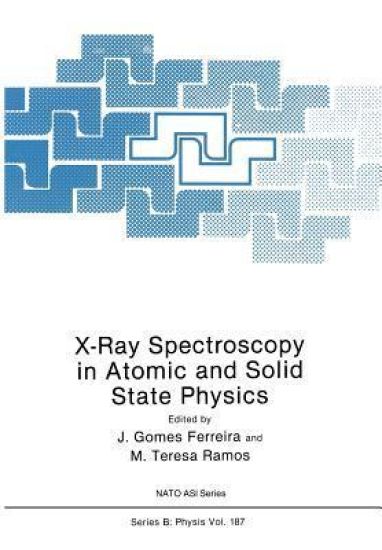
X-Ray Spectroscopy in Atomic and Solid State Physics
The fields of X-Ray Spectroscopy in Atomic and Solid State Physics have undergone spectacular growth, sometimes rather anarchic, during the past decade. The old mold of X-ray spectroscopy has been burst, and this ASI provided an in-depth exploration of theory and recently developed techniques; however, some work still needs to be done to create a new frame and reduce anarchy in the field. The purpose of this Institute was to gather atomic and solid state physicists working in theoretical and new experimental techniques recently developed. The lectures were concerned with, among others, the following fields: theory of X-ray near-edge structure, XPS and AES with conventional and synchrotron radiation sources, PIXE, EXAFS, SEXAFS, XRF, SXS, and molecular spectroscopy. The Institute considered in detail some of these experimental tech­ niques and the pertinent theoretical interpretations by selecting an important list of lectures which summarize the scientific contents of the ASI. The truly international character of this NATO ASI, its size, and the high quality of the lecturers contributed to make this school a very fruitful scientific meeting. Two to four general lectures were given each working day and three afternoons were reserved for presentation of current work in the form of posters. We think that these poster presentations reflect the current research work of the participants.
Local Density Approximations in Quantum Chemistry and Solid State Physics

Local Density Approximations in Quantum Chemistry and Solid State Physics

Jens Peder Dahl; John Avery

Springer-Verlag New York Inc.
2013
nidottu
The· simplest picture of an atom, a molecule or a solid is the picture of its distribution of charge. It is obtained by specifying the positions of the atomic nuclei and by showing how the density, p(E), of the electronic charge-cloud varies from place to place. A much more detailed picture is provided by the many-electron wavefunction. This quantity shows not only the arrangement of the electrons with respect to the nuclei, but also the arrangement of the electrons with respect to each other, and it allows the evaluation of the total energy and other properties. The many-electron wavefunction is in principle obtained by solving the many-electron Schrodinger equation for the motion of the interacting electrons under the influ­ ence of the nuclei, but in practice the equation is unsolvable, and it is necessary to proceed by methods of approximation. Needless to say, .such methods will as a rule depend on the complexity of the system considered.
Analysis of certain random operators related to solid state physics

Analysis of certain random operators related to solid state physics

Maxim Drabkin

Sudwestdeutscher Verlag Fur Hochschulschriften AG
2016
pokkari
The presented book is about the random Kronig-Penney model and other related quantum mechanical models. The main objects in consideration are random mostly one dimensional and discrete Schr dinger operators and their spectral properties. From the physical point of view the most interesting objects in these models are conductivity and charge transport in disordered solid media. These show different behavior than the ordered systems. For the Kronig-Penney model lower bounds on the growth of the time-averaged q-th moment of the position operator X are obtained, as well as the perturbative analysis of the Lyapunov exponent and the integrated density of states. On the technical level the theory of the products of random matrices is used. It is known, that the products of random matrices exhibit Gaussian fluctuations around almost surely convergent Lyapunov exponents. For the 2x2 matrices the variance is calculated perturbatively. Furthermore for the random Bogoliubov-de Gennes model operators the localization in the spectral gap is proven.
Exploring Electron-Electron Interactions in Solid-State Physics
Introduction In this thesis, we delve into the application of quantum mechanics to electrons in solids, a concept initially introduced by Sommerfeld 1]. At the outset, this approach assumed that all valence electrons were free, effectively disregarding both electron-electron and electron-lattice interactions within the model. These two interactions serve as the central focus of our investigation.Free-Electron Theory The free-electron theory effectively accounted for the small heat capacity and magnetic susceptibility of metals. At finite temperatures, the number of electrons contributing to thermal or transport properties is proportional to kBT divided by EF, where EF represents the Fermi energy. Consequently, properties such as specific heat scale with an order of magnitude of kBT divided by EF.Formation of Energy Bands Within a solid, numerous atomic orbitals overlap with each other, resulting in a complex interplay of electronic states. If we commence with N atomic levels, this leads to N 2 molecular orbitals. Half of these molecular orbitals possess lower energies compared to the atomic energies, while the other half exhibit higher energies. The energy gap between these "molecular levels" diminishes as atoms approach one another, eventually forming a quasi-continuous spectrum of energy levels known as an energy band. This assumption, although reasonable, should be considered alongside the presence of closely spaced energy levels.Metals and Insulators The formation of energy bands is depicted schematically in Figure 1.1. In band theory, a clear distinction arises between metals and insulators. A material hosting one or more partially filled bands is categorized as a metal. At absolute zero temperature, electrons occupy energy states up to a maximum energy level known as the Fermi energy (EF), leaving higher energy states unoccupied. When an electric field is applied, electrons can freely migrate to these empty higher energy states, enabling electrical conduction. Prominent examples of such materials include alkali metals found in the periodic table, such as Li, Na, K, Rb, and Cs.Conversely, insulators (or semiconductors) present a different scenario, with lower-energy bands being fully occupied, while higher-energy bands remain unoccupied. An energy gap (Eg) exists between these occupied and unoccupied bands. Consequently, the density of states (N(E)) at the Fermi energy (EF) is zero for insulators. Figure 1.2 illustrates the density of states for a typical metal.Conclusion This thesis explores the intricacies of these interactions and energy bands, shedding light on the fundamental distinctions between metals and insulators, and their implications for the behavior of electrons in solids.
Part I: Physical Chemistry. Part II: Solid State Physics

Part I: Physical Chemistry. Part II: Solid State Physics

Springer-Verlag Berlin and Heidelberg GmbH Co. K
2012
nidottu
The fourth volume of the Collected Works is devoted to Wigner's contribution to physical chemistry, statistical mechanics and solid-state physics. In his annotation to the first part, N. Balazs clearly points out Wigner's role in early quantum chemistry and applied statistical mechanics. One corner stone was his introducing of what is now called the Wigner function, and his paper on adiabatic perturbations foreshadowed later work on Berry phases. Although few in number, Wigner's articles on solid-state physics laid the ground for the modern theory of the electronic structure of metals. W. Kohn writes about this in his annotation to Part 2 of the book and he also points out Wigner's great influence in the development of solid-state theory.
Epioptics-8 - Proceedings Of The 33rd Course Of The International School Of Solid State Physics
This volume contains the proceedings of the 8th Epioptics Workshop, held at the Ettore Majorana Foundation and Centre for Scientific Culture, Erice, Sicily. The book assesses the capabilities of state-of-the-art optical techniques in elucidating the fundamental electronic and structural properties of semiconductor and metal surfaces, interfaces, thin layers, and layer structures. The contributions consider the usefulness of these techniques for optimization of high quality multilayer samples through feedback control during materials growth and processing. Particular emphasis is placed on the theory of non-linear optics and on dynamical processes through the use of pump-probe techniques together with the search for new optical sources. Some new applications of Scanning Near-field Optical Microscopy to material science and biological samples, dried and in vivo, with the use of different laser sources are also included.
Epioptics-9 - Proceedings Of The 39th Course Of The International School Of Solid State Physics
This special volume contains the proceedings of the 9th Epioptics Workshop, held at the Ettore Majorana Foundation and Centre for Scientific Culture, Erice, Sicily, from July 20 to 26, 2006. The workshop was the 9th in the Epioptics series and the 39th of the International School of Solid State Physics.The workshop was aimed at assessing the capabilities of state-of-the-art optical techniques in elucidating the fundamental electronic and structural properties of semiconductor and metal surfaces, interfaces, thin layers, and layer structures, and at assessing the usefulness of these techniques for optimization of high-quality multilayer samples through feedback control during materials growth and processing. Particular emphasis is dedicated to the theory of non-linear optics and to dynamical processes through the use of pump-probe techniques together with the search for new optical sources. Some new applications of scanning probe microscopy to material science and biological samples, dried and in vivo, with the use of different laser sources are also presented.
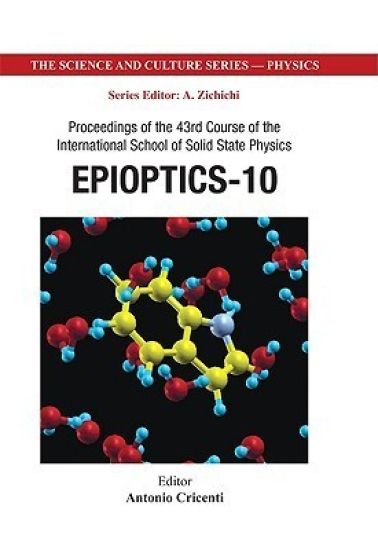
Epioptics-10 - Proceedings Of The 43rd Course Of The International School Of Solid State Physics
The book is aimed at assessing the capabilities of state-of-the-art optical techniques in elucidating the fundamental electronic and structural properties of semiconductor and metal surfaces, interfaces, thin layers, and layer structures, and assessing the usefulness of these techniques for optimization of high quality multilayer samples through feedback control during materials growth and processing. Particular emphasis is placed on the theory of non-linear optics and dynamical processes through the use of pump-probe techniques together with the search for new optical sources. Some new applications of Scanning Probe Microscopy to Material science and biological samples, dried and in vivo, with the use of different laser sources are also presented. Materials of special interest are silicon, semiconductor-metal interfaces, semiconductor and magnetic multi-layers and III-V compound semiconductors.
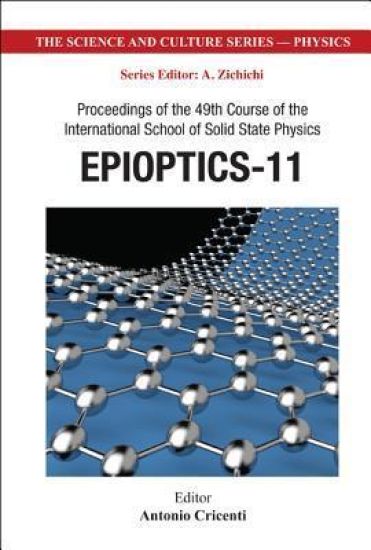
Epioptics-11 - Proceedings Of The 49th Course Of The International School Of Solid State Physics
The book is aimed at assessing the capabilities of state-of-the-art optical techniques in elucidating the fundamental electronic and structural properties of semiconductor and metal surfaces, interfaces, thin layers, and layer structures, and assessing the usefulness of these techniques for optimization of high quality multilayer samples through feedback control during materials growth and processing. Particular emphasis is dedicated to the theory of nonlinear optics and to dynamical processes through the use of pump-probe techniques together with the search for new optical sources. Some new applications of Scanning Probe Microscopy to Material Science and biological samples, dried and in vivo, with the use of different laser sources are also presented. Materials of particular interest are silicon, semiconductor-metal interfaces, semiconductor and magnetic multi-layers and III-V compound semiconductors.
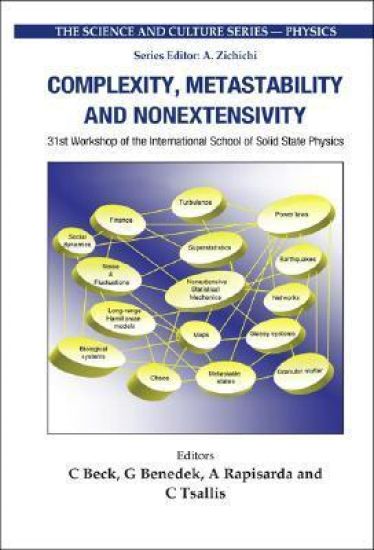
Complexity, Metastability And Nonextensivity - Proceedings Of The 31st Workshop Of The International School Of Solid State Physics
A broad introduction and overview of current interdisciplinary studies on complexity, this volume is an ideal starting point for scientists and graduate students who wish to enter the field. The book features a diverse collection of the latest research work not found in a single volume elsewhere.Among the highly regarded contributors to the volume are the 2004 Boltzmann medalists E G D Cohen and H E Stanley; G Parisi, Boltzmann medalist in 1992 and Dirac medalist in 1999; and numerous internationally renowned experts, such as S Abe, F T Arecchi, J-P Bouchaud, A Coniglio, W Ebeling, P Grigolini, R Mantegna, M Paczuski, A Robledo, L Pietronero, A Vespignani, and T Vicsek.