Kirjojen hintavertailu. Mukana 11 342 296 kirjaa ja 12 kauppaa.

Kirjahaku

Etsi kirjoja tekijän nimen, kirjan nimen tai ISBN:n perusteella.

1000 tulosta hakusanalla Adam Levin

Adam's Curse

Adam's Curse

Denis Donoghue

University of Notre Dame Press
2001
sidottu
Taking its title from a poem of William Butler Yeats, this collection of essays focuses on "Adam's Curse"—the burdens and harsh conditions that, as Denis Donoghue underscores throughout, make any human achievement difficult. As he says, those "conditions include at various levels of reference the Fall of Man, categorical failure, loss, the limitations inscribed so insistently in human life that they seem to be in the nature of things, like death and weather." But hope is never ruled out, as Donoghue reminds us of "the possibility of putting up with the conditions and turning them to some account." It is the "putting up with the conditions and turning them to some account"—a post-lapsarian struggle fraught with religious questions—that most interests Donoghue. These essays, which are explorations of both faith and literary works that engage faith, address a dazzling range of texts and writers: Yeats, Milton, Larkin, Heaney, Emmanuel Levinas, Alasdair MacIntyre, John Crowe Ransom, Henry Adams, William Lynch's Christ and Apollo, and Robert Bellah's Beyond Belief, among others. Common to all is an alertness to the social bearing of literature and the role it plays in relation to politics, religion, and especially ethics. What emerges, for Donoghue, is the need to restore the primacy of theology and church doctrine without evading the "dark parts" of the Old and New Testaments. Through his probing, reflective encounters with philosophical and religious issues, we witness a magisterial intelligence at work.
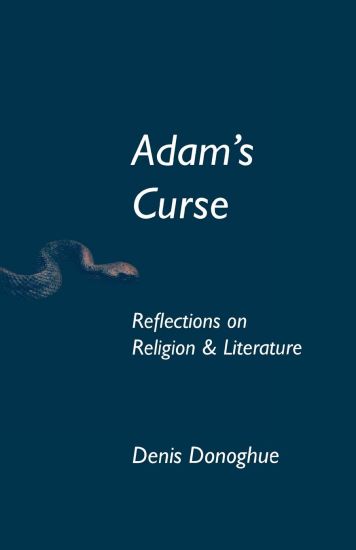
Adam's Curse

Adam's Curse

Denis Donoghue

University of Notre Dame Press
2001
nidottu
Taking its title from a poem of William Butler Yeats, this collection of essays focuses on "Adam's Curse"—the burdens and harsh conditions that, as Denis Donoghue underscores throughout, make any human achievement difficult. As he says, those "conditions include at various levels of reference the Fall of Man, categorical failure, loss, the limitations inscribed so insistently in human life that they seem to be in the nature of things, like death and weather." But hope is never ruled out, as Donoghue reminds us of "the possibility of putting up with the conditions and turning them to some account." It is the "putting up with the conditions and turning them to some account"—a post-lapsarian struggle fraught with religious questions—that most interests Donoghue. These essays, which are explorations of both faith and literary works that engage faith, address a dazzling range of texts and writers: Yeats, Milton, Larkin, Heaney, Emmanuel Levinas, Alasdair MacIntyre, John Crowe Ransom, Henry Adams, William Lynch's Christ and Apollo, and Robert Bellah's Beyond Belief, among others. Common to all is an alertness to the social bearing of literature and the role it plays in relation to politics, religion, and especially ethics. What emerges, for Donoghue, is the need to restore the primacy of theology and church doctrine without evading the "dark parts" of the Old and New Testaments. Through his probing, reflective encounters with philosophical and religious issues, we witness a magisterial intelligence at work.
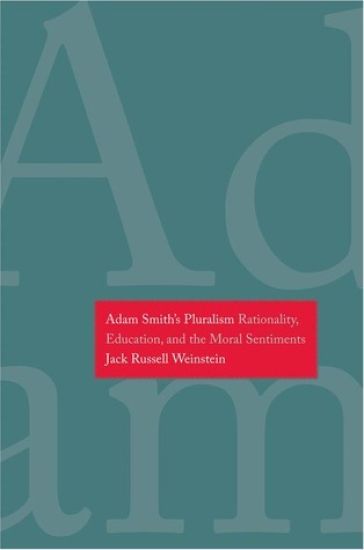
Adam Smith's Pluralism

Adam Smith's Pluralism

Jack Russell Weinstein

Yale University Press
2013
sidottu
In this thought-provoking study, Jack Russell Weinstein suggests the foundations of liberalism can be found in the writings of Adam Smith (1723–1790), a pioneer of modern economic theory and a major figure in the Scottish Enlightenment. While offering an interpretive methodology for approaching Smith’s two major works, The Theory of Moral Sentiments and The Wealth of Nations, Weinstein argues against the libertarian interpretation of Smith, emphasizing his philosophies of education and rationality. Weinstein also demonstrates that Smith should be recognized for a prescient theory of pluralism that prefigures current theories of cultural diversity.
Adam Smith and the Origins of American Enterprise
Adam Smith was a Scottish professor of moral philosophy. He published his classic "The Wealth of Nations" in 1776, the year the American Revolution began. Smith became widely known for his ideas of free markets, laissez-faire commerce, and the "invisible hand." Yet English politicians, landed gentry, and the nobility paid little attention and enacted none of Smith's suggested reforms.The American colonies, however, began their existence as an independent nation in 1781 with no money, no industry, no banks, and deep in debt. The Founding Fathers-particularly Alexander Hamilton, James Madison, and Benjamin Franklin-turned to the ideas of Adam Smith to create and jump-start an economic system for America with both immediate and long-sustained results.This little-known but vital part of U.S. history is now revealed in Roy C. Smith's highly readable new book.
Adam Smith: International Perspectives

Adam Smith: International Perspectives

Hiroshi Mizuta; Chuhei Sugiyama

Palgrave Macmillan
1992
sidottu
Adam Smith (1723-90) is well known as the author of The Wealth of Nations and as a champion of free enterprise but he also wrote on moral philosophy and lectured on rhetoric and jurisprudence. This collection reveals a new portrait of the well known economist, not as a simple-minded champion of free trade but as an interdisciplinary social scientist with a moral philosophy for the modern world. His legacy should not be restricted to economics and to the English-speaking world.
Adam's Blues

Adam's Blues

Richard Leach

Lulu.com
2019
pokkari
""I remember, I remember, how the garden used to be./We had everything we wanted, except for that one tree."" Those lines are from ""Adam's Blues,"" title piece and first entry in this collection. The book continues with poems on Adam and Eve in Eden and in the 21st century; a summer blockbuster superhero psalm (""Sheol my arch-nemesis/sent his minions after me/They trapped me in a death net/and hit me with a hydro-blast""); poems which travel from the Apostles' Creed to unexpected destinations (""They say I'm lucky/to be here in the Creed,"" says Pontius Pilate); and more. Humorous, thoughtful and poignant poems in rhyme or free verse. Richard Leach is a poet and visual artist in Stamford, Connecticut. His sacred poetry, words for hymns and anthems, has been set to music by many composers and is widely published and sung. Since 2009 he has written secular verse on many topics and in many forms.
Adam & Andy. The Complete Adventures 2005-2013
The existentially thrilling and mundane adventures of Adam (mild neurotic), Andy (cheerful slob), Baxter (spoiled beagle) and their friends in the fictional town of Woodfield, Connecticut. This deluxe reprint volume includes all episodes of the long-running comic strip feature from January 2005 through December 2013.
Adam in Seventeenth Century Political Writing in England and New England
Designed to contribute to a greater understanding of the religious foundations of seventeenth century political writing, this study offers a detailed exploration of the significance of the figure and story of Adam at that time. The book investigates seventeenth-century writings from England and New England-examining writings by Roger Williams and John Eliot, Gerrard Winstanley, John Milton, and John Locke-to explore the varying significance afforded to the Biblical figure of Adam in theories of the polity. In so doing, it counters over-simplified views of modern secular political thought breaking free from the confines of religion, by showing the diversity of political models and possibilities that Adamic theories supported. It provides contextual background for the appreciation of seventeenth-century culture and other cultural artefacts, and feeds into current scholarly interest in the relationship between religion and the public sphere, and in stories of origins and Creation.
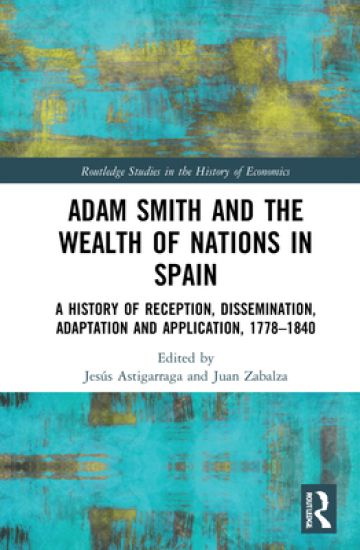
Adam Smith and The Wealth of Nations in Spain
Adam Smith’s An Inquiry into the Nature and Causes of the Wealth of Nations was the product of the rich tradition of the Scottish Enlightenment but the book’s fame immediately spread across the whole of Europe. This book looks at the long journey of Smith’s ideas from Scotland to peninsular Spain, reconstructing in detail the reception, adaptation, interpretation, and application of Smith's central concepts from 1777 up to 1840. In light of methodological advances during the last two decades in the history of economic thought and the studies on the late Spanish Enlightenment and early Liberalism, the book tackles a series of significant issues and gaps in the historiography. In particular: this book sheds new light on the role of France as an intermediate step as the ideas spread from Britain southwards; the analysis draws not just on translations but also handwritten materials, book reviews, syntheses, summaries, plagiarism and rebuttals; a wide range of methods of dissemination are considered including the printing press and periodicals, parliamentary debates, academic chairs and societies; the role of individual translators and agents is given due prominence; the political interpretations of the Wealth of Nations and the ways in which the book was incorporated into the work of Spanish economists in the decades following publication are also considered.This book marks a significant contribution to the literature on the reception of Smith’s Wealth of Nations, studies of the Spanish Enlightenment and history of economic thought more broadly.
Adam Smith and The Wealth of Nations in Spain
Adam Smith’s An Inquiry into the Nature and Causes of the Wealth of Nations was the product of the rich tradition of the Scottish Enlightenment but the book’s fame immediately spread across the whole of Europe. This book looks at the long journey of Smith’s ideas from Scotland to peninsular Spain, reconstructing in detail the reception, adaptation, interpretation, and application of Smith's central concepts from 1777 up to 1840. In light of methodological advances during the last two decades in the history of economic thought and the studies on the late Spanish Enlightenment and early Liberalism, the book tackles a series of significant issues and gaps in the historiography. In particular: this book sheds new light on the role of France as an intermediate step as the ideas spread from Britain southwards; the analysis draws not just on translations but also handwritten materials, book reviews, syntheses, summaries, plagiarism and rebuttals; a wide range of methods of dissemination are considered including the printing press and periodicals, parliamentary debates, academic chairs and societies; the role of individual translators and agents is given due prominence; the political interpretations of the Wealth of Nations and the ways in which the book was incorporated into the work of Spanish economists in the decades following publication are also considered.This book marks a significant contribution to the literature on the reception of Smith’s Wealth of Nations, studies of the Spanish Enlightenment and history of economic thought more broadly.
Adam's Curse

Adam's Curse

Bryan Sykes

WW Norton Co
2005
pokkari
By the nationally best-selling author of "The Seven Daughters of Eve," "Adam's Curse" investigates the ultimate evolutionary crisis: a man-free future. How is it possible that the Y chromosome, which separated the sexes and allowed humans to rise to the apex of the animal kingdom, also threatens to destroy sexual reproduction altogether? Bryan Sykes confronts recent advances in evolutionary theory to find the answers to the questions that inexorably follow: Is there a genetic cause for men's greed, aggression, and promiscuity? Could a male homosexual gene possibly exist? A must read for anyone interested in popular science, family genealogy, and today's infertility crisis, "Adam's Curse" provokes a shocking debate on the nature of sexual reproduction.
The Essential Adam Smith

The Essential Adam Smith

Adam Smith

WW Norton Co
1987
nidottu
The sheer strength of his great work, The Wealth of Nations, discourages many from attempting to explore its rich and lucid arguments. In this brilliantly crafted volume, one of the most eminent economists of our day provides a generous selection from the entire body of Smith's work, ranging from his fascinating psychological observations on human nature to his famous treatise on what Smith called a "society of natural liberty," The Wealth of Nations. Among the works represented in this volume in addition to The Wealth of Nations are The History of Astronomy, Lectures on Jurisprudence, The Theory of Moral Sentiments, and Smith's correspondence with David Hume. Before each of Smith's writings Robert Heilbroner presents a clear and lively discussion that will interest the scholar as much as it will clarify the work for the non-specialist. Adam Smith emerges from this collection of his writings, as he does from his portrait in Professor Heilbroner's well-known book, as the first economist to deserve the title of "worldly philosopher."
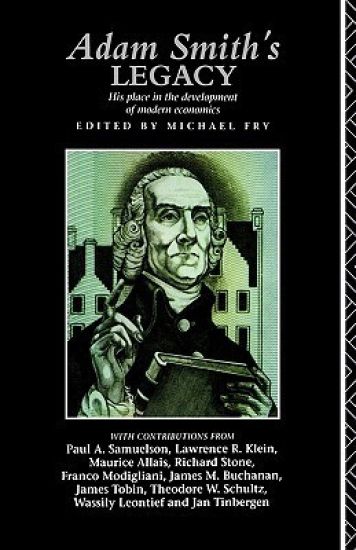
Adam Smith's Legacy
Although Adam Smith, the father of modern economics, died over two hundred years ago his presence is still felt in many areas of contemporary economics. In this volume some of the world's leading economists pay tribute to Smith's continuing importance. The contributors, including ten Nobel Laureates, consider themes as diverse as Smith's use of data, his attitude to human capital and his views on economic policy. Heirs to Smith as leaders of the discipline, they also reflect upon the current state of economics, assessing the extent to which it measures up to the benchmark established by its founder.
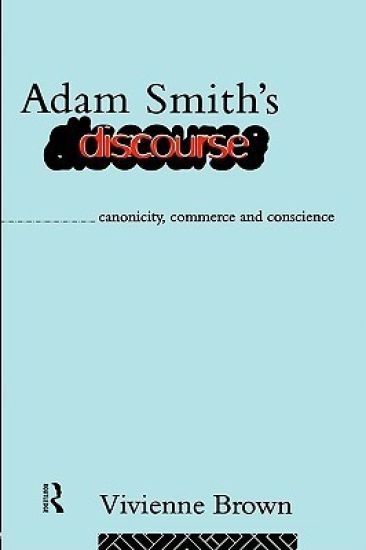
Adam Smith's Discourse

Adam Smith's Discourse

Vivienne Brown

Routledge
1994
sidottu
Adam Smith's name has become synonymous with free market economics; The Wealth of Nations is taken as the definitive account of the benefits of free competitive markets. Yet recent scholarship has challenged this view and given us a richer, more nuanced figure, steeped in the intricacies of enlightenment social and political philosophy. Adam Smith's Discourse both develops this literature and gives it a radical new extension by taking into account recent debates in literary theory.
Adam Smith
Adam Smith:Second Series completes the project of the earlier assessments by making available the many significant articles which have appeared subsequently. Providing immediate access to one of the world's greatest economics theorists.
Adam Smith's Discourse

Adam Smith's Discourse

Vivienne Brown

Routledge
1994
nidottu
Adam Smith's name has become synonymous with free market economics; The Wealth of Nations is taken as the definitive account of the benefits of free competitive markets. Yet recent scholarship has challenged this view and given us a richer, more nuanced figure, steeped in the intricacies of enlightenment social and political philosophy. Adam Smith's Discourse both develops this literature and gives it a radical new extension by taking into account recent debates in literary theory.