Kirjojen hintavertailu. Mukana 11 717 486 kirjaa ja 12 kauppaa.

Kirjahaku

Etsi kirjoja tekijän nimen, kirjan nimen tai ISBN:n perusteella.

833 tulosta hakusanalla Ajith Fernando

Tree-Structure based Hybrid Computational Intelligence

Tree-Structure based Hybrid Computational Intelligence

Yuehui Chen; Ajith Abraham

Springer-Verlag Berlin and Heidelberg GmbH Co. K
2009
sidottu
Research in computational intelligence is directed toward building thinking machines and improving our understanding of intelligence. As evident, the ultimate achievement in this field would be to mimic or exceed human cognitive capabilities including reasoning, recognition, creativity, emotions, understanding, learning and so on. In this book, the authors illustrate an hybrid computational intelligence framework and it applications for various problem solving tasks. Based on tree-structure based encoding and the specific function operators, the models can be flexibly constructed and evolved by using simple computational intelligence techniques. The main idea behind this model is the flexible neural tree, which is very adaptive, accurate and efficient. Based on the pre-defined instruction/operator sets, a flexible neural tree model can be created and evolved. This volume comprises of 6 chapters including an introductory chapter giving the fundamental definitions and the last Chapter provides some important research challenges. Academics, scientists as well as engineers engaged in research, development and application of computational intelligence techniques and data mining will find the comprehensive coverage of this book invaluable.
Metaheuristic Clustering

Metaheuristic Clustering

Swagatam Das; Ajith Abraham; Amit Konar

Springer-Verlag Berlin and Heidelberg GmbH Co. K
2010
nidottu
Cluster analysis means the organization of an unlabeled collection of objects or patterns into separate groups based on their similarity. The task of computerized data clustering has been approached from diverse domains of knowledge like graph theory, multivariate analysis, neural networks, fuzzy set theory, and so on. Clustering is often described as an unsupervised learning method but most of the traditional algorithms require a prior specification of the number of clusters in the data for guiding the partitioning process, thus making it not completely unsupervised. Modern data mining tools that predict future trends and behaviors for allowing businesses to make proactive and knowledge-driven decisions, demand fast and fully automatic clustering of very large datasets with minimal or no user intervention. In this volume, we formulate clustering as an optimization problem, where the best partitioning of a given dataset is achieved by minimizing/maximizing one (single-objective clustering) or more (multi-objective clustering) objective functions. Using several real world applications, we illustrate the performance of several metaheuristics, particularly the Differential Evolution algorithm when applied to both single and multi-objective clustering problems, where the number of clusters is not known beforehand and must be determined on the run. This volume comprises of 7 chapters including an introductory chapter giving the fundamental definitions and the last Chapter provides some important research challenges. Academics, scientists as well as engineers engaged in research, development and application of optimization techniques and data mining will find the comprehensive coverage of this book invaluable.
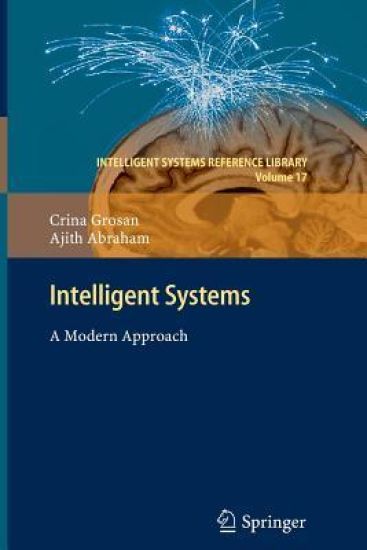
Intelligent Systems

Intelligent Systems

Crina Grosan; Ajith Abraham

Springer-Verlag Berlin and Heidelberg GmbH Co. K
2011
sidottu
Computational intelligence is a well-established paradigm, where new theories with a sound biological understanding have been evolving. The current experimental systems have many of the characteristics of biological computers (brains in other words) and are beginning to be built to perform a variety of tasks that are difficult or impossible to do with conventional computers. As evident, the ultimate achievement in this field would be to mimic or exceed human cognitive capabilities including reasoning, recognition, creativity, emotions, understanding, learning and so on. This book comprising of 17 chapters offers a step-by-step introduction (in a chronological order) to the various modern computational intelligence tools used in practical problem solving. Staring with different search techniques including informed and uninformed search, heuristic search, minmax, alpha-beta pruning methods, evolutionary algorithms and swarm intelligent techniques; the authors illustrate the design of knowledge-based systems and advanced expert systems, which incorporate uncertainty and fuzziness. Machine learning algorithms including decision trees and artificial neural networks are presented and finally the fundamentals of hybrid intelligent systems are also depicted. Academics, scientists as well as engineers engaged in research, development and application of computational intelligence techniques, machine learning and data mining would find the comprehensive coverage of this book invaluable.
Tree-Structure based Hybrid Computational Intelligence

Tree-Structure based Hybrid Computational Intelligence

Yuehui Chen; Ajith Abraham

Springer-Verlag Berlin and Heidelberg GmbH Co. K
2012
nidottu
Research in computational intelligence is directed toward building thinking machines and improving our understanding of intelligence. As evident, the ultimate achievement in this field would be to mimic or exceed human cognitive capabilities including reasoning, recognition, creativity, emotions, understanding, learning and so on. In this book, the authors illustrate an hybrid computational intelligence framework and it applications for various problem solving tasks. Based on tree-structure based encoding and the specific function operators, the models can be flexibly constructed and evolved by using simple computational intelligence techniques. The main idea behind this model is the flexible neural tree, which is very adaptive, accurate and efficient. Based on the pre-defined instruction/operator sets, a flexible neural tree model can be created and evolved. This volume comprises of 6 chapters including an introductory chapter giving the fundamental definitions and the last Chapter provides some important research challenges. Academics, scientists as well as engineers engaged in research, development and application of computational intelligence techniques and data mining will find the comprehensive coverage of this book invaluable.
Intelligent Systems

Intelligent Systems

Crina Grosan; Ajith Abraham

Springer-Verlag Berlin and Heidelberg GmbH Co. K
2013
nidottu
Computational intelligence is a well-established paradigm, where new theories with a sound biological understanding have been evolving. The current experimental systems have many of the characteristics of biological computers (brains in other words) and are beginning to be built to perform a variety of tasks that are difficult or impossible to do with conventional computers. As evident, the ultimate achievement in this field would be to mimic or exceed human cognitive capabilities including reasoning, recognition, creativity, emotions, understanding, learning and so on. This book comprising of 17 chapters offers a step-by-step introduction (in a chronological order) to the various modern computational intelligence tools used in practical problem solving. Staring with different search techniques including informed and uninformed search, heuristic search, minmax, alpha-beta pruning methods, evolutionary algorithms and swarm intelligent techniques; the authors illustrate the design of knowledge-based systems and advanced expert systems, which incorporate uncertainty and fuzziness. Machine learning algorithms including decision trees and artificial neural networks are presented and finally the fundamentals of hybrid intelligent systems are also depicted. Academics, scientists as well as engineers engaged in research, development and application of computational intelligence techniques, machine learning and data mining would find the comprehensive coverage of this book invaluable.
Risk Assessment Models for Cloud Computing

Risk Assessment Models for Cloud Computing

Nada Ahmed; Ajith Abraham

LAP Lambert Academic Publishing
2018
pokkari
Cloud computing moves computing and data away from desktop and mobile devices into large data center distributed around the world. As a result, this will create a need for a considerable risk assessment approach to manage the various types of risks. Risk assessment is a concept that has developed to the point where it has the potential to address current limitations in cloud computing assessment methodologies. The novelty of this book comes from the use of machine learning technique as a novel and efficient technique to assess risk in cloud computing environment. To build the model; first data mining algorithms are applied, then the ensemble method is used to combine the outputs of the data mining algorithms. The results of this research demonstrate the strengths of the use of data mining algorithms to assess risks, and it indicates that the methodology of using ensemble of machine learning algorithm represent a valuable alternative to existing methodologies.