Kirjojen hintavertailu. Mukana 12 390 323 kirjaa ja 12 kauppaa.

Kirjahaku

Etsi kirjoja tekijän nimen, kirjan nimen tai ISBN:n perusteella.

1000 tulosta hakusanalla Anna M. Morrison

Gender, Empire, and Postcolony

Gender, Empire, and Postcolony

Anna M. Klobucka

Palgrave Macmillan
2015
nidottu
Analyzing a wide body of cultural texts, including literature, film, and other visual arts, Gender, Empire, and Postcolony: Luso-Afro-Brazilian Intersections is a diverse collection of essays on gender in Portuguese colonialism and Lusophone postcolonialism.
Sir Philip Sidney

Sir Philip Sidney

Anna M Stoddart

Palala Press
2018
pokkari
This work has been selected by scholars as being culturally important, and is part of the knowledge base of civilization as we know it. This work was reproduced from the original artifact, and remains as true to the original work as possible. Therefore, you will see the original copyright references, library stamps (as most of these works have been housed in our most important libraries around the world), and other notations in the work.This work is in the public domain in the United States of America, and possibly other nations. Within the United States, you may freely copy and distribute this work, as no entity (individual or corporate) has a copyright on the body of the work.As a reproduction of a historical artifact, this work may contain missing or blurred pages, poor pictures, errant marks, etc. Scholars believe, and we concur, that this work is important enough to be preserved, reproduced, and made generally available to the public. We appreciate your support of the preservation process, and thank you for being an important part of keeping this knowledge alive and relevant.
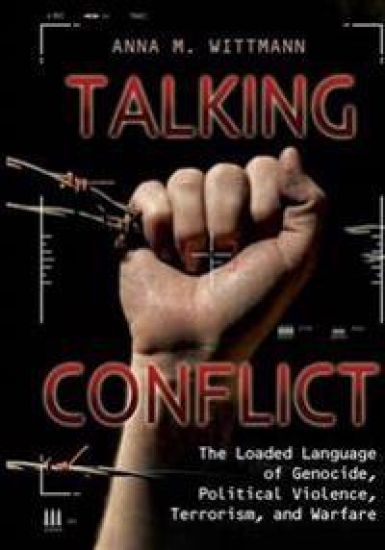
Talking Conflict

Talking Conflict

Anna M. Wittmann

Greenwood Press
2016
sidottu
In today's information era, the use of specific words and language can serve as powerful tools that incite violence—or sanitize and conceal the ugliness of war. This book examines the complex, "twisted" language of conflict.Why is the term "collateral damage" used when military strikes kill civilians? What is a "catastrophic success"? What is the difference between a privileged and unprivileged enemy belligerent? How does deterrence differ from detente? What does "hybrid warfare" mean, and how is it different from "asymmetric warfare"? How is shell shock different from battle fatigue and PTSD? These are only a few of the questions that Talking Conflict: The Loaded Language of Genocide, Political Violence, Terrorism, and Warfare answers in its exploration of euphemisms, "warspeak," "doublespeak," and propagandistic terms.This handbook of alphabetically listed entries is prefaced by an introductory overview that provides background information about how language is used to obfuscate or minimize descriptions of armed conflict or genocide and presents examples of the major rhetorical devices used in this subject matter. The book focuses on the "loaded" language of conflict, with many of the entries demonstrating the function of given terms as euphemisms, propaganda, or circumlocutions. Each entry is accompanied by a list of cross references and "Further Reading" suggestions that point readers to pertinent sources for further research. This book is ideal for students—especially those studying political science, international relations, and genocide—as well as general readers.
Poland and the Western Powers 1938-1938

Poland and the Western Powers 1938-1938

Anna M. Cienciala

University of Toronto Press
1968
pokkari
This study has two objectives. The first is to explain the nature and historical roots of the problems facing Polish foreign policy in 1938–39 and the manner in which they were approached by the men who shaped and directed Polish diplomacy. The second is to illustrate the political interdependence in these years of Eastern and Western Europe. This interdependence hinged on the German problem. The attitude of France and Britain towards Poland and Eastern Europe as a whole was primarily a reflection of their policy towards Germany; at the same time, this policy was the decisive factor in the individual reactions of Germany's eastern neighbours to the threat of resurgent German power. As far as Poland was concerned, she not only had to strive to avert the danger of German revisionism, the realization of which would have made her a vassal of Berlin, but she also had to consider the possibility of Soviet expansion at her expense. This study is, however, primarily concerned with Polish attempts to obtain security with regard to Germany and, in the period in question, this was the main objective of Polish diplomacy.