How has the distinctive Armenian-American community expressed its identity as an ethnic minority while ‘assimilating’ to life in the United States? This book examines the role of community leaders and influencers, including clergy, youth organizers, and partisan newspaper editors, in fostering not only a sense of Armenian identity but specific ethnic-partisan leanings within the group’s population. Against the backdrop of key geopolitical events from the aftermath of the Armenian Genocide to the creation of an independent and then Soviet Armenia, it explores the rivalry between two major Armenian political parties, the Tashnags and the Ramgavars, and the relationship that existed between partisan leaders and their broader constituency. Rather than treating the partisan conflict as simply an impediment to Armenian unity, Benjamin Alexander examines the functional if accidental role that it played in keeping certain community institutions alive. He further analyses the two camps as representing two conflicting visions of how to be an ethnic group, drawing a comparison between the sociology-of-religion models of comfort religion and challenge religion. A detailed political and social history, this book integrates the Armenian experience into the broader and more familiar narratives of World War I, World War II, and the Cold War in the USA.
How has the distinctive Armenian-American community expressed its identity as an ethnic minority while ‘assimilating’ to life in the United States? This book examines the role of community leaders and influencers, including clergy, youth organizers, and partisan newspaper editors, in fostering not only a sense of Armenian identity but specific ethnic-partisan leanings within the group’s population. Against the backdrop of key geopolitical events from the aftermath of the Armenian Genocide to the creation of an independent and then Soviet Armenia, it explores the rivalry between two major Armenian political parties, the Tashnags and the Ramgavars, and the relationship that existed between partisan leaders and their broader constituency. Rather than treating the partisan conflict as simply an impediment to Armenian unity, Benjamin Alexander examines the functional if accidental role that it played in keeping certain community institutions alive. He further analyses the two camps as representing two conflicting visions of how to be an ethnic group, drawing a comparison between the sociology-of-religion models of comfort religion and challenge religion. A detailed political and social history, this book integrates the Armenian experience into the broader and more familiar narratives of World War I, World War II, and the Cold War in the USA.
Marketing to Pharmacists: Understanding Their Role and Influence will help pharmaceutical marketers better understand pharmaceutical practice in order to develop better relationships with pharmacists and effectively market products. This book examines important trends in pharmaceutical health care, including patient education and compliance, quality of life assessment, disease management, and cost containment strategies that assist pharmacists in providing better care to patients which results in increased sales for your business. From Marketing to Pharmacists, you?ll learn how pharmacists influence product selection, monitor drug therapy, and serve as a primary source of patient education in order for you to create successful marketing strategies for your company. Recognizing that cost control is a key goal for all members of the health care system, Marketing to Pharmacists provides you with advice and strategies that emphasize working together with pharmacists. This will help you determine demand for a specific product so you can devise your own marketing strategies to meet the needs of both the pharmacist and patient. With Marketing to Pharmacists, you?ll improve your marketing skills by using innovative techniques and suggestions, including:understanding pharmacists’influence in prescription product selection to help develop effective marketing strategiesasking for pharmacists’assistance in designing care management programs, participating in the development and negotiation of care management contracts, and offering knowledge as pharmacotherapeutic experts to emphasize patient advocacy and accessibility to patientsunderstanding the dimensions of the quality of life and other aspects of pharmaceutical care to design effective sales tactics to pharmacistscommunicating with pharmacists to learn about the needs of certain patients in order to create effective marketing strategies that will lessen the occurrence of unclaimed prescriptions and decrease the loss of revenue to pharmaceutical companiesdeveloping a positive relationship between pharmacists and pharmaceutical companies by displaying genuine customer interest, providing pharmacists with useful and accurate information about products, and establishing ethical guidelinesContaining charts, tables, and graphs to give you a comprehensive look at techniques and data, Marketing to Pharmacists will help you create marketing strategies that will successfully meet the needs of your customers and result in economic benefits for your company.
Planning, operating, and policy making in the electric utility and natural gas sectors involves important trade-offs among economic, social, and environmental criteria. These trade-offs figure prominently in ongoing debates about how to meet growing energy demands and how to restructure the world's power industry. Energy Decisions and the Environment: A Guide to the Use of Multicriteria Methods reviews practical tools for multicriteria (also called multiobjective) decision analysis that can be used to quantify trade-offs and contribute to more consistent, informed, and transparent decision making. These methods are designed to generate and effectively communicate information about trade-offs; to help people form, articulate, and apply value judgments in decision making; and to promote effective negotiation among stakeholders with competing interests. Energy Decisions and the Environment: A Guide to the Use of Multicriteria Methods includes explanations of a wide range of methods, tutorial applications that readers can duplicate, a detailed review of energy-environment applications, and three in-depth case studies.
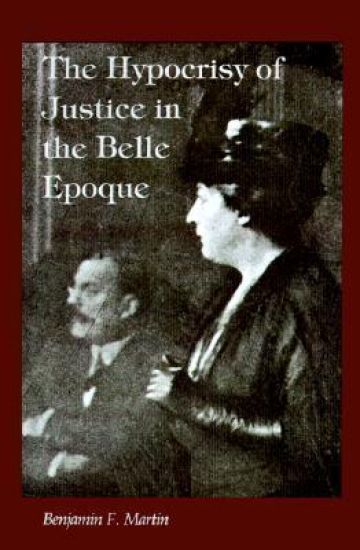
The Dreyfus Affair of the 1890s and the violent controversies that surrounded it appeared to pass two very different judgments on the France of the Third Republic. The outcome o the trial- Captain Dreyfus convicted without guilt and the real traitor acquitted despite guilt- demonstrated without question the extraordinary hypocrisy of the military justice system. But the furor raised by Dreyfus' conviction and the agitation for his release suggested that the injustice of the courts' verdict was uncharacteristic of French society; that for France as a nation the rendering of justice was paramount, even at the expense of disgracing both the military and a conspiring government.In The Hypocrisy of Justice in the Belle Epoque, Benjamin Martin examines the events of three sensational criminal cases to reveal that the willful mangling of justice that occurred in the Dreyfus trial was far from rare in the Third Republic France. He finds, in fact, that justice in the Belle Epoque was ""hypocritical in the extreme,"" with the outcome of trials easily tainted by the power and influence of politics, money, and illicit sex. At times, justice deviated so far from the ideal that its goal was not the strict application of the law or even the discovery of the truth, but rather the imposition of a system of rewards and punishments meted out in accordance with a capricious vision of social utility.Martin begins with the case of Marguerite Steinheil, the wife of an artist of only middling talent. A strikingly beautiful woman, she presided over a famous salon and was the lover of influential politicians. When she was tried for the brutal murders of her husband and her mother, Marguerite defended herself with a flurry of extravagant stories and unlikely counter-accusations. Even so, she was found innocent of all charges, and the crimes were left unsolved.The second trial considered is that of Thérése Humbert, a young woman who used an apparently innate talent for elaborate deception in rising from poverty to the upper reaches of Parisian society. With the aid of her husband and her brothers, Thérése created a series of specious lawsuits over an illusory American legacy. Then, playing on the greed of dozens of investors, she skillfully manipulated the French courts to perpetrate a fraud that would last for twenty years, yield millions, and make her salon one of the most dazzling in Europe until the day when the ruse was finally found out.The third case is that of Henriette Caillaux, the wife of an important leader in the Radical party. She admitted shooting Gaston Calmette, the influential newspaper editor who had been carrying out a campaign of vilification against her husband. But when she was tried for the murder in 1914, Henriette was found innocent and allowed to go free.The sensational trials of Marguerit Steinheil, Thérése Humbert, and Henriette Caillaux mirrored in many the stalemate society of the Belle Epoque itself. By examining the hypocrisy of justice in the Third Republic, Benjamin Martin uncovers the vast extent of that society's corruption, the amorality and sordidness that were cloaked only partially by the mantle of respectability.
Although victorious in the First World War, the French of the Third Republic soon learned the devastating price of success. The grave loss of life and incredibly harsh conditions during and after the war shook survivors to the core. The extraordinary suffering would eventually bring about the collective failure of national nerve in the 1930s that led to the appeasement at Munich and the collapse before German invasion in June 1940. But during the Après Guerre- the half decade following World War I- the French held out hope for a return to the ideal conditions of the Belle Epoque, a hope that gradually gave way to disillusionment.Benjamin Martin's close examination of the aftershocks felt by the French and their world at war's end is a story masterfully told and thoroughly gripping. Using astute analysis and the cultivation of detail to paint a fresco of French society, Martin vividly describes the period's changes, remainders, exultations, fears, lives, deaths, addictions, crimes, figures grand and small, significant and not, remembered or forgotten. Through compelling character sketches of the great politicians of the day, including Georges Clemenceau, Raymond Poincaré, and Aristide Briand, Martin reveals the inner workings of French political life and its role in society as political figures sought to make sense of the tumultuous times.The collective portrait builds to overwhelming sadness. More than 1.3 million Frenchmen had been killed in the war, nearly one in three of those aged eighteen to forty-two. Material damage was estimated to total 55 billion francs. Inflation, hardly known in France during the nineteenth century, soared, while the franc declined disastrously against other currencies. Professionals and rentiers- the social groups that had provided the political and intellectual leadership of the Third Republic before 1914- were struck disproportionately hard by both the war and its aftermath. The new demands of feminism and of changing moral codes, a growing fascination with suicide and drugs, and, above all, the utter strangeness of the postwar world left many in anomie. A devastated France was left to face Germany essentially alone as the United States refused to ratify the Versailles Treaty, Great Britain exhibited early interest in restoring trade with Germany, and one-time ally Russia collapsed into Bolshevism. As Martin shows, French frustration reached a climax in 1923 with the occupation of Germany's Ruhr Valley as a means of compelling the payment of reparations. The failure of this Ruhr incursion meant the end of serious efforts to control Germany.France and the Après Guerre, 1918- 1924 shows in convincing detail that the men who had won the war had lost the peace. Their struggle, and that of French society, makes a captivating and moving story.
When Benjamin Martin's latest report from the front of French fallibility does not read like a tragedy, whose end is foreordained, it reads like a melodrama: sensational doings punctuated by catchy melodies like 'L'Internationale' and 'La Marseillaise.' In both cases it reads well.... French life in the run-up to World War II was a gangrenous decomposition, to be followed by still worse. The country's leaders found nary a pratfall that they could avoid. They chose a semblance of peace above honor and ended up with neither.... In spite of a masterful prologue, successful synthesis, elegant concision and lucid presentation (or perhaps thanks to them), the reader can't help sharing the nation's shames. A tribute to the historian's talent."" -- Eugen Weber, Phi Beta Kappa Key Reporter.At the beginning of 1938, containment of Nazi Germany by a coalition of eastern and western democracies without resorting to war was still a distinct possibility. By the end of 1938, however, Germany was much stronger, the western democracies stood alone, and war was all but certain. The primary cause for these developments, argues Benjamin F. Martin, was the foreign and domestic policies adopted by the French government and embraced by the French people. In a riveting account of the dark days leading up to France's defeat and occupation, Martin reveals a great and civilized nation committing a kind of suicide in 1938. Using movies, novels, newspapers, and sensational court cases, Martin weaves an absorbing tale of France's collective fear and melancholy during this troubled prewar period.
More than one hundred fifty years ago, Moravian missionaries first landed along a so-called isolated stretch of Honduras’s Mosquito Coast bordering the western Caribbean Sea. The missionaries were sent, with the strong encouragement of German political leaders and in the context of German attempts at colonization, to “spread the word” of Protestantism in Central America. Upon their arrival, the missionar-ies employed a three-pronged approach consisting of proselytizing, medical treatment, and education to convert the majority of the indige-nous population. Much like the Spanish and English attempts before them, German colonizing efforts in the region never complete-ly took hold. Still, as Benjamin Tillman shows, for the region’s indigenous inhabitants, the Miskito people, the arrival of the Moravian missionaries marked the beginning of an important cultural interface. Imprints on Native Lands documents Moravian contributions to the Miskito settlement landscape in sixty-four villages of eastern Honduras through field observations of material culture, interviews with village residents, and research in primary sources in the Moravian Church archives. Tillman employs the resulting data to map a hierarchy of Moravian centers, illustrating spatially varying degrees of Moravian influence on the Miskito settlement landscape. Tillman reinforces Miskito claims to ancestral lands by identifying and mapping their created ethnic landscape, as well as supporting earlier efforts at land-use mapping in the region. This book has broad implications, providing a methodology that will be of help to those with an interest in geography, anthropology, or Latin American studies, and to anyone interested in documenting and strengthening indigenous land claims.
Originally published in 1983 after the convictions of the Wilmington Ten were overturned, Psalms from Prison was updated and re-released in 1994. Now in its third edition, this update to Psalms from Prison includes autobiographical reflections from Benjamin Chavis about the unjust imprisonment of the Wilmington Ten and the struggle for equal rights. On October 18, 1972, Benjamin Chavis and nine others (the famous Wilmington Ten) were wrongly convicted of having incited race riots. Chavis spent four years in jail--and it was in the flames of that injustice that these psalms were forged. The deep and abiding faith that sustains Chavis today can be found in these powerful prayers, now accompanied by autobiographical reflections in this third edition. Chavis' psalms spoke to the issues of the African American struggle then . . . and they speak to those same issues today.