Kirjojen hintavertailu. Mukana 11 342 296 kirjaa ja 12 kauppaa.

Kirjahaku

Etsi kirjoja tekijän nimen, kirjan nimen tai ISBN:n perusteella.

1000 tulosta hakusanalla Bruce W. Perry

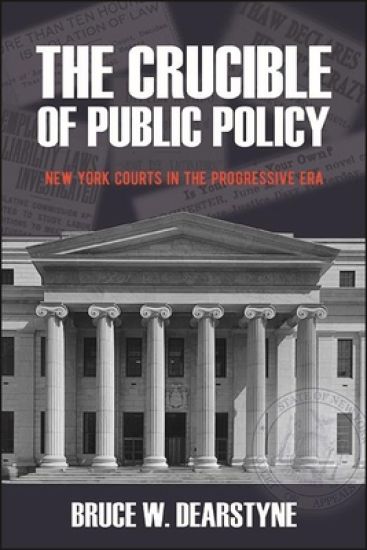
The Crucible of Public Policy

The Crucible of Public Policy

Bruce W. Dearstyne

STATE UNIVERSITY OF NEW YORK PRESS
2022
pokkari
Relates the dramatic role of New York courts in shaping public policy on key reform legislation in the progressive era.The Crucible of Public Policy: New York Courts in the Progressive Era relates the dramatic story of New York State courts, particularly the Court of Appeals, in deciding on the constitutionality of key state statutes in the progressive era. The Court of Appeals, second in importance only to the United States Supreme Court, made groundbreaking decisions on the constitutional validity of laws relating to privacy, personal liberty, state regulation of business, women workers' hours, compensation for on-the-job injuries, public health, and other vital areas. In the process, the Court became a crucible of sorts-a place where complex public policy issues of the day were argued and decided. These decisions set precedents that continue to influence contemporary debates. The book puts people-those who made the laws, were impacted by them, supported or opposed them in public forums, and the courts, attorneys, and judges-at the center of the story. Author Bruce W. Dearstyne presents new material previously unused by scholars, reflecting extensive research in the Court of Appeals' archival records.
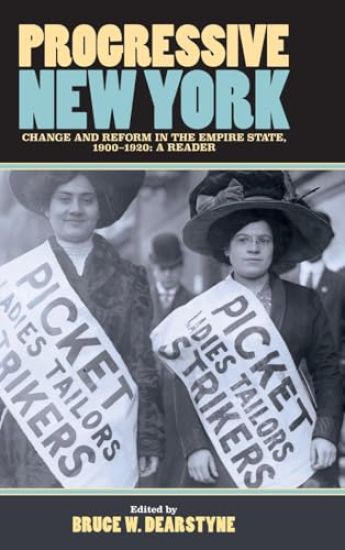
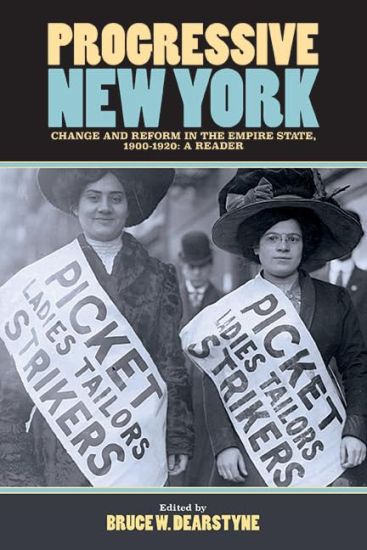
Progressive New York

Progressive New York

Bruce W. Dearstyne

STATE UNIVERSITY OF NEW YORK PRESS
2024
sidottu
The exciting story of New York in the progressive era told by the reformers and visionaries who shaped its history.Progressive New York provides a firsthand portrait of one of the most exciting times in New York's and the nation's history: the progressive era, 1900–1920. This was a time of vast uncertainty and change-with major social and economic developments, including large-scale immigration, industrialization, and urbanization-roiling the nation. New Yorkers were among the first to confront and develop policies to deal with these issues. Political reformers made government more accountable; workers achieved shorter hours and better working conditions; social workers fought poverty and urban overcrowding; women achieved the right to vote; Black citizens advanced the cause of opportunity and equality; and, millions of immigrants enriched New York's culture. Drawing on accounts from contemporary newspapers, periodicals, books, and other sources, this collection introduces readers to the foundational ideas of the modern era. Among the authors are such influential figures as Emma Goldman, Alain Locke, Jacob Riis, Mary Beard, Abraham Cahan, W.E.B. Du Bois, and many others.
Progressive New York

Progressive New York

Bruce W. Dearstyne

STATE UNIVERSITY OF NEW YORK PRESS
2024
pokkari
The exciting story of New York in the progressive era told by the reformers and visionaries who shaped its history.Progressive New York provides a firsthand portrait of one of the most exciting times in New York's and the nation's history: the progressive era, 1900–1920. This was a time of vast uncertainty and change-with major social and economic developments, including large-scale immigration, industrialization, and urbanization-roiling the nation. New Yorkers were among the first to confront and develop policies to deal with these issues. Political reformers made government more accountable; workers achieved shorter hours and better working conditions; social workers fought poverty and urban overcrowding; women achieved the right to vote; Black citizens advanced the cause of opportunity and equality; and, millions of immigrants enriched New York's culture. Drawing on accounts from contemporary newspapers, periodicals, books, and other sources, this collection introduces readers to the foundational ideas of the modern era. Among the authors are such influential figures as Emma Goldman, Alain Locke, Jacob Riis, Mary Beard, Abraham Cahan, W.E.B. Du Bois, and many others.
Conducting Educational Research

Conducting Educational Research

Bruce W. Tuckman; Brian E. Harper

Rowman Littlefield
2012
sidottu
Conducting Educational Research, Sixth Edition thoroughly addresses the major components of research design and methodology. The text is especially useful for inexperienced student-researchers and doctoral students in the early stages of preparing a dissertation. The early chapters of the text clearly describe the process of selecting a problem, reviewing the literature, constructing a hypothesis, identifying and labeling variables, and constructing operational definitions. The later chapters assist students in refining methodological procedures, analyzing data, and writing the final research report. The clarity of the text and the numerous practical examples help to reinforce important concepts and key ideas, increasing the efficacy of the text for even the most inexperienced student-researchers. Additionally, sample studies are included as models of acceptable published research and serve as a guide against which students may evaluate their own work. Changes in New Edition ·More illustrations, tables, figures, and bulleted lists to enhance understanding ·More and simpler explanations of complex process ·A greater balance between the various approaches to research, ranging from experimental to qualitative, with causal-comparative, survey, and evaluation in-between Part I ·Expanded to include additional ethical considerations when conducting research. Part II: ·Renamed "Carrying out Fundamental Steps of Research" ·Additional details regarding measurement and observation ·Expanded discussion of the application of design criteria Part III: ·Renamed "Carrying out Quantitative Research" ·Additional chapters on experimental research, correlational and causal-comparative research, survey research, and evaluation research.
Conducting Educational Research

Conducting Educational Research

Bruce W. Tuckman; Brian E. Harper

Rowman Littlefield
2012
nidottu
Conducting Educational Research, Sixth Edition thoroughly addresses the major components of research design and methodology. The text is especially useful for inexperienced student-researchers and doctoral students in the early stages of preparing a dissertation. The early chapters of the text clearly describe the process of selecting a problem, reviewing the literature, constructing a hypothesis, identifying and labeling variables, and constructing operational definitions. The later chapters assist students in refining methodological procedures, analyzing data, and writing the final research report. The clarity of the text and the numerous practical examples help to reinforce important concepts and key ideas, increasing the efficacy of the text for even the most inexperienced student-researchers. Additionally, sample studies are included as models of acceptable published research and serve as a guide against which students may evaluate their own work. Changes in New Edition ·More illustrations, tables, figures, and bulleted lists to enhance understanding ·More and simpler explanations of complex process ·A greater balance between the various approaches to research, ranging from experimental to qualitative, with causal-comparative, survey, and evaluation in-between Part I ·Expanded to include additional ethical considerations when conducting research. Part II: ·Renamed "Carrying out Fundamental Steps of Research" ·Additional details regarding measurement and observation ·Expanded discussion of the application of design criteria Part III: ·Renamed "Carrying out Quantitative Research" ·Additional chapters on experimental research, correlational and causal-comparative research, survey research, and evaluation research.
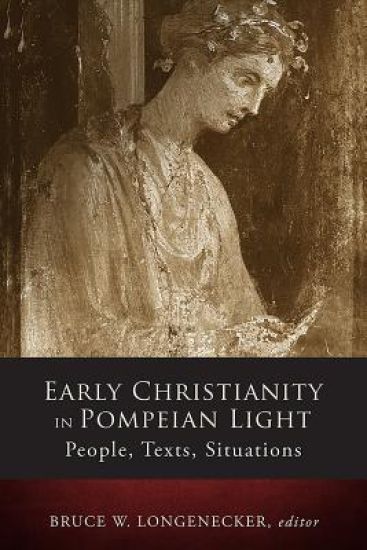
Early Christianity in Pompeian Light

Early Christianity in Pompeian Light

Bruce W. Logenecker

Fortress Press,U.S.
2016
sidottu
Scholars of early Christianity are awakening to the potential of Pompeii's treasures for casting light on the settings and situations that were commonplace and conventional for the first urban Christians. The uncovered world of Pompeii, destroyed by the eruption of Mount Vesuvius in 79 C.E., allows us to peer back in time, capturing a heightened sense of what life was like on the ground in the first century - the very time when the early Jesus-movement was beginning to find its feet. In light of the Vesuvian material remains, historians are beginning to ask fresh questions of early Christian texts and perceive new contours, nuances, and subtleties within the situations those texts address. The essays of this book explore different dimensions of Pompeii's potential to refine our lenses for interpreting the texts and situations of early Christianity. The contributors to this book {including Carolyn Osiek, David Balch, Peter Oakes, Bruce Longenecker, and others) demonstrate that it is an exciting time to explore the interface between the Vesuvian contexts and the early Jesus-movement.
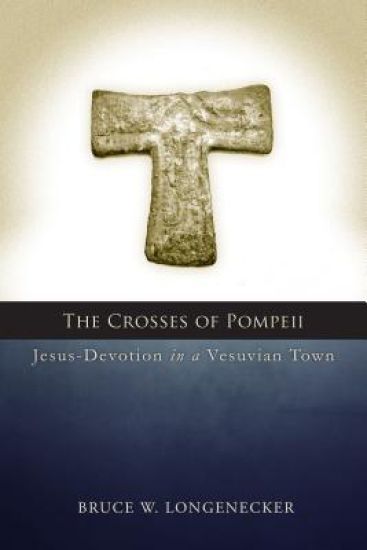
The Crosses of Pompeii

The Crosses of Pompeii

Bruce W. Longenecker

Fortress Press,U.S.
2016
pokkari
Through a twist of fate, the eruption that destroyed Pompeii in 79 CE also preserved a wealth of evidence about the town, buried for centuries in volcanic ash. Since the town's excavations in the eighteenth century, archaeologists have disputed the evidence that might attest the presence of Christians in Pompeii before the eruption. Now, Bruce W. Longenecker reviews that evidence, in comparison with other possible evidence of first-century Christian presence elsewhere, and reaches the conclusion that there were indeed Christians living in the doomed town. Illustrated with maps, charts, photographs, and line drawings depicting artefacts from the town, The Crosses of Pompeii presents an elegant case for their presence. Longenecker's arguments require dramatic changes to our understanding of the early history of Christianity.
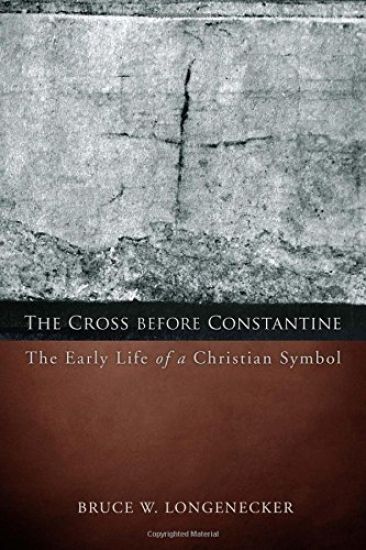
The Cross before Constantine

The Cross before Constantine

Bruce W. Longenecker

Fortress Press,U.S.
2015
pokkari
This book brings together, for the first time, the relevant material evidence demonstrating Christian use of the cross prior to Constantine. Bruce W. Longenecker upends a longstanding consensus that the cross was not a Christian symbol until Constantine appropriated it to consolidate his power in the fourth century. Longenecker presents a wide variety of artifacts from across the Mediterranean basin that testify to the use of the cross as a visual symbol by some pre-Constantinian Christians. Those artifacts interlock with literary witnesses from the same period to provide a consistent and robust portrait of the cross as a pre-Constantinian symbol of Christian devotion. The material record of the pre-Constantinian period illustrates that Constantine did not invent the cross as a symbol of Christian faith,- for an impressive number of Christians before Constantine's reign, the cross served as a visual symbol of commitment to a living deity in a dangerous world.
Production Wine Analysis

Production Wine Analysis

Bruce W. Zoecklein

Springer-Verlag New York Inc.
2012
nidottu
This text is designed to acquaint the reader with the commonly used procedures of juice and wine analysis as they are generally practiced in the industry, and as they are taught in the Department of Enology at California State University, Fresno. It is assumed that the reader has a basic preparation in the fields of chemistry and microbiology. In developing material for this text, the authors have emphasized analyses as they would be carried out in a production laboratory. Realizing that different laboratories have different analytical capabilities, personnel as well as equip­ ment, we have in many instances provided several different approaches to the same analysis. Throughout this book we have attempted to give special attention to practical considerations and the importance of these analyses in the total spectrum of winery operations. We hope the book's format will satisfy the inter­ ests oflaboratory personnel as well as winemakers. The process of making wine involves a series of concerns for the winemaker and staff of a winery. The first concerns are viticultural. Upon arrival of the fruit, its quality is assessed, grapes are processed and fermentation is begun. Almost immediately, and in many instances simultaneously, chemical and microbiological stability of the young and/or aging wine become important. Finally, problems do occur on occasion, and a number of what may be consid­ ered remedial techniques can be employed to produce an acceptable product.