Kirjojen hintavertailu. Mukana 11 342 296 kirjaa ja 12 kauppaa.

Kirjahaku

Etsi kirjoja tekijän nimen, kirjan nimen tai ISBN:n perusteella.

1000 tulosta hakusanalla C. Stuart Chapman

No Solution

No Solution

Stuart C. Aveyard

Manchester University Press
2016
sidottu
Utilising a wide range of archival correspondence and diaries, this monograph reconstructs the 1974-79 Labour government's policies in Northern Ireland. It covers the collapse of power-sharing in May 1974, the secret dialogue with the Provisional IRA during the 1975 ceasefire, the acquiescence of Labour ministers in continuing indefinite direct rule from Westminster, efforts to mitigate conflict through industrial investment, a major shift in security policy emphasizing the police over the army, the adaptation of republicans to the threat of these new measures and their own adoption of a 'Long War' strategy. In so doing, it sheds light on the challenges faced by British ministers, civil servants, soldiers and policemen and the reasons why the conflict lasted so long. It will be a key text for researchers and students of both British and Northern Irish politics.
The Awkward Spaces of Fathering

The Awkward Spaces of Fathering

Stuart C. Aitken

Ashgate Publishing Limited
2009
sidottu
Societal notions of fathers have evolved from the distant breadwinner through genial dad and masculine role model to today's equal co-parent. This book seeks to explore the spaces and movements of men-as-fathers. Weaving together theories of space, sexuality and political identity with the stories of fathers from a range of sources, including popular culture, it discusses the way in which geographies of space can disconnect and disempower fathers, while societal notions marginalize and disassociate them from raising children. It explores how fathering identities are shaped by family and community spaces and aims to move the definition of 'fathering' beyond its definition in opposition to 'mothering'. In doing so, it provides insights into the contradictory nature of father's lives and argues that, rather than moving away from the traditional notions of masculine roles, that the emotional work of fathering in itself is an heroic act.
That Other World

That Other World

Stuart C. Cumberland

Cambridge University Press
2011
pokkari
Although Stuart Cumberland (1857–1922) was renowned for his mind-reading skills, he was a staunch critic of related spiritualist practices. He claimed that many séances and other events that he had seen confirmed his suspicions that 'the chief basis of the movement was money-making'. So he decided to launch his own campaign to uncover the truth about the methods of spirit-mediums, and in this work, published in 1918, he explains many mediums' tricks, such as making tables move using special silk thread, not spiritual aid. He lectured about the subject in places ranging from Cambridge University to Lambeth Palace, and attributed his own success to his ability to read muscle movement, rather than any supernatural communication. Providing a fascinating picture of the changing spiritualist movement, this work illustrates the extent of the social and political influence of some spiritualists, but also how credibility about their practices was being challenged.
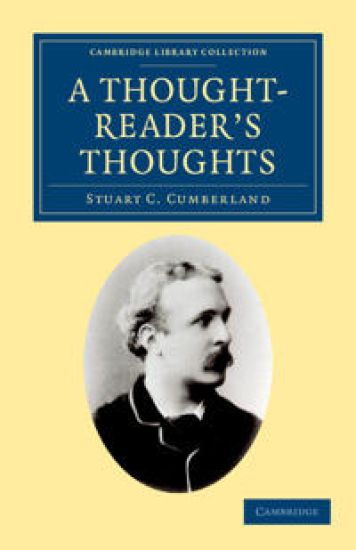
A Thought-Reader's Thoughts

A Thought-Reader's Thoughts

Cumberland Stuart C.

Cambridge University Press
2012
pokkari
Although famous throughout Europe for his mind-reading skills, Stuart C. Cumberland (1857–1922) was a staunch critic of the 'rascality' of some spiritualist practices and their practitioners. He claimed that many of the séances and other events which he had experienced were merely fraudulent money-making impostures. He wrote several books on his life as a thought-reader, in which he also revealed the techniques of fake mediums and psychics. (His That Other World, of 1918, is also reissued in this series.) In this 1888 work, Cumberland narrates his own history and career and describes some of his most memorable séances. One of these took place in the House of Commons, where Cumberland subjected none other than the prime minister at the time, W. E. Gladstone, to having his thoughts read. Their encounter made a great impression on the author, who found Gladstone one of his most remarkable subjects.
The Ethnopoetics of Space and Transformation
Change is inevitable, we are told. A job is lost, a couple falls in love, children leave home, an addict joins Narcotics Anonymous, two nations go to war, a family member's health deteriorates, a baby is born, a universal health care bill is voted into law. Life comprises events over which we have considerable, partial, or little or no control. The distance between the event and our daily lives suggests a quirky spatial politics. Our lives move forward depending upon how events play out in concert with our reactions to them. Drawing on nearly three decades of geographic projects that involve ethnographies and interviews with, and stories about, young people in North and South American, Europe and Asia and using the innovative technique of ethnopoetry, Aitken examines key life-changing events to look at the interconnections between space, politics, change and emotions. Analysing the intricate spatial complexities of these events, he explores the emotions that undergird the ways change takes place, and the perplexing spatial politics that almost always accompany transformations. Aitken positions young people as effective agents of change without romanticizing their political involvement as fantasy and unrealistic dreaming. Going further, he suggests that it is the emotional palpability of youth engagement and activism that makes it so potent and productive. Pulling on the spatial theories of de Certeau, Deleuze, Massey, Agamben, Rancière, Zizek and Grosz amongst others, Aitken argues that spaces are transformative to the degree that they open the political and he highlights the complexly interwoven political, economic, social and cultural practices that simultaneously embed and embolden people in places. If we think of spaces as events and events encourage change, then spaces and people become other through complex relations. Taking poetry to be an emotive construction of language, Aitken re-visualizes, contorts and arranges people's words and gestures to
The Awkward Spaces of Fathering

The Awkward Spaces of Fathering

Stuart C. Aitken

Routledge
2016
nidottu
Societal notions of fathers have evolved from the distant breadwinner through genial dad and masculine role model to today's equal co-parent. This book seeks to explore the spaces and movements of men-as-fathers. Weaving together theories of space, sexuality and political identity with the stories of fathers from a range of sources, including popular culture, it discusses the way in which geographies of space can disconnect and disempower fathers, while societal notions marginalize and disassociate them from raising children. It explores how fathering identities are shaped by family and community spaces and aims to move the definition of 'fathering' beyond its definition in opposition to 'mothering'. In doing so, it provides insights into the contradictory nature of father's lives and argues that, rather than moving away from the traditional notions of masculine roles, that the emotional work of fathering in itself is an heroic act.
The Queen's Highway, from ocean to ocean, etc. With plates and maps

The Queen's Highway, from ocean to ocean, etc. With plates and maps

Stuart C Pseud I E Charle Cumberland

British Library, Historical Print Editions
2011
pokkari
Title: The Queen's Highway, from ocean to ocean, etc. With plates and maps.]Publisher: British Library, Historical Print EditionsThe British Library is the national library of the United Kingdom. It is one of the world's largest research libraries holding over 150 million items in all known languages and formats: books, journals, newspapers, sound recordings, patents, maps, stamps, prints and much more. Its collections include around 14 million books, along with substantial additional collections of manuscripts and historical items dating back as far as 300 BC.The HISTORY OF COLONIAL NORTH AMERICA collection includes books from the British Library digitised by Microsoft. This collection refers to the European settlements in North America through independence, with emphasis on the history of the thirteen colonies of Britain. Attention is paid to the histories of Jamestown and the early colonial interactions with Native Americans. The contextual framework of this collection highlights 16th century English, Scottish, French, Spanish, and Dutch expansion. ++++The below data was compiled from various identification fields in the bibliographic record of this title. This data is provided as an additional tool in helping to insure edition identification: ++++ British Library Cumberland, Stuart C. pseud. i.e. Charles Garner; 1887. 431 p.; 8 . 10470.ff.3.
What I Think of South Africa; Its People and Its Politics ... with Numerous ... Portraits and Map.
Title: What I think of South Africa; its people and its politics ... With numerous ... portraits and map.Publisher: British Library, Historical Print EditionsThe British Library is the national library of the United Kingdom. It is one of the world's largest research libraries holding over 150 million items in all known languages and formats: books, journals, newspapers, sound recordings, patents, maps, stamps, prints and much more. Its collections include around 14 million books, along with substantial additional collections of manuscripts and historical items dating back as far as 300 BC.The GENERAL HISTORICAL collection includes books from the British Library digitised by Microsoft. This varied collection includes material that gives readers a 19th century view of the world. Topics include health, education, economics, agriculture, environment, technology, culture, politics, labour and industry, mining, penal policy, and social order. ++++The below data was compiled from various identification fields in the bibliographic record of this title. This data is provided as an additional tool in helping to insure edition identification: ++++ British Library Cumberland, Stuart C.; 1896. 224 p.; 8 . 10097.de.27.
A Handbook for Testing Extra-Sensory Perception

A Handbook for Testing Extra-Sensory Perception

C. E. Stuart; J. G. Pratt

Literary Licensing, LLC
2013
sidottu
""A Handbook For Testing Extra-Sensory Perception"" by C. E. Stuart is a comprehensive guide to understanding and testing the phenomenon of extra-sensory perception (ESP). The book covers various types of ESP, including telepathy, clairvoyance, and precognition, and provides practical exercises and experiments for readers to explore and develop their own abilities. The author also delves into the scientific research on ESP and discusses the controversies surrounding the field. This book is a valuable resource for anyone interested in exploring the mysteries of the human mind and unlocking their potential for psychic abilities.This is a new release of the original 1937 edition.This scarce antiquarian book is a facsimile reprint of the old original and may contain some imperfections such as library marks and notations. Because we believe this work is culturally important, we have made it available as part of our commitment for protecting, preserving, and promoting the world's literature in affordable, high quality, modern editions, that are true to their original work.
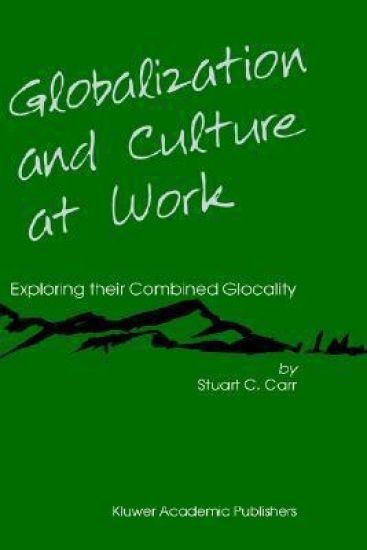
Globalization and Culture at Work

Globalization and Culture at Work

Stuart C. Carr

Springer-Verlag New York Inc.
2004
nidottu
Behaviour at work can no longer be stereotyped as global or local – modern or traditional – with very little in-between. Instead work behaviour is a complex interplay between Global and Local values. It takes place in a Glocality. Thus individual achievement co-exists with group aspirations, pay diversity takes place in a social context, teamwork reflects cultural narrative, and labour mobility is bound by community bias. Globalization and Culture at Work: Exploring their Combined Glocality breaks new ground by exploring such glocalities, and the implications they create for managing human potential better. The volume is essential reading for researchers, managers, culturalists and consultants of work behaviour alike.
The Ethnopoetics of Space and Transformation

The Ethnopoetics of Space and Transformation

Stuart C. Aitken

Ashgate Publishing Limited
2014
sidottu
Change is inevitable, we are told. A job is lost, a couple falls in love, children leave home, an addict joins Narcotics Anonymous, two nations go to war, a family member's health deteriorates, a baby is born, a universal health care bill is voted into law. Life comprises events over which we have considerable, partial, or little or no control. The distance between the event and our daily lives suggests a quirky spatial politics. Our lives move forward depending upon how events play out in concert with our reactions to them. Drawing on nearly three decades of geographic projects that involve ethnographies and interviews with, and stories about, young people in North and South American, Europe and Asia and using the innovative technique of ethnopoetry, Aitken examines key life-changing events to look at the interconnections between space, politics, change and emotions. Analysing the intricate spatial complexities of these events, he explores the emotions that undergird the ways change takes place, and the perplexing spatial politics that almost always accompany transformations. Aitken positions young people as effective agents of change without romanticizing their political involvement as fantasy and unrealistic dreaming. Going further, he suggests that it is the emotional palpability of youth engagement and activism that makes it so potent and productive. Pulling on the spatial theories of de Certeau, Deleuze, Massey, Agamben, Rancière, Zizek and Grosz amongst others, Aitken argues that spaces are transformative to the degree that they open the political and he highlights the complexly interwoven political, economic, social and cultural practices that simultaneously embed and embolden people in places. If we think of spaces as events and events encourage change, then spaces and people become other through complex relations. Taking poetry to be an emotive construction of language, Aitken re-visualizes, contorts and arranges people's words and gestures to