Kirjojen hintavertailu. Mukana 12 434 316 kirjaa ja 12 kauppaa.

Kirjahaku

Etsi kirjoja tekijän nimen, kirjan nimen tai ISBN:n perusteella.

1000 tulosta hakusanalla D. Rampton

The Portable Film School: Everything You'd Learn in Film School Without Ever Going to Class
"The Portable Film School" is a private tutorial from an instructor at one of the nation's most prestigious film schools. D.B. Gilles explains the fundamental skills and techniques of screenwriting and making a short film arming you with the two calling cards you'll need to break into Hollywood without having spent the tuition or a minute in a classroom."
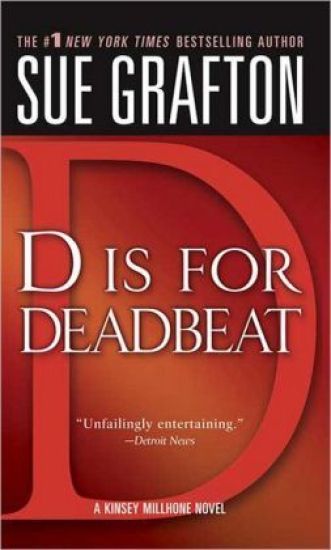
D Is for Deadbeat: A Kinsey Millhone Mystery

D Is for Deadbeat: A Kinsey Millhone Mystery

Sue Grafton

St. Martin's Press
2005
pokkari
Sue Grafton's #1 New York Times bestselling series, reissued for a whole new generation of readers D IS FOR DEADBEAT When Alvin Limardo walks into P.I. Kinsey Millhone's office, she smells bad news. He wants Kinsey to deliver $25,000. The recipient: A fifteen-year-old boy. It's a simple matter. So simple that Kinsey wonders why he doesn't deliver the money himself. She's almost certain something is off. But with rent due, Kinsey accepts Limardo's retainer against her better judgment... When Limardo's check bounces, Kinsey discovers she's been had big time. Alvin Limardo is really John Daggett--an ex-con with a drinking problem, two wives to boot, and a slew of people who would like to see him dead. Now Kinsey is out four hundred dollars and in hot pursuit of Daggett. When Daggett's corpse shows up floating in the Santa Teresa surf, the cops rule the death an accident. Kinsey thinks it's murder. But seeking justice for a man who everyone seemed to despise is going to be a lot tougher than she bargained for--and what awaits her at the end of the road is much more disturbing than she could've ever imagined... "A" Is for Alibi"B" Is for Burglar"C" Is for Corpse"D" Is for Deadbeat"E" Is for Evidence"F" Is for Fugitive"G" Is for Gumshoe"H" Is for Homicide"I" Is for Innocent"J" Is for Judgment"K" Is for Killer"L" is for Lawless"M" Is for Malice"N" Is for Noose"O" Is for Outlaw"P" Is for Peril "Q" Is for Quarry"R" Is for Ricochet "S" Is for Silence "T" Is for Trespass"U" Is for Undertow "V" Is for Vengeance "W" Is for Wasted "X"
D. H. Lawrence

D. H. Lawrence

Paul Poplawski

Greenwood Press
1996
sidottu
D.H. Lawrence remains one of the most popular and studied authors of the 20th century. This book is a comprehensive but easy to use reference guide to Lawrence's life, works, and critical reception. The volume has been systematically structured to convey a coherent overall sense of Lawrence's achievement and critical reputation, but it is also designed to enable the reader who may be interested in only one aspect of Lawrence's career, perhaps even in only one of his novels or stories, to find relevant information quickly and easily without having to read other parts of the text. The book begins with an original biography by John Worthen, one of the world's foremost authorities on Lawrence's life and work. The chapters that follow provide separate entries for all of Lawrence's works, except for individual poems and paintings, with critical summaries, discussions of characters, and details of settings. There is also a complete overview of Lawrence and film, with the most complete listing available of film adaptations of his works and of criticism relating to them. Each section of the book provides comprehensive primary and secondary bibliographical data, including citations for the most recent scholarly studies. Maps and chronologies further trace Lawrence's travels and his development over time.
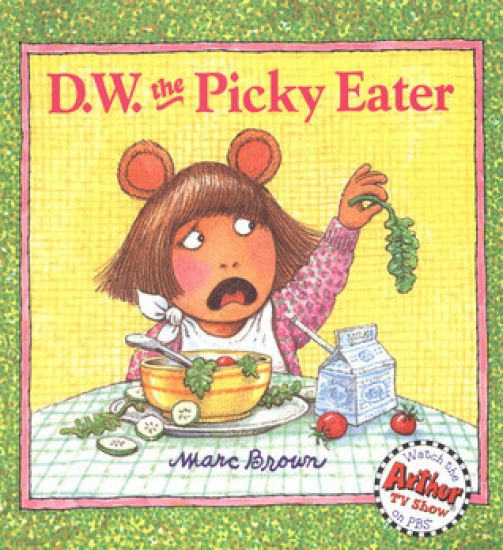
D.W. The Picky Eater

D.W. The Picky Eater

Brown Marc

Little, Brown Young Readers
2008
nidottu
There's a whole slew of edibles that D.W. finds disgusting, but spinach is at the top of her list. Dining out with her family, she causes a scene when her parents suggest that she give her salad greens a try - no more restaurants for the picky little aardvark after that. Staying home with a sitter is boring, though, so when she hears about her grandmother's birthday dinner at a fancy restaurant, she wants to come, too. She orders the Little Bo Peep Pot Pie, devours it with relish, amazing everybody, including herself, and learns a lesson. The text is spare and funny, and while all the coloured-pencil illustrations reflect Brown's sense of humour and familiarity with the little details of childhood, some are downright hilarious. Charming endpapers feature some of the foods D.W. loves to hate. Although she wears an expression of pure horror when she discovers the main ingredient of her pie, readers will suspect that she'll keep that delicious spinach down and her mind and mouth open to new eating possibilities in the future.
D. H. Lawrence and the Art of Translation
This study of D.H.Lawrence as a translator is concerned particularly with the European Lawrence; a writer in touch with and responding vividly to works of European literature which struck a chord in his own creative sensibility. German, French, Spanish and above all Italian he knew well; Russian he failed to learn, despite more than one attempt and in his translations from Russian he always collaborated with S.S. Koteliansky, the Russian émigré. The author is not concerned with the theory of translation as such, but shows how an engagement with the style and sensibility of European authors in the translation process set up a kind of dialectic with far-reaching implications, so that translation came to mean for Lawrence a process of interpretation and evaluation in which his own fiction played an active part. The act of translation not only stimulated Lawrence to define his position in relation to other European cultures, especially the Italian and the Russian, it also served as an important focus of the philosophy of Love and Law set out in his Study of Thomas Hardy. In addition, a consideration of Lawrence's translations of Verga throws new light on the function of dialect in Lawrence's own work. Very little has been written on Lawrence's work as a translator, partly, no doubt, because he was himself anxious that his translating activities should not attract too much attention. It is clear from his own comments, however, that when he undertook a translation he was responding to a specific cultural or linguistic challenge and saw the translated text as meeting some spiritual need not only in terms of his own creative work, but also in terms of the imaginative life of his civilisation.
D.H.Lawrence: The Early Fiction

D.H.Lawrence: The Early Fiction

Michael Black

Palgrave Macmillan
1986
sidottu
Based on the Cambridge Edition of Lawrence's letters and works, this is a systematic study of his neglected early novels and short stories. Michael Black considers that these should be taken seriously as a representative part of Lawrence's entire output and demonstrates how they show originality. He places Lawrence in a new light as an artist, especially considering the relationship between his art and thought.
D. H. Lawrence in the Modern World
60 years after Lawrence's death, the nature of his achievement is still being debated. His vision has aroused passionate interest in many countries beyond his own. As a writer in the 20th century and as one with international standing, this book presents Lawrence "in the modern world".
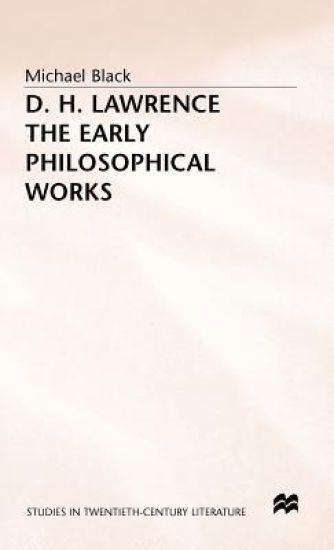
D.H. Lawrence: The Early Philosophical Works

D.H. Lawrence: The Early Philosophical Works

Michael Black

Palgrave Macmillan
1991
sidottu
This second volume of Michael Black's commentary on Lawrence's prose-works concentrates on the extraordinary sequence of non-fictional texts written between 1913 and 1917: the 'Foreword' to Sons and Lovers, Study of Thomas Hardy, Twilight in Italy, 'The Crown', 'The Reality of Peace'. In all of them Lawrence was compulsively rewriting what he called 'my philosophy'. This extended commentary makes sense of them, treating them as a succession of experimental writings which support each other, develop non-discursive modes of writing, and are linked by shared metaphors which reveal shared preoccupations.
D.H. Lawrence: The Thinker as Poet

D.H. Lawrence: The Thinker as Poet

F. Becket

Palgrave Macmillan
1997
sidottu
D.H. Lawrence: The Thinker as Poet addresses a particular body of language and thought within Lawrence's oeuvre where the metaphorical, the poetic and the philosophical are intricately enmeshed. Lawrence emerges as a writer who pulls metaphor away from its merely rhetorical moorings: his distinctive style is the hallmark of one who thinks not analytically but poetically, about the birth of the self, the body unconscious, complex kinds of otherness and about metaphor itself as a mode of understanding.
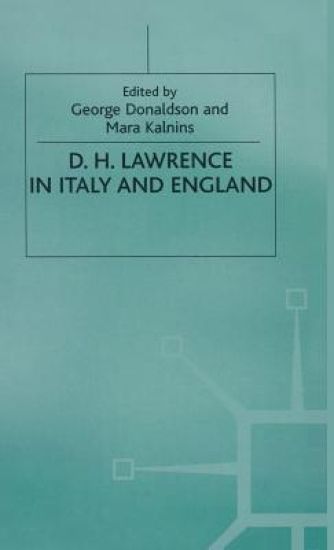
D. H. Lawrence in Italy and England
The critical essays in this volume, by leading authorities on D. H. Lawrence, focus on the importance of Italy and England in Lawrence's work and life. They span the years of his creative maturity from 1915 - which witnessed the important visit to Cambridge, the revisions to Twilight in Italy and the banning of The Rainbow - to 1926, the year in which he began research for the pieces that became Etruscan Places .
D.H. Lawrence: The Novels

D.H. Lawrence: The Novels

Nicholas Marsh

Red Globe Press
2000
sidottu
This volume focuses on three widely-studied novels: Sons and Lovers, The Rainbow and Women in Love. Chapters on narrative texture, impulse and emotion in Lawrence's characters, the quest for a male-female relationship, class and society, and imagery, symbols and structures, use practical analysis to build and refine our insight into the novels as well as equipping the readers with techniques and approaches which enable them to continue studying Lawrence independently. Suggestions for further reading, fully explained examples of analysis and suggestions for further work, make this volume both accessible and a bridge to further study.
D.H. Lawrence: The Novels

D.H. Lawrence: The Novels

Nicholas Marsh

Red Globe Press
2000
nidottu
This volume focuses on three widely-studied novels: Sons and Lovers, The Rainbow and Women in Love. Chapters on narrative texture, impulse and emotion in Lawrence's characters, the quest for a male-female relationship, class and society, and imagery, symbols and structures, use practical analysis to build and refine our insight into the novels as well as equipping the readers with techniques and approaches which enable them to continue studying Lawrence independently. Suggestions for further reading, fully explained examples of analysis and suggestions for further work, make this volume both accessible and a bridge to further study.
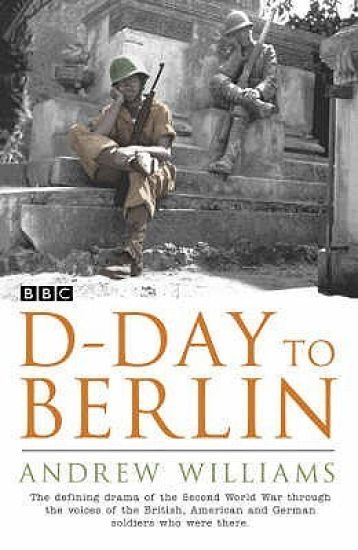
D-Day To Berlin

D-Day To Berlin

Andrew Williams

Hodder Paperback
2005
pokkari
Nightfall, 6 June 1944. D-Day is over and the Allies have carved a tenuous foothold in 'Fortress Europe'. The future of Europe hangs in the balance as Hitler's formidable SS Panzer troops threaten to drive them back into the sea. D-Day to Berlin is the remarkable story of the Allied struggle for survival - the battle from the beaches of Normandy to the heart of Hitler's Reich and ultimate victory just eleven months later. The campaign to free Europe from Nazi oppression through the collective operations from D-Day to Berlin mark one of the greatest ever military offensives. The Allies overcame initial setbacks to inflict a devastating defeat on Hitler's crack divisions in France - a victory that was threatened just months later in the bitter winter fighting of the Battle of the Bulge. The final crossing of the Rhine and the advance into Germany changed the course of European history forever. In D-Day to Berlin we meet men and women from both sides - British, American and German soldiers - whose bravery and endurance made the final push through Europe the defining drama of the Second World War.
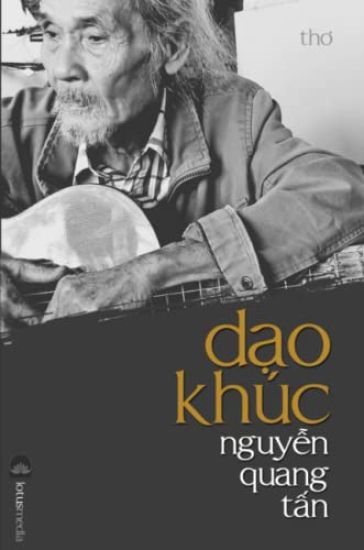
D?o Kh?c Nguy?n Quang T?n

D?o Kh?c Nguy?n Quang T?n

Tan Nguyen Quang

Lulu.com
2019
pokkari
Một điều v c ng nguy hiểm cho c c văn nghệ sĩ l chạy theo những tr o lưu mang t nh thời thượng, đến khi tr o lưu n y tho i tr o, lỗi thời, th họ cũng mất t ch theo. Một sự ph phạm đ ng tiếc nếu c c văn nghệ sĩ n y c thực t i. Trong đạo qu n nh thơ đ ng ngh n nghịt hiện nay: Thơ thiền, thơ tranh đấu, thơ t nh dục, thơ t n h nh thức, thơ hiện đại, thơ hậu hiện đại, thơ l n đồng vv... kh ng biết đặt Nguyễn quang Tấn ở trong h ng ngũ n o. Anh phải đứng một m nh. C thể l đứng hi n ngang oai h ng, nhưng cũng c thể l đứng co ro, ủ rũ, nhưng vẫn cứ l phải đứng một m nh. Như đ n i, t i kh ng biết g về thi ph p, cũng kh ng biết g về ph b nh văn học. T i chỉ n i theo cảm t nh b nh thường của một người đọc thơ b nh thường, n i ra những điều b nh thường ai cũng c thể nhận thấy. Sau c ng, xin tr ch dẫn một c u của Nguyễn Phước Nguy n: - Đọc Dạo Kh c Đi, Bạn Sẽ Kh ng Thất Vọng.
Ð?o Ph?t V?i Tu?i Tr?

Ð?o Ph?t V?i Tu?i Tr?

Thích Thanh T? Ht

Lulu.com
2019
pokkari
đạo Phật l đạo chung tất cả, nhưng th ch hợp nhất l tuổi trẻ. V tuổi trẻ mới c đủ phương tiện thực hiện triệt để gi o l cao si u của Phật, v tuổi trẻ mới đủ bầu nhiệt huyết hăng h i quả cảm tr n con đường tự gi c, gi c tha, d gặp mọi gian nguy kh khổ. Do đ n n Phật dạy bốn ph p ki n cố đến quả Bồ đề, "tuổi trẻ biết mộ đạo tu h nh" l một trong bốn điều ấy vậy. Tuổi trẻ l tuổi th ch hợp với đạo Phật, vậy những bạn thanh ni n kh ng n n luống ph thời giờ, ph thời kỳ qu b u ấy, đợi đến khi sức kiệt hơi t n, c hối tiếc cũng kh ng kịp.