Kirjojen hintavertailu. Mukana 12 542 268 kirjaa ja 12 kauppaa.

Kirjahaku

Etsi kirjoja tekijän nimen, kirjan nimen tai ISBN:n perusteella.

1000 tulosta hakusanalla Daniel M. Davis

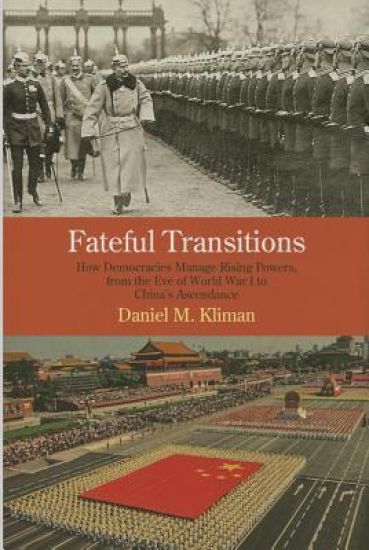
Fateful Transitions

Fateful Transitions

Daniel M. Kliman

University of Pennsylvania Press
2014
sidottu
As China emerges as a global force in the twenty-first century, questions of how existing great powers will navigate the geopolitical transition loom large. In Fateful Transitions, Daniel M. Kliman revisits historic power shifts to shed light on enduring patterns in international relations, demonstrating that the regime type of ascendant powers greatly influences global interactions. Since the late nineteenth century, the world's major democracies have tended to accommodate or conciliate ascendant democratic states. Certain attributes of democracy, such as a free press and domestic checks and balances, encourage trust during power shifts, whereas closed and autocratic regimes on the ascent tend to produce a cycle of suspicion, competition, and confrontation. Drawing on democratic peace theory and power transition theory, Kliman compares Great Britain's embrace of U.S. ascendancy in the early twentieth century to its confrontational stance toward autocratic Germany and later U.S. mistrust of the Soviet Union. Within this geopolitical context, he evaluates the interactions between China and current great powers, the United States and Japan. Building on this analysis, Kliman offers new insights into the dynamics of power shifts and explores their implications for how today's established and emerging powers can successfully navigate fateful transitions.
Making Sense of Marshall Ledbetter

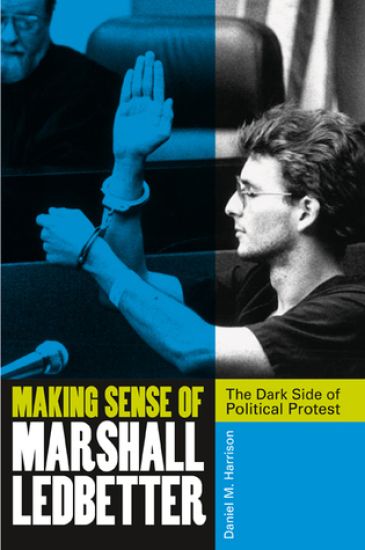
Making Sense of Marshall Ledbetter

Daniel M. Harrison

University Press of Florida
2014
sidottu
Armed with an empty whiskey bottle and wearing a tie-dyed Jimi Hendrix T-shirt, Florida State University dropout Marshall Ledbetter broke into the Florida State Capitol early one morning in June 1991. He occupied the Sergeant of Arms suite, demanding an extra-large Gumby’s pizza and 666 donuts for the cops waiting outside. He hoped to garner media attention for his protest of poverty, homelessness, and cuts to higher education.After an eight hour standoff, Ledbetter was betrayed by the very media he had counted on to tell his story; his demands were not broadcast on CNN as he had been promised but streamed into the office on closed-circuit TV. Although he left the building peacefully, the ensuing trial, his trips in and out of the state’s mental health institutions over the following decade, and his eventual suicide in 2003 speak to how difficult it is to untangle addiction, isolation, brilliance, and deviance.Ledbetter’s invasion of the Capitol remains the biggest security breach of the building’s history, but Daniel Harrison’s telling of the Ledbetter saga is about more than one misguided young man’s breaking and entering into the state’s most secure building. Making Sense of Marshall Ledbetter thoughtfully and honestly explores the ways society manages deviant people in real world situations and whether or not our law enforcement and justice systems are adequately equipped to handle mental illness.
Community Policy Analysis Modeling

Community Policy Analysis Modeling

Daniel M. Otto; Steven C. Deller; Thomas G. Johnson

Iowa State University Press
2006
sidottu
With the shifting of responsibility for designing, planning and managing federally funded programs to state and local government, there is a need for a new group of public servants and others to be aware of how to deal with these responsibilities and challenges. The editors have been active in conducting training with state and local policy makers on how to deal with models using the material in this proposed work. The proposed work outlines and documents a set of community level analytical tools and procedures to assist local decision-making processes. The major goals of the work are to provide a reference for future community policy modeling and analysis efforts, and to provide a group of examples of applications of modeling.
Nonprofits and Their Networks

Nonprofits and Their Networks

Daniel M. Sabet

University of Arizona Press
2008
sidottu
On the border of the United States and Mexico, few policy issues face such acute challenges as those related to water. Border cities face an uncertain future water supply, low-income neighborhoods often lack water and sewer services, and water contamination poses a risk to the health of residents and the environment. Responses by government agencies on both sides of the border have been insufficient. Increasing economic development has mainly resulted in increasing problems. These limitations of government and market forces suggest that nonprofit organizations the so-called third sector? might play an important role in meeting the growing challenges in the region. Finding that these organizations do have a positive impact, Daniel Sabet seeks to understand how autonomous nonprofit organizations have emerged and developed along the border. He employs data from more than 250 interviews with members of civil society organizations and public officials, surveys of neighborhood association leaders, observations at public meetings, and many secondary sources. His research compares the experiences of third-sector organizations in four prominent Mexican border cities: Tijuana, Nogales, Ciudad Juarez, and Nuevo Laredo. Sabet finds that political change is a necessary precondition for the establishment of an independent third sector. The demise of one-party rule in Mexico has given nonprofit organizations greater opportunities to flourish, he finds, but persistent informal rules still obstruct their emergence and development. Sabet concludes that the success of the third sector will depend on the organizations? networks. He examines organizational ties to three key groups?U.S. nonprofits, the business community, and government-created methods for public participation, nd evaluates the importance of these connections for the future.
Human Relations in Interracial Housing

Human Relations in Interracial Housing

Daniel M. Wilner; Rosabelle Price Walkley; Stuart W. Cook

University of Minnesota Press
1955
nidottu
Human Relations in Interracial Housing was first published in 1955. Minnesota Archive Editions uses digital technology to make long-unavailable books once again accessible, and are published unaltered from the original University of Minnesota Press editions.No phase of this country's domestic or foreign relations holds greater potential power for harmony or conflict than our racial attitudes. Yet there is probably no area of social relations in which we have had fewer facts and more assumptions on which to base our thinking and our efforts at constructive action. This sociopsychological study adds considerably to our knowledge of actual racial attitudes in the United States and some of the factors that affect them.The study examines the racial attitudes of people living in public, interracial housing projects in four cities: Philadelphia, Pittsburgh, Hartford, and Springfield, Massachusetts. Based on interviews with more than 1000 white and Negro residents, it sought information that would help answer such questions as these: What is the effect of Negro-white residential proximity on race relations? Does living nearby reduce or intensify any already existing prejudices? What is the nature of the contacts that develop among members of the two races?The findings show in great detail the effects of residential proximity and suggest the underlying reasons for the role that such proximity plays. They reveal, further, the effects of the contact experience itself and the perception of the social climate in the community regarding such contact.The research forms an important sequel to the investigation reported in the book, Interracial Housing, by Deutsch and Collins, confirming some of the basic findings in the earlier study as well as providing new insights.Psychologists, sociologists, social workers, housing officials, and community leaders will find solid evidence here on a subject that has been sparsely documented up to now.
Political Organizing in Grassroots Politics

Political Organizing in Grassroots Politics

Daniel M. Russell

University Press of America
1990
sidottu
This book is an analysis of the organizational dynamics of the Association of Community Organizations for Reform Now (ACORN), a national low- and moderate-income neighborhood organization, detailing the means by which it survives and promotes its goals in the political system. It applies mainstream organizational theories to interview data with ACORN members and organizers to enhance an understanding of both theory and practice. ACORN is recognized as one of the most successful organizing efforts of the 70s and 80s and warrants study as a group capable of surmounting the considerable problems of organizing low- and moderate-income people in American politics. Contents: Theories of Political Organization; Principles of Low-Income Organizing; The ACORN Organizing Strategy; The Organizers; The Members; and the Conclusion.
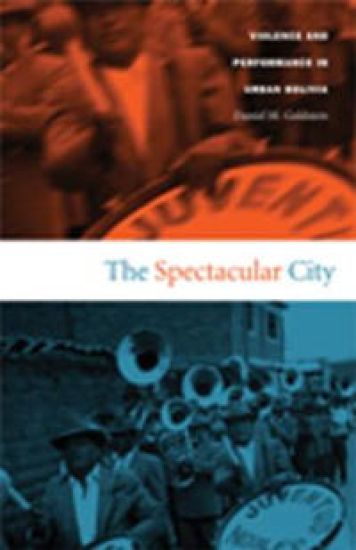
The Spectacular City

The Spectacular City

Daniel M. Goldstein

Duke University Press
2004
sidottu
Since the Bolivian revolution in 1952, migrants have come to the city of Cochabamba, seeking opportunity and relief from rural poverty. They have settled in barrios on the city’s outskirts only to find that the rights of citizens-basic rights of property and security, especially protection from crime-are not available to them. In this ethnography, Daniel M. Goldstein considers the significance of and similarities between two kinds of spectacles-street festivals and the vigilante lynching of criminals-as they are performed in the Cochabamba barrio of Villa Pagador. By examining folkloric festivals and vigilante violence within the same analytical framework, Goldstein shows how marginalized urban migrants, shut out of the city and neglected by the state, use performance to assert their national belonging and to express their grievances against the inadequacies of the state’s official legal order.During the period of Goldstein’s fieldwork in Villa Pagador in the mid-1990s, residents attempted to lynch several thieves and attacked the police who tried to intervene. Since that time, there have been hundreds of lynchings in the poor barrios surrounding Cochabamba. Goldstein presents the lynchings of thieves as a form of horrific performance, with elements of critique and political action that echo those of local festivals. He explores the consequences and implications of extralegal violence for human rights and the rule of law in the contemporary Andes. In rich detail, he provides an in-depth look at the development of Villa Pagador and of the larger metropolitan area of Cochabamba, illuminating a contemporary Andean city from both microethnographic and macrohistorical perspectives. Focusing on indigenous peoples’ experiences of urban life and their attempts to manage their sociopolitical status within the broader context of neoliberal capitalism and political decentralization, The Spectacular City highlights the deep connections between performance, law, violence, and the state.
The Spectacular City

The Spectacular City

Daniel M. Goldstein

Duke University Press
2004
pokkari
Since the Bolivian revolution in 1952, migrants have come to the city of Cochabamba, seeking opportunity and relief from rural poverty. They have settled in barrios on the city’s outskirts only to find that the rights of citizens-basic rights of property and security, especially protection from crime-are not available to them. In this ethnography, Daniel M. Goldstein considers the significance of and similarities between two kinds of spectacles-street festivals and the vigilante lynching of criminals-as they are performed in the Cochabamba barrio of Villa Pagador. By examining folkloric festivals and vigilante violence within the same analytical framework, Goldstein shows how marginalized urban migrants, shut out of the city and neglected by the state, use performance to assert their national belonging and to express their grievances against the inadequacies of the state’s official legal order.During the period of Goldstein’s fieldwork in Villa Pagador in the mid-1990s, residents attempted to lynch several thieves and attacked the police who tried to intervene. Since that time, there have been hundreds of lynchings in the poor barrios surrounding Cochabamba. Goldstein presents the lynchings of thieves as a form of horrific performance, with elements of critique and political action that echo those of local festivals. He explores the consequences and implications of extralegal violence for human rights and the rule of law in the contemporary Andes. In rich detail, he provides an in-depth look at the development of Villa Pagador and of the larger metropolitan area of Cochabamba, illuminating a contemporary Andean city from both microethnographic and macrohistorical perspectives. Focusing on indigenous peoples’ experiences of urban life and their attempts to manage their sociopolitical status within the broader context of neoliberal capitalism and political decentralization, The Spectacular City highlights the deep connections between performance, law, violence, and the state.
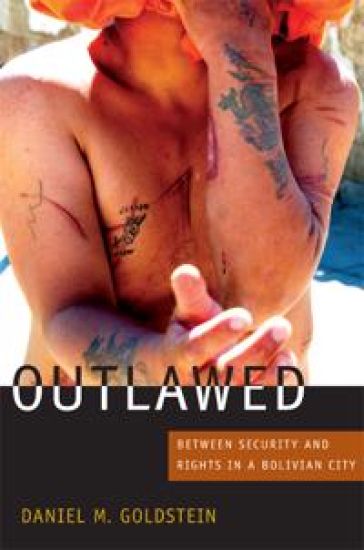
Outlawed

Outlawed

Daniel M. Goldstein

Duke University Press
2012
sidottu
In Outlawed, Daniel M. Goldstein reveals how indigenous residents of marginal neighborhoods in Cochabamba, Bolivia, struggle to balance security with rights. Feeling abandoned to the crime and violence that grip their communities, they sometimes turn to vigilante practices, including lynching, to apprehend and punish suspected criminals. Goldstein describes those in this precarious position as "outlawed": not protected from crime by the law but forced to comply with legal measures in other areas of their lives, their solutions to protection criminalized while their needs for security are ignored. He chronicles the complications of the government's attempts to provide greater rights to indigenous peoples, including a new constitution that recognizes "community justice." He also examines how state definitions of indigeneity ignore the existence of marginal neighborhoods, continuing long-standing exclusionary practices. The insecurity felt by the impoverished residents of Cochabamba-and, more broadly, by the urban poor throughout Bolivia and Latin America-remains. Outlawed illuminates the complex interconnections between differing definitions of security and human rights at the local, national, and global levels.
Outlawed

Outlawed

Daniel M. Goldstein

Duke University Press
2012
pokkari
In Outlawed, Daniel M. Goldstein reveals how indigenous residents of marginal neighborhoods in Cochabamba, Bolivia, struggle to balance security with rights. Feeling abandoned to the crime and violence that grip their communities, they sometimes turn to vigilante practices, including lynching, to apprehend and punish suspected criminals. Goldstein describes those in this precarious position as "outlawed": not protected from crime by the law but forced to comply with legal measures in other areas of their lives, their solutions to protection criminalized while their needs for security are ignored. He chronicles the complications of the government's attempts to provide greater rights to indigenous peoples, including a new constitution that recognizes "community justice." He also examines how state definitions of indigeneity ignore the existence of marginal neighborhoods, continuing long-standing exclusionary practices. The insecurity felt by the impoverished residents of Cochabamba-and, more broadly, by the urban poor throughout Bolivia and Latin America-remains. Outlawed illuminates the complex interconnections between differing definitions of security and human rights at the local, national, and global levels.
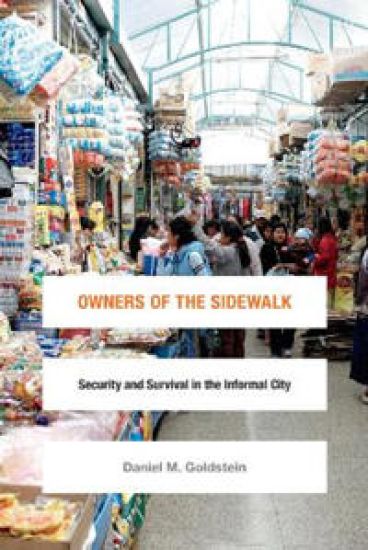
Owners of the Sidewalk

Owners of the Sidewalk

Daniel M. Goldstein

Duke University Press
2016
sidottu
Many of Bolivia's poorest and most vulnerable citizens work as vendors in the Cancha mega-market in the city of Cochabamba, where they must navigate systems of informality and illegality in order to survive. In Owners of the Sidewalk Daniel M. Goldstein examines the ways these systems correlate in the marginal spaces of the Latin American city. Collaborating with the Cancha's legal and permanent stall vendors (fijos) and its illegal and itinerant street and sidewalk vendors (ambulantes), Goldstein shows how the state's deliberate neglect and criminalization of the Cancha's poor-a practice common to neoliberal modern cities-makes the poor exploitable, governable, and consigns them to an insecure existence. Goldstein's collaborative and engaged approach to ethnographic field research also opens up critical questions about what ethical scholarship entails.
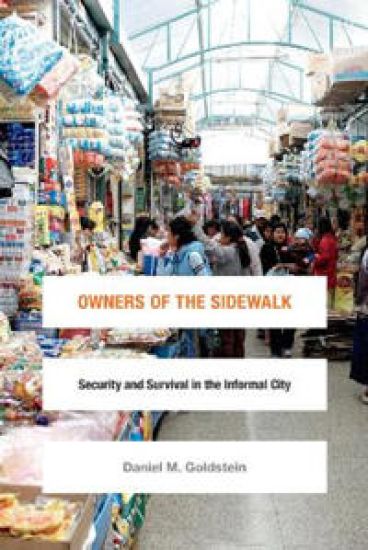
Owners of the Sidewalk

Owners of the Sidewalk

Daniel M. Goldstein

Duke University Press
2016
pokkari
Many of Bolivia's poorest and most vulnerable citizens work as vendors in the Cancha mega-market in the city of Cochabamba, where they must navigate systems of informality and illegality in order to survive. In Owners of the Sidewalk Daniel M. Goldstein examines the ways these systems correlate in the marginal spaces of the Latin American city. Collaborating with the Cancha's legal and permanent stall vendors (fijos) and its illegal and itinerant street and sidewalk vendors (ambulantes), Goldstein shows how the state's deliberate neglect and criminalization of the Cancha's poor-a practice common to neoliberal modern cities-makes the poor exploitable, governable, and consigns them to an insecure existence. Goldstein's collaborative and engaged approach to ethnographic field research also opens up critical questions about what ethical scholarship entails.
Corporate Romanticism

Corporate Romanticism

Daniel M. Stout

Fordham University Press
2016
sidottu
Corporate Romanticism offers an alternative history of the connections between modernity, individualism, and the novel. In early nineteenth-century England, two developments—the rise of corporate persons and the expanded scale of industrial action—undermined the basic assumption underpinning both liberalism and the law: that individual human persons can be meaningfully correlated with specific actions and particular effects. Reading works by Godwin, Austen, Hogg, Mary Shelley, and Dickens alongside a wide-ranging set of debates in nineteenth-century law and Romantic politics and aesthetics, Daniel Stout argues that the novel, a literary form long understood as a reflection of individualism's ideological ascent, in fact registered the fragile fictionality of accountable individuals in a period defined by corporate actors and expansively entangled fields of action. Examining how liberalism, the law, and the novel all wrestled with the moral implications of a highly collectivized and densely packed modernity, Corporate Romanticism reconfigures our sense of the nineteenth century and its novels, arguing that we see in them not simply the apotheosis of laissez-fair individualism but the first chapter of a crucial and distinctly modern problem about how to fit the individualist and humanist terms of justice onto a world in which the most consequential agents are no longer persons.
Corporate Romanticism

Corporate Romanticism

Daniel M. Stout

Fordham University Press
2016
pokkari
Corporate Romanticism offers an alternative history of the connections between modernity, individualism, and the novel. In early nineteenth-century England, two developments—the rise of corporate persons and the expanded scale of industrial action—undermined the basic assumption underpinning both liberalism and the law: that individual human persons can be meaningfully correlated with specific actions and particular effects. Reading works by Godwin, Austen, Hogg, Mary Shelley, and Dickens alongside a wide-ranging set of debates in nineteenth-century law and Romantic politics and aesthetics, Daniel Stout argues that the novel, a literary form long understood as a reflection of individualism's ideological ascent, in fact registered the fragile fictionality of accountable individuals in a period defined by corporate actors and expansively entangled fields of action. Examining how liberalism, the law, and the novel all wrestled with the moral implications of a highly collectivized and densely packed modernity, Corporate Romanticism reconfigures our sense of the nineteenth century and its novels, arguing that we see in them not simply the apotheosis of laissez-fair individualism but the first chapter of a crucial and distinctly modern problem about how to fit the individualist and humanist terms of justice onto a world in which the most consequential agents are no longer persons.
A Special Relationship

A Special Relationship

Daniel M. Fineman

University of Hawai'i Press
1997
nidottu
The development of the Thai-American alliance from 1947 to 1958 dramatically transformed both countries' involvement in Southeast Asia. Bounded by two important political events in Thailand, an army coup in 1947 and the military's assumption of complete control of government in 1958, the period witnessed both the entrenchment of authoritarian military government in Thailand and a revolution in U.S.-Thai relations. During these years the modern Thai political system emerged, and the United States established its interest and influence in mainland Southeast Asian affairs. The developments of the period made possible American's later, more extensive, involvement in Indochina. A Special Relationship provides the most comprehensive analysis of this critical founding period of the Thai-American alliance. It reveals surprising new information on joint covert operations in Indochina, American support for suppression of government opponents, and CIA involvement in Thai domestic politics.
Spreading the Dhamma

Spreading the Dhamma

Daniel M. Veidlinger

University of Hawai'i Press
2006
sidottu
How did early Buddhists actually encounter the seminal texts of their religion? What were the attitudes held by monks and laypeople toward the written and oral Pali traditions? In this pioneering work, Daniel Veidlinger explores these questions in the context of the northern Thai kingdom of Lan Na. Drawing on a vast array of sources, including indigenous chronicles, reports by foreign visitors, inscriptions, and palm-leaf manuscripts, he traces the role of written Buddhist texts in the predominantly oral milieu of northern Thailand from the fifteenth to the nineteenth centuries. Veidlinger examines how the written word was assimilated into existing Buddhist and monastic practice in the region, considering the use of manuscripts for textual study and recitation as well as the place of writing in the cultic and ritual life of the faithful. He shows how manuscripts fit into the economy, describes how they were made and stored, and highlights the understudied issue of the ""cult of the book"" in Theravada Buddhism. Looking at the wider Theravada world, Veidlinger argues that manuscripts in Burma and Sri Lanka played a more central role in the preservation and dissemination of Buddhist texts. By offering a detailed examination of the motivations driving those who sponsored manuscript production, this study draws attention to the vital role played by forest-dwelling monastic orders introduced from Sri Lanka in the development of Lan Na's written Pali heritage. It also considers the rivalry between those monks who wished to preserve the older oral tradition and monks, rulers, and laypeople who supported the expansion of the new medium of writing.
A Kabbalah and Jewish Mysticism Reader

A Kabbalah and Jewish Mysticism Reader

Daniel M. Horwitz

Jewish Publication Society
2016
pokkari
An unprecedented annotated anthology of the most important Jewish mystical works, A Kabbalah and Jewish Mysticism Reader is designed to facilitate teaching these works to all levels of learners in adult education and college classroom settings. Daniel M. Horwitz’s insightful introductions and commentary accompany readings in the Talmud and Zohar and writings by Ba'al Shem Tov, Rav Kook, Abraham Joshua Heschel, and others. Horwitz’s introduction describes five major types of Jewish mysticism and includes a brief chronology of their development, with a timeline. He begins with biblical prophecy and proceeds through the early mystical movements up through current beliefs. Chapters on key subjects characterize mystical expression through the ages, such as Creation and deveikut (“cleaving to God”); the role of Torah; the erotic; inclinations toward good and evil; magic; prayer and ritual; and more. Later chapters deal with Hasidism, the great mystical revival, and twentieth-century mystics, including Abraham Isaac Kook, Kalonymous Kalman Shapira, and Abraham Joshua Heschel. A final chapter addresses today’s controversies concerning mysticism’s place within Judaism and its potential for enriching the Jewish religion.
Assessment of the Consolidation of the Australian Customs and Border Protection Service (Acbps) with the Department of Immigration and Border Protection (Dibp)
RAND conducted an analysis of the effectiveness and efficiency of Australia's newly integrated Department of Immigration and Border Protection. The integration reflects an important inflection point in the history of customs, immigration, and border-management activities within the government of Australia.
Looking to the Future of the Department of Immigration and Border Protection (Dibp)
This evaluation of the Department of Immigration and Border Protection (DIBP) updates a previous analysis and informs the upcoming transition to an Australian Department of Home Affairs (HA). Interviews with senior leaders and documents dating to 2005 provide the foundation for the findings, which indicate that progress toward integration and reform continues, although unevenly, and provide insights for the future formation of the HA.
Coastal Ecosystem Processes

Coastal Ecosystem Processes

Daniel M. Alongi

CRC Press Inc
1997
sidottu
Coastal Ecosystem Processes, written by the renowned marine scientist Daniel Alongi, describes how pelagic and benthic food webs, from beaches and tidal flats to the continental edge, process energy and matter. This volume focuses on recent advances and new developments on how food webs are closely intertwined with the geology, chemistry, and physics of coastal seas. Dr. Alongi presents a process-functional approach as a way of understanding how the energetics of coastal ecosystems rely not only on exchanges within and between food chains, but how such functions are influenced by terrigenous and atmospheric processes. There is a need for documentation and an awareness of just how necessary, yet delicate, is the interplay of biological and physical forces between coastal ocean, land, and the atmosphere. Marine scientists today need to make informed management decisions about sustainable development and conservation of these fragile ecosystems. Coastal Ecosystem Processes provides present and future marine scientists the latest coastal ecosystem information to make the right decisions concerning the ecology of our oceans.