Kirjahaku
Etsi kirjoja tekijän nimen, kirjan nimen tai ISBN:n perusteella.
1000 tulosta hakusanalla Daniel Webster
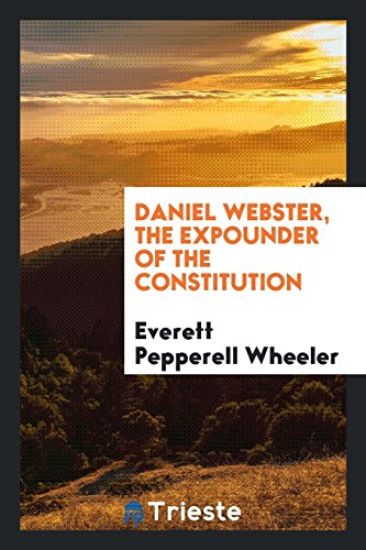
Daniel Webster, the Expounder of the Constitution
Everett Pepperell Wheeler
Trieste Publishing
2018
nidottu
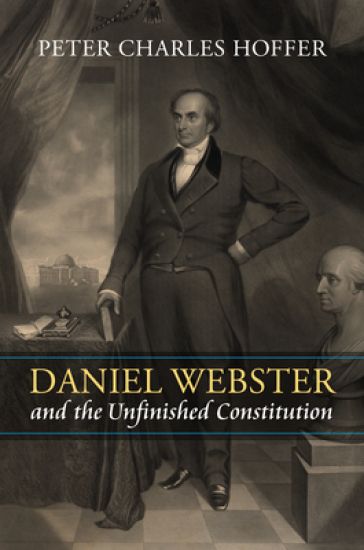
Daniel Webster and the Unfinished Constitution
Peter Charles Hoffer
University Press of Kansas
2021
sidottu
Daniel Webster and the Unfinished Constitution reveals Webster as the foremost constitutional lawyer of his day. Peter Charles Hoffer builds a persuasive case that Webster was more than a skilled practitioner who rose rapidly from his hardscrabble New Hampshire origins. Hoffer thoroughly documents the ways in which Webster was an innovative jurist. While Chief Justice John Marshall gets credit for much of our early constitutional jurisprudence, in fact in a series of key cases Marshall simply borrowed Webster's oral and written arguments.For Webster, Marshall, and many lawyers and jurists of their day, professions of adherence to the Constitution were universal. Yet they knew that the Constitution could not be fixed in time; its text needed to be read in light of the rapidly transforming early republic and antebellum eras or it would become irrelevant. As Chief Justice Marshall explained in Bank of the United States v. Deveaux (1809): 'A constitution, from its nature, deals in generals, not in detail. Its framers cannot perceive minute distinctions which arise in the progress of the nation, and therefore confine it to the establishment of broad and general principles.' But were these 'broad and general principles' themselves fixed? For Webster there were landmarks: the Contract Clause and the Commerce Clause. While others were exploring and surveying the Northwest Territory and the Louisiana Purchase, Webster set out to map the spaces in the constitutional and legal landscape that were unmarked.Peter Charles Hoffer provides an insightful and timely study of how Webster's analysis of three key constitutional issues is relevant to today's constitutional conflicts: the relationship between law and politics, between public policy and private rights, and between the federal government and the states, all of which remain contentious in our constitutional jurisprudence and crucial to our constitutional order.

Daniel Webster and the Oratory of Civil Religion
Craig R. Smith
University of Missouri Press
2004
sidottu
Daniel Webster (1782-1852) was a statesman and lawyer who embodied the golden age of oratory in America; mastering each of the major genres of public speaking of the time. This study examines Webster's career and how his great speeches and created a ""civil religion"" that moved citizens to true romantic patriotism.
Select Speeches of Daniel Webster
Daniel Webster; Andrew Jackson George
Anson Street Press
2025
pokkari
Select Speeches of Daniel Webster
Daniel Webster; Andrew Jackson George
Anson Street Press
2025
sidottu

Daniel Webster for Young Americans
Daniel Webster; Charles F (Charles Franc Richardson
Anson Street Press
2025
pokkari
Daniel Webster for Young Americans
Daniel Webster; Charles F (Charles Franc Richardson
Anson Street Press
2025
sidottu

Daniel Webster, the Orator; an Address Delivered Before the Brooklyn Institute of Arts and Sciences and the New England Society of Brooklyn
Albert E 1849-1930 Pillsbury
Hutson Street Press
2025
sidottu
Daniel Webster, the Orator; an Address Delivered Before the Brooklyn Institute of Arts and Sciences and the New England Society of Brooklyn
Albert E 1849-1930 Pillsbury
Hutson Street Press
2025
sidottu

Daniel Webster, the Orator; an Address Delivered Before the Brooklyn Institute of Arts and Sciences and the New England Society of Brooklyn
Albert E 1849-1930 Pillsbury
Hutson Street Press
2025
pokkari
Daniel Webster, the Orator; an Address Delivered Before the Brooklyn Institute of Arts and Sciences and the New England Society of Brooklyn
Albert E 1849-1930 Pillsbury
Hutson Street Press
2025
pokkari
Daniel Webster, der amerikanische staatsmann
Hutson Street Press
2025
sidottu