Kirjojen hintavertailu. Mukana 12 390 323 kirjaa ja 12 kauppaa.

Kirjahaku

Etsi kirjoja tekijän nimen, kirjan nimen tai ISBN:n perusteella.

1000 tulosta hakusanalla Dirk Wippert

The Soul of Basketball: The Epic Showdown Between Lebron, Kobe, Doc, and Dirk That Saved the NBA
The Soul of Basketball tells the story of an NBA prodigy, his league and their sport in the throes of crisis during the pivotal 2010-11 season. It began with The Decision, that infamous televised moment when uber-star LeBron James revealed that he was leaving the Cleveland Cavaliers - thereby distancing himself from his role model Michael Jordan - to pursue his first championship with his former opponents on the Miami Heat. To the great fortune of LeBron, the NBA and basketball itself, the mission didn't work out as planned. In the cultural tradition of Moneyball and Friday Night Lights, veteran NBA writer Ian Thomsen portrays the NBA as a self-correcting society in which young LeBron is forced to absorb hard truths inflicted by his rivals Kobe Bryant, Doc Rivers and Dirk Nowitzki, in addition to lessons set forth by Pat Riley, Gregg Popovich, Larry Bird, David Stern, Joey Crawford and many more. This is about the making of a champion. Brimming with inside access, The Soul of Basketball tells the inspiring story of LeBron's loneliest year, insecure and uncertain, when his ultimate foe was an unlikely immigrant who renewed the American game's ideals. From Miami to Boston, Los Angeles to Dallas, Germany to the NBA's Manhattan headquarters, the biggest names in basketball are driven by something more valuable than money and fame - a quest that will pave the way for Stephen Curry, Kevin Durant and future generations to thrive.
Das sakrale eurasische Imperium des Aleksandr Dugin. Eine Diskursanalyse zum postsowjetischen russischen Rechtsextremismus. Mit einem Vorwort von Dirk Uffelmann
Aleksandr Gel'evič Dugin, geb. 1962, ist eine prominente Gestalt auf der politischen und ideologischen B hne des heutigen Russlands. Seit Beginn der 1990er nimmt Dugins Pr senz in den Medien und intellektuellen Debatten, im WWW und politischen Leben der GUS stetig zu. In zahlreichen B chern und Artikeln, die vor allem auch ber das Internet gro e Verbreitung finden, entfaltet er weitreichende geopolitische und gesellschaftspolitische Visionen. Sein Traum von einem sakralen russisch-eurasischen Imperium geht Hand in Hand mit einem frenetischen Hass auf den Westen, vor allem auf die USA. Die Werte des Westens, Demokratie und Menschenrechte, werden in Bausch und Bogen abgelehnt. Ihnen wird der totalit re Entwurf einer "Geschlossenen Gesellschaft," beruhend auf einem antiliberalen Wertekanon, als Ideal gegen bergestellt. Die eklektizistische Ideologie Dugins greift dabei sowohl auf radikale westliche Denkstr mungen als auch auf die russische Slavophilie des 19. Jahrhunderts und den Eurasismus der 1920-30er zur ck. Dugins Versuch, sein als "Neoeurasismus" etikettiertes ideologisches Konglomerat als politische Leitideologie Russlands zu etablieren, erzielt erstaunliche Erfolge. Ma gebliche Vertreter kultureller und politischer Eliten Russlands bedienen sich eines Jargons, der seiner Ideologie entlehnt ist. Dugin repr sentiert heute st rker als jede andere russische Figur ein politisches und gesellschaftliches Klima, das unter dem Vorzeichen einer fundamentalen Feindschaft gegen ber dem Westen steht.Trotz dieser Erfolge ist der Name Dugin im Westen bislang nur wenigen bekannt. Dies d rfte auch am Fehlen einer umfassenden Darstellung der Aktivit ten und der Gedankenwelt Dugins f r den westlichen Leser liegen. Dem schafft die vorliegende Arbeit Abhilfe: Die Untersuchung arbeit anhand der zentralen Parameter Raum, Zeit und Gesellschafts- und Staatsphilosophie die Facetten des Welt- und Menschenbilds Dugins im Detail heraus und zeigt die Widerspr che in seiner Ideologie auf. Methodologisch innovativ an dieser zwischen slavistischer Kulturwissenschaft und Politikwissenschaft entstandenen Studie ist eine Herangehensweise an die Gedankenwelt Dugins, die dessen totale Dialogverweigerung gegen ber dem Westen dialogisch unterwandert.
Fear

Fear

Dirk Kurbjuweit

Harper
2017
sidottu
"Fear shifts our moral codes. It makes us accessories to murder. A great achievement." --Herman Koch, author of The DinnerAn acclaimed German writer makes his American debut with this gripping and sophisticated thriller reminiscent of The Dinner and the early novels of Ian McEwan, about the murder of a neighbor who had been harassing a middle-class family--and the relative imprisoned for the crime."I had always believed my father capable of a massacre. Whenever I heard on the news that there had been a killing spree, I would hold my breath, unable to relax until it was clear that it couldn't have been him."Randolph Tiefenthaler insists he had a normal childhood, though he grew up with a father who kept thirty loaded guns in the house. A modestly successful architect with a wonderful family and a beautiful home, he soon finds his life compromised when his father, a man Randolph loves yet has always feared, is imprisoned for murder.Fear is the story of the twisted events leading up to his father's incarceration. It begins when Randolph and his family move into a new building and meet their neighbor, Dieter Tiberius, the peculiar yet seemingly friendly man living in the basement apartment. As the Tiefenthalers settle into their home, they becoming increasingly disturbed as Dieter's strange behavior turns malevolent. Randolph unravels the tale of Dieter's harassment--the erotic letters he sends to Randolph's wife Rebecca, his spying, his accusations of child abuse, the police reports he filed against them. Finally, Randolph admits his of own feelings of desperation and helplessness, which ultimately led to his father's intervention. As Randolph plumbs the depths of his own uncertainty surrounding the murder--pondering fundamental questions about masculinity, violence, and the rule of law--his reliability is slowly but irrevocably called into doubt. The result is an unsettling meditation on middle-class privilege and "civilized life" that builds to a shocking conclusion.
Fear

Fear

Dirk Kurbjuweit

HARPER PAPERBACKS
2018
nidottu
"Fear shifts our moral codes. It makes us accessories to murder. A great achievement." --Herman Koch, author of The DinnerAn acclaimed German writer makes his American debut with this gripping and sophisticated thriller reminiscent of The Dinner and the early novels of Ian McEwan, about the murder of a neighbor who had been harassing a middle-class family--and the relative imprisoned for the crime."I had always believed my father capable of a massacre. Whenever I heard on the news that there had been a killing spree, I would hold my breath, unable to relax until it was clear that it couldn't have been him."Randolph Tiefenthaler insists he had a normal childhood, though he grew up with a father who kept thirty loaded guns in the house. A modestly successful architect with a wonderful family and a beautiful home, he soon finds his life compromised when his father, a man Randolph loves yet has always feared, is imprisoned for murder.Fear is the story of the twisted events leading up to his father's incarceration. It begins when Randolph and his family move into a new building and meet their neighbor, Dieter Tiberius, the peculiar yet seemingly friendly man living in the basement apartment. As the Tiefenthalers settle into their home, they becoming increasingly disturbed as Dieter's strange behavior turns malevolent. Randolph unravels the tale of Dieter's harassment--the erotic letters he sends to Randolph's wife Rebecca, his spying, his accusations of child abuse, the police reports he filed against them. Finally, Randolph admits his of own feelings of desperation and helplessness, which ultimately led to his father's intervention. As Randolph plumbs the depths of his own uncertainty surrounding the murder--pondering fundamental questions about masculinity, violence, and the rule of law--his reliability is slowly but irrevocably called into doubt. The result is an unsettling meditation on middle-class privilege and "civilized life" that builds to a shocking conclusion.
The Champion Real Estate Agent

The Champion Real Estate Agent

Dirk Zeller

McGraw-Hill Professional
2006
nidottu
A proven plan for peak sales performance-and a better life!In The Champion Real Estate Agent, renowned sales trainer Dirk Zeller shows you how to dramatically boost sales and achieve all your professional goals. But there's much more to being a champion agent than just selling. Zeller's proven program not only turns you into a top sales performer, it gives you all the tools to build your real estate business and create a secure and prosperous future for yourself.Full of inside tips, expert advice, and real-world examples from Zeller's many years as a champion agent and trainer, this comprehensive career guide presents a complete system for managing your business and time-so you can earn more money and enjoy more of life.Don't just get into the real estate game; become an all-star when you learn how to:Supercharge your sales and commissions Use Zeller's unique referral strategy to turn effort into income Develop trust and credibility with customers Design a custom business plan that fits your life and goals Generate multiple streams of income“This ultra-complete book shows realty agents what it takes to be successful, as measured by high earnings and business satisfaction. On my scale of one to 10, this excellent book rates a solid 10.”--Robert J. Bruss, nationally syndicated real estate columnist
Influencing Powerful People : Engage and Command the Attention of the Decision-Makers to Get What You Need to Succeed
Influence the Influencers in Your Life"I've known Dirk Schlimm for years, and observed with admiration his ability to work effectively with powerful people while sustaining his own core values. His topic is important, and his experience has given him a deep practical wisdom."--Jim Collins, author, Good to Great"For every 'powerful person' who has influenced history, there are three or four people behind the scenes without whom history would never have changed. Vision and drive for implementation are never enough. Dirk Schlimm's book is about how to accomplish the work of real change in the real world by doing the hard work that rarely gets noticed."--Governor Howard Dean, Chairman Emeritus, The Democratic National Committee"Influencing Powerful People provides invaluable insights into this dynamic--insights that will assist anyone to be more effective and successful."--Peter Jewett, Chair, Corporate Department, Torys LLPAbout the BookDealing with powerful people can be intimidating. Many of them have reached the height of achievement through a combination of charm, confidence, and rilliance, and they certainly deserve our dmiration and respect. More than likely, owever, they also succeeded as a result of their relentless drive and, in the process, developed reputations for being intense, demanding, and temperamental. How do you keep up with such individuals, gain their confidence, contribute to their enterprise, and ensure that your ideas count?Influencing Powerful People provides you with the tools you need to connect and get results with key influencers and decision makers--chief executives, department heads, supervisors, and anyone else in a position of authority. Author Dirk Schlimm, who has frontline experience working with "larger-than-life" leaders, provides sixteen proven rules for working successfully with the powerful people in your life--whether your boss, client, partner, associate, or international counterpart. These rules include:Adopt the role of a "helper"Counter ego with humilityAppreciate who they are and what they doDo the things they can'tBecome an effective counterweightIt's not about giving up your values or telling them what they want to hear--in fact, what powerful people need most often is your loyalty and unbiased perspective. It's about learning to build a relationship and communicating in a way that gets their attention. It's about strategically managing and adapting your everyday behavior so that the powerful people in your life gain confidence in you, appreciate your contribution, and listen to you when charting their course.No matter what your level in an organization, Influencing Powerful People holds the key to ensuring that you make an impact, earn respect, and progress to even greater achievement and responsibility.
Failure Analysis of Wood and Wood-Based Products

Failure Analysis of Wood and Wood-Based Products

Dirk Lukowsky

McGraw-Hill Professional
2015
sidottu
Publisher's Note: Products purchased from Third Party sellers are not guaranteed by the publisher for quality, authenticity, or access to any online entitlements included with the product.PRACTICAL, PROVEN METHODS FOR WOOD FAILURE ANALYSISWritten by an expert in the field, this authoritative resource presents tested techniques for conducting in-depth, professional investigations of failures involving wood and wood-based products. The book offers a detailed look at the various causes of damage to wood, includingmaterial characteristics, design and conditions of use,and chemical influences.State-of-the-art forensic analysis methods such as tracking of relevant features, physical and chemical analysis, and microscopy are provided. This comprehensive guide shows you how to conduct efficient, costeffective,and reproducible wood failure investigations on site and inthe laboratory and deliver accurate findings and conclusions.Failure Analysis of Wood and Wood-Based Products covers:Investigation strategyMethods of investigationInterpretation of features and distributionsExamples of failures
Genetic Criticism

Genetic Criticism

Dirk Van Hulle

Oxford University Press
2022
sidottu
In Genetic Criticism, Dirk Van Hulle introduces the study of creative processes to an Anglophone audience. As a method in the study of literary writing processes, genetic criticism is also a reading strategy. The idea behind this book is to introduce this strategy to a broader audience, from interested readers and graduate students to early career researchers and literary critics. In literary studies, it is often obvious that a particular work somehow seems to hit a nerve, but more challenging to pinpoint exactly why it 'works'. This book therefore starts from a clear, basic assumption: knowing how something was made can help us understand how and why it works. This strategy is at the basis of many disciplines, including art history. By means of X-ray technology or hyperspectral imaging, it is possible to look at a painting as a multilayered object with not only spatial dimensions, but also a temporal one. This temporal dimension is the core of the reading strategy introduced in this book. Note books, marginalia, manuscripts, and typescripts (even if one works with scans) give a concrete dimension to literature, which is a helpful reading strategy for many students. On the one hand, this involves concrete, transferrable skills such as aspects of transcription and digital scholarly editing. On the other hand, it also involves more abstract theoretical issues relating to matters of authorship, collaboration, authority, agency, intention and intertextuality.
Neuropsychological Treatment of Dyslexia

Neuropsychological Treatment of Dyslexia

Dirk J. Bakker

Oxford University Press Inc
1990
nidottu
This volume provides a complete description of the relationship between learning to read and hemispheric functioning, which has been found to change the course of development. Initial reading skills are controlled primarily by the right cerebral hemisphere, but as readers become more advanced, the left hemisphere becomes dominant. Some children fail to make this shift and are at risk of developing one type of dyslexia, while children who prematurely rely on left-hemispheric reading strategies may develop another type. These two types of dyslexia have been found to respond to different types of stimulation. The book includes comprehensive information on these treatments, with extensive discussion of their strengths, weaknesses, and limitations, along with an analysis of a number of experimental, field, and individual case studies.
Diachronic Prototype Semantics

Diachronic Prototype Semantics

Dirk Geeraerts

Clarendon Press
1997
sidottu
Prototype theory makes a crucial distinction between the central and peripheral sense of words. Geeraerts explores the implications of this model for a theory of semantic change, in the first full-scale treatment of the impact of the most recent developments in lexicological theory on the study of meaning change. He identifies structural features of the development of word meanings which follow from a prototype-theoretical model of semantic structure, and incorporates these diachronic prototypicality effects into a theory of meaning change. The author strikes a balance between theoretical exploration and diachronic description, supporting each step in the argumentation with detailed case studies which chart the semantic development of particular words, or illustrate specific mechanisms of semantic change. Thus the book provides both a theoretical model for diachronic semantics and a number of methodological strategies and representational formats that exemplify how changes of word meaning can be studied in practice.
Spatial Analysis in Epidemiology

Spatial Analysis in Epidemiology

Dirk U. Pfeiffer; Timothy P. Robinson; Mark Stevenson; Kim B. Stevens; David J. Rogers; Archie C.A. Clements

Oxford University Press
2008
sidottu
This book provides a practical, comprehensive and up-to-date overview of the use of spatial statistics in epidemiology - the study of the incidence and distribution of diseases. Used appropriately, spatial analytical methods in conjunction with GIS and remotely sensed data can provide significant insights into the biological patterns and processes that underlie disease transmission. In turn, these can be used to understand and predict disease prevalence. This user-friendly text brings together the specialised and widely-dispersed literature on spatial analysis to make these methodological tools accessible to epidemiologists for the first time. With its focus is on application rather than theory, Spatial Analysis in Epidemiology includes a wide range of examples taken from both medical (human) and veterinary (animal) disciplines, and describes both infectious diseases and non-infectious conditions. Furthermore, it provides worked examples of methodologies using a single data set from the same disease example throughout, and is structured to follow the logical sequence of description of spatial data, visualisation, exploration, modelling and decision support. This accessible text is aimed at graduate students and researchers dealing with spatial data in the fields of epidemiology (both medical and veterinary), ecology, zoology and parasitology, environmental science, geography and statistics.
Spatial Analysis in Epidemiology

Spatial Analysis in Epidemiology

Dirk U. Pfeiffer; Timothy P. Robinson; Mark Stevenson; Kim B. Stevens; David J. Rogers; Archie C.A. Clements

Oxford University Press
2008
nidottu
This book provides a practical, comprehensive and up-to-date overview of the use of spatial statistics in epidemiology - the study of the incidence and distribution of diseases. Used appropriately, spatial analytical methods in conjunction with GIS and remotely sensed data can provide significant insights into the biological patterns and processes that underlie disease transmission. In turn, these can be used to understand and predict disease prevalence. This user-friendly text brings together the specialised and widely-dispersed literature on spatial analysis to make these methodological tools accessible to epidemiologists for the first time. With its focus is on application rather than theory, Spatial Analysis in Epidemiology includes a wide range of examples taken from both medical (human) and veterinary (animal) disciplines, and describes both infectious diseases and non-infectious conditions. Furthermore, it provides worked examples of methodologies using a single data set from the same disease example throughout, and is structured to follow the logical sequence of description of spatial data, visualisation, exploration, modelling and decision support. This accessible text is aimed at graduate students and researchers dealing with spatial data in the fields of epidemiology (both medical and veterinary), ecology, zoology and parasitology, environmental science, geography and statistics.
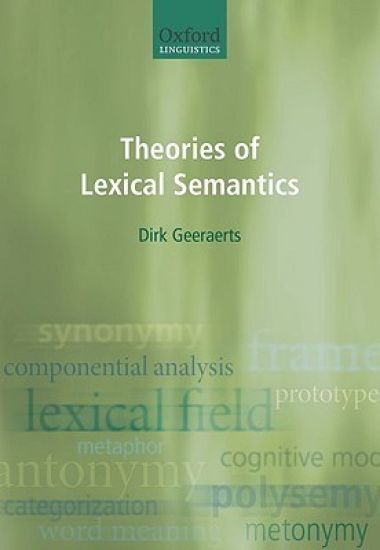
Theories of Lexical Semantics

Theories of Lexical Semantics

Dirk Geeraerts

Oxford University Press
2009
sidottu
Theories of Lexical Semantics offers a comprehensive overview of the major traditions of word meaning research in linguistics. In spite of the growing importance of the lexicon in linguistic theory, no overview of the main theoretical trends in lexical semantics is currently available. This book fills that gap by charting the evolution of the discipline from the mid nineteenth century to the present day. It presents the main ideas, the landmark publications, and the dominant figures of five traditions: historical-philological semantics, structuralist semantics, generativist semantics, neostructuralist semantics, and cognitive semantics. The theoretical and methodological relationship between the approaches is a major point of attention throughout the text: going well beyond a mere chronological enumeration, the book does not only describe the theoretical currents of lexical semantics, but also the undercurrents that have shaped its evolution.
Theories of Lexical Semantics

Theories of Lexical Semantics

Dirk Geeraerts

Oxford University Press
2009
nidottu
Theories of Lexical Semantics offers a comprehensive overview of the major traditions of word meaning research in linguistics. In spite of the growing importance of the lexicon in linguistic theory, no overview of the main theoretical trends in lexical semantics is currently available. This book fills that gap by charting the evolution of the discipline from the mid nineteenth century to the present day. It presents the main ideas, the landmark publications, and the dominant figures of five traditions: historical-philological semantics, structuralist semantics, generativist semantics, neostructuralist semantics, and cognitive semantics. The theoretical and methodological relationship between the approaches is a major point of attention throughout the text: going well beyond a mere chronological enumeration, the book does not only describe the theoretical currents of lexical semantics, but also the undercurrents that have shaped its evolution.
The Emancipation of Biblical Philology in the Dutch Republic, 1590-1670
The Emancipation of Biblical Philology in the Dutch Republic, 1590-1670 argues that the application of tools, developed in the study of ancient Greek and Latin authors, to the Bible was aimed at stabilizing the biblical text but had the unintentional effect that the text grew more and more unstable. Baruch Spinoza (1632-1677) capitalized on this tradition in his notorious Theological-political Treatise (1670). However, the foundations on which his radical biblical scholarship is built were laid by Reformed philologists who started from the hermeneutical assumption that philology was the servant of reformed dogma. On the basis of this principle, they pushed biblical scholarship to the centre of historical studies during the first half of the seventeenth century. Dirk van Miert shows how Jacob Arminius, Franciscus Gomarus, the translators and revisers of the States' Translation, Daniel Heinsius, Hugo Grotius, Claude Saumaise, Isaac de La Peyrère, and Isaac Vossius all drew on techniques developed by classical scholars of Renaissance humanism, notably Joseph Scaliger, who devoted themselves to the study of manuscripts, (oriental) languages, and ancient history. Van Miert assesses and compares the accomplishments of these scholars in textual criticism, the analysis of languages, and the reconstruction of political and cultural historical contexts, highlighting that their methods were closely linked.
Principles of Sustainable Finance

Principles of Sustainable Finance

Dirk Schoenmaker; Willem Schramade

Oxford University Press
2018
sidottu
Finance is widely seen as an obstacle to a better world. Principles of Sustainable Finance explains how the financial sector can be mobilized to counter this. Using finance as a means to achieve social goals we can divert the planet and its economy from its current path to a world that is sustainable for all. Written for undergraduate, graduate, and executive students of finance, economics, business, and sustainability, this textbook combines theory, empirical data, and policy to explain the sustainability challenges for corporate investment. It shows how finance can steer funding to certain companies and projects without sacrificing return and thus speed up the transition to a sustainable economy. It analyses the Sustainable Development Goals as a strategy for a better world and provides evidence that environmental, social, and governance factors matter, explaining in detail how to incorporate these factors in the corporate and financial sectors. Tailored for students, Principles of Sustainable Finance starts each chapter with an overview and learning objectives to support study. It includes suggestions for further reading, lists and definitions of key concepts, and extensive uses of figures, boxes, and tables to enhance educational goals and clarify concepts. Principles of Sustainable Finance is also supported by an online resource that includes teaching materials and cases.