Kirjojen hintavertailu. Mukana 11 342 296 kirjaa ja 12 kauppaa.

Kirjahaku

Etsi kirjoja tekijän nimen, kirjan nimen tai ISBN:n perusteella.

1000 tulosta hakusanalla Elizabeth M. Butler

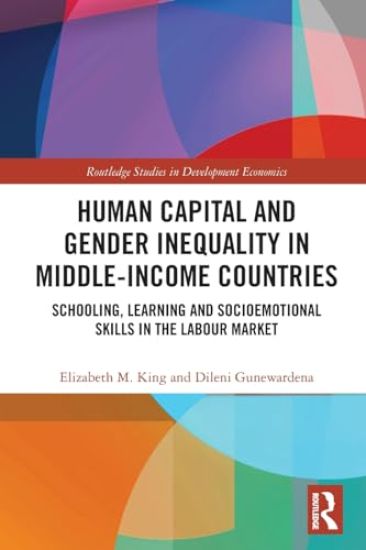
Human Capital and Gender Inequality in Middle-Income Countries

Human Capital and Gender Inequality in Middle-Income Countries

Elizabeth M. King; Dileni Gunewardena

TAYLOR FRANCIS LTD
2024
nidottu
The role of cognitive and socioemotional skills alongside education in determining people’s success in the labour market has been the topic of a growing body of research - but previous studies have mostly missed middle-income countries and the developing world because measures of those skills and data on employment and earnings on large enough samples of adults have typically not been available. Using comparable survey data on these schooling, skills and labour market outcomes from 13 developing and emerging economies worldwide, this book revisits human capital and gender inequality models. It presents new estimates of the returns to different levels of schooling as well as cognitive and socioemotional skills for women and men. It examines whether those returns are due to levels of human capital or to structural bias in labour markets, and how these two factors work across the earnings spectrum. The book examines the existence of 'glass ceilings' and 'sticky floors' for women using this expanded measure of human capital. Further, by analyzing a group of countries of wide-ranging levels of economic development and socio-political contexts, the book reveals patterns and insights into how context mediates the relationship between skills and gender gaps in labour market outcomes. This book will be of interest to scholars of human capital and gender inequality in the labour market and development economics, as well as gender and development policy makers.
Hydrology in Practice

Hydrology in Practice

Elizabeth M. Shaw; Keith J. Beven; Nick A. Chappell; Rob Lamb

CRC Press
2010
sidottu
Hydrology in Practice is an excellent and very successful introductory text for engineering hydrology students who go on to be practitioners in consultancies, the Environment Agency, and elsewhere. This fourth edition of Hydrology in Practice, while retaining all that is excellent about its predecessor, by Elizabeth M. Shaw, replaces the material on the Flood Studies Report with an equivalent section on the methods of the Flood Estimation Handbook and its revisions. Other completely revised sections on instrumentation and modelling reflect the many changes that have occurred over recent years. The updated text has taken advantage of the extensive practical experience of the staff of JBA Consulting who use the methods described on a day-to-day basis. Topical case studies further enhance the text and the way in which students at undergraduate and MSc level can relate to it. The fourth edition will also have a wider appeal outside the UK by including new material on hydrological processes, which also relate to courses in geography and environmental science departments. In this respect the book draws on the expertise of Keith J. Beven and Nick A. Chappell, who have extensive experience of field hydrological studies in a variety of different environments, and have taught undergraduate hydrology courses for many years.Second- and final-year undergraduate (and MSc) students of hydrology in engineering, environmental science, and geography departments across the globe, as well as professionals in environmental protection agencies and consultancies, will find this book invaluable. It is likely to be the course text for every undergraduate/MSc hydrology course in the UK and in many cases overseas too.
Hydrology in Practice

Hydrology in Practice

Elizabeth M. Shaw; Keith J. Beven; Nick A. Chappell; Rob Lamb

CRC Press
2010
nidottu
Hydrology in Practice is an excellent and very successful introductory text for engineering hydrology students who go on to be practitioners in consultancies, the Environment Agency, and elsewhere. This fourth edition of Hydrology in Practice, while retaining all that is excellent about its predecessor, by Elizabeth M. Shaw, replaces the material on the Flood Studies Report with an equivalent section on the methods of the Flood Estimation Handbook and its revisions. Other completely revised sections on instrumentation and modelling reflect the many changes that have occurred over recent years. The updated text has taken advantage of the extensive practical experience of the staff of JBA Consulting who use the methods described on a day-to-day basis. Topical case studies further enhance the text and the way in which students at undergraduate and MSc level can relate to it. The fourth edition will also have a wider appeal outside the UK by including new material on hydrological processes, which also relate to courses in geography and environmental science departments. In this respect the book draws on the expertise of Keith J. Beven and Nick A. Chappell, who have extensive experience of field hydrological studies in a variety of different environments, and have taught undergraduate hydrology courses for many years.Second- and final-year undergraduate (and MSc) students of hydrology in engineering, environmental science, and geography departments across the globe, as well as professionals in environmental protection agencies and consultancies, will find this book invaluable. It is likely to be the course text for every undergraduate/MSc hydrology course in the UK and in many cases overseas too.
Media Effects and Society

Media Effects and Society

Elizabeth M. Perse; Jennifer Lambe

Routledge
2016
sidottu
Grounded in theoretical principle, Media Effects and Society help students make the connection between mass media and the impact it has on society as a whole. The text also explores how the relationship individuals have with media is created, therefore helping them alleviate its harmful effects and enhance the positive ones. The range of media effects addressed herein includes news diffusion, learning from the mass media, socialization of children and adolescents, influences on public opinion and voting, and violent and sexually explicit media content. The text examines relevant research done in these areas and discusses it in a thorough and accessible manner. It also presents a variety of theoretical approaches to understanding media effects, including psychological and content-based theories. In addition, it demonstrates how theories can guide future research into the effects of newer mass communication technologies.The second edition includes a new chapter on effects of entertainment, as well as text boxes with examples for each chapter, discussion of new technology effects integrated throughout the chapters, expanded pedagogy, and updates to the theory and research in the text. These features enhance the already in-depth analysis Media Effects and Society provides.
Media Effects and Society

Media Effects and Society

Elizabeth M. Perse; Jennifer Lambe

Routledge
2016
nidottu
Grounded in theoretical principle, Media Effects and Society help students make the connection between mass media and the impact it has on society as a whole. The text also explores how the relationship individuals have with media is created, therefore helping them alleviate its harmful effects and enhance the positive ones. The range of media effects addressed herein includes news diffusion, learning from the mass media, socialization of children and adolescents, influences on public opinion and voting, and violent and sexually explicit media content. The text examines relevant research done in these areas and discusses it in a thorough and accessible manner. It also presents a variety of theoretical approaches to understanding media effects, including psychological and content-based theories. In addition, it demonstrates how theories can guide future research into the effects of newer mass communication technologies.The second edition includes a new chapter on effects of entertainment, as well as text boxes with examples for each chapter, discussion of new technology effects integrated throughout the chapters, expanded pedagogy, and updates to the theory and research in the text. These features enhance the already in-depth analysis Media Effects and Society provides.
Selection, Preparation and Pharmacological Evaluation of Plant Material, Volume 1

Selection, Preparation and Pharmacological Evaluation of Plant Material, Volume 1

Elizabeth M. Williamson; David T. Okpako; Fred J. Evans

John Wiley Sons Inc
1996
nidottu
Laboratory protocols for pharmacological investigation of plant material Pharmacological Methods in Phytotherapy Research, Vol. 1: Selection, Preparation, and Pharmaceutical Evaluation of Plant Materials provides invaluable reference for anyone working with medicinal plants. Clear protocols detail methods for selection and extraction of plant material, as well as pharmacological investigation and presentation of results. Organized by therapeutic area, coverage includes methods for investigation of compounds relating to the gastrointestinal tract, respiratory system, nervous system, cardiovascular system, and more, with special guidance toward anti-inflammatories, analgesics, and diabetes mellitus.
Light and Electron Microscopy

Light and Electron Microscopy

Elizabeth M. Slayter; Henry S. Slayter

Cambridge University Press
1992
sidottu
The compound optical microscope, in its various modern forms, is probably the most familiar of all laboratory instruments and the electron microscope, once an exotic rarity, has now become a standard tool in biological and materials research. Both instruments are often used effectively with little knowledge of the relevant theory, or even of how a particular type of microscope functions. Eventually however, proper use, interpretation of images and choices of specific applications demand an understanding of fundamental principles. This book describes the principles of operation of each type of microscope currently available and of use to biomedical and materials scientists. It explains the mechanisms of image formation, contrast and its enhancement, accounts for ultimate limits on the size of observable details (resolving power and resolution) and finally provides an account of Fourier optical theory. Principles behind the photographic methods used in microscopy are also described and there is some discussion of image processing methods. The book will appeal to graduate students and researchers in the biomedical sciences, and it will be helpful to students taking a course involving the principles of microscopy.
How to Survive Middle School: World History

How to Survive Middle School: World History

Elizabeth M. Fee; Dan Tucker

RANDOM HOUSE USA INC
2022
nidottu
Learn from home or on-the-go and navigate the wilderness of middle school level World History in this hands-on study guide that gives 6th-8th graders all the tools for success Learning is an adventure inside or outside of the classroom with this highly illustrated, handy field guide that will help kids master the essential skills and lessons of middle school World History. With expert knowledge presented in a bold and fun format that's easy to read and understand, students will learn and explore the groundwork of civilizations, conflicts, and creativity around the globe. The How to Survive Middle School study guides tackle all the essential middle school subjects. Each book trains readers in critical thinking and problem-solving skills to help them become independent learners. The interactive text, full of helpful tips and techniques, and engaging illustrations makes this so much more than just a textbook
Greta Saga Across the Prairie Book 3

Greta Saga Across the Prairie Book 3

Elizabeth M. Dunaj

Thomas Buckskin Publishing
2018
nidottu
They thought the worst was behind them until they are challenged with more trials, more tests, that even the toughest man would buckle under. Do they sustain the trials set before them and succeed to their destination? Or do they forsake God and family when amnesia, grizzly attacks, severe storms, Indians, and ruthless men make their mark in the lives of this family? Journey with Greta, Ellie, Emma, Ruth, Claire, Anne, Katie, Alex, and Marie on their adventure and ask yourself, would I sustain?