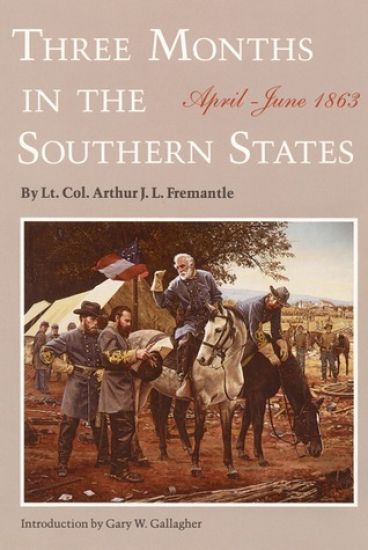
The American Civil War was at a turning point in 1863 when Lt. Col. Arthur J. L. Fremantle of the British Coldstream Guards toured the Confederacy. Mildly predisposed toward the Union side because of his dislike of slavery, he was soon awakened to the gallantry of Jefferson Davis, Robert E. Lee and his generals, ordinary Johnny Rebs, and the women left at home. From April to early July 1863—the critical period of campaigns at Vicksburg, Chancellorsville, and Gettysburg—Fremantle traveled from the Texas frontier to northern Virginia, recording in a diary his experience of the war. Three Months in the Southern States, published upon his return to England later in the year, has long been considered a classic of wartime writing, especially in its description of the Battle of Gettysburg. Filled with biographical vignettes of Lee, Davis, Stonewall Jackson, Sam Houston, and others, this book offers a kaleidoscopic view of the Confederacy at floodtide.
Originally published in 1929, this volume discusses the early effects of the industrial revolution – the condition of the cotton spinners, the hardships for labouring children, the overcrowded prisons and other brutal punishments. At this time the principal branch of local government was the Poor Law and this book discusses how, in the monumental task of providing workhouses for the destitute, the England of the eighteenth century had completely failed. As well as social history, the book also covers military and political history.
Originally published in 1929, this volume discusses the early effects of the industrial revolution – the condition of the cotton spinners, the hardships for labouring children, the overcrowded prisons and other brutal punishments. At this time the principal branch of local government was the Poor Law and this book discusses how, in the monumental task of providing workhouses for the destitute, the England of the eighteenth century had completely failed. As well as social history, the book also covers military and political history.
Originally published in 1929, this volume discusses the early effects of the industrial revolution – the condition of the cotton spinners, the hardships for labouring children, the overcrowded prisons and other brutal punishments. At this time the principle branch of local government was the Poor Law and this book discusses how, in the monumental task of providing workhouses for the destitute, the England of the eighteenth century had completely failed. As well as social history, the book also covers military and political history.
Originally published in 1929, this volume discusses the early effects of the industrial revolution – the condition of the cotton spinners, the hardships for labouring children, the overcrowded prisons and other brutal punishments. At this time the principle branch of local government was the Poor Law and this book discusses how, in the monumental task of providing workhouses for the destitute, the England of the eighteenth century had completely failed. As well as social history, the book also covers military and political history.
The book ""Language Of The Sierra Miwok: Indiana University Publications In Anthropology And Linguistics"" by Lucy Shepard Freeland is a comprehensive study of the language spoken by the Sierra Miwok people of California. The author, a renowned linguist, offers a detailed analysis of the phonology, morphology, syntax, and semantics of the Sierra Miwok language. The book is based on extensive fieldwork conducted by the author in the early 20th century, during which she collected a large corpus of texts and recordings from native speakers. The book is divided into several chapters, each focusing on a different aspect of the language. The first chapter provides an introduction to the Sierra Miwok people, their culture, and their language. The following chapters cover topics such as phonetics and phonology, word formation, syntax, and discourse analysis. The author also includes a section on the historical development of the language, tracing its evolution from earlier forms of Miwok to its current state.The book is written in a clear and accessible style, making it suitable for both linguists and general readers interested in the Sierra Miwok language and culture. The author provides numerous examples and illustrations to help readers understand the intricacies of the language. The book also includes a glossary of Sierra Miwok terms and a bibliography of related works.Overall, ""Language Of The Sierra Miwok"" is a valuable resource for anyone interested in the study of indigenous languages and cultures. It provides a detailed and insightful analysis of the Sierra Miwok language, shedding light on the rich linguistic heritage of this fascinating people.Additional Editors Are George Herzog And Glenn A. Black. Memoir 6 Of The International Journal Of American Linguistics, Supplement To V17, No. 1, January, 1951.This scarce antiquarian book is a facsimile reprint of the old original and may contain some imperfections such as library marks and notations. Because we believe this work is culturally important, we have made it available as part of our commitment for protecting, preserving, and promoting the world's literature in affordable, high quality, modern editions, that are true to their original work.
"A tremendous book. Research shows—and teachers know—that student motivation is a central challenge. This text provides fresh insight into self-efficacy, an essential component of motivation, by exploring what it is, how to cultivate it, and how to nurture it in the context of innovative teaching that develops literacy competency in a range of areas."—Jeffrey D. Wilhelm, Professor of English Education Boise State UniversityBuild students' self-confidence in reading with clear strategies you can implement today!All students need to feel good about who they are, their capabilities, and potential. Many adolescents, however, may suffer from insecurities about their ability to grasp and comprehend ideas, particularly when it involves reading. How can teachers nurture in students the literacy skills that foster a sense of competence and enthusiasm?In this practical guide, the authors present a unique framework of research-based strategies for building reading self-efficacy by focusing on four important concepts: confidence, independence, metacognition, and stamina. Building Reading Confidence in Adolescents offers real classroom scenarios that help instructors develop more proficient readers in Grades 6–12. Ideal for all types of classrooms—from urban centers to rural settings—this book helps teachers explore critical elements such as:Creating classroom conditions and practices to support learner successIdentifying individual student strengths and challenges with written/visual materialsLinking the cognitive and affective domains to build students' skills Developing positive teacher-student relationships Help your students learn to work through any reading challenge to become confident, independent readers who are fully engaged as learners.
Building Reading Confidence in Adolescents offers a unique framework to build students' literacy skills at the middle and secondary levels. Based on their research and experience, the authors provide strategies to help learners grow in four key areas: confidence, independence, metacognition, and stamina. The text explores critical elements such as the classroom environment and teacher-student interactions; discusses how to create instructional frameworks for developing more proficient readers; and provides practical solutions for all types of classrooms - from urban centers to rural settings.
In these riveting poems, Wright declares, "I've said all that / I had to say. / In writing. / I signed my name. / It's death's move." As he considers his mortality, the poet finds a new elation and clarity on the page, handing over for our examination the flawed yet kneeling-in-gratitude self he has become. F stands both for Franz, the poet-speaker who represents all of us on our baffling lifelong journeys, and for the alphabet, the utility and sometimes brutality of our symbols. (It may be, he jokes grimly, his "grade in life.") From "Entries of the Cell," the long central poem that details the loneliness of the single soul, to short narrative prose poems and traditional lyrics, Wright revels in the compensatory power of language, observing the daytime headlights following a hearse, or the wind, "blessing one by one the unlighted buds of the backbent peach tree's unnoted return." He is at his best in this beautiful and startling collection.
From the internationally acclaimed author of Measuring the World, here is a dazzling tragicomedy about the three sons of a lost father. Arthur Friedland is a wannabe writer who one day takes his sons to a performance by the Great Lindemann, Master of Hypnosis. Arthur declares himself immune to hypnosis and a disbeliever in magic. But the Great Lindemann knows better, and after he extracts Arthur's deepest secrets and tells him to make them real, Arthur empties the family bank account and vanishes. He goes on to become a world-famous author, a master of the mystical. (F is for fake.) But what of his abandoned boys? The painfully shy Martin grows up to be a priest without a vocation. (F is for faith, and lack of it.) Eric becomes a financier on the brink of ruin (F is for fraud), while Ivan, hoping for glory as a painter, instead becomes a forger. (F is for forgery, too.) During the summer before the global financial crisis, they are thrown together again with cataclysmic results. Wildly funny and heartbreaking, Daniel Kehlmann's novel about truth, family, and the terrible power of fortune is a fictional triumph.
College rule (also known as medium ruled paper) is the most common lined paper in use in the United States. It is generally used in middle school through to college and is also popular with adults. This is a good choice for teen or adult notebooks and composition books (known as exercise books outside the US).