This book charts Fitzgerald's use of racial stereotypes to encode the dual nature of his literary ambition: his desire to be on the one hand a popular American entertainer, and on the other to make his mark in an elite, international literary field.
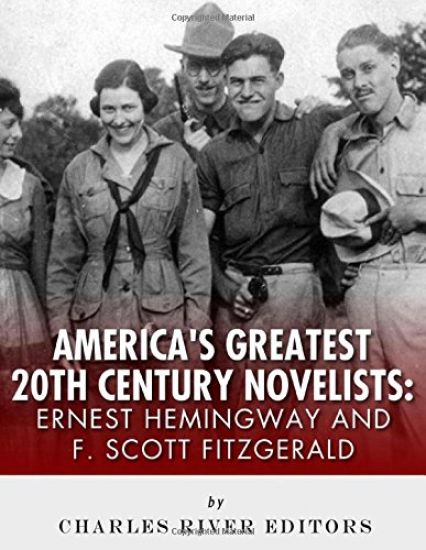
*Includes pictures of important people and places. *Includes some of the authors' most famous quotes. *Analyzes the real life inspirations behind their work and relationships. *Explains the relationship and rivalry between Hemingway and Fitzgerald. *Includes a Bibliography of each for further reading. The 1920s in the United States were known as the "Roaring Twenties" and the Jazz Age, a time in the nation that glorified hard and fast living. Nobody personified the age or wrote so descriptively about it better than F. Scott Fitzgerald (1896-1940), whose name became synonymous with the times after penning the epic Great Gatsby. Along with his dazzling wife Zelda, Fitzgerald was all too keen to play the role. When his writing made them celebrities, they were celebrated by the national press for being "young, seemingly wealthy, beautiful, and energetic." While Scott used their relationship as material in his novels, Zelda wrote herself, and she also strove to become a ballerina. However, the Fitzgerald's barely outlasted the '20s. Their hard living left Fitzgerald, a notorious alcoholic, in poor health by the '30s. Financially broke, he would die of a massive heart attack in 1940, by which time Zelda had already suffered various mental illnesses. Zelda died in a freak fire in 1948, both Fitzgerald's having burned out almost as quickly as they had shined. Fitzgerald traveled constantly, and one of his expatriate friends in Europe was none other than Ernest Hemingway, widely considered one of the most influential American authors of the 20th century. Students are unlikely to leave high school without reading one of Hemingway's classics, especially The Sun Also Rises (1926), and they are usually introduced to rudimentary details about Hemingway's eclectic life and controversial death. Hemingway's literary career included several unquestioned classics, but a great deal of his fame and notoriety today comes from the fact that it has become impossible to separate his work from his life. In fact, Hemingway's service in World War I and his time as a war correspondent at places like Normandy during D-Day in World War II have also established him as the kind of masculine, adventurous man that Americans have long held out as cultural heroes. This is made even more ironic by the fact that Hemingway spent so much time overseas, both in Europe and Africa, to the extent that he became one of the most identifiable members of the "Lost Generation" of American expatriates, which included literary stars like Fitzgerald and Gertrude Stein. It is possible today for people to be familiar with the basic outline of his life despite rarely coming into contact with his writing. Fitzgerald and Hemingway had tumultuous lives, so it was only fitting that they had a tumultuous friendship that also bordered on rivalry. In fact, Fitzgerald hoped that the last novel he was working on before his untimely end, The Last Tycoon, would propel him to the top of the literary world again, a spot occupied by Hemingway after the publication of For Whom The Bell Tolls. While that novel wouldn't do it, The Great Gatsby ultimately ensured that Fitzgerald would remain renowned, and the two have been permanently associated with each other ever since. America's Greatest 20th Century Novelists profiles the lives and careers of two of America's most famous writers and cultural icons. Along with pictures of important people, places, and events, you will learn about Hemingway and Fitzgerald like you never have before.
This Critical Introduction explores the main themes, characters and symbols of "The Great Gatsby"; the quest for a new life, the preoccupation with one's place in society, the desire for riches and the greatest dream of all human beings.In doing so it offers an interpretation which, unlike most analyses of this American Masterpiece, places Nick as the focus of Fitzgerald's attention.It includes a series of questions that helps the reader develop a deeper understanding of the story.NOTE A new cover has recently been uploaded for this book to reflect its inclusion in the author's Critical Introduction Series
Tender is the Night, the novel F. Scott Fitzgerald worked longest and hardest on, has not achieved its proper recognition because the text is peppered with errors and chronological inconsistencies. Moreover, the novel has a concentration of references to people, places and events that most readers no longer recognize. In this guide to the novel, Matthew J. Bruccoli corrects those errors and explains the factual details. He also offers maps, photos, correspondence and notes that demystify the writing of one of literature's most misunderstood - and underrated - masterpieces.
Conversations with F. Scott Fitzgerald assembles over thirty interviews with one of America's greatest novelists, the author of The Great Gatsby and Tender Is the Night. Although most of these are not standard interviews in the modern sense, the quotes from Fitzgerald and the contemporary journalistic reaction to him reveal much about his writing techniques, artistic wisdom, and life. Editors Matthew J. Bruccoli, the foremost Fitzgerald scholar, and Judith S. Baughman have collected the most usable and articulate pieces on Fitzgerald, including a three-part 1922 interview conducted for the St. Paul Daily News. Fitzgerald (1896-1940) died before the authorial interview became a literary subgenre after World War II. Although Fitzgerald enjoyed his celebrity, as is clear in these pieces, he had a poor sense of public relations and provided interviewers with opportunities to trivialize him. As a result, Fitzgerald was often treated condescendingly in the press. Seven of his interviews-five printed before 1924-have flapper in their headlines. In the Jazz Age-a term Fitzgerald coined-he was regarded as a spokesman for rebellious youth, as a playboy, as an authority on sex and marriage, as an expert on Prohibition, and as an immensely popular writer for his work published in the Saturday Evening Post. Yet his literary ambitions were sizable and his impact on American fiction immeasurable. Matthew J. Bruccoli is Jefferies Professor of English at the University of South Carolina. He has written or edited thirty volumes on Fitzgerald, including the standard biography, Some Sort of Epic Grandeur: The Life of F. Scott Fitzgerald. Judith S. Baughman, who works in the department of English at the University of South Carolina, has written the F. Scott Fitzgerald volume in the Gale Study Guides series and has edited American Decades: 1920-1929.
A collection of F. Scott Fitzgerald's remarks on his craft, taken from his works and letters to friends and colleagues--an essential trove of advice for aspiring writers. As F. Scott Fitzgerald famously decreed, "An author ought to write for the youth of his own generation, the critics of the next, and the schoolmasters of ever after." Fitzgerald's own work has gone on to be reviewed and discussed for over one hundred years. His masterpiece The Great Gatsby brims with the passion and opulence that characterized the Jazz Age--a term Fitzgerald himself coined. These themes also characterized his life: Fitzgerald enlisted in the US army during World War I, leading him to meet his future wife, Zelda, while stationed in Alabama. Later, along with Ernest Hemingway and other American artist expats, he became part of the "Lost Generation" in Europe. Fitzgerald wrote books "to satisfy his] own craving for a certain type of novel," leading to modern American classics including Tender Is the Night, This Side of Paradise, The Beautiful and Damned. In this collection of excerpts from his books, articles, and personal letters to friends and peers, Fitzgerald illustrates the life of the writer in a timeless way.
When The Great Gatsby was first published, in 1925, reviews were mixed. H.L. Mencken called it "no more than a glorified anecdote". L.P. Hartley, author of The Go-Between, thought Fitzgerald deserved "a good shaking": "The Great Gatsby is evidently not a satire; but one would like to think that Mr Fitzgerald's heart is not in it, that it is a piece of mere naughtiness." Yet, gradually the book came to be seen as one of the greatest - if not the greatest - of American novels. Why? What is it that makes this story of a petty hoodlum so compelling? Why has a novel so intimately rooted in its own time "lasted" into ours? What is it that posterity, eight decades later, finds so fascinating in this chronicle of the long-gone "Jazz Age", flappers, speakeasies and wild parties? It is, after all, scarcely a novel at all, more a long short story. But it has a power out of all proportion to its length. It is beautifully written, making it feel even shorter than it is, and is full of haunting imagery. It is also, perhaps, the most vivid literary evocation of the "Great American Dream", about which it is profoundly sceptical, as it is about dreams generally. In the end, however, as D.H. Lawrence would put it, it is "on the side of life". Gatsby's dream may be impossible, so much so that the book can end in no other way than with his death, but up to a point he is redeemed by it and by the tenacity with which he clings to it. It is this that makes the novel so moving and so haunting.
This research monograph argues that Scott Fitzgerald consciously used a variety of Joycean devices in The Great Gatsby and these devices were the result of close readings of Joyce’s Dubliners and Ulysses. The monograph breaks new ground in Fitzgerald scholarship and has implications for Joyceans as well. This study sets out to prove that Fitzgerald modeled numerous elements of GATSBY on elements found in Joyce’s ULYSSES. FSF imitated Joyce’s use of the first letter in each of the parts of ULYSSES. There Joyce alluded to two matters (1)the first names of his characters and (2) the logical steps of a syllogism. Fitzgerald enriched this device. He developed three parts in his novel (3-3-3) and used the first and last letters of each of his 9 chapters for two purposes : to repay in a bold and playful way his debt to Joyce and to honor Ernest Renan, famed for his LIFE OF JESUS,and a source of burlesque techniques employed in Gatsby. This is just one example of a number of research issues raised by Tanner, a number new to Fitzgerald scholarship.Other chapters deal with FSF imitation of Joyce’s “Araby” in Fitzgerald’s story “Absolution”(a precursor to Gatsby), sources for Christian allusions and direct allusions to ULYSSES, the shadowing and doubling of characters ,patterns of imagery and numeracy in topics and theme. The work contains two appendices including a significant comparison of Trimalchio and THE GREAT GATSBY.
*Includes pictures of important people and places. *Includes some of the authors' most famous quotes. *Analyzes the real life inspirations behind their work and relationships. *Explains the relationship and rivalry between Hemingway and Fitzgerald. *Includes a Bibliography of each for further reading. The 1920s in the United States were known as the "Roaring Twenties" and the Jazz Age, a time in the nation that glorified hard and fast living. Nobody personified the age or wrote so descriptively about it better than F. Scott Fitzgerald (1896-1940), whose name became synonymous with the times after penning the epic Great Gatsby. Along with his dazzling wife Zelda, Fitzgerald was all too keen to play the role. When his writing made them celebrities, they were celebrated by the national press for being "young, seemingly wealthy, beautiful, and energetic." While Scott used their relationship as material in his novels, Zelda wrote herself, and she also strove to become a ballerina. However, the Fitzgerald's barely outlasted the '20s. Their hard living left Fitzgerald, a notorious alcoholic, in poor health by the '30s. Financially broke, he would die of a massive heart attack in 1940, by which time Zelda had already suffered various mental illnesses. Zelda died in a freak fire in 1948, both Fitzgerald's having burned out almost as quickly as they had shined. Fitzgerald traveled constantly, and one of his expatriate friends in Europe was none other than Ernest Hemingway, widely considered one of the most influential American authors of the 20th century. Students are unlikely to leave high school without reading one of Hemingway's classics, especially The Sun Also Rises (1926), and they are usually introduced to rudimentary details about Hemingway's eclectic life and controversial death. Hemingway's literary career included several unquestioned classics, but a great deal of his fame and notoriety today comes from the fact that it has become impossible to separate his work from his life. In fact, Hemingway's service in World War I and his time as a war correspondent at places like Normandy during D-Day in World War II have also established him as the kind of masculine, adventurous man that Americans have long held out as cultural heroes. This is made even more ironic by the fact that Hemingway spent so much time overseas, both in Europe and Africa, to the extent that he became one of the most identifiable members of the "Lost Generation" of American expatriates, which included literary stars like Fitzgerald and Gertrude Stein. It is possible today for people to be familiar with the basic outline of his life despite rarely coming into contact with his writing. Fitzgerald and Hemingway had tumultuous lives, so it was only fitting that they had a tumultuous friendship that also bordered on rivalry. In fact, Fitzgerald hoped that the last novel he was working on before his untimely end, The Last Tycoon, would propel him to the top of the literary world again, a spot occupied by Hemingway after the publication of For Whom The Bell Tolls. While that novel wouldn't do it, The Great Gatsby ultimately ensured that Fitzgerald would remain renowned, and the two have been permanently associated with each other ever since. America's Greatest 20th Century Novelists profiles the lives and careers of two of America's most famous writers and cultural icons. Along with pictures of important people, places, and events, you will learn about Hemingway and Fitzgerald like you never have before.
Unlock the more straightforward side of The Last Tycoon with this concise and insightful summary and analysis This engaging summary presents an analysis of The Last Tycoon by F. Scott Fitzgerald, which tells the story of Monroe Stahr, a young film producer struggling to cope with the death of his wife. When he encounters a woman who bears an uncanny resemblance to her he immediately falls in love, but upon discovering that she is engaged to another man, he instead embarks on a relationship with Cecilia Brady, the daughter of his business partner Pat Brady, leading to a deadly rift between the two men. Fitzgerald is best known for his 1925 novel The Great Gatsby, and is widely regarded as one of the foremost chroniclers of the Jazz Age in the USA. Find out everything you need to know about The Last Tycoon in a fraction of the time This in-depth and informative reading guide brings you: - A complete plot summary- Character studies- Key themes and symbols- Questions for further reflection Why choose BrightSummaries.com? Available in print and digital format, our publications are designed to accompany you on your reading journey. The clear and concise style makes for easy understanding, providing the perfect opportunity to improve your literary knowledge in no time. See the very best of literature in a whole new light with BrightSummaries.com