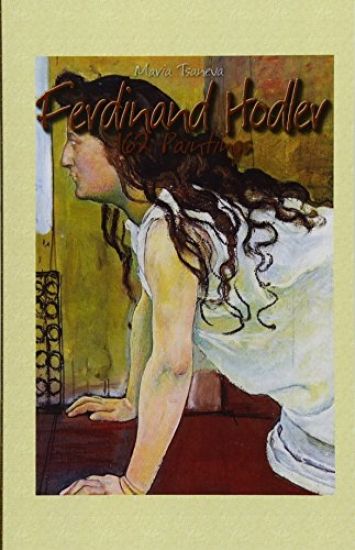
Ferdinand Hodler was one of the famous Swiss painters of the 19th century. His early maturity paintings were landscapes, figure compositions, and portraits, treated with a strong realism. He made a voyage to Basel in 1875, where he studied the paintings of Hans Holbein. In the last decade of the 19th century his work progressed to combine influences from several genres including symbolism and art nouveau. He developed a style which he called "Parallelism", characterized by groupings of figures symmetrically arranged in poses suggesting ritual or dance. Hodler's work in his final phase took on an expressionist aspect with strongly colored and geometrical figures. Landscapes were pared down to essentials, sometimes consisting of a jagged wedge of land between water and sky. These mystical, non-realistic paintings depicting an escape from the bourgeois cares of modern life gained Hodler first notoriety and then popularity.
Ferdinand De Soto, The Discoverer of the Mississippi is a classic biography of the great Spanish explorer, Ferdinand De Soto. Mr. Theodore Irving, in his valuable history of the "Conquest of Florida," speaking of the astonishing achievements of the Spanish Cavaliers, in the dawn of the sixteenth century says: "Of all the enterprises undertaken in this spirit of daring adventure, none has surpassed, for hardihood and variety of incident, that of the renowned Ferdinand de Soto, and his band of cavaliers. It was poetry put in action. It was the knight-errantry of the old world carried into the depths of the American wilderness.
Discours de r ception de M. Ferdinand Bruneti re, R ponse de M. le comte d'Haussonville by Ferdinand Bruneti re. This book is a reproduction of the original book published in 1894 and may have some imperfections such as marks or hand-written notes.
Behemoth, full title Behemoth: the history of the causes of the civil wars of England, and of the counsels and artifices by which they were carried on from the year 1640 to the year 1660, also known as The Long Parliament, is a book written by Thomas Hobbes discussing the English Civil War. Published posthumously in 1681, it was written in 1668, but remained unpublished at the request of Charles II of England. Behemoth was written in 1668 as a follow-up to a previous and scandalous political work, Leviathan (1651). Leviathan is a representation of an ideal political world, and Behemoth has been considered to be a contrasting treatise on what happens when the very worst abuses of government come to pass. Hobbes applied his understanding of the science of human nature to explain why the English Civil War came to pass. He was able to do this because he "did not make an impassable gulf between his rational understanding on the one hand and the particular events which he witnessed, remembered, or heard about on the other".The book is written in the form of a discourse between two men. The first speaker, called only "A", is an eyewitness and possible insider to the events of the English Civil War. The second speaker, referred to as "B", is a student aiming to understand the breakdown in the government of England at that time. Hobbes was refused permission by King Charles II to publish Behemoth. While the king recognised the correctness of the account of events and issues, he was concerned that the book would not be well received.Charles withheld his permission to publish, in the hope that Hobbes would avoid further scandal, and perhaps see his reputation as a thinker restored.The manuscript for Behemoth was pirated and printed in unauthorised editions in Europe during the 1670s and in a letter to his friend John Aubrey, Hobbes stated his disappointment with this turn of events.An official edition was released three years after Hobbes' death in 1679, by his literary agent William Crooke. According to Aloysius Martinich, "after its initial success the book was relatively unread and unstudied until there was a resurgence of interest in it in the last quarter of the twentieth century". Behemoth is not entirely factual, accurate or literal in retelling of the events of the English Civil War but still has value that it has for students of the history of thought or revolution. As Royce MacGillivray puts it: "It is noteworthy, however, for the brilliance of the interpretation, the excellence of the prose, the revelation of what it was possible for a profoundly rationalist thinker to conclude about the religious issues of the war, and the interest of seeing this daring and powerful thinker, more fully than he had done elsewhere, apply his philosophy to the state of the catastrophe of the war." Ferdinand T nnies (German: 26 July 1855, near Oldenswort, Eiderstedt, North Frisia, Schleswig - 9 April 1936, Kiel, Germany) was a German sociologist and philosopher. He was a major contributor to sociological theory and field studies, best known for his distinction between two types of social groups, Gemeinschaft and Gesellschaft..... Thomas Hobbes (5 April 1588 - 4 December 1679), in some older texts Thomas Hobbes of Malmesbury, was an English philosopher, best known today for his work on political philosophy. His 1651 book Leviathan established social contract theory, the foundation of most later Western political philosophy......