Kirjojen hintavertailu. Mukana 12 489 692 kirjaa ja 12 kauppaa.

Kirjahaku

Etsi kirjoja tekijän nimen, kirjan nimen tai ISBN:n perusteella.

1000 tulosta hakusanalla Foulcault Publisher

Foucault

Foucault

Gilles Deleuze

University of Minnesota Press
1988
nidottu
Examines the philosophical foundations of Foucault's writings and discusses his views on knowledge, punishment, power, and subjectivation
Foucault And Heidegger

Foucault And Heidegger

Milchman Alan

University of Minnesota Press
2003
sidottu
Michel Foucault and Martin Heidegger are two of the most important intellectual figures of the twentieth century, and yet there are significant, largely unexplored questions about the relationship between their projects. Foucault and Heidegger stages a crucial critical encounter between these two thinkers; in doing so, it clarifies not only the complexities of the Heidegger-Foucault relationship, but also their relevance to questions about truth and nihilism, acquiescence and resistance, and technology and agency that are central to debates in contemporary thought. These essays examine topics ranging from Heidegger's and Foucault's intellectual forebears to their respective understanding of the Enlightenment, modernity, and technology, to their conceptions of power and the political.
Foucault And Heidegger

Foucault And Heidegger

Alan Milchman

University of Minnesota Press
2003
nidottu
Michel Foucault and Martin Heidegger are two of the most important intellectual figures of the twentieth century, and yet there are significant, largely unexplored questions about the relationship between their projects. Foucault and Heidegger stages a crucial critical encounter between these two thinkers; in doing so, it clarifies not only the complexities of the Heidegger-Foucault relationship, but also their relevance to questions about truth and nihilism, acquiescence and resistance, and technology and agency that are central to debates in contemporary thought. These essays examine topics ranging from Heidegger's and Foucault's intellectual forebears to their respective understanding of the Enlightenment, modernity, and technology, to their conceptions of power and the political.
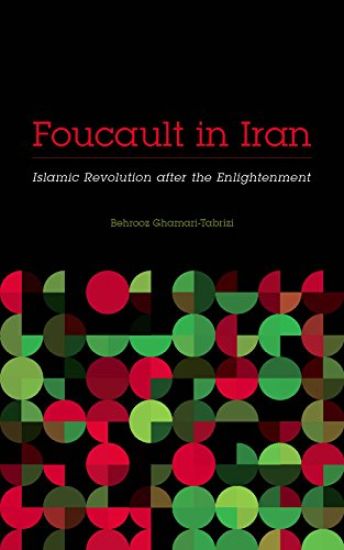
Foucault in Iran

Foucault in Iran

Behrooz Ghamari-Tabrizi

University of Minnesota Press
2016
sidottu
Were the thirteen essays Michel Foucault wrote in 1978–1979 endorsing the Iranian Revolution an aberration of his earlier work or an inevitable pitfall of his stance on Enlightenment rationality, as critics have long alleged? Behrooz Ghamari-Tabrizi argues that the critics are wrong. He declares that Foucault recognized that Iranians were at a threshold and were considering if it were possible to think of dignity, justice, and liberty outside the cognitive maps and principles of the European Enlightenment. Foucault in Iran centers not only on the significance of the great thinker’s writings on the revolution but also on the profound mark the event left on his later lectures on ethics, spirituality, and fearless speech. Contemporary events since 9/11, the War on Terror, and the Arab Uprisings have made Foucault’s essays on the Iranian Revolution more relevant than ever. Ghamari-Tabrizi illustrates how Foucault saw in the revolution an instance of his antiteleological philosophy: here was an event that did not fit into the normative progressive discourses of history. What attracted him to the Iranian Revolution was precisely its ambiguity.Theoretically sophisticated and empirically rich, this interdisciplinary work will spark a lively debate in its insistence that what informed Foucault’s writing was not an effort to understand Islamism but, rather, his conviction that Enlightenment rationality has not closed the gate of unknown possibilities for human societies.
Foucault in Iran

Foucault in Iran

Behrooz Ghamari-Tabrizi

University of Minnesota Press
2016
nidottu
Were the thirteen essays Michel Foucault wrote in 1978 1979 endorsing the Iranian Revolution an aberration of his earlier work or an inevitable pitfall of his stance on Enlightenment rationality, as critics have long alleged? Behrooz Ghamari-Tabrizi argues that the critics are wrong. He declares that Foucault recognized that Iranians were at a threshold and were considering if it were possible to think of dignity, justice, and liberty outside the cognitive maps and principles of the European Enlightenment. Foucault in Iran centers not only on the significance of the great thinkers writings on the revolution but also on the profound mark the event left on his later lectures on ethics, spirituality, and fearless speech. Contemporary events since 9/11, the War on Terror, and the Arab Uprisings have made Foucaults essays on the Iranian Revolution more relevant than ever. Ghamari-Tabrizi illustrates how Foucault saw in the revolution an instance of his antiteleological philosophy: here was an event that did not fit into the normative progressive discourses of history. What attracted him to the Iranian Revolution was precisely its ambiguity. Theoretically sophisticated and empirically rich, this interdisciplinary work will spark a lively debate in its insistence that what informed Foucaults writing was not an effort to understand Islamism but, rather, his conviction that Enlightenment rationality has not closed the gate of unknown possibilities for human societies.
Foucault and Education Primer

Foucault and Education Primer

Gail McNicol Jardine

Peter Lang Publishing Inc
2005
nidottu
This book explores the works of Michel Foucault and their relevance for educational theory and practice. Gail McNicol Jardine investigates Foucault's early examinations of the transformation of systems of knowledge as societies change, his in-depth, critical analyses of Knowledge-Power, and his increasingly more explicit examination of the relationship of the Self to acts of Knowledge-Power. Specific themes that are explored from Foucault's work are archeology, genealogy, disciplinary knowledge and power, normality, the gaze, panopticism, the examination, critique and resistance. This primer contains ample references that allow the reader to examine Foucault's own use of these important analytic concepts and tools. This book will be useful in undergraduate and graduate courses in education, critical theory, educational theory, critical pedagogy, philosophy, psychology, and sociology.
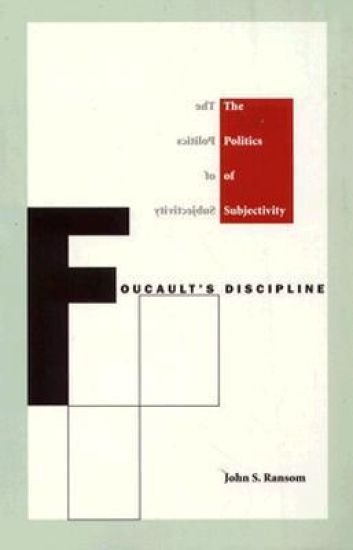
Foucault's Discipline

Foucault's Discipline

John S. Ransom

Duke University Press
1997
pokkari
In Foucault’s Discipline, John S. Ransom extracts a distinctive vision of the political world-and oppositional possibilities within it-from the welter of disparate topics and projects Michel Foucault pursued over his lifetime. Uniquely, Ransom presents Foucault as a political theorist in the tradition of Weber and Nietzsche, and specifically examines Foucault’s work in relation to the political tradition of liberalism and the Frankfurt School. By concentrating primarily on Discipline and Punish and the later Foucauldian texts, Ransom provides a fresh interpretation of this controversial philosopher’s perspectives on concepts such as freedom, right, truth, and power. Foucault’s Discipline demonstrates how Foucault’s valorization of descriptive critique over prescriptive plans of action can be applied to the decisively altered political landscape of the end of this millennium. By reconstructing the philosopher’s arguments concerning the significance of disciplinary institutions, biopower, subjectivity, and forms of resistance in modern society, Ransom shows how Foucault has provided a different way of looking at and responding to contemporary models of government-in short, a new depiction of the political world.
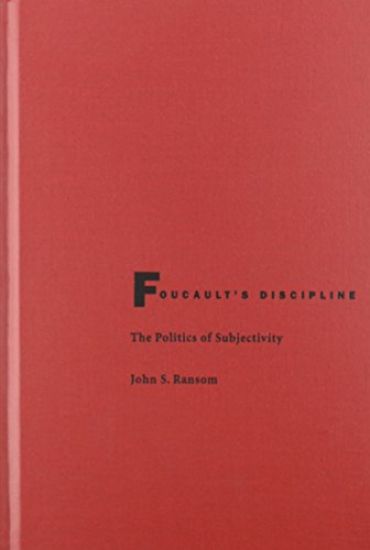
Foucault's Discipline

Foucault's Discipline

John S. Ransom

Duke University Press
1997
sidottu
In Foucault’s Discipline, John S. Ransom extracts a distinctive vision of the political world-and oppositional possibilities within it-from the welter of disparate topics and projects Michel Foucault pursued over his lifetime. Uniquely, Ransom presents Foucault as a political theorist in the tradition of Weber and Nietzsche, and specifically examines Foucault’s work in relation to the political tradition of liberalism and the Frankfurt School. By concentrating primarily on Discipline and Punish and the later Foucauldian texts, Ransom provides a fresh interpretation of this controversial philosopher’s perspectives on concepts such as freedom, right, truth, and power. Foucault’s Discipline demonstrates how Foucault’s valorization of descriptive critique over prescriptive plans of action can be applied to the decisively altered political landscape of the end of this millennium. By reconstructing the philosopher’s arguments concerning the significance of disciplinary institutions, biopower, subjectivity, and forms of resistance in modern society, Ransom shows how Foucault has provided a different way of looking at and responding to contemporary models of government-in short, a new depiction of the political world.
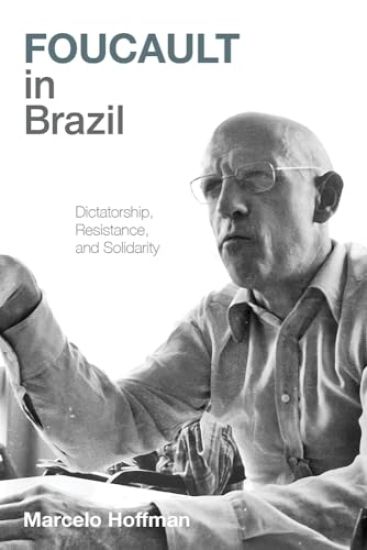
Foucault in Brazil

Foucault in Brazil

Marcelo Hoffman

UNIVERSITY OF PITTSBURGH PRESS
2024
sidottu
Philosopher Michel Foucault’s cultural criticism crosses disciplines and is well known as an influence on modern conceptions of knowledge and power. Less well known are the five trips he took to Brazil between 1965 and 1976\. Although a coup in 1964 had installed a military dictatorship, Foucault kept his opinion on the Brazilian government largely to himself until October 23, 1975\. On that date, he delivered a manifesto at a student assembly in São Paulo expressing his solidarity with students and professors protesting a wave of arrests and torture. This manifesto caught the government’s attention and became the focal point of the dictatorship’s surveillance of Foucault. Foucault in Brazil explores the production of the public antagonism between the philosopher and the dictatorship through a meticulous consideration of each of his visits to Brazil. Marcelo Hoffman connects history, philosophy, and political theory to open new ways of thinking about Foucault as a person and thinker and about Brazil and authoritarianism.
Foucault's Critical Ethics

Foucault's Critical Ethics

Richard A. Lynch

Fordham University Press
2016
sidottu
The central thesis of Foucault's Critical Ethics is that Foucault's account of power does not foreclose the possibility of ethics; on the contrary, it provides a framework within which ethics becomes possible. Tracing the evolution of Foucault's analysis of power from his early articulations of disciplinary power to his theorizations of biopower and governmentality, Richard A. Lynch shows how Foucault's ethical project emerged through two interwoven trajectories: analysis of classical practices of the care of the self, and engaged practice in and reflection upon the limits of sexuality and the development of friendship in gay communities. These strands of experience and inquiry allowed Foucault to develop contrasting yet interwoven aspects of his ethics; they also underscored how ethical practice emerges within and from contexts of power relations. The gay community's response to AIDS and its parallels with the feminist ethics of care serve to illustrate the resources of a Foucauldian ethic—a fundamentally critical attitude, with substantive (but revisable) values and norms grounded in a practice of freedom.
Foucault and the Art of Ethics

Foucault and the Art of Ethics

Timothy O'Leary

Mansell Publishing
2002
nidottu
The work of Michael Focault has been extremely influential in fields as varied as philosophy, history, cultural studies, sociology and sexualilty studies. In his later work, Focault turned to the question of ethics. Working back through history, through the Christian interrogation of desire to the origins of the self in the texts of classical Greece, Focault attempted to concieve of ethics as an art of the self, as an aesthetics of existence and as a practice of liberty. Focault and the Art of Ethics argues that Focault's exploration of the history of sexuality and reinterpretation of the critical philosophical tradition combine to frame a new approach both to the way we understand the tasks of philosophy and to the way we live our lives. The book is essential reading for all those working at the intersection of contemporary debates in philosophy, ethics, politics and cultural studies. Timothy O'Leary is Assistant Professor of Philosophy at the University of Hong Kong. He has spent several years working in the Focault Archives and has published on Focault, aesthetics and literature.
Foucault and the Art of Ethics

Foucault and the Art of Ethics

Timothy O'Leary

Continuum International Publishing Group Ltd.
2006
nidottu
The work of Michel Foucault has been extremely influential in fields as varied as philosophy, history, cultural studies, sociology and sexuality studies. In his later work, Foucault turned to the question of ethics. Working back through history, through the Christian interrogation of desire to the origins of the self in the texts of classical Greece, Foucault attempted to conceive of ethics as an art of the self, as an aesthetics of existence and as a practice of liberty. Foucault and the Art of Ethics argues that Foucault's exploration of the history of sexuality and his reinterpretation of the critical philosophical tradition combine to frame a new approach both to the way we understand the tasks of philosophy and to the way we live our lives. The book is essential reading for all those working at the intersection of contemporary debates in philosophy, ethics, politics and cultural studies.
Foucault

Foucault

Gilles Deleuze

Continuum International Publishing Group Ltd.
2006
nidottu
Giles Deleuze (1925-1995) was Professor of Philosophy at the University of Paris VIII. He is a key figure in poststructuralism and one of the most influential philosophers of the twentieth century. In "Foucault", Deleuze presents one of the most incisive and productive analyses of the work of Michel Foucault. This is a crucial examination of the philosophical foundations and principal themes of Foucault's work, providing a rigorous engagement with Foucault's views on knowledge, punishment, power, and the nature of subjectivity.
Foucault's Heidegger

Foucault's Heidegger

Rayner Timothy

Continuum International Publishing Group Ltd.
2007
sidottu
Foucault's philosophical relationship to Heidegger is the subject of continuing academic debate. To date, no comprehensive interpretation of this relationship has emerged. This book provides a groundbreaking new approach to Foucault and Heidegger's relationship, based in an original approach to the problem itself. Rather than explore points of similarity between these thinkers, the book identifies a Heideggerian style, or practice, of thinking in Foucault's work, which first emerges in his early studies of madness and literature. Through a series of penetrating studies, Foucault's Heidegger shows how this philosophical practice informs the content and objectives of Foucault's critical writings to the end of his career. This argument clarifies the central role of transformative experience in Foucault's work. In addition to establishing the nature of Foucault's engagement with Heidegger, it provides a new perspective on the role of 'fiction' in Foucault's critique, and revitalizes our conception of Foucault's status as a philosopher. Foucault's Heidegger will be a landmark in Foucault studies, the first comprehensive account of Foucault's relationship to Heidegger in print. As such, it will be a key reference for future debates on this matter and discussions of Foucault's work generally.
Foucault and Fiction

Foucault and Fiction

Timothy O'Leary

BLOOMSBURY PUBLISHING PLC
2009
sidottu
This monograph offers a new interpretation of Melville's work (focusing on "Moby-Dick", "Pierre" and "Benito Cereno") in the light of scholarship on globalization from critics in 'new' American studies. In "Melville, Mapping and Globalization", Robert Tally argues that Melville does not belong in the tradition of the American Renaissance, but rather creates a baroque literary cartography, artistically engaging with spaces beyond the national model. At a time of intense national consolidation and cultural centralization, Melville discovered the postnational forces of an emerging world system, a system that has become our own in the era of globalization. Drawing on the work of a range of literary and social critics (including Deleuze, Foucault, Jameson, and Moretti), Tally argues that Melville's distinct literary form enabled his critique of the dominant national narrative of his own time and proleptically undermined the national literary tradition of American Studies a century later. Melville's hypercanonical status in the United States makes his work all the more crucial for understanding the role of literature in a post-American epoch. Offering bold new interpretations and theoretical juxtapositions, Tally presents a postnational Melville, well suited to establishing new approaches to American and world literature in the twenty-first century.
Foucault, Sexuality, Antiquity
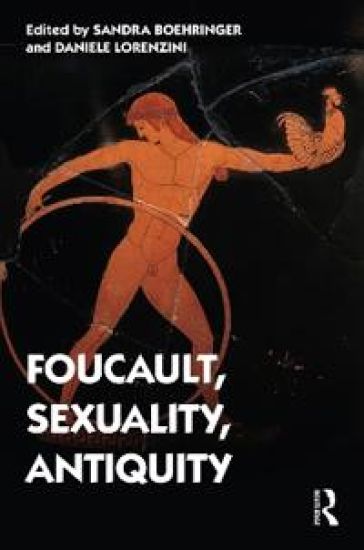
Foucault, Sexuality, Antiquity, published for the first time in English, takes an interdisciplinary approach to exploring how the work of Michel Foucault has influenced studies of Ancient Greece and Rome. Foucault’s The History of Sexuality has had a profound and lasting impact across the humanities and social sciences. In the two volumes dedicated to pagan antiquity, Foucault provided scholars with new questions for addressing ancient Greek and Roman societies, and an original epistemological framework for thinking about eroticism and about the processes by which individuals are led to recognize themselves as the subjects of their desires. Now, decades later, the scholars in this volume explore Foucault’s role in shaping and reorienting discussions of antiquity in the fields of philosophy, gender studies, and psychoanalysis, among others.A multidisciplinary exploration of Foucault’s work and its relationship to our understanding of ancient Greco-Roman societies, Foucault, Sexuality, Antiquity will be of interest to students and scholars in classical studies, philosophy, gender studies, and ancient history.
Foucault, Sexuality, Antiquity
Foucault, Sexuality, Antiquity, published for the first time in English, takes an interdisciplinary approach to exploring how the work of Michel Foucault has influenced studies of Ancient Greece and Rome. Foucault’s The History of Sexuality has had a profound and lasting impact across the humanities and social sciences. In the two volumes dedicated to pagan antiquity, Foucault provided scholars with new questions for addressing ancient Greek and Roman societies, and an original epistemological framework for thinking about eroticism and about the processes by which individuals are led to recognize themselves as the subjects of their desires. Now, decades later, the scholars in this volume explore Foucault’s role in shaping and reorienting discussions of antiquity in the fields of philosophy, gender studies, and psychoanalysis, among others.A multidisciplinary exploration of Foucault’s work and its relationship to our understanding of ancient Greco-Roman societies, Foucault, Sexuality, Antiquity will be of interest to students and scholars in classical studies, philosophy, gender studies, and ancient history.
Foucault, Biopolitics and Resistance

Foucault, Biopolitics and Resistance

Lauri Siisiäinen

Taylor Francis Ltd
2021
nidottu
Political resistance is flourishing. In this context, there is a growing interest to reread Michel Foucault’s work, especially from the late period, from the perspective of resistance, social movements and affirmative biopolitics. Yet what has been missing so far is a book-length, comprehensive study focusing on this topic. This volume undertakes this task, providing an original typology of the resources of resistance discovered in Foucault’s late thinking: resistance as discursive protection of autonomy bodily and affective resistance the strategies, arts and practices of affirmative biopolitics or ‘politics of life’ The book shows how these different types of tools, arts and practices can be used in resistant politics, in struggles against various regimes and institutions of power and government, so that they mutually supplement and reinforce one another. The author embarks on advancing Foucault’s insights on resistance from where he stopped. Furthermore, the volume proposes a novel assessment of the Foucauldian political toolkit in the 21st century context, addressing its pertinence for struggles against neoliberalism and post-Fordist capitalism. Foucault, Biopolitics and Resistance will be an important resource for students and scholars interested in Foucault, resistance and 21st century politics within many fields, including political science, international relations, contemporary and continental philosophy as well as sociology. The work elaborates fresh methodological insights, fruitful for further empirical research on social and political movements.
Foucault on Power, Law, and Society

Foucault on Power, Law, and Society

Marco Brigaglia

TAYLOR FRANCIS LTD
2026
sidottu
This book offers a detailed analysis and reappraisal of Michel Foucault’s work on power, law, and society. Highlighting the ambiguities, tensions, inconsistencies, and transformations in Foucault’s work, the book shows how, in Foucault’s later years, his ideas gradually converged toward a conception of power that was significantly different from the one that emerges from the works and courses of the mid-1970s, and which came to provide the mainstream understanding of his thought. From the vantage point of this later conception, the book is then able to reframe the tensions and inconsistencies in Foucault’s thought as parts of a multiplex but coherent conceptual system. Foucault’s theses on the development of techniques of power since the 18th century, and on the impact of these developments affected the structure of modern law, are then reformulated to offer a more comprehensive and more balanced appraisal of their contemporary significance. Foucault on Power, Law and Society will appeal to theorists in law, philosophy, and political science, as well as others with interests in the perpetually influential work of Michel Foucault on power and subjectivity.