The Glacial Boundary In Ohio, Indiana And Kentucky has been considered by academicians and scholars of great significance and value to literature. This forms a part of the knowledge base for future generations. So that the book is never forgotten we have represented this book in a print format as the same form as it was originally first published. Hence any marks or annotations seen are left intentionally to preserve its true nature.
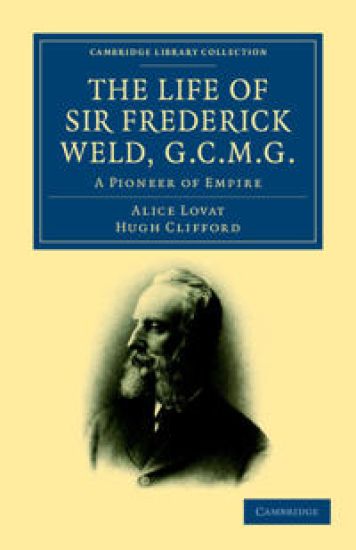
Written in 1914 by Alice, Lady Lovat (1846–1938), a cousin, this biography of Sir Frederick Aloysius Weld (1823–91) is characterised by its subtitle, 'a pioneer of empire'. The young Weld emigrated to New Zealand with a cousin to establish sheep stations. Entering politics, he became Minister for Native Affairs and then Premier; his Native Rights Act of 1865 redressed many of the grievances which had led to the Maori Wars. In 1868 he was appointed Governor of Western Australia, where he brought in a degree of representative government and helped develop the telegraph and transport infrastructure. In 1874 he became Governor of Tasmania, and in 1880 was promoted to the Straits Settlements, where his period as a colonial administrator was notable for the increase of British influence among the princely rulers of the Malay States. Retiring in 1887 for health reasons, he died in England in 1891.
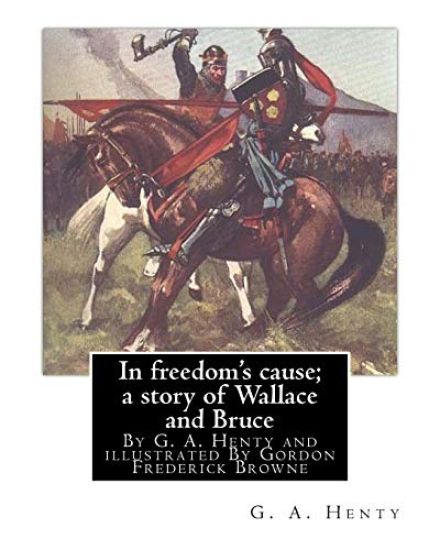
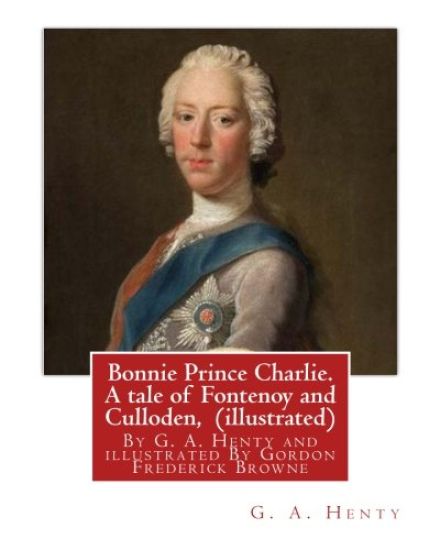
At the end of the thirteenth century, the oppressed people of Scotland rebelled against their despised English ruler, Edward Longshanks. In Freedom's Cause recounts the Scots' desperate but ultimately triumphant struggle in the face of overwhelming odds - a hard-fought series of battles conducted under the leadership of William Wallace and Robert Bruce. Time has burnished the feats of these great heroes to mythic proportions, but Wallace and Bruce were real people. This gripping tale of courage, loyalty, and ingenuity recounts their deeds within an accurate historical context. Readers join their company alongside a fictional protagonist, young Archie Forbes, whose estates have been wrongfully confiscated. Archie forms a group of scouts to fight alongside the legendary Scottish chieftains (who were memorably portrayed in the film Braveheart) for their country's independence. In Freedom's Cause is one among the many historical novels for young readers by George Alfred Henty. A storyteller who specialized in blending authentic historical facts with exciting fictional characters, Henty produced more than 140 books and achieved a reputation as "The Prince of Storytellers." Immensely popular and widely used in schools for many years, Henty's novels continue to fire young imaginations with their spirited tales of adventure amid exciting historical eras.... George Alfred Henty (8 December 1832 - 16 November 1902) was a prolific English novelist and war correspondent.He is best known for his historical adventure stories that were popular in the late 19th century. His works include The Dragon & The Raven (1886), For The Temple (1888), Under Drake's Flag (1883) and In Freedom's Cause (1885).G. A. Henty was born in Trumpington, near Cambridge. He was a sickly child who had to spend long periods in bed. During his frequent illnesses he became an avid reader and developed a wide range of interests which he carried into adulthood. He attended Westminster School, London, and later Gonville and Caius College, Cambridge, where he was a keen sportsman. He left the university early without completing his degree to volunteer for the Army Hospital Commissariat when the Crimean War began. He was sent to the Crimea and while there he witnessed the appalling conditions under which the British soldier had to fight. His letters home were filled with vivid descriptions of what he saw. His father was impressed by his letters and sent them to The Morning Advertiser newspaper which printed them. This initial writing success was a factor in Henty's later decision to accept the offer to become a special correspondent, the early name for journalists now better known as war correspondents. Shortly before resigning from the army as a captain in 1859 he married Elizabeth Finucane. The couple had four children. Elizabeth died in 1865 after a long illness and shortly after her death Henty began writing articles for the Standard newspaper. In 1866 the newspaper sent him as their special correspondent to report on the Austro-Italian War where he met Giuseppe Garibaldi. He went on to cover the 1868 British punitive expedition to Abyssinia, the Franco-Prussian War, the Ashanti War, the Carlist Rebellion in Spain and the Turco-Serbian War.He also witnessed the opening of the Suez Canal and travelled to Palestine, Russia and India. Henty was a strong supporter of the British Empire all his life; according to literary critic Kathryn Castle: "Henty...exemplified the ethos of the new imperialism, and glorified in its successes". Henty's ideas about politics were influenced by writers such as Sir Charles Dilke and Thomas Carlyle.... Gordon Frederick Browne (15 April 1858 - 27 May 1932) was an English artist and children's book illustrator in the late 19th century and early 20th century........
Title: A Catalogue of Maps, Plans, and Views of London, Westminster & Southwark. Collected and arranged by Frederick Crace. Edited by his son J. G. Crace.Publisher: British Library, Historical Print EditionsThe British Library is the national library of the United Kingdom. It is one of the world's largest research libraries holding over 150 million items in all known languages and formats: books, journals, newspapers, sound recordings, patents, maps, stamps, prints and much more. Its collections include around 14 million books, along with substantial additional collections of manuscripts and historical items dating back as far as 300 BC.The HISTORY OF BRITAIN & IRELAND collection includes books from the British Library digitised by Microsoft. As well as historical works, this collection includes geographies, travelogues, and titles covering periods of competition and cooperation among the people of Great Britain and Ireland. Works also explore the countries' relations with France, Germany, the Low Countries, Denmark, and Scandinavia. ++++The below data was compiled from various identification fields in the bibliographic record of this title. This data is provided as an additional tool in helping to insure edition identification: ++++ British Library Crace, John Gregory; Crace, Frederick; 1878. xxii. 696 p.; 8 . 010349.dd.42.
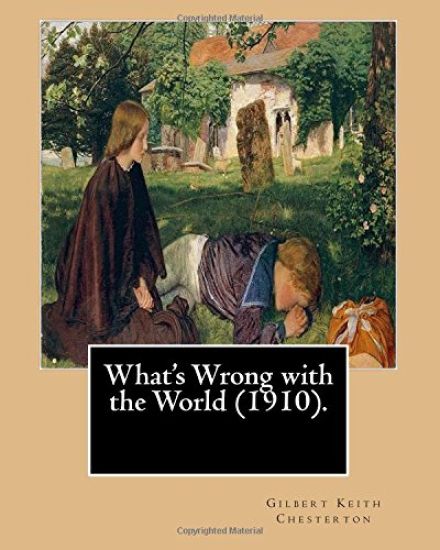
Gilbert Keith Chesterton, KC*SG (29 May 1874 - 14 June 1936), better known as G. K. Chesterton, was an English writer, poet, philosopher, dramatist, journalist, orator, lay theologian, biographer, and literary and art critic. Chesterton is often referred to as the "prince of paradox". Time magazine has observed of his writing style: "Whenever possible Chesterton made his points with popular sayings, proverbs, allegories-first carefully turning them inside out." Chesterton is well known for his fictional priest-detective Father Brown, and for his reasoned apologetics. Even some of those who disagree with him have recognised the wide appeal of such works as Orthodoxy and The Everlasting Man.Chesterton, as a political thinker, cast aspersions on both Progressivism and Conservatism, saying, "The whole modern world has divided itself into Conservatives and Progressives. The business of Progressives is to go on making mistakes. The business of the Conservatives is to prevent the mistakes from being corrected."Chesterton routinely referred to himself as an "orthodox" Christian, and came to identify this position more and more with Catholicism, eventually converting to Catholicism from High Church Anglicanism. George Bernard Shaw, Chesterton's "friendly enemy" according to Time, said of him, "He was a man of colossal genius."Biographers have identified him as a successor to such Victorian authors as Matthew Arnold, Thomas Carlyle, Cardinal John Henry Newman, and John Ruskin.... Charles Frederick Gurney Masterman PC (24 October 1873 - 17 November 1927) was a radical Liberal Party politician, intellectual and man of letters, He worked closely with such Liberal leaders as David Lloyd George and Winston Churchill in designing social welfare projects, including the National Insurance Act of 1911. During the First World War, he played a central role in the main government propaganda agency....








![A Description Of The Machine For The Fireworks ... And A Detail Of The Manner In Which They Are To Be Exhibited ... On Account Of The General Peace ... 1748 [by G. Ruggieri And G. Sarti, Tr. By W. Frederick.]. [3 Large Paper Copies]](/covers/9781024311501.jpg)