Kirjojen hintavertailu. Mukana 11 244 527 kirjaa ja 12 kauppaa.

Kirjahaku

Etsi kirjoja tekijän nimen, kirjan nimen tai ISBN:n perusteella.

1000 tulosta hakusanalla G. Addison Powell

G Protein-Coupled Receptors
Covering recently developed methods in membrane-bound receptors, this book emphasizes receptor structure and function, knowledge of which is essential to the study of signal transduction. G Protein-Coupled Receptors has culled contributors from domestic and international sources, providing a broad base of knowledge. Some topics covered are the regulation of receptors; phosphorylation of G-protein-coupled receptors and ion channel receptors; desensitization studies using electrophysiological or confocal microscopic methods and the search for endogenous ligands for orphan receptors. This volume is useful at both the university and industrial levels, and is of particular interest to those who are developing therapeutic approaches to diseases using drugs that influence receptor activation.
G. W. M. Reynolds and His Fiction

G. W. M. Reynolds and His Fiction

Stephen Knight

Routledge
2020
nidottu
George Reynolds is arguably the most prolific of all nineteenth-century English novelists, reaching an enormous audience through his thirty-six novels. Often selling in very large numbers in weekly one-penny installments, his works were known as by the most popular English novelist ever. Yet today, he remains almost unknown in the canon of English Literature.A serious radical, strongly pro-woman, and a leading Chartist seeking the vote for all men, Reynolds’ vigorous heroines differ notably from the Victorian novelists’ timid norm. He was strongly pro-Jewish and pro-Gypsy, very interested in French and Italian society, but wrote for ordinary English working people. Dickens thought him a dangerous leftist: for all these reasons, he was excluded from the elite literary world.G. W. M. Reynolds: The Man Who Outsold Dickens reestablishes Reynolds as a major figure of mid-nineteenth-century fiction and an author of European range and status. This book examines his massive popularity and notable concern with the problems of ordinary people, especially women, in the complex and often dangerous new world of the modern city. With the support of his wife Susannah, Reynolds’ enormous influence would also make a contribution to the cause of mass political education through his role in the development of popular fiction and journalism. This book is a major innovation in the field of Victorian literary studies, with relevance to popular cultural studies, the politics of literature, and publishing history, presenting properly a much overlooked major English novelist.
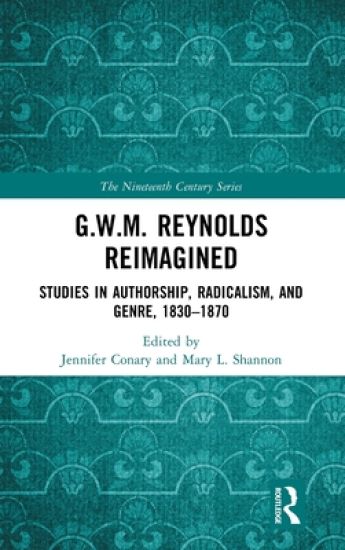
G.W.M. Reynolds Reimagined

G.W.M. Reynolds Reimagined

TAYLOR FRANCIS LTD
2023
sidottu
This essay collection proposes that G.W.M. Reynolds’s contribution to Victorian print culture reveals the interrelations between authorship, genre, and radicalism in popular print culture of the nineteenth century. As a best-selling author of popular fiction marketed to the lower classes, and a passionate champion of radical politics and "the industrious classes," Reynolds and his work demonstrate the relevance of Victorian Studies to topics of pressing contemporary concern including populism, working-class fiction, the concept of ‘originality’, and the collective scholarly endeavour to ‘widen’ and ‘undiscipline’ Victorian Studies. Bringing together well-known and newly-emerging scholars from across different disciplinary perspectives, the volume explores the importance of Reynolds Studies to scholarship on the nineteenth-century. This book will appeal to students and scholars of the nineteenth-century press, popular culture, and of authorship, as well as to Victorian Studies scholars interested in the translation of Victorian texts into new and indigenous markets.
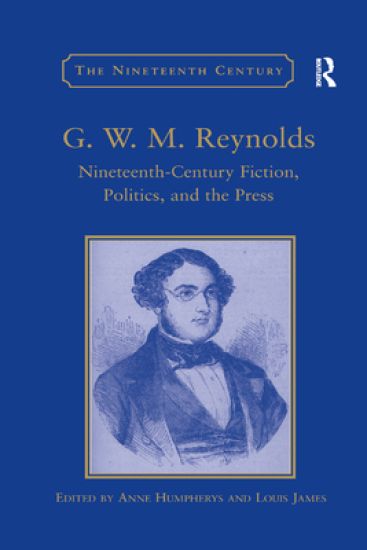
G.W.M. Reynolds

G.W.M. Reynolds

Anne Humpherys

Routledge
2019
nidottu
G.W.M. Reynolds (1814-1879) had a major impact on the mid-Victorian era that until now has been largely unacknowledged. A prolific novelist whose work had a massive circulation, and an influential journalist and editor, he was a man of contradictions in both his life and writing: a middle-class figure who devoted his life to working class issues but seldom missed a chance to profit from the exploitation of current issues; the founder of the radical newspaper Reynolds Weekly, as well as a bestselling author of historical romances, gothic and sensation novels, oriental tales, and domestic fiction; a perennial bankrupt who nevertheless ended his life prosperously. A figure of such diversity requires a collaborative study. Bringing together a distinguished group of scholars, this volume does justice to the full range of Reynolds's achievement and influence. With proper emphasis on new work in the field, the contributors take on Reynolds's involvement with Chartism, serial publication, the mass market periodical, commodity culture, and the introduction of French literature into British consciousness, to name just a few of the topics covered. The Mysteries of London, the century's most widely read serial, receives the extensive treatment this long-running urban gothic work deserves. Adding to the volume's usefulness are comprehensive bibliographies of Reynolds's own writings and secondary criticism relevant to the study of this central figure in mid-nineteenth-century Britain.
G-Man

G-Man

Stephen Hunter

G.P. Putnam's Sons
2018
pokkari
"A roaring good read."--FORBES.com Master sniper Bob Lee Swagger returns in this riveting novel by bestselling author and Pulitzer Prize winner Stephen Hunter. The Great Depression was marked by an epidemic of bank robberies and Tommy-gun-toting outlaws who became household names. Hunting them down was the new U.S. Division of Investigation--soon to become the FBI--which was determined to nab the most dangerous gangster this country has ever produced: Baby Face Nelson. To stop him, the Bureau recruited talented gunman Charles Swagger, World War I hero and sheriff of Polk County, Arkansas. Eighty years later, Charles's grandson Bob Lee Swagger uncovers a strongbox containing an array of memorabilia dating back to 1934--a federal lawman's badge, a .45 automatic preserved in cosmoline, a mysterious gun part, and a cryptic diagram--all belonging to Charles Swagger. Bob becomes determined to find out what happened to his grandfather-- and why his own father never spoke of Charles. But as he investigates, Bob learns that someone is following him--and shares his obsession. Told in alternating timeframes, G-Man is a thrilling addition to Stephen Hunter's bestselling Bob Lee Swagger series.
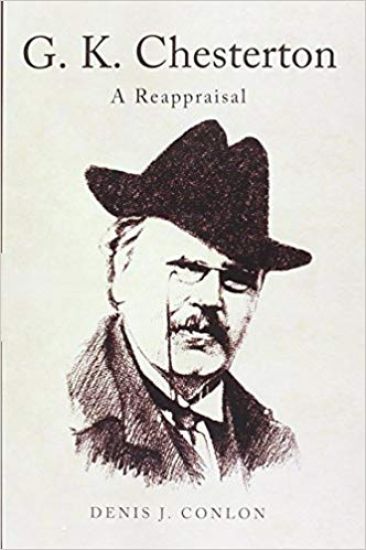
G K Chesterton: a Reappraisal

G K Chesterton: a Reappraisal

Conlon Denis

Methuen Publishing Ltd
2015
sidottu
Gilbert Keith Chesterton (1874-1936), who was one of the most important literary figures of the early twentieth century, is now almost forgotten. A recent suggestion that he should be elevated to sainthood has renewed interest in him as have accusations of anti-Semitism by critics of the suggestion. From a modest start with a job in publishing and as a book reviewer, Chesterton went on to achieve a massive reputation as journalist, novelist, poet and playwright and much else. Born into a comfortable middle class family, Gilbert had a younger brother Cecil and a sister Beatrice, who died in infancy. Their father Edward, an estate agent, ensured his sons received a good education at St Paul's School. Gilbert went on to the Slade School of Art, to train as an Illustrator. At St Paul's Gilbert formed life-long friendships with, among others, Edmund Clerihew Bentley, who achieved fame of a sort with his 'clerihew' poetry. Others of Gilbert's friends were Lucian Oldershaw, E W Fordham, Digby and Waldo d'Avigdor who bonded further in the Junior Debating Club and later in the amusingly named IDK club.Known universally as G K Chesterton, Gilbert wrote 80 books, hundreds of poems and essays and several plays. He contributed articles to newspapers and journals on the important political and social issues of the day and launched his own G.K.'s Weekly. He was a brilliant orator and undertook speaking tours of North America and in Europe. He also engaged in friendly debates with George Bernard Shaw, H G Wells, Bertrand Russell and Hilaire Belloc. In his latter years, Chesterton became a successful broadcaster on BBC radio. His marriage to Frances Blogg in 1901 endured for the rest of his life. There were no children but the couple formed lasting friendships with children of other families. Frances was frequently ill and often a burden to Gilbert whose own idiosyncrasies - absent-minded, dishevelled, disorganised - gave cause for Frances and a string of secretaries to indulge him. At his death due to heart disease, he weighed more than 20 stones.In this excellent biography Denis Conlon portrays Chesterton as the giant that he was, literally and metaphorically.It includes some previously unpublished photographs and illustrations and the diary of their trip to Palestine and the Holy Land reveals his empathy with all peoples of the region. The book is a worthy addition to the genre.
G.W.F. Hegel
G.W.F. Hegel(1770-1831), arguably the greatest philosopher of the nineteenth century, decisively influenced the direction of all subsequent European thought. Variously understood as a theist and an atheist, a conservative and a liberal, an essentialist and a proto-existentialist, a rationalist and an irrationalist, the ambiguities of Hegel's position mean that `interpreting Hegel means taking a stand on all the philosophical, political and religious problems of our century'(Merleau-Ponty). This collection of writings on Hegel reflects the many-sided nature of Hegel's reception from 1831 onwards, and also offers critical studies on the full range of his work. The four volumes incorporate the classic readings of Hegel, from both the continental and analytic traditions, and also include the central twentieth century readings of his work. Each volume is provided with a clear and helpful introduction which sets the articles in their historical context and highlights the central philosophical issues that they raise.
G.W. Leibniz
Gottfried Wilhelm Leibniz (1646-1716) was one of the seventeenth century's most important thinkers. A philosopher, mathematician and scientist, his work is comparable in scope and importance only to that of Newton and Descartes. His work dominated German philosophy until Kant, and was revived in the early part of this century when his important work on logic was re-discovered. This four volume set contains 97 of the most important essays ever written about Leibniz's work. The selection has been made to bring out the scope of Leibniz's work in all the areas he wrote upon, as well as its importance to contemporary philosophy and the history of philosophy. It will be an essential reference work for anyone concerned with seventeenth century philosophy and science, as well as to all Leibniz specialists.
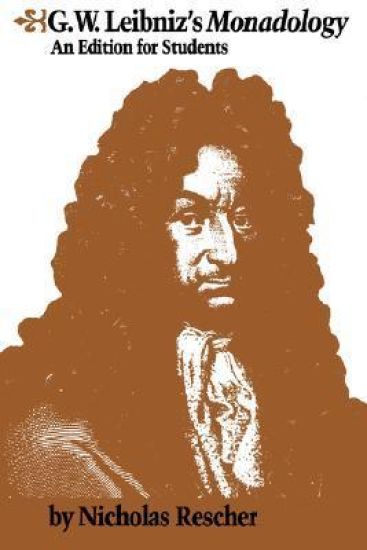
G.W. Leibniz's Monadology

G.W. Leibniz's Monadology

Nicholas Rescher

Routledge
1992
nidottu
G.W. Leibniz's Monadology , one of the most important pieces of the Leibniz corpus, is at once one of the great classics of modern philosophy and one of its most puzzling productions. Because the essay is written in so condensed and compact a fashion, for almost three centuries it has baffled and beguiled those who have read it for the first time. Nicholas Rescher accompanies the text of the Monadology section-by-section with relevant excerpts from other Leibnizian writings. Using these brief sections as an outline, Rescher collects together some of Leibniz's widely scattered discussions of the matters at issue. The result serves a dual purpose of providing a commentary on the Monadology by Leibniz himself, while at the same time supplying an exposition of his philosophy using the Monadology as an outline.
G.E. Moore

G.E. Moore

G.E. Moore

Routledge
1993
sidottu
G.E. Moore, more than either Bertrand Russell or Ludwig Wittgenstein, was chiefly responsible for the rise of the analytic method in twentieth-century philosophy. This selection of his writings shows Moore at his very best.The classic essays are crucial to major philosophical debates that still resonate today. Amongst those included are:* A Defense of Common Sense* Certainty* Sense-Data* External and Internal Relations* Hume's Theory Explained* Is Existence a Predicate?* Proof of an External WorldIn addition, this collection also contains the key early papers in which Moore signals his break with idealism, and three important previously unpublished papers from his later work which illustrate his relationship with Wittgenstein.
G E Moore

G E Moore

Routledge
2002
sidottu
This is Volume III of twenty-two volumes on 20th Century Philosophy. Originally published in 1970, this is a collection of essays of George Edward Moore (1873-1958) who was one of the most influential philosophers of the twentieth century, and the outcome of the changes he introduced into our ways of thinking in philosophy cannot yet be foreseen.
G. Literature and Fantasy
These three volumes are part of the forty-one volume set New Accents. First launched in 1977, the New Accents series rapidly changed the face of literary studies. Its clear and concise volumes brought the latest in literary theory to students and academics and paved the way for undergraduate teaching on essential new topics and approaches.
G. Philosophy of Religion and General Philosophy
This set contains an exciting mix of volumes which will be of interest to a range of readers. Religion, Philosophy and Psychical Research, by the eminent philosopher C. D. Broad looks at psychical research, religion and politics. Speculations, published in 1924, is an edited selection from T. E. Hulme's notebooks and unpublished manuscripts, containing essays on humanism and the philosophy of art. The Philosophy of Music, also published in 1924, was one of the first studies to apply philosophy to music. Exploring the meaning and structure of music and the science of acoustics, this volume will attract those people interested in how perceptions of music have changed in almost eighty years. Reasons and Faiths describes the nature of religious doctrines and concepts, including discussions of Buddhism and Hinduism.
G: General Psychology

G: General Psychology

Paul Schilder

Routledge
2007
muu
This set provides an eclectic mix of areas within psychology, with many volumes covering a broad range of subjects in themselves. Areas covered include creative imagination, art and the unconscious, dreams, the mind in sleep, the nature of laughter, common sense and consciousness, nervous disorders, the nature of love and hate, as well as investigations into areas now considered more obscure, such as telepathy and clairvoyance. Titles such as The ABC of Psychology (1929), The Psychologist at Work (1937) and Readings in General Psychology (1959) provide an excellent overview of psychology as it has developed over the years. This set also includes classic works such as Man for Himself by Erich Fromm and Emotion by James Hillman.
G. India: Language and Literature
This set illustrates the diversity of Indian language and literature, incorporating translations and discussions of Indian poetry, dramas and proverbs. Albrecht Weber's foundational study, The History of Indian Literature includes analyses of writings from the Sanskrit, Buddhist and Vedic periods. Herman Jensen's A Classical Collection of Tamil Proverbs lists proverbs in the Tamil script and with both a literal translation, and an explanation in English. Similarly, John Christian's Behar Proverbs illustrates the different means of expression in these regional proverbs. The volumes in this set will be very useful research tools for anyone interested in Indian Language and Literature.
G. Metaphysics

G. Metaphysics

Andrew Wyatt

Routledge
2007
muu
Metaphysics is the branch of philosophy that deals with the question of existence and the nature of reality. Reprinted here are 17 texts offering a broad range of different perspectives.
G. Mental Health

G. Mental Health

Various Authors

Routledge
2007
muu
The volumes in this set make available significant studies on mental health and illness. Issues examined include Chronic Schizophrenia, Psychosis, different approaches to psychiatric research and the community aspect of mental health.
G.H. Mead

G.H. Mead

G. H. Mead

Routledge
2011
sidottu
This book introduces social scientists to the ideas of George Herbert Mead (1863-1931) - one of the most original yet neglected thinkers of early twentieth century sociology.Mead is an exceptional case amongst sociological classics in that, until now, there has been no comprehensive reader of his work. As the first one-volume, comprehensive edited collection of Mead’s published and unpublished writing, this book fills this gap. It is the first to critically assess all of Mead's writings and draw out the aspects that are central to his system of thought. The book is divided into three parts (social psychology, science and epistemology, and democratic politics), comprising a total of 30 chapters - a third of which are published here for the first time.G.H. Mead: A Reader provides a unique and timely contribution to the understanding of this key theorist. It is essential reading for both undergraduate and postgraduate students in the fields of sociology, social psychology, philosophy of social science, social and cultural anthropology, and social and political theory.
G. D. H. Cole: Selected Works
G. D. H. Cole was one of the foremost British socialist thinkers of the twentieth century. His literary output was immense and encompassed works of social theory, economics, political economy, economic history, social and labour history, political theory, history of thought and sociology. The books and pamphlets chosen for this edition are amongst his most significant. They are representative of the different phases of his thinking and illustrative of an acute and inquiring socialist mind as it wrestled with the formidable political and intellect challenges confronted by socialists in this most turbulent of centuries. This set re-issues 10 works of the well-known socialist thinker G. D. H. Cole and one volume of collected pamphlets, originally published between 1917 and 1956. The works in this collection encompass three critical periods of Cole’s socialist thinking: the guild socialist decade from 1913-23; the post 1929 period when his political economy was dominated by the notion of socialist economic intervention and planning, and the post-war period when, like other socialist theorists, he sought to come to terms with the particular challenges posed by the legacy of the Attlee governments, and the emergence of an affluent society. A substantial introduction by Noel Thompson places the works in their social, political and historical context and illustrates their continued relevance.For institutional purchases for e-book sets please contact [email protected] (customers in the UK, Europe and Rest of World)