Kirjojen hintavertailu. Mukana 11 342 296 kirjaa ja 12 kauppaa.

Kirjahaku

Etsi kirjoja tekijän nimen, kirjan nimen tai ISBN:n perusteella.

1000 tulosta hakusanalla Geoffrey Howse

The Works of Geoffrey Chaucer, Compared with the Former Editions, and Many Valuable Mss. ... by John Urry,
The 18th century was a wealth of knowledge, exploration and rapidly growing technology and expanding record-keeping made possible by advances in the printing press. In its determination to preserve the century of revolution, Gale initiated a revolution of its own: digitization of epic proportions to preserve these invaluable works in the largest archive of its kind. Now for the first time these high-quality digital copies of original 18th century manuscripts are available in print, making them highly accessible to libraries, undergraduate students, and independent scholars.Western literary study flows out of eighteenth-century works by Alexander Pope, Daniel Defoe, Henry Fielding, Frances Burney, Denis Diderot, Johann Gottfried Herder, Johann Wolfgang von Goethe, and others. Experience the birth of the modern novel, or compare the development of language using dictionaries and grammar discourses. ++++The below data was compiled from various identification fields in the bibliographic record of this title. This data is provided as an additional tool in helping to insure edition identification: ++++British LibraryT106027For additional holdings, please see N66255. Work left unfinished at Urry's death; final revision and completion entrusted to Timothy Thomas, who wrote the preface and glossary.London: printed for Bernard Lintot, 1721. 52],626,81, 1]p., plates: ill., ports.; 2
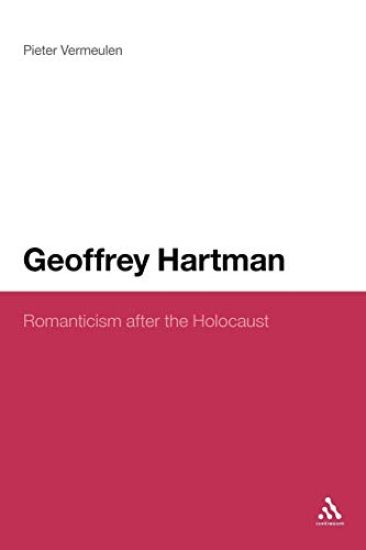
Geoffrey Hartman

Geoffrey Hartman

Pieter Vermeulen

Continuum Publishing Corporation
2012
nidottu
Geoffrey Hartman: Romanticism after the Holocaust offers the first comprehensive critical account of the work of the American literary critic Geoffrey Hartman. The book aims to achieve two things: first, it charts the whole trajectory of Hartman's career (now more than half a century long) while playing close attention to the place of his career in broader cultural and intellectual contexts; second, it engages with contemporary discussions about ecology, ethics, trauma, the media, and community in order to argue that Hartman's work presents a surprisingly consistent and original position in current debates in literary and cultural studies. Vermeulen identifies a persistent belief in the potency of aesthetic mediation at the heart of Hartman's project, and shows how his work repeatedly reasserts that belief in the face of institutional, cultural and intellectual factors that seem to deny the singular importance of literature. The book allows Hartman to emerge as a major literary thinker whose relevance extends far beyond the domains of Romanticism, of literary theory, and of trauma studies.
Geoffrey Hartman

Geoffrey Hartman

Pieter Vermeulen

CONTINUUM PUBLISHING CORPORATION
2010
sidottu
This comprehensive account demonstrates how Hartman's commitment to the potency of aesthetic mediation informs a similar position in current debates about ethics, media, and memory. "Geoffrey Hartman: Romanticism after the Holocaust" offers the first comprehensive critical account of the work of the American literary critic Geoffrey Hartman. The book aims to achieve two things: first, it charts the whole trajectory of Hartman's career (now more than half a century long) while playing close attention to the place of his career in broader cultural and intellectual contexts; second, it engages with contemporary discussions about ecology, ethics, trauma, the media, and community in order to argue that Hartman's work presents a surprisingly consistent and original position in current debates in literary and cultural studies. Vermeulen identifies a persistent belief in the potency of aesthetic mediation at the heart of Hartman's project, and shows how his work repeatedly reasserts that belief in the face of institutional, cultural and intellectual factors that seem to deny the singular importance of literature. The book allows Hartman to emerge as a major literary thinker whose relevance extends far beyond the domains of Romanticism, of literary theory, and of trauma studies.