

Kirjahaku
Etsi kirjoja tekijän nimen, kirjan nimen tai ISBN:n perusteella.
1000 tulosta hakusanalla George H. Atkinson
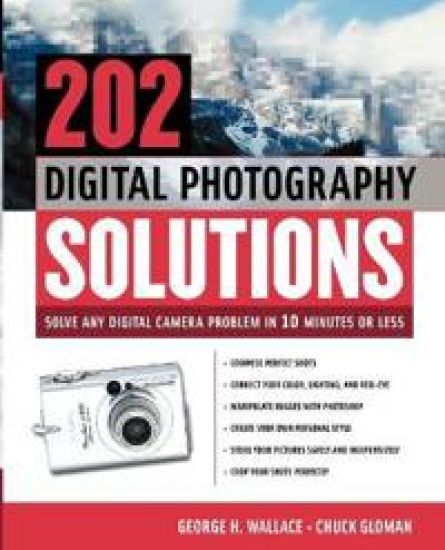
202 Digital Photography Solutions
George H. Wallace; Chuck B. Gloman
McGraw Hill Higher Education
2003
pokkari
Here's a working collection of expert tips and tricks hobbyists need to shoot, edit, and publish digital photos just like a pro! Using 2-5 page "solutions", the author covers everything from purchasing the best equipment to composing with a digital camera to using digital special to create highly personalized images. This title helps readers to: compose perfect shots with a digital camera; correct poor color, lighting, and redeye; use special effects for creating their own unique style; and choose the right equipment for their shooting style. It also provides answers to such questions as: What storage solution is safest? Cheapest? as well as tips for a perfect cropping, and putting your picture on the web.
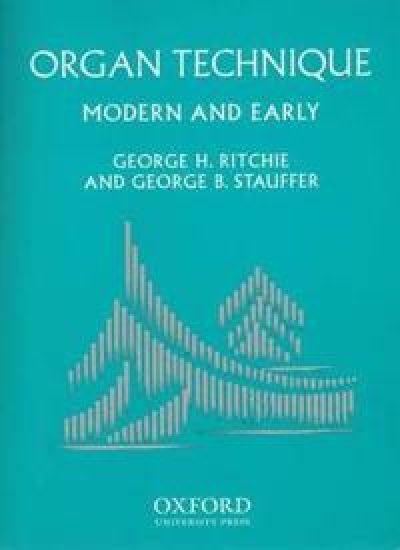
The authors' new approach to learning two playing techniques offers a systematic method for mastering the modern, legato technique needed for organ music composed arter 1750, as well as an articulated technique for earlier works. The authors also present useful information on accompanying anthems and solos and on adapting piano and orchestral accompaniments to the organ.
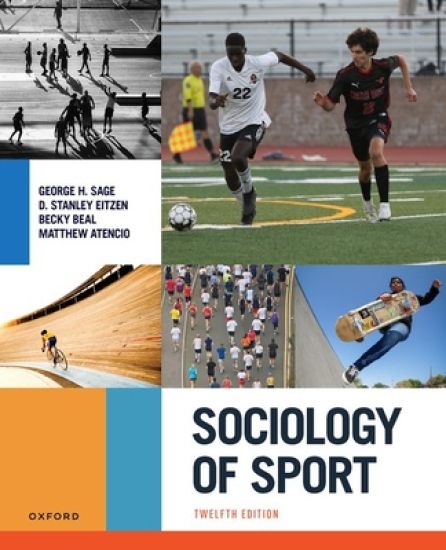
Sociology of Sport
George H. Sage; D. Stanley Eitzen; Becky Beal; Matthew Atencio
OXFORD UNIVERSITY PRESS INC
2023
nidottu
This engaging, comprehensive textbook for sociology of sport courses takes a critical approach, focusing in particular on issues of power and inequality. By addressing questions such as "Are sports free of racism and sexism?" and "Who pays for, and who benefits from, sports?", students understand sport from a sociological perspective rather than as simply a spectator or participant.
This engaging, comprehensive textbook for sociology of sport courses takes a critical approach, focusing in particular on issues of power and inequality. By addressing questions such as "Are sports free of racism and sexism?" and "Who pays for, and who benefits from, sports?", students understand sport from a sociological perspective rather than as simply a spectator or participant.
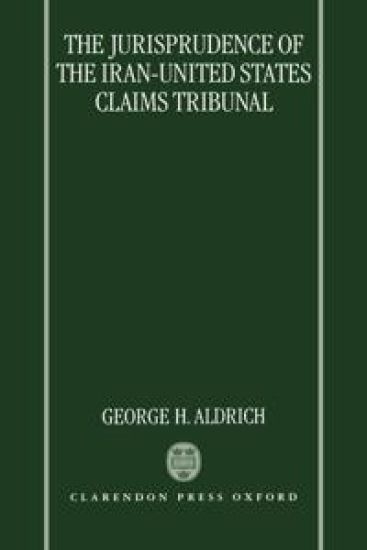
The Jurisprudence of the Iran-United States Claims Tribunal
George H. Aldrich
Clarendon Press
1996
sidottu
The Iran-United States Claims Tribunal is the most important source of international arbitral decisions for at least the past half century, and its decisions have contributed significantly to the development of international law and the law of international commercial transactions. Judge Aldrich, who is the only member of the Tribunal to have served since its inception in 1981, has written what will be recognised as the definitive book about the jurisprudence of the Tribunal. The book seeks to preserve and to make accessible the substantial body of Awards and Decisions rendered by the Tribunal during the years since it was established in. Its hundreds of Awards and Decisions may be individually consulted (there are twenty-seven volumes so far) but hitherto there has been no detailed analytical guide through the vast published work of the Tribunal. This important new book provides a two-fold service. First, it quotes from the most significant Awards and Decisions at sufficient length so that both their substance and the reasoning of the Tribunal can be understood from access to the present volume alone. Second, it organizes and summarizes the decisions to facilitate finding complete texts relevant to any particular issue.
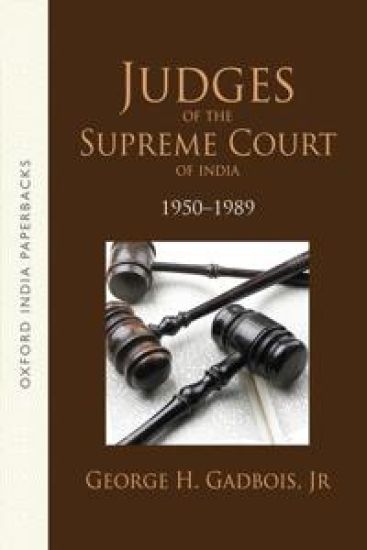
This book contains biographical essays for each of the first ninety-three judges who served on the Supreme Court of India from 1950 through mid-1989. It is the first close look at these judges, and follows them from their birth to their deaths. An attempt is made to account for why they were chosen - the selection criteria employed and, to the extent possible in a furtive selection environment, to identify those who selected them. The latter represents the first comprehensive attempt to connect the dots between a potential nominee and his ultimate appointment. The book concludes with a collective portrait of them, paying particular attention to changes in their backgrounds - fathers' occupation, education, pre-SCI careers, caste, religion, region, over the four decades.
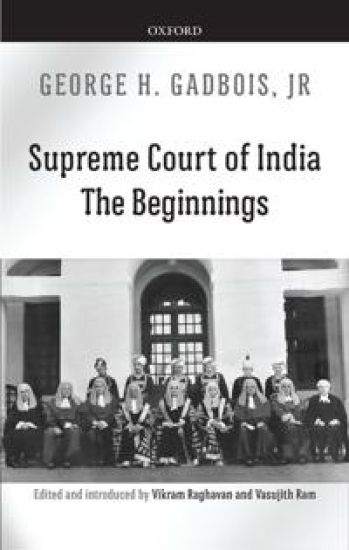
This work seeks to determine the roles played by the paramount judiciary in the Indian polity between 1937 and 1964. The discussion starts with an examination of the Federal Court, the establishment of which in 1937 brought into existence Indias first central judicial institution. After a consideration of events leading to the creation of the Federal Court, the nature of its jurisdiction and representative decisions are analysed. Other matters considered include the relationship of the Federal Court with the Privy Council, and the unsuccessful efforts made to empower the Federal Court with a jurisdiction to hear civil appeals. In addition, the major part of this work is devoted to the present Supreme Court of India, which replaced the Federal Court in 1950. After discussing the general features of the new judicial establishment, attention is focused upon the nature of its review powers and the manner in which the Court can exercise these powers. Against the background of debates in the Constituent Assembly that reflect the attitudes of the Constitution-makers towards judicial review, the important decisions which provoked clashes between the judges and politicians have been analysed.

Juana inés De La Cruz and the Theology of Beauty
George H. Tavard
University of Notre Dame Press
1991
sidottu
With Juana Inés de la Cruz and the Theology of Beauty, George H. Tavard presents the first thorough investigation of the theology of the greatest Latin American poet before our own time. HIs program is all the more important because she was the first woman of this continent to assert the right of women to study to the full extent of their capacities. An intelligent and intellectual woman, Juana Inés was eager to live a life of scholarship and felt "a great aversion to matrimony," which directed her to enter the convent in 1667. Tavard provides a thought-provoking analysis both of the theological ideas that Juana Inés expressed in poetry and prose and of the conclusions, provisional or definitive, she may have reached about herself and about humanity. Through a close study of many of her clearly authenticated works—her didactic poem, Primero Sueño (First Dream); her poems in honor of the saints; her religious drama; her poems in honor of Christ and the Virgin; her lyric verse on devotional themes; and her prose writings on religious topics--Tavard draws out Sor Juana's conception of the world and the soul, her ideas about the saints, her understanding of the Virgin, and her Christology. He offers a coherent theological and spiritual argument for Juana's renunciation of further writing in 1692. In discussing the shape of her theological imagination, Tavard concludes that for Juana, "the physical and spiritual beauty of creatures, a gift of God's love, acts as a theopany" through which divine glory is perceived.
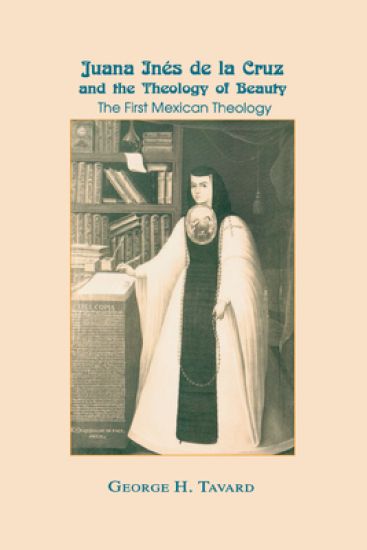
Juana inés De La Cruz and the Theology of Beauty
George H. Tavard
University of Notre Dame Press
2004
nidottu
With Juana Inés de la Cruz and the Theology of Beauty, George H. Tavard presents the first thorough investigation of the theology of the greatest Latin American poet before our own time. HIs program is all the more important because she was the first woman of this continent to assert the right of women to study to the full extent of their capacities. An intelligent and intellectual woman, Juana Inés was eager to live a life of scholarship and felt "a great aversion to matrimony," which directed her to enter the convent in 1667. Tavard provides a thought-provoking analysis both of the theological ideas that Juana Inés expressed in poetry and prose and of the conclusions, provisional or definitive, she may have reached about herself and about humanity. Through a close study of many of her clearly authenticated works—her didactic poem, Primero Sueño (First Dream); her poems in honor of the saints; her religious drama; her poems in honor of Christ and the Virgin; her lyric verse on devotional themes; and her prose writings on religious topics--Tavard draws out Sor Juana's conception of the world and the soul, her ideas about the saints, her understanding of the Virgin, and her Christology. He offers a coherent theological and spiritual argument for Juana's renunciation of further writing in 1692. In discussing the shape of her theological imagination, Tavard concludes that for Juana, "the physical and spiritual beauty of creatures, a gift of God's love, acts as a theopany" through which divine glory is perceived.

Show Trials combines first-hand knowledge with hitherto unpublished, confidential material, to offer a penetrating and candid account of the Stalinist purges that occurred in Albanian, East German, Bulgarian, and Rumanian purges, as well as in Hungary, Czechoslovakia, and Poland. George Hodos shows how these trials played a pivotal role in consolidating Soviet domination over the satellite countries during Stalin's lifetime. As an important addition to our understanding of these events and times, Show Trials is essential for historians of Eastern Europe and absorbing reading for anyone interested in world affairs.
An examination of East-Central European history, this book looks to the past for the roots of the cleavage between the eastern and western regions of Europe and the reasons for the east-central countries' backward, reactionary nature; their slide into fascism and war; and the ultimate destruction of the region within the Stalinist orbit. East-Central Europe emerged as a distinct region as early as the 15th century, when, in sharp contrast to an expanding urban economy and a loosening of serfdom in the West, it pursued a brutal Second Serfdom. This development would determine much of its future course, as 19th century attempts to modernize society included revolutions from above and the abolishment of serfdom, while stubbornly retaining decisive feudal structures. After World War I, industrial developments created a semi-feudal, distorted capitalism, and the region soon saw the emergence of ultra-nationalist, fascist-style regimes whose actions would eventually lead to catastrophe.In the post-war era, the region found itself in the Soviet sphere. The short People's Democracy period attempted to purge its structure of feudal, reactionary and fascist remnants, but soon got destroyed as a distinct region by brutal Stalinization. The collapse of Communism did not restore its separate existence reintegration into the West requires a painful transition period with a yet uncertain outcome. Hodos produces a comprehensive, comparative overview of the centuries-old division, along with the resulting social, political, and economic consequences. Chapters on anti-Semitism and the Holocaust illustrate the stark differences between the regions.
This original and insightful study explores the points at which theater and propaganda meet. Defining propaganda as a form of "activated ideology," George H. Szanto discusses the distortion of information that occurs in dramatic literature in its stage, film, and television forms. Szanto analyzes the nature of "integration propaganda," which is designed to render the audience passive and to encourage the acceptance of the status quo, as opposed to "agitation propaganda," which aims to inspire the audience to action. In Szanto's view, most popular western theater is saturated, though usually not intentionally, with integration propaganda. The overall purpose of Theater and Propaganda is twofold: to analyze the nature of integration propaganda so that it becomes visible to western readers as a tool of the dominant class in society, and to examine the manner by which unself-conscious propagandistic methods have saturated dramatic presentation. In discussing the importance of propaganda within and between technological states, the author examines the seminal work of Jacques Ellul. In this chapter he analyzes the function of integration propaganda in a relatively stable society. The following chapter defines and analyzes three theaters (in the sense of performance) of propaganda: the theater of agitation propaganda, of integration propaganda, and of dialectical propaganda. In this section he uses examples from a variety of plays, movies, and television commercials. In succeeding chapters Szanto discusses the role of integration propaganda in the medieval Wakefield mystery plays and the plays of Samuel Beckett. The appendix, "Contradiction and Demystification," provides a general model that suggests ways of breaking down and overcoming the propagandistic intentions of an artwork and discusses theater's possible role in this breakdown.
Comparatively little critical attention has been devoted to narrative technique in modern fiction, and formal analysis of the work of Kafka, Beckett, and Robbe-Grillet in particular has for the most part been limited to short studies in journals, many of these in languages other than English. The criticism written in English has dealt primarily with theme with metaphysics and myth and ignored structure and style.Yet it is structure and style that offer the reader a way into the often bewildering and disturbing fictional worlds these three writers present. The problem confronting writers since the middle of the nineteenth century has been how to cope artistically with an increasingly alienating and mechanized world. As George Szanto sees it, Kafka, Beckett and Robbe-Grillet conclude, by the example of their fictions, that the writer's province is no longer this impossible environment. Instead, the writer must work within the only knowledge available to any one person: the knowledge attained through perceptions. The proper study for a storyteller is thus the search for the unique details, the describable perceptions a person chooses from the outside world and brings into their mind, which in the end define their nature. The shape of the story is determined by the narrating consciousness, that single character through whose awareness the details are filtered. Thus, in a very special sense, the tale and the telling are one.Szanto's meticulous and thoughtful study of the major fiction of Kafka, Beckett, and Robbe-Grillet searches out these details and examines the manner in which each author, through the minds of his characters, has selected and ordered them. His structural approach not only leads the reader directly into the works under scrutiny, but also provides an understanding of the workings of the art itself.In the appendices, the author surveys the different ways in which criticism has treated these three writers. His extensive bibliography provides a valuable research tool.

A stunning celebration of the architect’s residential masterpieces Louis Kahn (1901–1974), one of the most important architects of the postwar period, is widely admired for his great monumental works, including the Kimbell Art Museum, the Salk Institute, and the National Assembly Complex in Bangladesh. However, the importance of his houses has been largely overlooked. This beautiful book is the first to look at Kahn’s nine major private houses. Beginning with his earliest encounters with Modernism in the late 1920s and continuing through his iconic work of the 1960s and 1970s, the authors trace the evolution of the architect’s thinking, which began and matured through his design of houses and their interiors, a process inspired by his interactions with clients and his admiration for vernacular building traditions.Richly illustrated with new and period photographs and original drawings, as well as previously unpublished materials from personal interviews, archives, and Kahn’s own writings, The Houses of Louis Kahn shows how his ideas about domestic spaces challenged conventions, much like his major public commissions, and were developed into one of the most remarkable expressions of the American house.
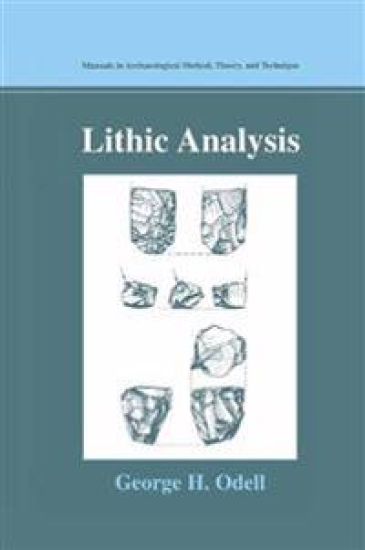
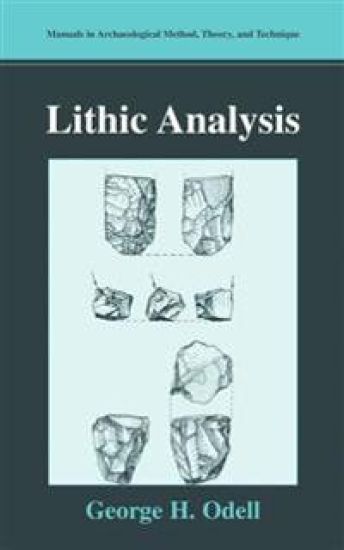
Procedures by which archaeological stone tools have been analyzed have tradition ally operated on an apprenticeship model, whereby a novice acquires competency at the elbow of a grizzled but revered expert in the field. After shuffling through literally thousands of stones and asking hundreds of questions, the neophite even tually reaches a level at which he or she can fly solo, requiring less and less attention from the Master. While this pedagogical model has been frequently tried and tested, it is not always the most efficient method, it is very labor-intensive, and it requires a resident lithics expert, a situation that often does not exist in reality. Learning the ropes would clearly be more practical if there were a manual to consult, a book that provides information and direction so that the Master might at least be spared the most elemental questions and would not have to be available all the time. For years no such manual existed, but recently the ice has been bro ken by Bill Andrefsky's Lithics: Macroscopic Approaches to Analysis, and Brian Kooyman's Understanding Stone Toolsand Archaeological Sites. These are good books, and can profitably be employed by fledgling lithic analysts. My own interest in writing a manual for stone tool analysts derives initially from the way I was trained-literally at the knees of two Masters (in this case, revered but not grizzled):Dr. Raymond R. Newell in typological and technological matters, and Dr. Ruth E. Tringham in functional studies.
Procedures by which archaeological stone tools have been analyzed have tradition ally operated on an apprenticeship model, whereby a novice acquires competency at the elbow of a grizzled but revered expert in the field. After shuffling through literally thousands of stones and asking hundreds of questions, the neophite even tually reaches a level at which he or she can fly solo, requiring less and less attention from the Master. While this pedagogical model has been frequently tried and tested, it is not always the most efficient method, it is very labor-intensive, and it requires a resident lithics expert, a situation that often does not exist in reality. Learning the ropes would clearly be more practical if there were a manual to consult, a book that provides information and direction so that the Master might at least be spared the most elemental questions and would not have to be available all the time. For years no such manual existed, but recently the ice has been bro ken by Bill Andrefsky's Lithics: Macroscopic Approaches to Analysis, and Brian Kooyman's Understanding Stone Toolsand Archaeological Sites. These are good books, and can profitably be employed by fledgling lithic analysts. My own interest in writing a manual for stone tool analysts derives initially from the way I was trained-literally at the knees of two Masters (in this case, revered but not grizzled):Dr. Raymond R. Newell in typological and technological matters, and Dr. Ruth E. Tringham in functional studies.
Biblical Greek Exegesis presents a proven, highly practical approach to the study of intermediate and advanced Greek grammar. Most textbooks focus on learning syntactical categories, illustrated by sentences taken from the Greek New Testament, and place little emphasis on how to apply Greek grammar to the Greek text in preparing sermons and lectures. In contrast, Biblical Greek Exegesis stresses “real-life” application. Beginning with selections from the Greek New Testament, students learn intermediate and advanced Greek grammar inductively by analyzing the text. The process closely resembles the approach used in sermon and lecture preparation. In Part 1 (SYNTAX), students work through nine selections from the New Testament, taken from the Gospels, Paul’s letters (including Romans), and the General Letters. The selections are arranged in order of increasing difficulty. The student becomes familiar with syntactical categories through translation, grammatical analysis, and grammatical diagramming, supplemented by class discussion. Equally important, the length of these selections allows for semantic diagramming and analysis. This provides a tool for analyzing larger units of meaning, which is not possible when working only with sentences that illustrate specific points of grammar. In Part 2 (EXEGESIS), the student takes the sections from the Greek New Testament through a twelve-step method of exegesis and exposition. The student works through one section of approximately fifteen verses every two weeks, beginning with the first step—spiritual preparation—and ending with application and a preaching/teaching outline. This approach has two benefits. Advanced Greek students learn to use the Greek text and grammar as they will in the “real world.” They also learn to integrate other significant areas such as literary form and textual criticism, as well as the use of exegetical tools. In short, they become better expositors of the Word of God. Bibliographies are provided for each of the twelve steps in the exegetical process. Also included is a summary of syntactical categories based on Wallace’s Greek Grammar Beyond the Basics. This successfully field-tested approach to intermediate and advanced Greek will help students bridge the gap between understanding the categories of Greek grammar and the demand to communicate the meaning and significance of the New Testament message to the twenty-first century.