Kirjojen hintavertailu. Mukana 11 342 296 kirjaa ja 12 kauppaa.

Kirjahaku

Etsi kirjoja tekijän nimen, kirjan nimen tai ISBN:n perusteella.

1000 tulosta hakusanalla Giulio Mozzi

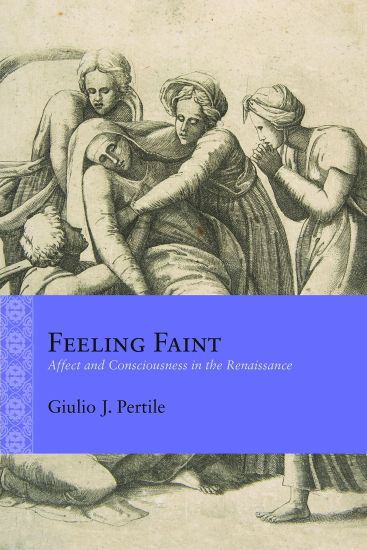
Feeling Faint

Feeling Faint

Giulio J. Pertile

Northwestern University Press
2019
nidottu
Feeling Faint is a book about human consciousness in its most basic sense: the awareness, at any given moment, that we live and feel. Such awareness, it argues, is distinct from the categories of selfhood to which it is often assimilated, and can only be uncovered at the margins of first-person experience. What would it mean to be conscious without being a first person—to be conscious in the absence of a self? Such a phenomenon, subsequently obscured by the Enlightenment identification of consciousness and personal identity, is what we discover in scenes of swooning from the Renaissance: consciousness without self, consciousness reconceived as what Frederic Jameson calls "a registering apparatus for transformed states of being." Where the early modern period has often been seen in terms of the rise of self-aware subjectivity, Feeling Faint argues that swoons, faints, and trances allow us to conceive of Renaissance subjectivity in a different guise: as the capacity of the senses and passions to experience, regulate, and respond to their own activity without the intervention of first-person awareness. In readings of Renaissance authors ranging from Montaigne to Shakespeare, Pertile shows how self-loss affords embodied consciousness an experience of itself in a moment of intimate vitality which precedes awareness of specific objects or thoughts—an experience with which we are all familiar, and yet which is tantalizingly difficult to pin down.
Feeling Faint

Feeling Faint

Giulio J. Pertile

Northwestern University Press
2019
sidottu
Feeling Faint is a book about human consciousness in its most basic sense: the awareness, at any given moment, that we live and feel. Such awareness, it argues, is distinct from the categories of selfhood to which it is often assimilated, and can only be uncovered at the margins of first-person experience. What would it mean to be conscious without being a first person—to be conscious in the absence of a self? Such a phenomenon, subsequently obscured by the Enlightenment identification of consciousness and personal identity, is what we discover in scenes of swooning from the Renaissance: consciousness without self, consciousness reconceived as what Frederic Jameson calls "a registering apparatus for transformed states of being." Where the early modern period has often been seen in terms of the rise of self-aware subjectivity, Feeling Faint argues that swoons, faints, and trances allow us to conceive of Renaissance subjectivity in a different guise: as the capacity of the senses and passions to experience, regulate, and respond to their own activity without the intervention of first-person awareness. In readings of Renaissance authors ranging from Montaigne to Shakespeare, Pertile shows how self-loss affords embodied consciousness an experience of itself in a moment of intimate vitality which precedes awareness of specific objects or thoughts—an experience with which we are all familiar, and yet which is tantalizingly difficult to pin down.

The Command of the Air

The Command of the Air

Giulio Douhet

Fine Ant Books
2009
nidottu
The Italian General Giulio Douhet reigns as one of the twentieth century’s foremost strategic air power theorists. As such scholars as Raymond Flugel have pointed out, Douhet’s theories were crucial at a pivotal pre-World War II Army Air Force institution, the Air Corps Tactical School.
The Cappadocian Reshaping of Metaphysics

The Cappadocian Reshaping of Metaphysics

Giulio Maspero

Cambridge University Press
2023
sidottu
In this volume, Giulio Maspero explores both the ontology and the epistemology of the Cappadocians from historical and speculative points of view. He shows how the Cappadocians developed a real Trinitarian Ontology through their reshaping of the Aristotelian category of relation, which they rescued from the accidental dimension and inserted into the immanence of the one divine and eternal substance. This perspective made possible a new conception of individuation. No longer exclusively linked to substantial difference, as in classical Greek philosophy, the concept was instead founded on the mutual relation of the divine Persons. The Cappadocians' metaphysical reshaping was also closely linked to a new epistemological conception based on apophaticism, which shattered the logical closure of their opponents, and anticipated results that modern research has subsequently highlighted, Bridging the late antique philosophy with Patristics, Maspero' s study allows us to find the relational traces within the Trinity in the world and in history.
Living the Modern Way; Form and Color in Interior Decoration
This work has been selected by scholars as being culturally important and is part of the knowledge base of civilization as we know it.This work is in the public domain in the United States of America, and possibly other nations. Within the United States, you may freely copy and distribute this work, as no entity (individual or corporate) has a copyright on the body of the work.Scholars believe, and we concur, that this work is important enough to be preserved, reproduced, and made generally available to the public. To ensure a quality reading experience, this work has been proofread and republished using a format that seamlessly blends the original graphical elements with text in an easy-to-read typeface.We appreciate your support of the preservation process, and thank you for being an important part of keeping this knowledge alive and relevant.