Kirjojen hintavertailu. Mukana 11 244 527 kirjaa ja 12 kauppaa.

Kirjahaku

Etsi kirjoja tekijän nimen, kirjan nimen tai ISBN:n perusteella.

1000 tulosta hakusanalla Helga Samset

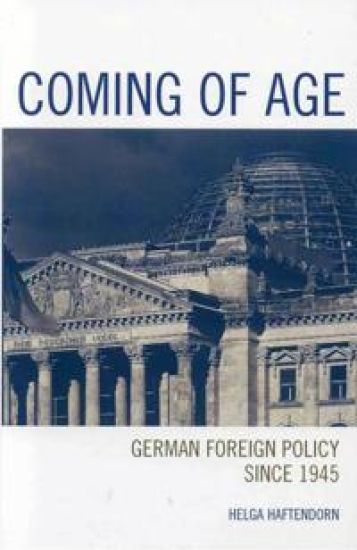
Coming of Age

Coming of Age

Helga Haftendorn

Rowman Littlefield Publishers
2006
sidottu
In this authoritative book, the only work to cover the full sweep of German foreign policy since the end of World War II, noted scholar Helga Haftendorn explores Germany's remarkable recovery from wartime defeat and destruction. Offspring of the Cold War, the Federal Republic of Germany and the German Democratic Republic entered the international arena in 1949 under three crippling constraints: they were held accountable for the crimes of the Third Reich, they were fully dependent on the occupation powers, and their international room for maneuver was limited by an East-West conflict that placed Bonn and East Berlin on opposite sides of the Iron Curtain. Tracing the FRG's strategy of multilateralism, Haftendorn convincingly demonstrates how these liabilities transformed into opportunities as Germany found a security guarantee in NATO membership and economic and political rewards in the system of European integration. The author's overview of past half-century shows a high degree of continuity and consistency in German foreign policy despite the tumultuous events of the era. However, Haftendorn argues that Germany's traditional policy of self-restraint was increasingly counterbalanced by a more assertive stance after reunification and the rise of a post-war generation to power. Although the country's leaders continued to value international institutions, the benefits were increasingly weighed against Germany's enlightened self-interest. Scholars and students of contemporary Germany, Europe, and East-West relations will find this nuanced and knowledgeable study invaluable.
Coming of Age

Coming of Age

Helga Haftendorn

Rowman Littlefield Publishers
2006
nidottu
In this authoritative book, the only work to cover the full sweep of German foreign policy since the end of World War II, noted scholar Helga Haftendorn explores Germany's remarkable recovery from wartime defeat and destruction. Offspring of the Cold War, the Federal Republic of Germany and the German Democratic Republic entered the international arena in 1949 under three crippling constraints: they were held accountable for the crimes of the Third Reich, they were fully dependent on the occupation powers, and their international room for maneuver was limited by an East-West conflict that placed Bonn and East Berlin on opposite sides of the Iron Curtain. Tracing the FRG's strategy of multilateralism, Haftendorn convincingly demonstrates how these liabilities transformed into opportunities as Germany found a security guarantee in NATO membership and economic and political rewards in the system of European integration. The author's overview of past half-century shows a high degree of continuity and consistency in German foreign policy despite the tumultuous events of the era. However, Haftendorn argues that Germany's traditional policy of self-restraint was increasingly counterbalanced by a more assertive stance after reunification and the rise of a post-war generation to power. Although the country's leaders continued to value international institutions, the benefits were increasingly weighed against Germany's enlightened self-interest. Scholars and students of contemporary Germany, Europe, and East-West relations will find this nuanced and knowledgeable study invaluable.
Time

Time

Helga Nowotny

Polity Press
1996
nidottu
"Helga Nowotny's exploration of the forms and meaning of time in contemporary life is panoramic without in any way partaking of the blandness of a survey. From the artificial time of the scientific laboratory to the distinctively modern yearning for one’s own time, she regards every topic in this wide-ranging book from a fresh angle of vision, one which reveals unsuspected affinities between the bravest, newest worlds of global technology and the most ancient worlds of myth." --Lorraine Daston, University of Chicago This book represents a major contribution to the understanding of time, giving particular attention to time in relation to modernity. The development of industrialism, the author points out, was based upon a linear and abstract conception of time. Today we see that form of production, and the social institutions associated with it, supplanted by flexible specialization and just-in-time production systems. New information and communication technologies have made a fundamental impact here. But what does all this mean for temporal regimes? How can we understand the transformation of time and space involved in the bewildering variety of options on offer in a postmodern world? The author provides an incisive analysis of the temporal implications of modern communication. She considers the implications of worldwide simultaneous experience, made possible by satellite technologies, and considers the reorganization of time involved in the continuous technological innovation that marks our era. In this puzzling universe of action, how does one achieve a 'time of one's own'? The discovery of a specific time perspective centred in the individual, she shows, expresses a yearning for forms of experience that are subversive of established institutional patterns. This brilliant study, became a classic in Germany, will be of interest to students and professionals working in the areas of social theory, sociology, politics and anthropology.
Re-Thinking Science

Re-Thinking Science

Helga Nowotny; Peter B. Scott; Michael T. Gibbons

Polity Press
2001
sidottu
Re-Thinking Science presents an account of the dynamic relationship between society and science. Despite the mounting evidence of a much closer, interactive relationship between society and science, current debate still seems to turn on the need to maintain a 'line' to demarcate them. The view persists that there is a one-way communication flow from science to society - with scant attention given to the ways in which society communicates with science. The authors argue that changes in society now make such communications both more likely and more numerous, and that this is transforming science not only in its research practices and the institutions that support it but also deep in its epistemological core. To explain these changes, Nowotny, Scott and Gibbons have developed an open, dynamic framework for re-thinking science. The authors conclude that the line which formerly demarcated society from science is regularly transgressed and that the resulting closer interaction of science and society signals the emergence of a new kind of science: contextualized or context-sensitive science. The co-evolution between society and science requires a more or less complete re-thinking of the basis on which a new social contract between science and society might be constructed. In their discussion the authors present some of the elements that would comprise this new social contract.
Re-Thinking Science

Re-Thinking Science

Helga Nowotny; Peter B. Scott; Michael T. Gibbons

JOHN WILEY AND SONS LTD
2001
nidottu
This text presents an account of the dynamic relationship between society and science. That line separating society from science is regularly transgressed, and the closer interaction between the two signals the emergence of a new kind of science - contextualized or context-sensitive science.
The Cunning of Uncertainty

The Cunning of Uncertainty

Helga Nowotny

Polity Press
2015
sidottu
Uncertainty is interwoven into human existence. It is a powerful incentive in the search for knowledge and an inherent component of scientific research. We have developed many ways of coping with uncertainty. We make promises, manage risks and make predictions to try to clear the mists and predict ahead. But the future is inherently uncertain - and the mist that shrouds our path an inherent part of our journey. The burning question is whether our societies can face up to uncertainty, learn to embrace it and whether we can open up to a constantly evolving future.In this new book, Helga Nowotny shows how research can thrive at the cusp of uncertainty. Science, she argues, can eventually transform uncertainty into certainty, but into certainty which remains always provisional.Uncertainty is never completely static. It is constantly evolving. It encompasses geological time scales and, at the level of human experience, split-second changes as cells divide. Life and death decisions are taken in the blink of the eye, while human interactions with the natural environment may reveal their impact over millennia.Uncertainty is cunning. It appears at unexpected moments, it shuns the straight line, takes the oblique route and sometimes the unexpected short-cut. As we acknowledge the cunning of uncertainty, its threats retreat. We accept that any scientific inquiry must produce results that are provisional and uncertain. This message is vital for politicians and policy-makers: do not be tempted by small, short-term, controllable gains to the exclusion of uncertain, high-gain opportunities.Wide-ranging in its use of examples and enriched by the author’s experience as President of the European Research Council, one of the world’s leading funding organisations for fundamental research. The Cunning of Uncertainty is a must-read for students and scholars of all disciplines, politicians, policy-makers and anyone concerned with the fundamental role of knowledge and science in our societies today.
The Cunning of Uncertainty

The Cunning of Uncertainty

Helga Nowotny

Polity Press
2017
nidottu
Uncertainty is interwoven into human existence. It is a powerful incentive in the search for knowledge and an inherent component of scientific research. We have developed many ways of coping with uncertainty. We make promises, manage risks and make predictions to try to clear the mists and predict ahead. But the future is inherently uncertain - and the mist that shrouds our path an inherent part of our journey. The burning question is whether our societies can face up to uncertainty, learn to embrace it and whether we can open up to a constantly evolving future.In this new book, Helga Nowotny shows how research can thrive at the cusp of uncertainty. Science, she argues, can eventually transform uncertainty into certainty, but into certainty which remains always provisional.Uncertainty is never completely static. It is constantly evolving. It encompasses geological time scales and, at the level of human experience, split-second changes as cells divide. Life and death decisions are taken in the blink of the eye, while human interactions with the natural environment may reveal their impact over millennia.Uncertainty is cunning. It appears at unexpected moments, it shuns the straight line, takes the oblique route and sometimes the unexpected short-cut. As we acknowledge the cunning of uncertainty, its threats retreat. We accept that any scientific inquiry must produce results that are provisional and uncertain. This message is vital for politicians and policy-makers: do not be tempted by small, short-term, controllable gains to the exclusion of uncertain, high-gain opportunities.Wide-ranging in its use of examples and enriched by the author’s experience as President of the European Research Council, one of the world’s leading funding organisations for fundamental research. The Cunning of Uncertainty is a must-read for students and scholars of all disciplines, politicians, policy-makers and anyone concerned with the fundamental role of knowledge and science in our societies today.
Isolationist States in an Interdependent World

Isolationist States in an Interdependent World

Helga Turku

Ashgate Publishing Limited
2009
sidottu
States that withdraw from the international system provide insight into an unexplored area of international relations in terms of rationality, self-interest, power politics, cooperation and alliances. Indeed, isolationism in an interdependent state system goes against the logic of modern society and state systems. Using historical, comparative and inductive analysis, Helga Turku explains why states may choose to isolate themselves both domestically and internationally, using comparative historical analysis to flesh out isolationism as a concept and in practice. The book examines extreme forms of self-imposed domestic and international isolation in an interdependent international system, noting the effects on both the immediate interests of a ruling regime and the long-term national interests of the state and the populace.
From Thread and Wire

From Thread and Wire

Helga Becker

Schiffer Publishing Ltd
2016
sidottu
Every one of these 60 astoundingly beautiful jewelry projects, ranging from bracelets to necklaces, uses a surprising technique: crocheting or knitting! The projects include small gifts which can be made in no time, as well as delicate "webs" which require more patience and time. Using varied materials, including stone, pearls, wood, sheet silver, plastic, and more, these step-by-step instructions showcase the variety that's possible in your jewelry making. First the tools, materials, and techniques are introduced, including the basic crocheting and knitting stitches. Next are step-by-step instructions for projects made from thread and other non-metallic strands. Then, move on to creating pieces from pure lacquered copper wire. For those who prefer more expensive jewelry, projects made from solid silver wire wrap up the book. Whether made of thread or silver, these projects require only a limited amount of equipment, all very affordable. Each project is coded as to difficulty level.
New Woodturning Techniques and Projects

New Woodturning Techniques and Projects

Helga Becker

Schiffer Publishing Ltd
2016
sidottu
For woodturners at an advanced level, this book offers skills, projects, and inspiration. The 10 turning techniques here allow experts to expand their skills and also learn tips that make for better projects. Step-by-step instructions and a wealth of appealing and informative photographs give precise guidance for mastering each technique. Next, 18 projects are presented with complete photo instructions. Designed by the author and five expert colleagues, these projects also offer useful tool-fabrication and chucking solutions, and include contemporary as well as traditional and artistic turned objects. A gallery section features objects designed by today's top woodturners, and provides additional inspiration for the technical and design aspects of your own projects.
Icelandic-English/English-Icelandic Practical Dictionary

Icelandic-English/English-Icelandic Practical Dictionary

Helga Helmisdottir

Hippocrene Books Inc.,U.S.
2017
pokkari
The most up-to-date two-way Icelandic dictionary available, from the author of popular textbook Beginner’s Icelandic! Icelandic is a North-Germanic language related to Norwegian, Danish and Swedish. The language can be traced back to Old Norse brought by settlers from Norway in the 9th and 10th centuries. Old Norse is the language of the Icelandic Sagas and these works from the Middle ages can be read by Icelandic speakers today with little difficulty as the written language has not changed drastically over the centuries. Ideal for businesspeople, travelers, and students, this dictionary features: Over 18,000 word-to-word entries, including common words as well as technical, legal, business and locally-specific terms (such as cities, foods, and cultural terms)Guides to the Icelandic alphabet and pronunciationPractical usage guide which outlines the parts of speech Due in large part to Iceland’s isolation and remote location, the linguistic changes that occurred in other Scandinavian languages are not seen in Icelandic, which still has complicated grammar systems such as four cases for nouns and three genders (male, female, and neuter). The Icelandic literary tradition is a large part of the nation’s culture and understanding the language is a necessity to learning more about Iceland.
Beginner's Icelandic with Online Audio

Beginner's Icelandic with Online Audio

Helga Hilmisdttir; Jacek Kozlowski

Hippocrene Books Inc.,U.S.
2020
pokkari
Learn Icelandic with this complete course, now with free audio download! Icelandic is a North-Germanic language spoken by over 300,000 people, mainly in Iceland where it is an official language. The language can be traced back to the Old Norse brought by settlers from Norway in the 9th and 10th centuries. Because of Iceland’s isolation and remote location, the linguistic changes that occurred in other Scandinavian languages are not seen in Icelandic, which still has complicated grammar systems.Ideal for those new to Icelandic, learning at home or in the classroom, Beginner’s Icelandic with Online Audio includes: Fourteen carefully-paced and practical lessons with dialogues, vocabulary, expressions, and exercisesAn alphabet and pronunciation guideEnglish-Icelandic and Icelandic-English glossariesA brief introduction to Iceland’s history and cultureOnline MP3 audio files for download featuring pronunciation by native speakers
The Nature of Expertise in Professional Acting
For nearly 25 years, expertise has been considered an important testing ground for theories of cognition. Cognitive scientists have examined experts as diverse as chess masters, waiters, field-hockey players, and computer programmers. Recently, increased attention has been given to the arts, including dance, music appreciation and performance, and literary analysis. It is therefore somewhat surprising that--except for the authors' program of research dating from the late 1980s--virtually no studies on the cognitive processes of professional actors can be found in the literature. These experts not only routinely memorize hours of verbal material in a very short time, but they retrieve it verbatim along with the accompanying gestures, movements, thoughts, and emotions of the characters. The mental processes involved in this task constitute the subject of this recent research and are described in detail in this book.
The Nature of Expertise in Professional Acting
For nearly 25 years, expertise has been considered an important testing ground for theories of cognition. Cognitive scientists have examined experts as diverse as chess masters, waiters, field-hockey players, and computer programmers. Recently, increased attention has been given to the arts, including dance, music appreciation and performance, and literary analysis. It is therefore somewhat surprising that--except for the authors' program of research dating from the late 1980s--virtually no studies on the cognitive processes of professional actors can be found in the literature. These experts not only routinely memorize hours of verbal material in a very short time, but they retrieve it verbatim along with the accompanying gestures, movements, thoughts, and emotions of the characters. The mental processes involved in this task constitute the subject of this recent research and are described in detail in this book.
Story Revolutions

Story Revolutions

Helga Lenart-Cheng

UNIVERSITY OF VIRGINIA PRESS
2022
sidottu
Social media has facilitated the sharing of once isolated testimonies to an extent and with an ease never before possible. The #MeToo movement provides a prime example of how such pooling of individual stories, in large enough numbers, can fuel political movements, fortify a sense of solidarity and community, and compel public reckoning by bringing important issues into mainstream consciousness.In this timely and important study, Helga Lenart-Cheng has uncovered the antecedents of this phenomenon and provided a historical and critical analysis of this seemingly new but in fact deeply rooted tradition. Story Revolutions features a rich variety of case studies, from eighteenth-century memoir collections to contemporary Web 2.0 databases, including memoir contests, digital story-maps, crowd-sourced Covid diaries, and AI-assisted life writing. It spans the Enlightenment, the 1930s, and the twenty-first century-three historical periods marked by a convergence of mass movements and new methods of data collection that led to a boom in activism based in the aggregation and communication of stories. Ultimately, this book offers readers a critical perspective on the concept of community itself, with incisive reflections on what it means to use storytelling to build democracy in the twenty-first century.
Story Revolutions

Story Revolutions

Helga Lenart-Cheng

UNIVERSITY OF VIRGINIA PRESS
2022
pokkari
Social media has facilitated the sharing of once isolated testimonies to an extent and with an ease never before possible. The #MeToo movement provides a prime example of how such pooling of individual stories, in large enough numbers, can fuel political movements, fortify a sense of solidarity and community, and compel public reckoning by bringing important issues into mainstream consciousness.In this timely and important study, Helga Lenart-Cheng has uncovered the antecedents of this phenomenon and provided a historical and critical analysis of this seemingly new but in fact deeply rooted tradition. Story Revolutions features a rich variety of case studies, from eighteenth-century memoir collections to contemporary Web 2.0 databases, including memoir contests, digital story-maps, crowd-sourced Covid diaries, and AI-assisted life writing. It spans the Enlightenment, the 1930s, and the twenty-first century—three historical periods marked by a convergence of mass movements and new methods of data collection that led to a boom in activism based in the aggregation and communication of stories. Ultimately, this book offers readers a critical perspective on the concept of community itself, with incisive reflections on what it means to use storytelling to build democracy in the twenty-first century.
Kachina Dolls

Kachina Dolls

Helga Teiwes

University of Arizona Press
1992
nidottu
Much has been written about the popular kachina dolls carved by the Hopi Indians of northern Arizona, but little has been revealed about the artistry behind them. Now Helga Teiwes describes the development of this art form from early traditional styles to the action-style kachina dolls made popular in galleries throughout the world, and on to the kachina sculptures that have evolved in the last half of the 1980s. Teiwes explains the role of the Katsina spirit in Hopi religion and that of the kachina doll the carved representation of a Katsina in the ritual and economic life of the Hopis. In tracing the history of the kachina doll in Hopi culture, she shows how these wooden figures have changed since carvers came to be influenced by their marketability among Anglos and how their carving has been characterized by increasingly refined techniques. Unique to this book are Teiwes's description of the most recent trends in kachina doll carving and her profiles of twenty-seven modern carvers, including such nationally known artists as Alvin James Makya and Cecil Calnimptewa. Enhancing the text are more than one hundred photographs, including twenty-five breathtaking color plates that bring to life the latest examples of this popular art form.
Hopi Basket Weaving

Hopi Basket Weaving

Helga Teiwes

University of Arizona Press
1996
nidottu
"With the inborn wisdom that has guided them for so long through so many obstacles, Hopi men and women perpetuate their proven rituals, strongly encouraging those who attempt to neglect or disrespect their obligations to uphold them. One of these obligations is to respect the flora and fauna of our planet. The Hopi closeness to the Earth is represented in all the arts of all three mesas, whether in clay or natural fibers. What clay is to a potter's hands, natural fibers are to a basket weaver."--from the Introduction Rising dramatically from the desert floor, Arizona's windswept mesas have been home to the Hopis for hundreds of years. A people known for protecting their privacy, these Native Americans also have a long and less known tradition of weaving baskets and plaques. Generations of Hopi weavers have passed down knowledge of techniques and materials from the plant world around them, from mother to daughter, granddaughter, or niece. This book is filled with photographs and detailed descriptions of their beautiful baskets--the one art, above all others, that creates the strongest social bonds in Hopi life. In these pages, weavers open their lives to the outside world as a means of sharing an art form especially demanding of time and talent. The reader learns how plant materials are gathered in canyons and creek bottoms, close to home and far away. The long, painstaking process of preparation and dying is followed step by step. Then, using techniques of coiled, plaited, or wicker basketry, the weaving begins. Underlying the stories of baskets and their weavers is a rare glimpse of what is called "the Hopi Way," a life philosophy that has strengthened and sustained the Hopi people through centuries of change. Many other glimpses of the Hopi world are also shared by author and photographer Helga Teiwes, who was warmly invited into the homes of her collaborators. Their permission and the permission of the Cultural Preservation Office of the Hopi Tribe gave her access to people and information seldom available to outsiders. Teiwes was also granted access to some of the ceremonial observances where baskets are preeminent. Woven in brilliant reds, greens, and yellows as well as black and white, Hopi weavings, then, not only are an arresting art form but also are highly symbolic of what is most important in Hopi life. In the women's basket dance, for example, woven plaques commemorate and honor the Earth and the perpetuation of life. Other plaques play a role in the complicated web of Hopi social obligation and reciprocity. Living in a landscape of almost surreal form and color, Hopi weavers are carrying on one of the oldest arts traditions in the world. Their stories in Hopi Basket Weaving will appeal to collectors, artists and craftspeople, and anyone with an interest in Native American studies, especially Native American arts. For the traveler or general reader, the book is an invitation to enter a little-known world and to learn more about an art form steeped in meaning and stunning in its beauty.
The Irony of State Intervention

The Irony of State Intervention

Helga Gerber

Northern Illinois University Press
2005
sidottu
Embracing individualism and antistatism, the United States traditionally has favored a limited role for government. Yet state intervention both against and on behalf of labor has a long history, culminating in the labor law reforms of the New Deal. How do we account for this irony? And how do we explain why, between World War I and the Great Depression, another leading industrial nation with similar ideological commitments, Great Britain, developed a different model? By comparing the United States and Britain, Larry G. Gerber makes clear that, in the development of industrial relations policies, ideology was secondary to economic realities—the structure of business, the market system, and the configuration of unions. Nonetheless, industrial policy developed within the broader context of the transition from the individualistic laissez-faire capitalism of the nineteenth century to a collectivist political economy in which the state and organized groups played increasingly important roles while pluralist and corporatist models contended for influence. In Britain, where most business enterprises remained comparatively small, collective bargaining between workers and management became the norm. In the United States, however, large-scale corporations quickly rose to dominance. Eager to retain control of the production process, corporate elites resisted negotiating with workers and occasionally called upon the state to resolve labor crises. American workers, who initially opposed state involvement, eventually turned to the state for assistance as well. The New Deal administration responded with a series of new labor policies designed to balance the interests of employers and employees alike. Since state intervention did nothing to permanently change employers' hostility toward unions, the New Deal legislation was short-lived. Gerber's broad study of this momentous period in labor history helps explain the conundrum of a nation with a typically limited government whose intense intervention in labor relations caused long-lasting effects.