Kirjojen hintavertailu. Mukana 11 342 296 kirjaa ja 12 kauppaa.

Kirjahaku

Etsi kirjoja tekijän nimen, kirjan nimen tai ISBN:n perusteella.

1000 tulosta hakusanalla Henry Festing Jones

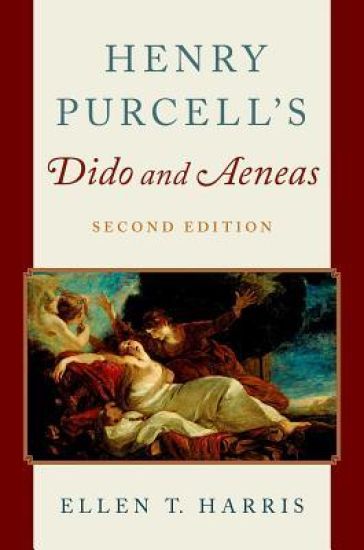
Henry Purcell's Dido and Aeneas

Henry Purcell's Dido and Aeneas

Harris Ellen

Oxford University Press Inc
2018
nidottu
Purcell's Dido and Aeneas stands as the greatest operatic achievement of seventeenth-century England, and yet, despite its global renown, it remains cloaked in mystery. The date and place of its first performance cannot be fixed with precision, and the absolute accuracy of the surviving scores, which date from almost 100 years after the work was written, cannot be assumed. In this thirtieth-anniversary new edition of her book, Ellen Harris closely examines the many theories that have been proposed for the opera's origin and chronology, considering the opera both as political allegory and as a positive exemplar for young women. Her study explores the work's historical position in the Restoration theater, revealing its roots in seventeenth-century English theatrical and musical traditions, and carefully evaluates the surviving sources for the various readings they offer-of line designations in the text (who sings what), the vocal ranges of the soloists, the use of dance and chorus, and overall layout. It goes on to provide substantive analysis of Purcell's musical declamation and use of ground bass. In tracing the performance history of Dido and Aeneas, Harris presents an in-depth examination of the adaptations made by the Academy of Ancient Music at the end of the eighteenth century based on the surviving manuscripts. She then follows the growing interest in the creation of an "authentic" version in the nineteenth and early twentieth centuries through published editions and performance reviews, and considers the opera as an important factor in the so-called English Musical Renaissance. To a significant degree, the continuing fascination with Purcell's Dido and Aeneas rests on its apparent mutability, and Harris shows this has been inherent in the opera effectively from its origin.
Henry Clay

Henry Clay

James C. Klotter

Oxford University Press Inc
2018
sidottu
Charismatic, charming, and one of the best orators of his era, Henry Clay seemed to have it all. He offered a comprehensive plan of change for America, and directed national affairs as Speaker of the House, Secretary of State to John Quincy Adams--the man he put in office--and acknowledged leader of the Whig party. As the broker of the Missouri Compromise and Compromise of 1850, Henry Clay fought to keep a young nation united when westward expansion and slavery threatened to tear it apart. Yet, despite all that talent and all those real assets, Henry Clay never became president. Three times he received Electoral College votes, twice more he sought his party's nomination, but he lost each time. Alongside fellow senatorial greats, Daniel Webster and John C. Calhoun, Clay was in the mix almost every moment from 1824 to 1848. Given his prominence, perhaps the years should be termed not the Jacksonian Era but rather the Age of Clay. This book is not a biography, though many biographical elements inform it, for only by knowing Clay the man can we understand Clay the politician. Instead, it uses new research and offers a more focused, nuanced explanation of Clay's programs and politics to provide answers to the question of why the man they called "The Great Rejected" never won the presidency but did win the accolades of history. James Klotter's fresh outlook reveal that the best monument to Henry Clay is the fact that the United States remains one country, one nation, one example of a successful democracy, still working, still changing, still reflecting his spirit. The appeal of Henry Clay and his emphasis on compromise still resonate in a society seeking less partisanship and more efforts at conciliation.
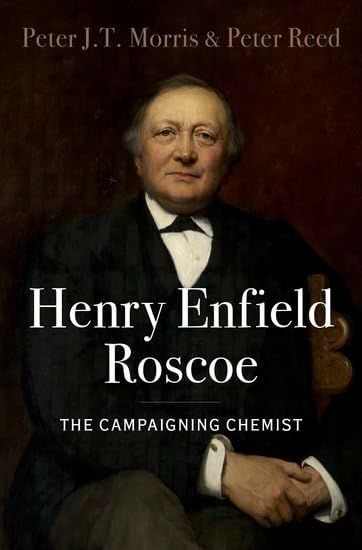
Henry Enfield Roscoe

Henry Enfield Roscoe

Peter J.T. Morris; Peter Reed

OXFORD UNIVERSITY PRESS INC
2024
sidottu
Little known today, Henry Enfield Roscoe was one of the most prominent chemists and educational reformers in Victorian Britain. Having studied in Heidelberg, he worked to transform English education by using Germany as a model. He made Owens College, Manchester, viable and converted it into Victoria University (now the University of Manchester). He then campaigned for the reform of technical education in an alliance with like-minded campaigners which resulted in the Technical Instruction Act of 1889. Roscoe was also the Liberal MP for South Manchester between 1885 and 1895, one of the few academic chemists to become a member of the House of Commons. In his "retirement," he helped found the Lister Institute of Preventive Medicine. Yet, despite his extensive impact on Britain at the time and our society today, he remains largely forgotten. In this detailed biography, authors Morris and Reed provide a timely and original contribution to the history of nineteenth-century British science and its relation to education, industry, and government policy, highlighting Roscoe's significant contributions and legacy as one of the leading scientists of his generation.
Henry James

Henry James

Susan L. Mizruchi

Oxford University Press Inc
2021
nidottu
An elegant introduction to one of America's most complex and influential writers. From his childhood in a family of leading American intellectuals through his mature life as a major American man of letters, Henry James (1843-1916) created a unique body of fiction that represents one of the greatest achievements in the nation's literary history. James's transnational life in the US and England and his extraordinary siblings (the philosopher William James and diarist Alice James) made his life as complicated as the fictions he produced. In this elegant introduction to the work of Henry James, Susan L. Mizruchi places the notoriously difficult and obscure writings in their historical and biographical context. As James grew in confidence as a writer, his fictions evolved accordingly. These complex accounts of human experience engage with the vital issues of both James's era and our own. Among the works treated in this introduction are Washington Square, The Europeans, Daisy Miller, The Portrait of a Lady, The Golden Bowl, and The Turn of the Screw. Through his novels, as well as his journalistic and critical endeavors, James explores themes related to gender relations, human sexuality, the nature of modernity, the threat of relativism, the rise of mass culture, and the role of art. Since their creation, James's writings have been a consistent subject of both literary theory and popular culture, receiving a diverse array of theoretical treatments, from formalism, deconstruction, phenomenology, and pragmatism to Marxism, new historicism, and gender and queer theory. James's novels have been adapted into numerous films by directors including William Wyler, Peter Bogdanovich, Michael Winner, Merchant/Ivory, and Jane Campion. The impact of Henry James cannot be overstated.
Henry IV Part I

Henry IV Part I

William Shakespeare

Oxford University Press
2024
nidottu
'What is honour? A word. What is in that word 'honour'? What is that 'honour'? Air.' A history play that combines a coming-of-age narrative with a tale of power, rebellion, friendship, and betrayal, Henry IV, Part I has been a perennial favourite from Shakespeare's time to the present. What has ensured its popularity is above all the towering figure of Falstaff, Shakespeare's greatest comic creation. The ebullient, unabashedly pleasure-seeking and brilliantly witty character has proved as irresistible for audiences as he was for his protégé, Prince Hal. This introduction discusses their relationship within the framework of the play's historical, cultural, and performative setting. At the same time, it explores the question of why the play has proved so enduringly attractive to audiences today. The New Oxford Shakespeare offers authoritative editions of Shakespeare's works with introductory materials designed to encourage new interpretations of the plays and poems. Using the text from the landmark The New Oxford Shakespeare Complete Works: Modern Critical Edition, these volumes offer readers the latest thinking on the authentic texts (collated from all surviving original versions of Shakespeare's work) alongside innovative introductions from leading scholars. The texts are accompanied by a comprehensive set of critical apparatus to give readers the best resources to help understand and enjoy Shakespeare's work. ABOUT THE SERIES: For over 100 years Oxford World's Classics has made available the widest range of literature from around the globe. Each affordable volume reflects Oxford's commitment to scholarship, providing the most accurate text plus a wealth of other valuable features, including expert introductions by leading authorities, helpful notes to clarify the text, up-to-date bibliographies for further study, and much more.
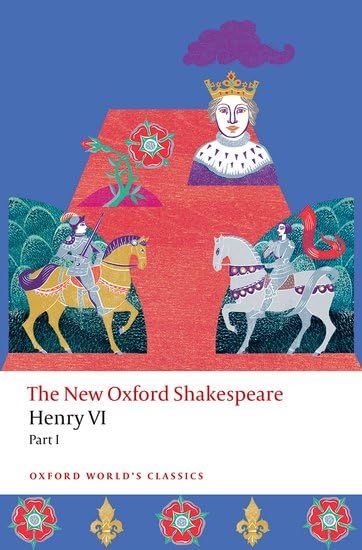
Henry VI, Part I

Henry VI, Part I

William Shakespeare; Christopher Marlowe; Thomas Nashe

Oxford University Press
2026
nidottu
'No, no, I am but shadow of myself...' Henry VI, Part I paints a vivid picture of political ambition, civil unrest, and war. One of Shakespeare's most collaborative plays, it was a theatrical hit when it was first performed in 1592. Scenes alternate between conflict at home and on foreign soil: between the growing civil dissention that would lead to the Wars of the Roses and the battles of the Hundred Years' War over England's claim to the French throne. It is an action-packed play, but one that offers a profound meditation on individual sacrifice and heroism, corruption, and the costs of conflict. Amy Lidster's introduction examines the play's historical, political, and theatrical contexts, offering a compelling analysis of the affective potential of theatre, language, and narrative to effect political change and shape our understanding of the history that it dramatizes. The introduction explores the play's use of sources, its position within a trilogy of plays about the reign of Henry VI, and its prominent but conflicted representation of France's defender, Joan la Pucelle (Joan of Arc). The introduction offers a fresh analysis of the vibrant theatrical repertory into which the play emerged — one that was marked by politically invested drama that staged diverse, transnational histories. The New Oxford Shakespeare offers authoritative editions of Shakespeare's works with introductory materials designed to encourage new interpretations of the plays and poems. Using the text from the landmark The New Oxford Shakespeare Complete Works: Modern Critical Edition, these volumes offer readers the latest thinking on the authentic texts (collated from all surviving original versions of Shakespeare's work) alongside innovative introductions from leading scholars. The texts are accompanied by a comprehensive set of critical apparatus to give readers the best resources to help understand and enjoy Shakespeare's work. ABOUT THE SERIES: For over 100 years Oxford World's Classics has made available the widest range of literature from around the globe. Each affordable volume reflects Oxford's commitment to scholarship, providing the most accurate text plus a wealth of other valuable features, including expert introductions by leading authorities, helpful notes to clarify the text, up-to-date bibliographies for further study, and much more.
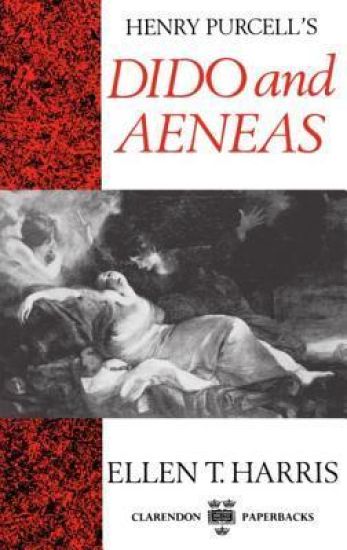
Henry Purcell's Dido and Aeneas

Henry Purcell's Dido and Aeneas

Harris Ellen T.

Clarendon Press
1989
nidottu
Purcell's Dido and Aeneas stands as the greatest operatic achievement of seventeenth-century England. Ellen Harris's comprehensive study examines the work in its historical and cultural context, with detailed coverage of contemporary performance practice and of the work's performance history and critical reception. The author examines the various surviving sources - all of which postdate the first performance by at least 80 years - and discusses their inconsistencies with Nahum Tate's original libretto. A useful reference section includes a critical discography and appendices charting a historical survey of national premieres and of editions.
Henry V - A Shakespeare Scenario
for speaker, SATB choir, boys' choir, and orchestra Olivier's Henry V was one of Walton's most celebrated film scores. Christopher Palmer's imaginative reconstruction turned it into a dramatic scenario which has been scrupulously edited, and is presented here with a full set of textual notes, including introduction, synopsis, notes on the sources and text, and facsimiles. Orchestral material is available on hire.
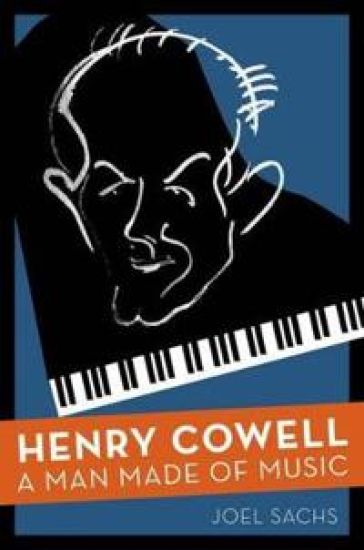
Henry Cowell

Henry Cowell

Sachs Joel

Oxford University Press Inc
2012
sidottu
Joel Sachs offers the first complete biography of one of the most influential figures in twentieth-century American music. Henry Cowell, a major musical innovator of the first half of the century, left a rich body of compositions spanning a wide range of styles. But as Sachs shows, Cowell's legacy extends far beyond his music. He worked tirelessly to create organizations such as the highly influential New Music Quarterly, New Music Recordings, and the Pan-American Association of Composers, through which great talents like Ruth Crawford Seeger and Charles Ives first became known in the US and abroad. As one of the first Western advocates for World Music, he used lectures, articles, and recordings to bring other musical cultures to myriad listeners and students including John Cage and Lou Harrison, who attributed their life work to Cowell's influence. Finally, Sachs describes the tragedy of Cowell's life—his guilty plea on a morals charge, which even the prosecutor felt was trivial, but brought him a sentence of 15 years in San Quentin, of which he served four.
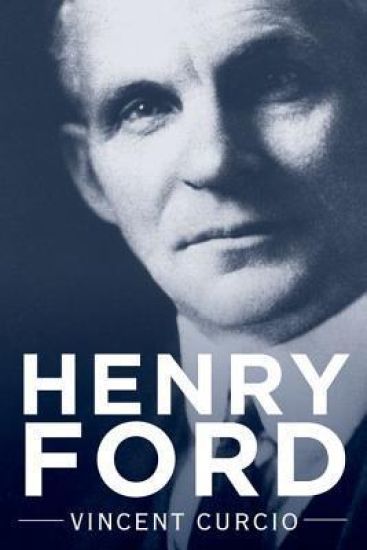
Henry Ford

Henry Ford

Vincent Curcio

Oxford University Press Inc
2013
sidottu
Most great figures in American culture and history reveal great contradictions, but none more so than Henry Ford. Vincent Curcio's compact, lively biography offers new insight on the man who not only founded Ford Motor Company and Henry Ford Company (later Cadillac) but also institutionalized the assembly line production process and (some argue) created the middle class in America. Ford invented an entire physical, economic and social system through the assembly line production of the Ford Model T automobile. By constantly improving his product, sales rose, enabling Ford to lower its price until it became a universal commodity. Ford created a market for this commodity by paying his workers so well that, for the first time in history, the people who manufactured a complex industrial product could own one. This was "Fordism, " social engineering on a vast scale. But Ford's anti-Semitism would forever stain his reputation and shadow his legacy. Hitler admired him greatly, both for his anti-Semitism and his autocratic leadership, displaying Ford's picture in his bedroom and keeping a copy of Ford's My Life and Work by his bedside. Despite this, Ford's workers were loyal. Ford offered good pay, good benefits, English language classes, and employment for those who struggled to find jobs - handicapped, African-American and female workers. Ford was a man both invigorated by the possibilities of modernism and yet conflicted by its implications. This new Lives and Legacies volume explores the dimensions of Ford's indisputable greatness while acknowledging the deep flaws that complicate his legacy.
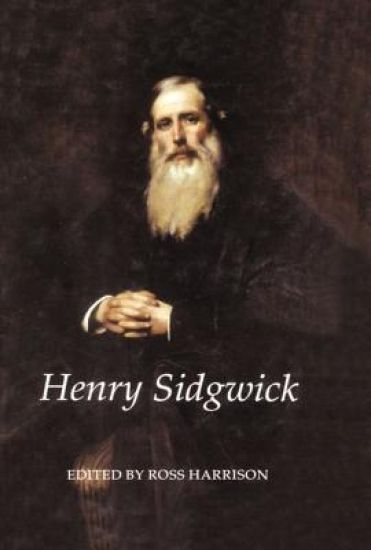
Henry Sidgwick

Henry Sidgwick

Oxford University Press
2001
sidottu
These essays constitute a welcome addition to the current re-engagement with the ethical thought of a prominent late Victorian philosopher and reformer. Henry Sidgwick wrote the first professional work of modern moral philosophy, yet one century after his death his thought remains relevant to the present revival of interest in the question of how we should live. How does moral philosophy fit in with the more general use of practical reason? - a still puzzling and deeply contested problem. Which actions are appropriate for an intellectual? - i.e., how should the moral thought of the professional few in the universities be related to the thought and action of the many in the world outside? Sidgwick's solutions to these questions are discussed and criticised by a distinguished group of scholars, providing new insights into these recurring issues of moral philosophy.
Henry of Harclay: Ordinary Questions, I–XIV
This is the first complete edition of the later work of the medieval philosopher and theologian Henry of Harclay. In colloboration with Raymond Edwards, an English translation is printed on facing pages, making this work available to a much wider audience. The twenty-nine Quaestiones Ordinariae cover a range of topics in metaphysics, theology, physical science, philosophical anthropology and ethics, which were among the most important of those debated in the early fourteenth century. The articles provide a window to this era, as Harclay discusses many of the main questions of his day: whether and why we choose what is evil, how God can know the future and we can still be free, what a virtue is, whether the human soul survives death, whether all things are made up of atoms. This edition enables us to evaluate Harclay, not only in relation to other notable thinkers of his time (such as John Duns Scotus and William of Ockham) but to appreciate the inner coherence of his own thought. An extensive introduction to Harclay's life, works and doctrine is provided. The volumes will also benefit scholars following the debates among lesser-studied thinkers such as William of Alnwick, Thomas of Sutton, Nicholas Trivet, and Robert Walsingham, whom this edition shows to have been in dialogue with Harclay during the years of the composition of his Quaestiones, 1310-1317. Because of the clarity of Harclay's thought and style, now mirrored in the English translation, the Quaestiones Ordinariae are an ideal way to introduce students to key problems in medieval philosophy, as well as to enable scholars to deepen their knowledge of the debates of this period. A further volume will publish Questions XV-XXIX.
Henry of Harclay: Ordinary Questions, XV–XXIX
This volume completes the first full edition of the later work of the medieval philosopher and theologian Henry of Harclay. In colloboration with Raymond Edwards, an English translation is printed on facing pages, making this work available to a much wider audience. The twenty-nine Quaestiones Ordinariae cover a range of topics in metaphysics, theology, physical science, philosophical anthropology and ethics, which were among the most important of those debated in the early fourteenth century. The articles provide a window to this era, as Harclay discusses many of the main questions of his day: whether and why we choose what is evil, how God can know the future and we can still be free, what a virtue is, whether the human soul survives death, whether all things are made up of atoms. This edition enables us to evaluate Harclay, not only in relation to other notable thinkers of his time (such as John Duns Scotus and William of Ockham) but to appreciate the inner coherence of his own thought. An extensive introduction to Harclay's life, works and doctrine is provided. The volumes will also benefit scholars following the debates among lesser-studied thinkers such as William of Alnwick, Thomas of Sutton, Nicholas Trivet, and Robert Walsingham, whom this edition shows to have been in dialogue with Harclay during the years of the composition of his Quaestiones, 1310-1317. Because of the clarity of Harclay's thought and style, now mirrored in the English translation, the Quaestiones Ordinariae are an ideal way to introduce students to key problems in medieval philosophy, as well as to enable scholars to deepen their knowledge of the debates of this period. Questions 1-14, together with an extensive introduction, were published as volume XVII in the Auctores series.
Henry David Thoreau

Henry David Thoreau

Lawrence Buell

OXFORD UNIVERSITY PRESS INC
2025
nidottu
"When I wrote the following pages, or rather the bulk of them, I lived alone, in the woods, a mile from any neighbor, in a house which I had built myself, on the shore of Walden Pond..." Henry David Thoreau (1817-1862) was a leading figure in the American Transcendentalist movement and the era of U. S. literary emergence, an intellectual with worldwide influence as essayist, social thinker, naturalist-environmentalist, and sage. Thoreau's Walden, an autobiographical narrative of his two-year sojourn in a self-built lakeside cabin, is one of the most widely studied works of American literature. It has generated scores of literary imitations and thousands of neo-Walden experiments in back-to-basics living, both rural and urban. Thoreau's great essay, "Civil Disobedience," is a classic of American political activism and a model for nonviolent reform movements around the world. Thoreau also stands as an icon of modern American environmentalism, the father of American nature writing, a forerunner of modern ecology, and a harbinger of freelance spirituality combining the wisdom of west and east. Thoreau is also a controversial figure. From his day to ours, he has provoked sharply opposite reactions ranging from reverence to dismissal. Scholars have regularly offered conflicting assessments of the significance of his work, the evolution of his thought, even the facts of his life. Some disagreements are in the eye of the beholder, but many follow from challenges posed by his own cross-grained idiosyncrasies. He was an advocate for individual self-sufficiency who never broke away from home, a self-professed mystic now also acclaimed as a pioneer natural and applied scientist, and a seminal theorist of nonviolent protest who defended the most notorious guerrilla fighter of his day. All told, he remains a rather enigmatic figure both despite and because we know so much about him, beginning with the two-million-word journal he kept throughout his adult life. The esteemed Thoreau scholar Lawrence Buell gives due consideration to all these aspects of Thoreau's art and thought, framing key issues and complexities in historical and literary context.
Henry David Thoreau

Henry David Thoreau

Lawrence Buell

OXFORD UNIVERSITY PRESS INC
2024
sidottu
"When I wrote the following pages, or rather the bulk of them, I lived alone, in the woods, a mile from any neighbor, in a house which I had built myself, on the shore of Walden Pond..." Henry David Thoreau (1817-1862) was a leading figure in the American Transcendentalist movement and the era of U. S. literary emergence, an intellectual with worldwide influence as essayist, social thinker, naturalist-environmentalist, and sage. Thoreau's Walden, an autobiographical narrative of his two-year sojourn in a self-built lakeside cabin, is one of the most widely studied works of American literature. It has generated scores of literary imitations and thousands of neo-Walden experiments in back-to-basics living, both rural and urban. Thoreau's great essay, "Civil Disobedience," is a classic of American political activism and a model for nonviolent reform movements around the world. Thoreau also stands as an icon of modern American environmentalism, the father of American nature writing, a forerunner of modern ecology, and a harbinger of freelance spirituality combining the wisdom of west and east. Thoreau is also a controversial figure. From his day to ours, he has provoked sharply opposite reactions ranging from reverence to dismissal. Scholars have regularly offered conflicting assessments of the significance of his work, the evolution of his thought, even the facts of his life. Some disagreements are in the eye of the beholder, but many follow from challenges posed by his own cross-grained idiosyncrasies. He was an advocate for individual self-sufficiency who never broke away from home, a self-professed mystic now also acclaimed as a pioneer natural and applied scientist, and a seminal theorist of nonviolent protest who defended the most notorious guerrilla fighter of his day. All told, he remains a rather enigmatic figure both despite and because we know so much about him, beginning with the two-million-word journal he kept throughout his adult life. The esteemed Thoreau scholar Lawrence Buell gives due consideration to all these aspects of Thoreau's art and thought, framing key issues and complexities in historical and literary context.
The Correspondence of Henry and Sarah Fielding

The Correspondence of Henry and Sarah Fielding

Henry and Sarah Fielding

Clarendon Press
1993
sidottu
Important discoveries in private and public archives have recently brought to light many new letters by Henry Fielding (1707-54) and by his sister, the novelist and classicist Sarah Fielding (1710-68). Published here for the first time is their entire extant correspondence, edited with an Introduction and explanatory annotations - 77 letters from and to Henry Fielding written over the years 1727 to 1754, and 33 letters from and to Sarah Fielding written from 1749 to 1767. The collection illuminates Henry Fielding's activities as author, lawyer, and magistrate; and it is valuable as well for the light it throws on his character and personal relationships. Fielding scholars are already acquainted with the important letters to his cousin Lady Mary Wortley Montagu, to his rival Samuel Richardson, to his friend George Lyttelton, and to his famous half-brother John Fielding, the latter written on the sad occasion of his final voyage to Lisbon. In this volume they will also find Fielding's correspondence with his great patron, the Duke of Bedford, and his agents - letters relating to Fielding's stewardship of the New Forest and to his appointments to the magistracy. The heart of this present collection, however - Fielding's correspondence with his closest friend, James `Hermes' Harris - is completely new. Never before published, the Harris letters comprise the finest extant examples of Fielding's epistolary correspondence, a kind of familiar writing he practised reluctantly, but well. The Harris papers are equally valuable for what they reveal of Sarah Fielding's literary and scholarly interests and her relationship with her brother. Other letters in the collection - several also published here for the first time - will serve to clarify her friendships with Richardson, Garrick, and Elizabeth Montagu. Included in the Appendix are a half-dozen letters from members of the family that will be of interest to biographers of Henry and Sarah.
Henry James

Henry James

Roslyn Jolly

Clarendon Press
1993
sidottu
This is a study of Henry James's changing attitudes to history as a narrative model, tracing the development from his early interest in `scientific' historiography to the radically anti-historical character of his late works. James's use of the term `history' was influenced by developments in nineteenth-century historiography, but was also embedded in the complex of defensive manoeuvres through which Victorian culture sought to control its anxiety about the power of fiction. Reading James's novels in the light of contemporary debates about the morality and authorship and the politics of reading, Dr Jolly finds that fiction develops from being history's censored `other' in the early works to being a valued mode of problem-solving in the later fiction. This shift may be seen as the product of James's increasing engagement with the reading practices of groups marginalized by high Victorian culture: women, the working class, other cultures, and the avant-garde. The book ends with a consideration of the challenge posed to James's radical anti-historical epistemology by the unprecedented violence of twentieth-century history. Drawing on contemporary narrative theory, and providing illuminating readings of a large number of James's novels, Roslyn Jolly had written a sophisticated and persuasive analysis of James's shifting definitions of history and fiction.