Kirjojen hintavertailu. Mukana 11 342 296 kirjaa ja 12 kauppaa.

Kirjahaku

Etsi kirjoja tekijän nimen, kirjan nimen tai ISBN:n perusteella.

1000 tulosta hakusanalla Joyce Rodgers

Joyce, Aristotle, and Aquinas

Joyce, Aristotle, and Aquinas

Fran O'Rourke

University Press of Florida
2022
sidottu
A rich examination of the influence of Aristotle and Thomas Aquinas on James JoyceIn this book, Fran O'Rourke examines the influence of Aristotle and Thomas Aquinas on James Joyce, arguing that both thinkers fundamentally shaped the philosophical outlook which pervades the author's oeuvre. O'Rourke demonstrates that Joyce was a philosophical writer who engaged creatively with questions of diversity and unity, identity, permanence and change, and the reliability of knowledge.Beginning with an introduction to each thinker, the book traces Joyce's discovery of their works and his concrete engagement with their thought. Aristotle and Aquinas equipped Joyce with fundamental principles regarding reality, knowledge, and the soul, which allowed him to shape his literary characters. Joyce appropriated Thomistic concepts to elaborate an original and personal aesthetic theory. O'Rourke provides an annotated commentary on quotations from Aristotle which Joyce entered into his famous Early Commonplace Book and outlines their crucial significance for his writings. He also provides an authoritative evaluation of Joyce's application of Aquinas's aesthetic principles.The first book to comprehensively illuminate the profound impact of both the ancient and medieval thinker on the modernist writer, Joyce, Aristotle, and Aquinas offers readers a rich understanding of the intellectual background and philosophical underpinnings of Joyce's work.
Joyce Without Borders

Joyce Without Borders

University Press of Florida
2022
sidottu
This book addresses James Joyce’s borderlessness and the ways his work crosses or unsettles boundaries of all kinds. The essays in this volume position borderlessness as a major key to understanding Joycean poiesis, opening new doors and new engagements with his work. Contributors begin by exploring the circulation of Joyce’s writing in Latin America via a transcontinental network of writers and translators, including José Lezama Lima, José Salas Subirat, Leopoldo Marechal, Eduardo Desnoës, Guillermo Cabrera Infante, and Augusto Monterroso. Essays then consider Joyce through the lens of the sciences, presenting theoretical interventions on posthumanist parasitology in Ulysses; on Giordano Bruno’s coincidence of opposites in Finnegans Wake; and on algorithmic agency in the Wake. Cutting-edge cognitive narratology is applied to the “Penelope” episode. Next, the volume features innovative essays on Joyce in relation to early animated film and comics, engaging with animated film in the “Circe” episode, Joyce’s points of contact with George Herriman’s cartoon strip Krazy Kat, and structural affinities between open-world gaming and Finnegans Wake. The final essays focus on abiding human concerns, offering new research on Joyce’s creative use of “spicy books”; a Lacanian consideration of “The Dead” alongside Katherine Mansfield’s “The Stranger” and Haruki Murakami’s “Kino”; and a meditation on Joyce’s uncertainties about the boundary between life and death. For Joyce, borders are problems—but ones that provided precious fodder for his art. And as this volume demonstrates, they encourage brilliant reflections on his work, from new scholars to leading luminaries in the field.
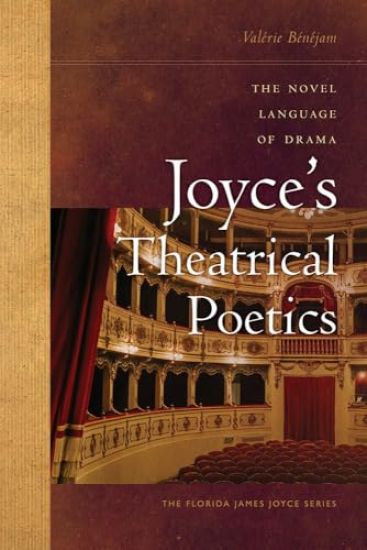
Joyce's Theatrical Poetics

Joyce's Theatrical Poetics

Valérie Bénéjam

University Press of Florida
2026
sidottu
Looking beyond the view of James Joyce as a failed playwright to uncover how Joyce's modernist breakthroughs are grounded in theatrical techniques In this book, Val rie B n jam argues that the success of James Joyce's fiction lies in its theatricality and examines the role of drama throughout the writer's entire oeuvre. While Joyce's only surviving play, Exiles, was widely considered a failure, B n jam demonstrates that Joyce inserted theater and theatricality into his short stories and novels instead, where they became the markers of his specific modernist aesthetics. B n jam identifies a theatrical bent in Joyce's early writings, seen in the minimalist play scripts of the epiphanies. His powerful use of dialogism continues in his early fiction, with Dubliners and A Portrait of the Artist as a Young Man. In Ulysses, Joyce includes theatrical techniques such as soliloquy, dialogue, script, and asides, most evident in chapters like "Circe" and "Penelope." And in his final work, Finnegans Wake, the conflict and crisis that are the essence of drama come to disrupt language at its very core. Blending biographical elements, close readings of text, and references to the playwrights whose work inspired Joyce, including Ibsen, Shakespeare, Wilde, and Synge, Joyce's Theatrical Poetics moves chronologically to explain how drama, conceived by Joyce as a demand for truth and movement in art, played a key role in his revolutionary disruption of the novel genre. A volume in the Florida James Joyce Series, edited by Sam Slote
Joyce in Trieste

Joyce in Trieste

University Press of Florida
2026
pokkari
A celebration of the transformative effects of James Joyce's time in Trieste Joyce in Trieste is a record of the transformation in text, meaning, and language that Trieste worked upon Joyce. This volume begins with three path-breaking essays: Michael Groden's unveiling of the manuscripts acquired by the National Library of Ireland in 2002, Margot Norris's introduction of the particularly effective paradigm of "risky reading" to describe the provocative re-contextualizations in history, theory, and culture that reveal something new about Joyce's work, and Zack Bowen's celebration of the Platonic and erotic qualities of Joyce's language. Each essay opens up to a section that follows the opening lead: essays on manuscript genetics following Groden, a political set of essays following Norris, and a set of essays on language following Bowen. Included are some final thoughts from the late Hugh Kenner, work from Joyceans such as Vike Martina Plock and Dirk Van Hulle, and political studies of Israel and Palestine. This volume provides a lively and useful summary of recent and future directions of Joyce scholarship and will be of particular interest to Joyce and Irish studies scholars as well as those interested in provocative readings of twentieth-century literature.
Joyce and the Joyceans

Joyce and the Joyceans

Morton P Levitt

Syracuse University Press
2002
nidottu
This collection of 17 essays on James Joyce covers a variety of subjects and approaches by some of the major figures of Joyce criticism and scholarship, as well as some by newer Joyceans. Its scope is among the very broadest of such collections as well as the most up to date. It includes a series of personal essays describing some pivotal events in the international study of Joyce, including the beginnings of the Joyce Foundation and Symposia.
Joyce and Reality

Joyce and Reality

John Gordon

Syracuse University Press
2004
sidottu
Joyce was a realist, but his reality was not ours, writes John Gordon in his new book. Here, he maintains that the shifting styles and techniques of Joyce's works is a function of two interacting realities - the external reality of a particular time and place and the internal reality of a character's mental state. In making this case Gordon offers up a number of new readings: how Stephen Dedalus conceives and composes his villanelle; why the Dubliners story about Little Chandler is titled ""A Little Cloud""; why MacDowell suddenly appears and disappears; what is happening when Leopold Bloom looks for two minutes at a beer bottle's label; why the triangle etched at the center of Finnegans Wake doubles itself and grows a pair of circles; why the next to last chapter of Ulysses has, by far, the book's highest incidence of the letter C; and who is the man in the macintosh. Gordon, whose authoritative Finnegans Wake: A Plot Summary received critical acclaim and is considered one of the standard references, revises - and challenges - the received version of that reality. For instance, Joyce features ghost visitations, telepathy, and other para-normal phenomena not as ""flights into fantasy"" but because he believed in the real possibility of such occurrences.
Joyce, Imperialism, and Postcolonialism
On the surface, James Joyce's work is largely a political. Through most of the twentieth century he was the proud embodiment of the rootless intellectual. However, perspectives on the colonial history of Ireland have proliferated in recent years, yielding a subtle and complex conception of the Irish postcolonial experience that has become a major theme in current Joyce scholarship. Highly original and often provocative, these essays bring Joyce powerfully within the ambit of postcolonial studies.
Joyce / Shakespeare

Joyce / Shakespeare

Syracuse University Press
2015
nidottu
Shakespeare’s presence in Joyce’s work is tentacular, extending throughout his career on many different levels: cultural, structural, lexical, and psychological; yet a surprisingly long time has passed since the last monograph on this literary nexus was published. Joyce/Shakespeare brings together fresh work by internationally recognized Joyce scholars on these two icons, reinvigorating our understanding of Joyce at play with the Bard. One way these essays revitalize the discussion is by moving well beyond the traditional Joycean challenge of “thinking Shakespearean” by “thinking Hamletian,” redefining the field to include works like Troilus and Cressida, Othello, and The Tempest. This collection also transforms our understanding of how Hamlet works in and for Joyce. In compelling essays that introduce new variables to the equation such as Trieste, Goethe, and Futurism, Hamlet’s role in Joyce gains fresh mobility. The Danish prince’s shadow, we learn, can still cast itself in unpredictable shapes, making Joyce/Shakespeare as rewarding in its analyses of this well-studied pairing as it is when it considers fresh Shakespearean matches.
Joyce's Book of Memory

Joyce's Book of Memory

John S. Rickard

Duke University Press
1999
sidottu
For James Joyce, perhaps the most crucial of all human faculties was memory. It represented both the central thread of identity and a looking glass into the past. It served as an avenue into other minds, an essential part of the process of literary composition and narration, and the connective tissue of cultural tradition. In Joyce’s Book of Memory John S. Rickard demonstrates how Joyce’s body of work-Ulysses in particular-operates as a “mnemotechnic,” a technique for preserving and remembering personal, social, and cultural pasts.Offering a detailed reading of Joyce and his methods of writing, Rickard investigates the uses of memory in Ulysses and analyzes its role in the formation of personal identity. The importance of forgetting and repression, and the deadliness of nostalgia and habit in Joyce’s paralyzed Dublin are also revealed. Noting the power of spontaneous, involuntary recollection, Rickard locates Joyce’s mnemotechnic within its historical and philosophical contexts. As he examines how Joyce responded to competing intellectual paradigms, Rickard explores Ulysses’ connection to medieval, modern, and (what would become) postmodern worldviews, as well as its display of tensions between notions of subjective and universal memory. Finally, Joyce’s Book of Memory illustrates how Joyce distilled subjectivity, history, and cultural identity into a text that offers a panoramic view of the modern period.This book will interest students and scholars of Joyce, as well as others engaged in the study of modern and postmodern literature.
Joyce's Book of Memory

Joyce's Book of Memory

John S. Rickard

Duke University Press
1999
pokkari
For James Joyce, perhaps the most crucial of all human faculties was memory. It represented both the central thread of identity and a looking glass into the past. It served as an avenue into other minds, an essential part of the process of literary composition and narration, and the connective tissue of cultural tradition. In Joyce’s Book of Memory John S. Rickard demonstrates how Joyce’s body of work-Ulysses in particular-operates as a “mnemotechnic,” a technique for preserving and remembering personal, social, and cultural pasts.Offering a detailed reading of Joyce and his methods of writing, Rickard investigates the uses of memory in Ulysses and analyzes its role in the formation of personal identity. The importance of forgetting and repression, and the deadliness of nostalgia and habit in Joyce’s paralyzed Dublin are also revealed. Noting the power of spontaneous, involuntary recollection, Rickard locates Joyce’s mnemotechnic within its historical and philosophical contexts. As he examines how Joyce responded to competing intellectual paradigms, Rickard explores Ulysses’ connection to medieval, modern, and (what would become) postmodern worldviews, as well as its display of tensions between notions of subjective and universal memory. Finally, Joyce’s Book of Memory illustrates how Joyce distilled subjectivity, history, and cultural identity into a text that offers a panoramic view of the modern period.This book will interest students and scholars of Joyce, as well as others engaged in the study of modern and postmodern literature.
Joyce Studies Annual 2007

Joyce Studies Annual 2007

Fordham University Press
2007
sidottu
An indispensable resource for scholars and students of James Joyce, Joyce Studies Annual gathers essays by foremost scholars and emerging voices in the field. Formerly published by the University of Texas, the first volume from Fordham University Press is scheduled for publication in November 2007, and will include historical, archival, and comparative approaches from a variety of theoretical perspectives. Volumes 1990–2003 continue to be published by the Univesity of Texas Press. Joyce Studies Annual welcomes submissions on any aspect of Joyce's work, and especially encourages longer essays treating historical, archival, or comparative issues.
Joyce Studies Annual 2008

Joyce Studies Annual 2008

Fordham University Press
2008
sidottu
Contents Addresses from the 2007 International James Joyce Conference Thomas F. Staley, "A Life With Joyce" Carol Loeb Shloss, "Copyright and the Joyce Estate: Legal Issues, Moral Issues, and Unresolved Issues in the Publication of Lucia Joyce: To Dance in the The Wake" Robert Spoo, "Litigating the Right To Be a Scholar" Visual Art Carl Kohler, Sketches of Joyce's Progressive Blindness Articles Garry Leonard, "He's Got Bette Davis Eyes: Joyce and Melodrama" Margot Backus, "Odd Jobs': James Joyce, Oscar Wilde, and the New Journalism" Alistair McCleery, William Brockman, and Ian Gunn, "Fresh Evidence and Further Complications: Correcting the Text of the Random House 1934 Edition of Ulysses" Andre Cormier, "The Transcendental, Blind Stripling in Ulysses" Michael Lapointe, "Irish Nationalism's Sacrificial Homosociality in Ulysses" Sam Slote, "1904, A Space Odyssey" William Sayers, "The Russian General, Gargantua, and Joyce Writing 'of his wit's waste' in Finnegans Wake
Joyce Studies Annual 2010

Joyce Studies Annual 2010

Fordham University Press
2011
sidottu
ARTICLES Amanda Sigler, Joyce's Ellmann: The Beginnings of James Joyce Peter Nohrnberg, "Building Up a Nation Once Again": Irish Masculinity, Violence, and the Cultural Politics of Sports in A Portrait of the Artist as a Young Man and Ulysses Denise Ayo, Scratching at Scabs: The Garryowens of Ireland Lauren Rich, A Table for One: Hunger and Unhomeliness in Joyce's Public Eateries Angela Nemecek, Reading the Disabled Woman: Gerty MacDowell and the Stigmaphilic Space of "Nausicaa" Dieter Fuchs, Szombathely, Vienna, Budapest: Epic Geography and the Austro-Hungarian Subtext of James Joyce's Ulysses Roy Benjamin, Intermisunderstanding Minds: The First Gospel in Finnegans Wake NOTES Faith Steinberg, Joyce Illustrates Finnegans Wake (verbally) and HCE Goes Tomb-Hopping Joseph Kestner, James Joyce's "Araby" on Film Brandon Lansom, Orpheus Descending: Images of Psychic Descent in "Hades" and "Circe" Thomas Rendall, Joyce's "The Dead" and the Mid-life Crisis