Kirjojen hintavertailu. Mukana 11 342 296 kirjaa ja 12 kauppaa.

Kirjahaku

Etsi kirjoja tekijän nimen, kirjan nimen tai ISBN:n perusteella.

1000 tulosta hakusanalla Justus Roth

The Parliament of Criticks, the Menippæan Satyr of Justus Lipsius in a Dream; Paraphras'd
The 18th century was a wealth of knowledge, exploration and rapidly growing technology and expanding record-keeping made possible by advances in the printing press. In its determination to preserve the century of revolution, Gale initiated a revolution of its own: digitization of epic proportions to preserve these invaluable works in the largest archive of its kind. Now for the first time these high-quality digital copies of original 18th century manuscripts are available in print, making them highly accessible to libraries, undergraduate students, and independent scholars.Delve into what it was like to live during the eighteenth century by reading the first-hand accounts of everyday people, including city dwellers and farmers, businessmen and bankers, artisans and merchants, artists and their patrons, politicians and their constituents. Original texts make the American, French, and Industrial revolutions vividly contemporary.++++The below data was compiled from various identification fields in the bibliographic record of this title. This data is provided as an additional tool in helping to insure edition identification: ++++British LibraryT108216London: printed for J. Hartley, 1702. 24],84p.; 12
Justus Ludewig von Uslar, and the First Book on Allelopathy

Justus Ludewig von Uslar, and the First Book on Allelopathy

R.J. Willis

Springer-Verlag New York Inc.
2005
sidottu
Allelopathy is a fascinating and perplexing topic that concerns the chemical interactions of plants. It has profound implications in agriculture and forestry where species are grown artificially in mixture, with no evolutionary history of co-existence. The topic of allelopathy is widely credited as commencing in 1937, when the term ‘allelopathy’ was coined by Molisch. However, the concept of allelopathy has been recorded since Greek and Roman times, became extremely controversial in the first half of the 19th century, and remains so today. This book concerns a virtually unknown treatise by Justus Ludewig von Uslar, published in 1844, which emerges as the first book entirely devoted to the concept of allelopathy. The book provides the historical background to allelopathic knowledge, from antiquity to c. 1840. It also provides for the first time a biography of Justus Ludewig von Uslar, who is best known as the first Consul-General for Hannover in Mexico, and Director of the Mexican Company, a British venture mining company. In many ways von Uslar epitomises the tradition of the gentleman scientist of the 19th century. The book then offers a full translation into English of von Uslar's rare treatise, which foreshadows many ideas current in allelopathic research.
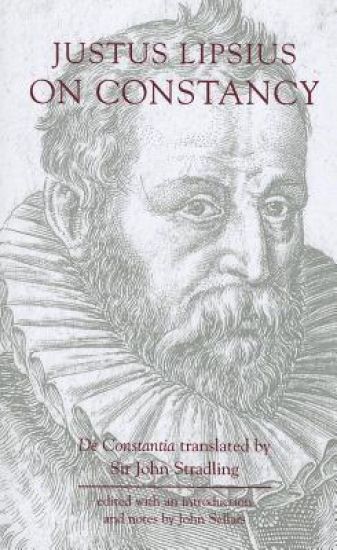
Justus Lipsius: On Constancy

Justus Lipsius: On Constancy

Justus Lipsius

Bristol Phoenix Press
2006
nidottu
Justus Lipsius' De Constantia (1584) is one of the most important and interesting of sixteenth century Humanist texts. A dialogue in two books, conceived as a philosophical consolation for those suffering through contemporary religious wars, De Constantia proved immensely popular in its day and formed the inspiration for what has become known as 'Neo-stoicism'. This movement advocated the revival of Stoic ethics in a form that would be palatable to a Christian audience. In De Constantia Lipsius deploys Stoic arguments concerning appropriate attitudes towards emotions and external events. He also makes clear which parts of stoic philosophy must be rejected, including its materialism and its determinism. De Constantia was translated into a number of vernacular languages soon after its original publication in Latin. Of the English translations that were made, that by Sir John Stradling (1595) became a classic; it was last reprinted in 1939. The present edition offers a lightly revised version of Stradling’s translation, updated for modern readers, along with a new introduction, notes and bibliography.
Justus Henning Böhmer und die Dissertationen seiner Schüler
In der Geschichte des protestantischen Kirchenrechts bedeutet das fünfbändige Ius Ecclesiasticum Protestantium des Hallenser Professors Justus Henning Böhmer (1674-1749) Grundlegung und Höhepunkt zugleich. Immer wieder rühmte man es dafür, dass es einerseits der Ordnung des Liber Extra Raimunds von Peñafort folgte, also in der Traditionslinie des katholischen Kirchenrechts blieb, andererseits aber durch gründliche historische und dogmatische Überlegungen das spezifisch Protestantische herausarbeitete. Wie jedoch verhalten sich die Dissertationen, über die Justus Henning Böhmers Schüler zwischen 1699 und 1747 disputierten, zum Ius Ecclesiasticum Protestantium? Ließ Böhmer gewisse Inhalte erst disputieren, um die Reaktion der akademischen Welt zu testen, bevor er die jeweilige Thematik für sein Hauptwerk bearbeitete? Ausgehend von den Dissertationen widmet sich Renate Schulze dem kirchenrechtlichen Werk des wohl bedeutendsten protestantischen Kirchenrechtlers des 18. Jahrhunderts. Angelpunkt vieler Diskussionen ist die Frage der Legitimation der weltlichen Aufsicht über die Kirche. Hinzu tritt die grundsätzliche Frage, was aus der katholischen kanonistischen Tradition in den protestantischen Kirchen mit Blick auf deren Bekenntnisschriften weiter Bestand haben kann. Daneben werden die Bedeutung der Dissertationen für Böhmers Werk sowie Kriterien dafür, was zu Böhmers Zeit und speziell in seinen Augen als "gute Dissertation" gelten konnte, herausgearbeitet und ein gutes Stück Hallenser Wissenschaftsgeschichte des Kirchenrechts in der ersten Blütezeit der Universität erschlossen.
Justus Gottfried Rabener- «Nuetzliche Lehrgedichte»
Die Autorin hat es sich zur Aufgabe gemacht, die "Nutzlichen Lehrgedichte," eine Fabelsammlung, die am Ende des 17. Jahrhunderts erschienen ist, zu untersuchen und durch die Edition bekannt zu machen. Die Texte stellen einen wichtigen Mosaikstein in der Geschichte der deutschen Fabeldichtung dar. Sie sind aber nicht mit einem zeitenthobenen literaturasthetischen Massstab zu lesen, sondern mussen aus ihrem Entstehungszusammenhang heraus bewertet werden. Damit das Werk Rabeners als sprachgeschichtliches Denkmal gelesen werden kann, hat die Autorin die Texte konservativ ediert. Die Arbeit zeigt, wie die Fabeln im 17. Jahrhundert im Schulunterricht verwendet worden sind und macht damit ein Stuck Schulgeschichte Sachsens deutlich. Durch die Untersuchung der Aspekte Verbindung von Reformation und Humanismus, neulateinische Tradition, Gelehrtenschule in Sachsen und Luthertum wird der Weg zum Verstandnis der Fabeltexte geoffnet. Es wird belegt, dass die Fabel im 17. Jahrhundert durchaus nicht als -quantite negligeable- abzuwerten ist."