

Kirjahaku
Etsi kirjoja tekijän nimen, kirjan nimen tai ISBN:n perusteella.
1000 tulosta hakusanalla Krista Perry Dunn


Four Letter Words: Finding Hope in a Tiny Wild Life
Krista Wilbur
Krista on Purpose Publishing
2016
nidottu
When Krista Wilbur was a little girl, she dreamed of one day becoming a teacher. But those dreams changed as she faced sexual abuse, an unplanned teen pregnancy, abandonment by her mother, and a violent rape, all within a decade. In spite of these circumstances, Krista found friends who gave her stability and hope and who showed her the love of Jesus... until those things were also taken from her, and her confidence and trust in people and the Church were crushed.Four Letter Words is Krista's story of resilience. It is a story of surviving devastating abuse and tragedy, finding and losing (and finding again) one's faith, and hope being written from a pile of ashes. Four Letter Words is, above all, the story of God's great and abiding love, even in a life that doesn't seem to make any sense.

S.W.A.G. (Saved Woman Going After God): Fashionable Devotions for Daily Life
Krista Mincey
Krista Danielle Mincey
2017
nidottu
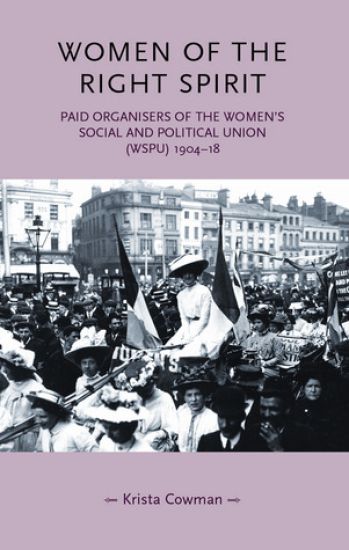
This book is the first investigation on how official organizers built and sustained the national militant campaign of the Women’s Social and Political Union between 1903 and 1918. Whilst the overall policy of the Union was devised by an ever-decreasing circle of women, centred around the mother-daughter team of Emmeline and Christabel Pankhurst, much of its actual activity, including its more extreme militant actions such as arson, was devised and implemented by these organizers who worked in the provinces and in London. Women of the right spirit reveals organizers to be a diverse bunch of women, whose class backgrounds ranged from the aristocratic to the extremely impoverished. It describes the ways in which they were recruited and deployed, and the work they undertook throughout Britain. The exhausting pace of their itinerant life is revealed as well as the occasions when organizers fell out with their employers or their own branches. Taking the story of the WSPU’s workers up to the end of the First World War, it considers what directions they took when votes for women became a reality.The book will appeal to academics, postgraduates and undergraduates with an interest in women’s history, as well as a more general readership wishing to understand the extent of support for the votes for women campaign and the mechanisms through which it organized.
The English System: Quarantine, Immigration and the Making of a Port Sanitary Zone
Krista Maglen
MANCHESTER UNIVERSITY PRESS
2014
sidottu
The English System is a history of port health and immigration at a critical moment of transformation at the end of the nineteenth and beginning of the twentieth century. During the later nineteenth century, British public health officials transformed the medieval quarantine system into a novel 'English System' of surveillance to control the introduction of infectious disease. This removed the much maligned hindrances of quarantine to high-speed international commerce and for maritime traffic through Britain's ports. At the same time, calls were made to restrict the arrival of increasing numbers of European immigrants and transmigrants. This book explores the tensions and transition in the regulation of port health from a paradigm focused on the origin of disease to one which converged on the origin of the diseased.
Walking in Unity
Krista Bontrager; Monique Duson; Alisa Childers
HARVEST HOUSE PUBLISHERS,U.S.
2024
pokkari
Biblical Guidance for Tough Conversations on Race Early in their friendship, Monique and Krista faced what felt like insurmountable barriers in their discussions about race and racism. Rather than retreating into avoidant silence or escalating tension until they burned down their friendship, they learned to face those difficult conversations together—because as children of God, they saw each other as worth it.Walking in Unity is about bringing Christ-centered answers to issues of race and racism. Drawing a clear distinction between the secular culture's instructions for agreement and Scripture's call for unity, authors Monique Duson and Krista Bontrager explore what the Bible really says about racial harmony and how Christians ultimately find their common identity in Christ. Avoiding cheap platitudes, Monique and Krista help you explore the tough issues that the larger culture has brought into our churches, such as historic racial injustices, systemic racism, and the call for reparations. As you employ this Christ-centered model for unity, you will find nuanced insights and practical guidelines for engaging the divisive issues of today with the love and truth found only in Jesus.
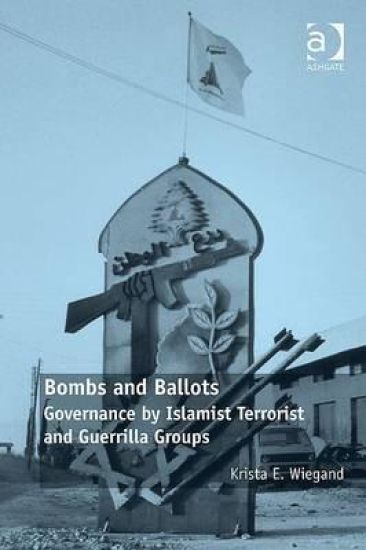
Eventually, most terrorist and guerrilla groups are defeated by governments or gradually die off - sometimes becoming political parties, democratically participating in the non-violent governance of their states. Yet some terrorist and guerrilla groups maintain military capabilities, using violence and democratic participation simultaneously. Here, Krista E. Wiegand examines the different political strategies that Islamist terrorist and guerrilla groups use to achieve their political objectives. Focussing on Hezbollah in Lebanon and Hamas in Palestine, Wiegand skilfully reveals the factors that determine why Islamist militant groups become involved in governance as political parties, how mainstream governments may or may not accept them as legitimate, why some groups like al- Gama'a al-Islamiya in Egypt renounce guerrilla tactics, and how some groups govern whilst employing political violence. Bombs and Ballots is a valuable contribution to the study of state-society relations in the Middle East, exposing the blurred line between terrorist activity and governance.

A raw, absorbing, tender, and witty novel about a woman's long-overdue reckoning with memory, truth, and the multiverse of familial love. Elin Henriksen is a middle-aged single parent under pressure. Her formidable mother's health is declining, her fearless teenage daughter wants to leave but won't say where, and the new high school principal has problems with her unorthodox teaching of physics. And then there is the upcoming ceremony at the Art Museum. In ten days, a gallery will be named after her late father, Tig Henriksen, a modernist furniture designer whose sought-after cult pieces hide a troubled narrative. With a mixture of anticipation and dread, Elin prepares to reunite with her once-estranged siblings--Mette, a free-spirited singer-songwriter, and the serious, emotionally distant architect Casper--hoping they'll finally grapple with hard truths they've so far refused to accept. In the countdown to the event, as her daughter's risk-taking mounts, her mother's fragility intensifies and strange packages land on her doorstep (including a yellow-eyed dog), Elin's only relief is confiding to a dead physicist. Struggling with the paradoxes of truth and clarity, love and witness, genius and ambition, and her own ambivalent connection to her confessor, she inches toward confronting not just the explosive potential of memory but the costly fallout of silence. Told with dazzling insight, intelligence, and compassion, Half Life is a beautifully rendered story about family truths and the profound human need to be believed.
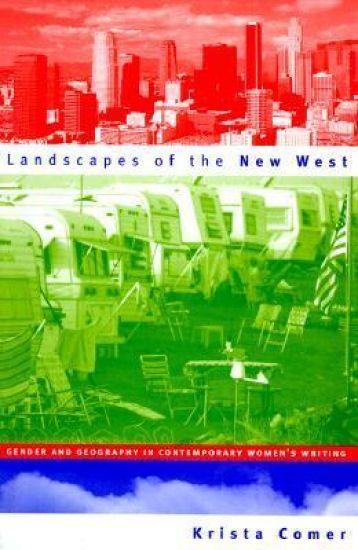
In the early 1970s, empowered by the civil rights and women's movements, a new group of women writers began speaking to the American public. Their topic, broadly defined, was the postmodern American West. By the mid-1980s, their combined works made for a bona fide literary groundswell in both critical and commercial terms. However, as Krista Comer notes, despite the attentions of publishers, the media, and millions of readers, literary scholars have rarely addressed this movement or its writers. Too many critics, Comer argues, still enamored of western images that are both masculine and antimodern, have been slow to reckon with the emergence of a new, far more ""feminine,"" postmodern, multiracial, and urban west. Here, she calls for a redesign of the field of western cultural studies, one that engages issues of gender and race and is more self-conscious about space itself--especially that cherished symbol of western ""authenticity,"" open landscape. Surveying works by Joan Didion, Wanda Coleman, Maxine Hong Kingston, Leslie Marmon Silko, Barbara Kingsolver, Pam Houston, Louise Erdrich, Sandra Cisneros, and Mary Clearman Blew, Comer shows how these and other contemporary women writers have mapped new geographical imaginations upon the cultural and social spaces of today's American West. |Challenges the field of western cultural studies to recognize the new cultural and social spaces successfully mapped by such feminist writers as Didion, Silko, Kingsolver, Erdrich and others.
Anglo-American Feminist Challenges to the Rhetorical Traditions
Krista Ratcliffe
Southern Illinois University Press
1996
sidottu
One of the few authors to define and focus on feminist theories of rhetoric, Krista Ratcliffe takes Bathsheba s dilemma as her controlling metaphor: "I have the feelings of a woman," says Bathsheba Everdene in Hardy s "Far from the Madding Crowd, ""but only the language of men." Although women and men have different relationships to language and to each other, traditional theories of rhetoric do not foreground such gender differences, Ratcliffe notes. She argues that feminist theories of rhetoric are needed if we are to recognize, validate, and address Bathsheba s dilemma. Ratcliffe argues that because feminists generally have not conceptualized their language theories from the perspective of rhetoric and composition studies, rhetoric and composition scholars must construct feminist theories of rhetoric by employing a variety of interwoven strategies: recovering lost or marginalized texts; rereading traditional rhetoric texts; extrapolating rhetorical theories from such nonrhetoric texts as letters, diaries, essays, cookbooks, and other sources; and constructing their own theories of rhetoric. Focusing on the third option, Ratcliffe explores ways in which the rhetorical theories of Virginia Woolf, Mary Daly, and Adrienne Rich may be extrapolated from their Anglo-American feminist texts through examination of the interrelationship between what these authors write and how they write. In other words, she extrapolates feminist theories of rhetoric from interwoven claims and textual strategies. By inviting Woolf, Daly, and Rich into the rhetorical traditions and by modeling the extrapolation strategy/methodology on their writings, Ratcliffe shows how feminist texts about women, language, and culture may be reread from the vantage point of rhetoric to construct feminist theories of rhetoric. She rereads Anglo-American feminist texts both to expose their white privilege and to rescue them from charges of naivete and essentialism. She also outlines the pedagogical implications of these three feminist theories of rhetoric, thus contributing to ongoing discussions of feminist pedagogies. Traditional rhetorical theories are gender-blind, ignoring the reality that women and men occupy different cultural spaces and that these spaces are further complicated by race and class, Ratcliffe explains. Arguing that issues such as who can talk, where one can talk, and how one can talk emerge in daily life but are often disregarded in rhetorical theories, Ratcliffe rereads Roland Barthes "The Old Rhetoric" to show the limitations of classical rhetorical theories for women and feminists. Discovering spaces for feminist theories of rhetoric in the rhetorical traditions, Ratcliffe invites readers not only to question how women have been located as a part of and apart from these traditions but also to explore the implications for rhetorical history, theory, and pedagogy. In extrapolating rhetorical theories from three feminist writers not generally considered rhetoricians, Ratcliffe creates a new model for examining women s work. She situates the rhetorical theories of Woolf, Daly, and Rich within current discussions about feminist pedagogy, particularly the interweavings of critical thinking, reading, and writing. Ratcliffe concludes with an application to teaching. "
Extending the feminist rhetorical project to define and model rhetorical listening. Long-ignored within rhetoric and composition studies, listening has returned to the disciplinary radar. ""Rhetorical Listening: Identification, Gender, Whiteness"" argues that rhetorical listening facilitates conscious identifications needed for cross-cultural communication. Krista Ratcliffe establishes eavesdropping, listening metonymically, and listening pedagogically as approaches to rhetorical listening. She defines and models rhetorical listening, addressing identifications with gender and whiteness within public debates, scholarship, and pedagogy. Offering an approach grounded in classical rhetorical theory, Heideggerian theory, feminist theory, and critical race theory, Ratcliffe presents rhetorical listening as an invention tactic that engages spoken and written texts and supplements reading, writing, speaking, and silence as a rhetorical art. Theorizing intersections of gender and whiteness, ""Rhetorical Listening"" examines how whiteness functions as an ""invisible"" racial category and provides disciplinary and cultural reasons for the displacement of listening and for the use of rhetorical listening as a code of cross-cultural conduct. Ratcliffe presents rhetorical listening in terms of cultural logics, stances, and dominant interpretive tropes. She high-lights the modern identification theory of Kenneth Burke and the postmodern identification and disidentification theory of Diana Fuss and presents nonidentification as a more productive site for rhetorical listening.
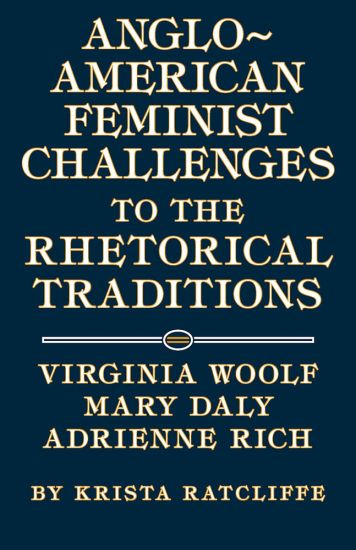
Anglo-American Feminist Challenges to the Rhetorical Traditions
Krista Ratcliffe
Southern Illinois University Press
2016
nidottu
One of the few authors to define and focus on feminist theories of rhetoric, Krista Ratcliffe takes Bathsheba’s dilemma as her controlling metaphor: ""I have the feelings of a woman,"" says Bathsheba Everdene in Hardy’s Far from the Madding Crowd, ""but only the language of men.""Although women and men have different relationships to language and to each other, traditional theories of rhetoric do not foreground such gender differences, Ratcliffe notes. She argues that feminist theories of rhetoric are needed if we are to recognize, validate, and address Bathsheba’s dilemma.Ratcliffe argues that because feminists generally have not conceptualized their language theories from the perspective of rhetoric and composition studies, rhetoric and composition scholars must construct feminist theories of rhetoric by employing a variety of interwoven strategies: recovering lost or marginalized texts; rereading traditional rhetoric texts; extrapolating rhetorical theories from such nonrhetoric texts as letters, diaries, essays, cookbooks, and other sources; and constructing their own theories of rhetoric.Focusing on the third option, Ratcliffe explores ways in which the rhetorical theories of Virginia Woolf, Mary Daly, and Adrienne Rich may be extrapolated from their Anglo-American feminist texts through examination of the interrelationship between what these authors write and how they write. In other words, she extrapolates feminist theories of rhetoric from interwoven claims and textual strategies.By inviting Woolf, Daly, and Rich into the rhetorical traditions and by modeling the extrapolation strategy/methodology on their writings, Ratcliffe shows how feminist texts about women, language, and culture may be reread from the vantage point of rhetoric to construct feminist theories of rhetoric. She rereads Anglo-American feminist texts both to expose their white privilege and to rescue them from charges of naïveté and essentialism. She also outlines the pedagogical implications of these three feminist theories of rhetoric, thus contributing to ongoing discussions of feminist pedagogies.Traditional rhetorical theories are gender-blind, ignoring the reality that women and men occupy different cultural spaces and that these spaces are further complicated by race and class, Ratcliffe explains. Arguing that issues such as who can talk, where one can talk, and how one can talk emerge in daily life but are often disregarded in rhetorical theories, Ratcliffe rereads Roland Barthes’ ""The Old Rhetoric"" to show the limitations of classical rhetorical theories for women and feminists. Discovering spaces for feminist theories of rhetoric in the rhetorical traditions, Ratcliffe invites readers not only to question how women have been located as a part of— and apart from—these traditions but also to explore the implications for rhetorical history, theory, and pedagogy.In extrapolating rhetorical theories from three feminist writers not generally considered rhetoricians, Ratcliffe creates a new model for examining women’s work. She situates the rhetorical theories of Woolf, Daly, and Rich within current discussions about feminist pedagogy, particularly the interweavings of critical thinking, reading, and writing. Ratcliffe concludes with an application to teaching.
This book defends a novel theory of singular concepts, emphasizing the pragmatic requirements of singular concept possession and arguing that these requirements must be understood to institute traditions and policies of thought.
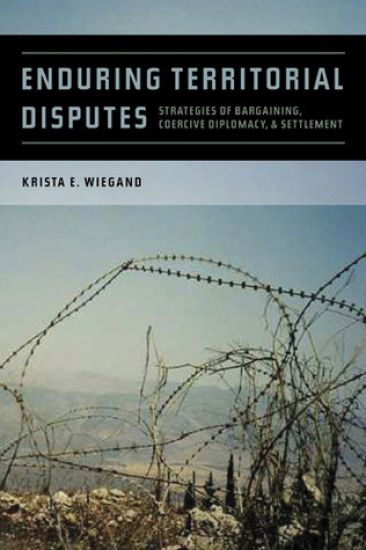
Of all the issues in international relations, disputes over territory are the most salient and most likely to lead to armed conflict. Understanding their endurance is of paramount importance. Although many states have settled their disagreements over territory, seventy-one disputes involving nearly 40 percent of all sovereign states remain unresolved.In this study, Krista E. Wiegand examines why some states are willing and able to settle territorial disputes while others are not. She argues that states may purposely maintain disputes over territory in order to use them as bargaining leverage in negotiations over other important unresolved issues. This dual strategy of issue linkage and coercive diplomacy allows the challenger state to benefit from its territorial claim. Under such conditions, it has strong incentive to pursue diplomatic and militarized threats and very little incentive to settle the dispute over territory.Wiegand tests her theory in four case studies, three representing the major types of territorial disputes: uninhabited islands and territorial waters, as seen in tensions between China and Japan over the Senkaku and Diaoyu Islands; inhabited tracts of territory, such as the North African enclaves of Ceuta and Melilla affecting Morocco and Spain; and border areas, like the Shebaa Farms dispute between Lebanon and Israel. A fourth case study of a dispute between China and Russia represents a combination of all three types; settled in 2008, it serves as a negative example. All these disputes involve areas that have key strategic and economic importance both regionally and globally.
Of all the issues in international relations, disputes over territory are the most salient and most likely to lead to armed conflict. Understanding their endurance is of paramount importance. Although many states have settled their disagreements over territory, seventy-one disputes involving nearly 40 percent of all sovereign states remain unresolved.In this study, Krista E. Wiegand examines why some states are willing and able to settle territorial disputes while others are not. She argues that states may purposely maintain disputes over territory in order to use them as bargaining leverage in negotiations over other important unresolved issues. This dual strategy of issue linkage and coercive diplomacy allows the challenger state to benefit from its territorial claim. Under such conditions, it has strong incentive to pursue diplomatic and militarized threats and very little incentive to settle the dispute over territory.Wiegand tests her theory in four case studies, three representing the major types of territorial disputes: uninhabited islands and territorial waters, as seen in tensions between China and Japan over the Senkaku and Diaoyu Islands; inhabited tracts of territory, such as the North African enclaves of Ceuta and Melilla affecting Morocco and Spain; and border areas, like the Shebaa Farms dispute between Lebanon and Israel. A fourth case study of a dispute between China and Russia represents a combination of all three types; settled in 2008, it serves as a negative example. All these disputes involve areas that have key strategic and economic importance both regionally and globally.
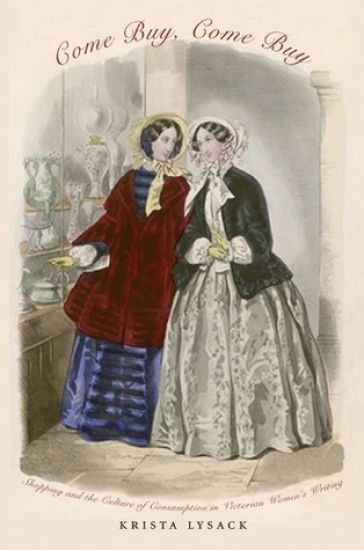
From the 1860s through the early twentieth century, Great Britain saw the rise of the department store and the institutionalization of a gendered sphere of consumption. Come Buy, Come Buy considers representations of the female shopper in British women's writing and demonstrates how women's shopping practices are materialized as forms of narrative, poetic, and cultural inscription, showing how women writers emphasize consumerism as productive of pleasure rather than the condition of seduction or loss. Krista Lysack examines works by Christina Rossetti, Mary Elizabeth Braddon, George Eliot, and Michael Field, as well as the suffragette newspaper Votes for Women, in order to challenge the dominant construction of Victorian femininity as characterized by self-renunciation and the regulation of appetite. Come Buy, Come Buy considers not only literary works, but also a variety of archival sources (shopping guides, women's fashion magazines, household management guides, newspapers, and advertisements) and cultural practices (department store shopping, shoplifting and kleptomania, domestic economy, and suffragette shopkeeping). With this wealth of sources, Lysack traces a genealogy of the woman shopper from dissident domestic spender to aesthetic connoisseur, from curious shop-gazer to political radical.
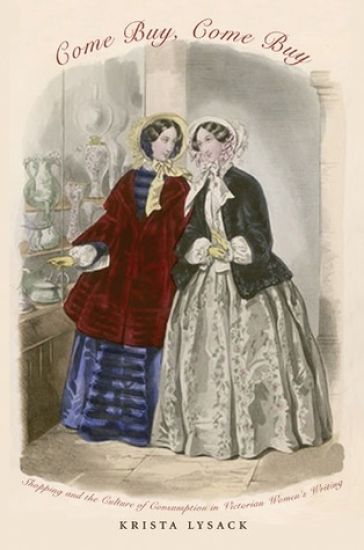
From the 1860s through the early twentieth century, Great Britain saw the rise of the department store and the institutionalization of a gendered sphere of consumption. Come Buy, Come Buy considers representations of the female shopper in British women's writing and demonstrates how women's shopping practices are materialized as forms of narrative, poetic, and cultural inscription, showing how women writers emphasize consumerism as productive of pleasure rather than the condition of seduction or loss. Krista Lysack examines works by Christina Rossetti, Mary Elizabeth Braddon, George Eliot, and Michael Field, as well as the suffragette newspaper Votes for Women, in order to challenge the dominant construction of Victorian femininity as characterized by self-renunciation and the regulation of appetite. Come Buy, Come Buy considers not only literary works, but also a variety of archival sources (shopping guides, women's fashion magazines, household management guides, newspapers, and advertisements) and cultural practices (department store shopping, shoplifting and kleptomania, domestic economy, and suffragette shopkeeping). With this wealth of sources, Lysack traces a genealogy of the woman shopper from dissident domestic spender to aesthetic connoisseur, from curious shop-gazer to political radical.
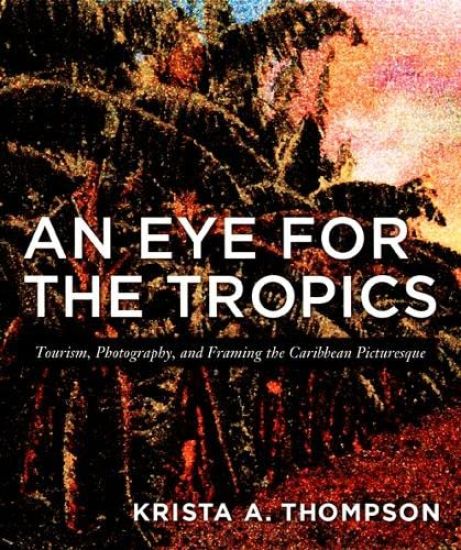
Images of Jamaica and the Bahamas as tropical paradises full of palm trees, white sandy beaches, and inviting warm water seem timeless. Surprisingly, the origins of those images can be traced back to the roots of the islands’ tourism industry in the 1880s. As Krista A. Thompson explains, in the late nineteenth century, tourism promoters, backed by British colonial administrators, began to market Jamaica and the Bahamas as picturesque “tropical” paradises. They hired photographers and artists to create carefully crafted representations, which then circulated internationally via postcards and illustrated guides and lectures.Illustrated with more than one hundred images, including many in color, An Eye for the Tropics is a nuanced evaluation of the aesthetics of the “tropicalizing images” and their effects on Jamaica and the Bahamas. Thompson describes how representations created to project an image to the outside world altered everyday life on the islands. Hoteliers imported tropical plants to make the islands look more like the images. Many prominent tourist-oriented spaces, including hotels and famous beaches, became off-limits to the islands’ black populations, who were encouraged to act like the disciplined, loyal colonial subjects depicted in the pictures.Analyzing the work of specific photographers and artists who created tropical representations of Jamaica and the Bahamas between the 1880s and the 1930s, Thompson shows how their images differ from the English picturesque landscape tradition. Turning to the present, she examines how tropicalizing images are deconstructed in works by contemporary artists-including Christopher Cozier, David Bailey, and IrÉnÉe Shaw-at the same time that they remain a staple of postcolonial governments’ vigorous efforts to attract tourists.