

Kirjahaku
Etsi kirjoja tekijän nimen, kirjan nimen tai ISBN:n perusteella.
1000 tulosta hakusanalla Kurt Jahn-Nottebohm

Kurt Diemberger's candour and powerful writing is fully displayed in this omnibus, which brings together his three main works: Summits and Secrets, The Endless Knot and Spirits of the Air. One of the survivors of the harrowing 1986 K2 disaster, Diemberger is a master storyteller and voice of optimism.

Cv/VAR 156 presents a study by Anne Blood the pioneering artist Kurt Schwitters (b. June 20, 1887, Hannover, d.January 8 1948 Lendal) which reviews an exhibition 'Kurt Schwitters in Britain at Tate Britain, January to May 2013.

In a world where vampires, werewolves, and other wild beasts are disguised as humans, Kurt Danger... just wants to drink his whiskey in peace. His days of hunting monsters are far behind him. Or are they? There's a little girl that needs saving, a young vampire with an old vendetta, and an old friend from his past who just needs one more favor. What will this jaded old man do when he has to choose between living miserably as a broken-hearted alcoholic or help salvage the future?



Typical Cynical: A Collection of Short Stories by Kurt Vonnegut plus Selections from A Cynic's Word Book by Ambrose Bierce
Kurt Vonnegut; Ambrose Bierce; Thor P. Doe
Createspace Independent Publishing Platform
2017
nidottu
Stuck in your feelings? You're not the only one. "Typical Cynical" is the first creation from breakout author Thor P. Doe. Explore the depths of 20th Century cynicism with three selections of short stories by author Kurt Vonnegut. Stories include: "The Big Trip Up Yonder", "2 B R 0 2 B", and "Harrison Bergeron". Thor P. Doe also includes a careful selection of delightful words from "A Cynic's Word Book" by Ambrose Bierce.
Kurt Gödel
Springer Nature Switzerland AG
2021
sidottu
Paris of the year 1900 left two landmarks: the Tour Eiffel, and David Hilbert's celebrated list of twenty-four mathematical problems presented at a conference opening the new century. Kurt Gödel, a logical icon of that time, showed Hilbert's ideal of complete axiomatization of mathematics to be unattainable. The result, of 1931, is called Gödel's incompleteness theorem. Gödel then went on to attack Hilbert's first and second Paris problems, namely Cantor's continuum problem about the type of infinity of the real numbers, and the freedom from contradiction of the theory of real numbers. By 1963, it became clear that Hilbert's first question could not be answered by any known means, half of the credit of this seeming faux pas going to Gödel. The second is a problem still wide open. Gödel worked on it for years, with no definitive results; The best he could offer was a start with the arithmetic of the entire numbers. This book, Gödel's lectures at the famous Princeton Institute for Advanced Study in 1941, shows how far he had come with Hilbert's second problem, namely to a theory of computable functionals of finite type and a proof of the consistency of ordinary arithmetic. It offers indispensable reading for logicians, mathematicians, and computer scientists interested in foundational questions. It will form a basis for further investigations into Gödel's vast Nachlass of unpublished notes on how to extend the results of his lectures to the theory of real numbers. The book also gives insights into the conceptual and formal work that is needed for the solution of profound scientific questions, by one of the central figures of 20th century science and philosophy.
Kurt Gödel
Springer Nature Switzerland AG
2022
nidottu
Paris of the year 1900 left two landmarks: the Tour Eiffel, and David Hilbert's celebrated list of twenty-four mathematical problems presented at a conference opening the new century. Kurt Gödel, a logical icon of that time, showed Hilbert's ideal of complete axiomatization of mathematics to be unattainable. The result, of 1931, is called Gödel's incompleteness theorem. Gödel then went on to attack Hilbert's first and second Paris problems, namely Cantor's continuum problem about the type of infinity of the real numbers, and the freedom from contradiction of the theory of real numbers. By 1963, it became clear that Hilbert's first question could not be answered by any known means, half of the credit of this seeming faux pas going to Gödel. The second is a problem still wide open. Gödel worked on it for years, with no definitive results; The best he could offer was a start with the arithmetic of the entire numbers. This book, Gödel's lectures at the famous Princeton Institute for Advanced Study in 1941, shows how far he had come with Hilbert's second problem, namely to a theory of computable functionals of finite type and a proof of the consistency of ordinary arithmetic. It offers indispensable reading for logicians, mathematicians, and computer scientists interested in foundational questions. It will form a basis for further investigations into Gödel's vast Nachlass of unpublished notes on how to extend the results of his lectures to the theory of real numbers. The book also gives insights into the conceptual and formal work that is needed for the solution of profound scientific questions, by one of the central figures of 20th century science and philosophy.
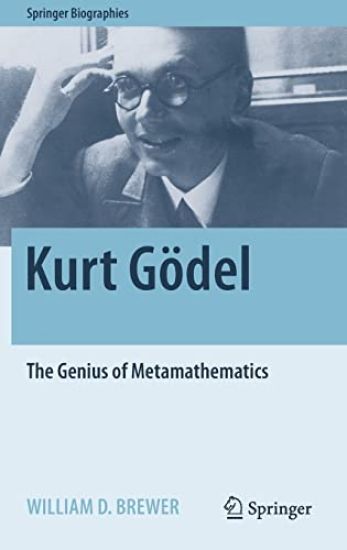
During his lifetime, Kurt Gödel was not well known outside the professional world of mathematicians, philosophers and theoretical physicists. Early in his career, for his doctoral thesis and then for his Habilitation (Dr.Sci.), he wrote earthshaking articles on the completeness and provability of mathematical-logical systems, upsetting the hypotheses of the most famous mathematicians/philosophers of the time. He later delved into theoretical physics, finding a unique solution to Einstein’s equations for gravity, the ‘Gödel Universe’, and made contributions to philosophy, the guiding theme of his life. This book includes more details about the context of Gödel’s life than are found in earlier biographies, while avoiding an elaborate treatment of his mathematical/scientific/philosophical works, which have been described in great detail in other books. In this way, it makes him and his times more accessible to general readers, and will allow them to appreciate the lasting effects of Gödel’s contributions (the latter in a more up-to-date context than in previous biographies, many of which were written 15–25 years ago). His work spans or is relevant to a wide spectrum of intellectual endeavor, and this is emphasized in the book, with recent examples. This biography also examines possible sources of his unusual personality, which combined mathematical genius with an almost childlike naiveté concerning everyday life, and striking scientific innovations with timidity and hesitancy in practical matters. How he nevertheless had a long and successful career, inspiring many younger scholars along the way, with the help of his loyal wife Adele and some of his friends, is a fascinating story in human nature.

During his lifetime, Kurt Gödel was not well known outside the professional world of mathematicians, philosophers and theoretical physicists. Early in his career, for his doctoral thesis and then for his Habilitation (Dr.Sci.), he wrote earthshaking articles on the completeness and provability of mathematical-logical systems, upsetting the hypotheses of the most famous mathematicians/philosophers of the time. He later delved into theoretical physics, finding a unique solution to Einstein’s equations for gravity, the ‘Gödel Universe’, and made contributions to philosophy, the guiding theme of his life. This book includes more details about the context of Gödel’s life than are found in earlier biographies, while avoiding an elaborate treatment of his mathematical/scientific/philosophical works, which have been described in great detail in other books. In this way, it makes him and his times more accessible to general readers, and will allow them to appreciate the lasting effects of Gödel’s contributions (the latter in a more up-to-date context than in previous biographies, many of which were written 15–25 years ago). His work spans or is relevant to a wide spectrum of intellectual endeavor, and this is emphasized in the book, with recent examples. This biography also examines possible sources of his unusual personality, which combined mathematical genius with an almost childlike naiveté concerning everyday life, and striking scientific innovations with timidity and hesitancy in practical matters. How he nevertheless had a long and successful career, inspiring many younger scholars along the way, with the help of his loyal wife Adele and some of his friends, is a fascinating story in human nature.
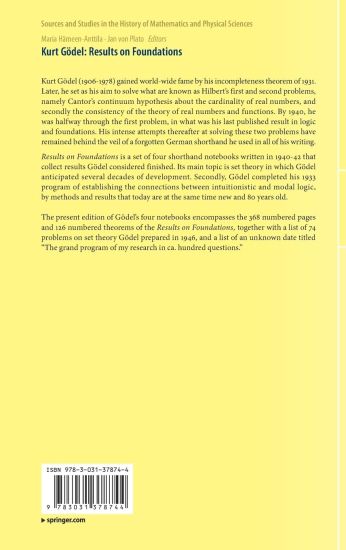
Kurt Gödel: Results on Foundations
Springer International Publishing AG
2023
sidottu
Kurt Gödel (1906-1978) gained world-wide fame by his incompleteness theorem of 1931. Later, he set as his aim to solve what are known as Hilbert's first and second problems, namely Cantor's continuum hypothesis about the cardinality of real numbers, and secondly the consistency of the theory of real numbers and functions. By 1940, he was halfway through the first problem, in what was his last published result in logic and foundations. His intense attempts thereafter at solving these two problems have remained behind the veil of a forgotten German shorthand he used in all of his writing. Results on Foundations is a set of four shorthand notebooks written in 1940-42 that collect results Gödel considered finished. Its main topic is set theory in which Gödel anticipated several decades of development. Secondly, Gödel completed his 1933 program of establishing the connections between intuitionistic and modal logic, by methods and results that today are at the same time new and 80 years old.The present edition of Gödel's four notebooks encompasses the 368 numbered pages and 126 numbered theorems of the Results on Foundations, together with a list of 74 problems on set theory Gödel prepared in 1946, and a list of an unknown date titled "The grand program of my research in ca. hundred questions.''

Zu seinen Lebzeiten war Kurt Gödel außerhalb der Fachwelt der Mathematiker, Philosophen und theoretischen Physiker kaum bekannt. Zu Beginn seiner Karriere schuf er beeindruckende Arbeiten zur Vollständigkeit und Beweisbarkeit formaler logischer Systeme, die zu seiner Dissertation und seiner Habilitations-schrift wurden und ihn unter Fachleuten weltberühmt machten. Seine Unvoll-ständigkeitssätze läuteten das Ende der formal-logischen Programme der Logizisten (Russell et al.) und der Formalisten (Hilbert et al.) ein. Später erzielte er auch signifikante Ergebnisse in der Mengenlehre. Nach seiner Emigration in die USA (Princeton), widmete er sich mehr der Philosophie, dem Leitmotiv seines Lebens, und er fand auch eine einzigartige Lösung zu Einsteins Feld-gleichungen der Gravitation, sein “Gödel-Universum“. Dieses Buch beschreibt sowohl den Gödel, der ein genialer Wissenschaftler war, und der gewagte und neuartige Hypothesen zu den Fundamenten der Mathe-matik und Physik hervorbrachte, - als auch den Gödel, der ein perfekter Rationalist war, aber sein Alltagsleben nur mit Mühe meistern konnte und zeitlebens unter Depressionen, Angstneurosen und Hypochondrie litt. Ein Leben voller Paradoxen, in dem er trotz all seiner psychischen Probleme Beachtliches leistete und zu einem Vorbild für viele jüngere Wissenschaftler wurde. Das Buch liefert den Kontext zu seinen Errungenschaften, die ein verblüffend breites Spektrum intellektueller Unternehmungen darstellen, und zu seiner zunehmenden Geisteskrankheit; und es zeigt, wie er eine lange und erfolgreiche Karriere mit Hilfe seiner loyalen Ehefrau Adele und einigen seiner Freunde durchlaufen konnte. Dies ist eine faszinierende Geschichte der wissen-schaftlichen Genialität und der menschlichen Natur.

Kurt Gödel
Springer Basel
2011
nidottu
Kurt Gödel, together with Bertrand Russell, is the most important name in logic, and in the foundations and philosophy of mathematics of this century. However, unlike Russel, Gödel the mathematician published very little apart from his well-known writings in logic, metamathematics and set theory. Fortunately, Gödel the philosopher, who devoted more years of his life to philosophy than to technical investigation, wrote hundreds of pages on the philosophy of mathematics, as well as on other fields of philosophy. It was only possible to learn more about his philosophical works after the opening of his literary estate at Princeton a decade ago. The goal of this book is to make available to the scholarly public solid reconstructions and editions of two of the most important essays which Gödel wrote on the philosophy of mathematics. The book is divided into two parts. The first provides the reader with an incisive historico-philosophical introduction to Gödel's technical results and philosophical ideas. Written by the Editor, this introductory apparatus is not only devoted to the manuscripts themselves but also to the philosophical context in which they were written. The second contains two of Gödel's most important and fascinating unpublished essays: 1) the Gibbs Lecture ("Some basic theorems on the foundations of mathematics and their philosophical implications", 1951); and 2) two of the six versions of the essay which Gödel wrote for the Carnap volume of the Schilpp series The Library of Living Philosophers ("Is mathematics syntax of language?", 1953-1959).





Keine ausf hrliche Beschreibung f r "SCHWABE: PHYSIKALISCHE CHEMIE BD 1 2A PHYSCH" verf gbar.

Mit seiner Feldtheorie revolutionierte der deutsch-jüdische Sozialpsychologe Kurt Lewin (1890-1947) die zeitgenössische Psychologie. Indem er erstmalig die komplexe Beziehung zwischen einer Person und ihrer Umwelt im Experiment befragte, legte Lewin den Grundstein für die bis heute wirkmächtige Psycho- und Soziotechnik der Gruppendynamik und avancierte zum Pionier eines demokratischen Social Engineering. In ihrer Studie zu Lewins Psychologie des Feldes rekonstruiert Nora Binder deren Entstehungskontexte und Anwendungsfelder. Dabei spannt sie einen Bogen von den frühen Überlegungen Lewins auf den Schlachtfeldern des Ersten Weltkriegs (1917) über die Formulierung der Feldtheorie in Berlin (1918-1933) bis hin zu den ersten gruppenpsychologischen Experimenten in den USA (1933-1947), der Action Research.