The Life, Letters and Work of Frederic Leighton. Volume II, has been regarded as significant work throughout human history, and in order to ensure that this work is never lost, we have taken steps to ensure its preservation by republishing this book in a contemporary format for both current and future generations. This entire book has been retyped, redesigned, and reformatted. Since these books are not made from scanned copies, the text is readable and clear.
The Life, Letters and Work of Frederic Leighton. Volume I, has been regarded as significant work throughout human history, and in order to ensure that this work is never lost, we have taken steps to ensure its preservation by republishing this book in a contemporary format for both current and future generations. This entire book has been retyped, redesigned, and reformatted. Since these books are not made from scanned copies, the text is readable and clear.
This book has been considered by academicians and scholars of great significance and value to literature. This forms a part of the knowledge base for future generations. So that the book is never forgotten we have represented this book in a print format as the same form as it was originally first published. Hence any marks or annotations seen are left intentionally to preserve its true nature.
"The Leighton Homestead" is a novel written by Mary Jane Holmes and published in 1866. The book tells the story of Edna Browning, a young woman who inherits a farm from her deceased father. The farm, known as the Leighton Homestead, is located in a small rural town and is in need of repair and upkeep. Edna moves to the farm and begins to work to restore it to its former glory. Along the way, she meets and falls in love with a local farmer, John Leighton. However, their love is complicated by the fact that John is engaged to another woman. The novel explores themes of love, family, and perseverance, as Edna works to overcome the challenges of running a farm and navigating the complexities of romantic relationships. It's a heartwarming story that offers a glimpse into rural life in 19th-century America.
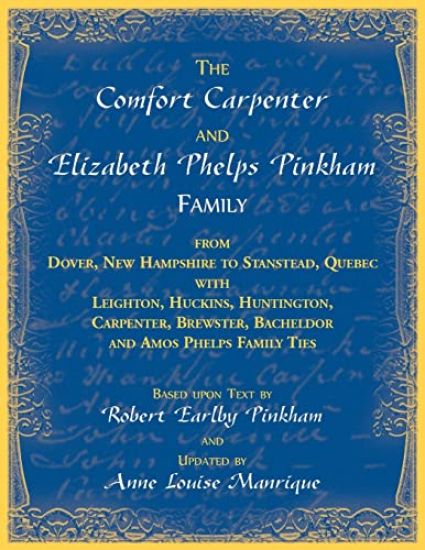
Richard Pyncombe (Richard Pinkham after his arrival to Dover) was born 7 November 1613 in Alvington, Devonshire, England and died in June 1681 in Dover, Strafford County, New Hampshire. He became "Generation 1" of the North American Dover, New Hampshire Pinkham line. Richard Pinkham was one of the first settlers of Dover, New Hampshire and signed the charter of New Hampshire, a document believed to be a foundation study for the Declaration of Independence.This detailed family history covers eleven generations and encompasses: Richard Pinkham (Generation 1), Richard Pinkham (Generation 2), Thomas Pinkham (Generation 3), Abijah Thomas Pinkham (Generation 4), Children of Abijah and Rachel (Huckins) Pinkham (Generation 5) including Samuel Pinkham Senior (Generation 5), Children of Samuel and Dorothy (Ordway) Pinkham (Generation 6) including Joseph, Samuel G. Junior and Abijah Pinkham (Generation 6), Children of Joseph Pinkham (Generation 7), Children of Abijah and Hannah (Sleeper) Pinkham (Generation 7), Children of Samuel G. Junior and Theodocia (Carpenter) Pinkham (Generation 7) including Comfort Carpenter Pinkham and siblings, the connection between the Pinkham and Phelps families, research upon the Amos and Diadama (Long) Phelps family including son, Amos B. Phelps Junior who died during the War of 1812, research upon Elizabeth Phelps' brother, Amos Phelps III, Children of Comfort and Elizabeth (Phelps) Pinkham (Generation 8), Children of John Wesley and Sarah (Irwin) Pinkham (Generation 9), Children of Lawrence Mowbray and Annie (Gordon) Pinkham (Generation 10), Children of Robert Earlby and Margaret (Milne) Pinkham (Generation 11) with a Daughters of the American Revolution certificate for Anne Louise Manrique (Generation 12) and a list of over ninety Phelps surnamed Eastern Townships of Quebec residents during the early 1800s.2022, 81/2x11, paper, 302 pp.
The primary aim of this book is to provide a text for economics students which gives a good balance between statistics and econometrics.The intention is to prepare students for an introductory course in econometrics, while instilling a clear understanding of statistics. It is suitable for first or second year courses in Introductory Statistics or Introductory Statistics and Econometrics on economics degrees. The book is characterized by Leighton Thomas’ clear style of explanation, gained through 35 years of teaching experience.
Security Controls Evaluation, Testing, and Assessment Handbook provides a current and well-developed approach to evaluation and testing of security controls to prove they are functioning correctly in today's IT systems. This handbook shows you how to evaluate, examine, and test installed security controls in the world of threats and potential breach actions surrounding all industries and systems. If a system is subject to external or internal threats and vulnerabilities - which most are - then this book will provide a useful handbook for how to evaluate the effectiveness of the security controls that are in place. Security Controls Evaluation, Testing, and Assessment Handbook shows you what your security controls are doing and how they are standing up to various inside and outside threats. This handbook provides guidance and techniques for evaluating and testing various computer security controls in IT systems. Author Leighton Johnson shows you how to take FISMA, NIST Guidance, and DOD actions and provide a detailed, hands-on guide to performing assessment events for information security professionals who work with US federal agencies. As of March 2014, all agencies are following the same guidelines under the NIST-based Risk Management Framework. This handbook uses the DOD Knowledge Service and the NIST Families assessment guides as the basis for needs assessment, requirements, and evaluation efforts for all of the security controls. Each of the controls can and should be evaluated in its own unique way, through testing, examination, and key personnel interviews. Each of these methods is discussed.
Security Controls Evaluation, Testing, and Assessment Handbook, Second Edition, provides a current and well-developed approach to evaluate and test IT security controls to prove they are functioning correctly. This handbook discusses the world of threats and potential breach actions surrounding all industries and systems. Sections cover how to take FISMA, NIST Guidance, and DOD actions, while also providing a detailed, hands-on guide to performing assessment events for information security professionals in US federal agencies. This handbook uses the DOD Knowledge Service and the NIST Families assessment guides as the basis for needs assessment, requirements and evaluation efforts.
Captain Jack is a three level pre-primary course, designed to teach English to 3-6 year olds in Spain. The course follows a story-based approach with a variety of age-appropriate activities. Worksheet activities are designed to develop children's motor skills and their cognitive skills with more challenging activities, such as matching, circling and sequencing. Early maths and early literacy skills are also worked on, which helps develop children's linguistic competences. The materials address the whole child and tie in closely with the new educational law in Spain. The syllabus covers vocabulary topics that relate to young learners' immediate environment, and the stories take place within surroundings familiar to children. The syllabus also covers areas of CLIL (Content Language Integrated Learning) to make children more aware of the world around them. The inclusion of photos in the material help to serve this purpose as well. There is also a light introduction to phonics. Captain Jack is designed for the same market as previous Macmillan Infantil courses for Spain i.e. Robby Rabbit, Patch and Cheeky Monkey.The main difference with this course from previous courses is the new PLUS book which includes two additional units for schools with more hours.
Captain Jack is a three level pre-primary course, designed to teach English to 3-6 year olds in Spain. The course follows a story-based approach with a variety of age-appropriate activities. Worksheet activities are designed to develop children's motor skills and their cognitive skills with more challenging activities, such as matching, circling and sequencing. Early maths and early literacy skills are also worked on, which helps develop children's linguistic competences. The materials address the whole child and tie in closely with the new educational law in Spain. The syllabus covers vocabulary topics that relate to young learners' immediate environment, and the stories take place within surroundings familiar to children. The syllabus also covers areas of CLIL (Content Language Integrated Learning) to make children more aware of the world around them. The inclusion of photos in the material help to serve this purpose as well. There is also a light introduction to phonics. Captain Jack is designed for the same market as previous Macmillan Infantil courses for Spain i.e. Robby Rabbit, Patch and Cheeky Monkey.The main difference with this course from previous courses is the new PLUS book which includes two additional units for schools with more hours.
No diagnosis of mental disorder is more important or more disputable than that of "schizophrenia." The 1982 case of John Hinckley, who shot President Reagan, brought both aspects of this diagnostic dilemma to the forefront of national attention. It became evident to the general public that the experts engaged to study him exhaustively could not agree on whether Hinckley was schizophrenic. General public outrage ensued, as schizophrenia, "the sacred symbol of psychiatry," in the words of Thomas Szasz (1976), emerged as a king of Alice in Wonderland travesty. Schizo phrenia seemed not to be a legitimate diagnostic entity but some sort of facade erected to protect the guilty. In 1973, David Rosenhan had already shown the readers of Science that schizo phrenia was a label that could be given to normal people presenting with a supposed auditory hallucination on even one occasion. In Rosenhan's studies, mental health professionals were outclassed by the regular psychiatric hospital patients, who cor rectly saw the false schizophrenics as imposters while the professional diagnosticians continued to fool themselves.
British Christianity was adapted and modified in colonial environments and helped to shape a growing sense of national identity in Australia, New Zealand, and the Pacific. This chronologically arranged index will identify for scholars documentary sources of the Archbishops of Canterbury and the Anglican Church relevant to Australia, New Zealand, New Guinea, and the other Pacific islands and held in the Lambeth Palace Library's archives. In the 1860s, Archbishops of Canterbury inherited responsibility from the Colonial Office for selecting and nominating colonial bishops. By the turn of the twentieth century, archbishops had become confidantes, counselors, and advisers to bishops overseas. Although the papers and correspondence primarily reflect the ecclesiastical life, they also reflect the social, economic, and political atmosphere of the time, and underscore how vital religious institutions were to the colonial communities' developing sense of unity. The papers' contents are diverse and include, among other topics, information about Aborigines, Australian church and community life, women's roles, immigration issues, imperialism, Protestant Episcopal Church of the United States, and race relations. This index will be a valuable source to scholars and researchers studying social and institutional developments in the former British Empire and Commonwealth. Data is organized chronologically by archbishop. The volume contains two appendices; one listing archbishops of Canterbury, bishops of London, and bishops and archbishops in Australia, New Zealand, and the Pacific, and another listing Lambeth degrees. Separate subject and name indexes are included.
In this short book, Evans interrogates the implications of VR’s re-emergence into the media mainstream, critiquing the notion of a VR revolution by analysing the development and ownership of VR companies while also exploring the possibilities of immersion in VR and the importance of immersion in the interest and ownership of VR enterprises. He assesses how the ideologies and desires of both computer programmers and major Silicon Valley industries may influence how VR worlds are conceived and experienced by users while also exploring the mechanisms that create the immersive experience that underpins interest in the medium.