Kirjojen hintavertailu. Mukana 11 342 296 kirjaa ja 12 kauppaa.

Kirjahaku

Etsi kirjoja tekijän nimen, kirjan nimen tai ISBN:n perusteella.

1000 tulosta hakusanalla Leo Herrmann

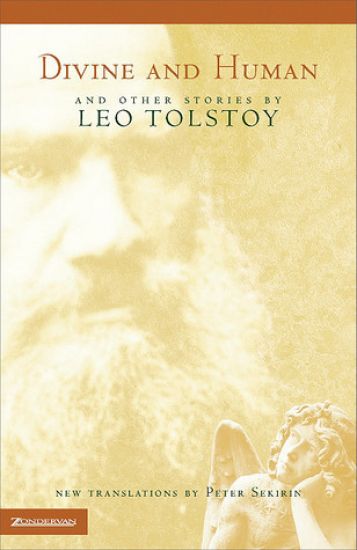
Divine and Human: And Other Stories by Leo Tolstoy

Divine and Human: And Other Stories by Leo Tolstoy

Leo Tolstoy; Peter Sekirin

ZONDERVAN
2000
nidottu
Divine and Human stands apart as both a landmark in literary history and master-piece of spiritual and ethical reflection. Suppressed in turn by the tzarist and Soviet regime, the tales contained in this book have, for the most part, never been published in English until now. Emerging at last, they offer western readers fresh glimpses of novelist and philosopher Leo Tolstoy. Divine and Human consists of choice selections from The Sunday Reading Stories, the second volume in a two-part work titled The Circle of Reading. In the words of translator Peter Sekirin, "Tolstoy considered The Circle of Reading to be the major work of his life. Considering its difficult history, it is not surprising that only recently has it been rediscovered." From its sparkling vignettes to its lengthier stories, Divine and Human probes the complexities of life and faith. Its characters range the spectrum of human emotions and qualities, from hatred to love and joy to grief; from sublime nobility to grotesque self-absorption. Tolstoy's world, though far-removed from today's information age, becomes our world -- indeed, has always been and always will be our world. Motor cars may have replaced horse-drawn cars, but human hearts remain the same, and questions of truth, mercy, forgiveness, devotion, justice, and the nature of God knock as insistently on the doors of our lives today as they did in Tolstoy's time. Welcome, then, to Divine and Human: a buried treasure at last unearthed, and certain to be prized by Tolstoy readers and lovers of great literature.
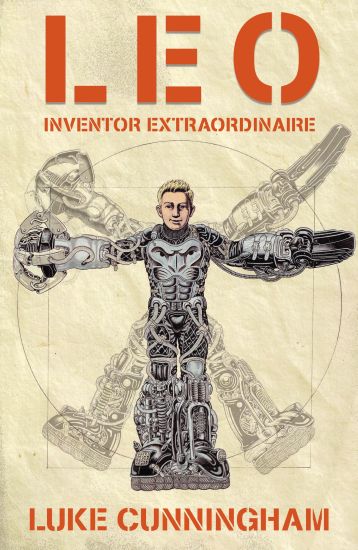
LEO, Inventor Extraordinaire

LEO, Inventor Extraordinaire

Luke Xavier Cunningham

ZonderKidz
2021
sidottu
In order to unlock his family’s past and how he became an orphan, Leo will need every skill and invention he has—even if his inventions don’t always work. This middle-school adventure mystery is perfect for puzzle solvers, as Leodiscovers a series of tunnels below his school filled with clues, riddles andpuzzles to solveabout his identity and his family.A “lifer” at the secluded Academy of Florence, Leo has never met his parents ... or anyone in his family for that matter. His current “family” is his mechanical monkey and robot lion, who along with his charming best friend and fellow lifer, Savvy, only get him into trouble. But after Leo’s latest experiment goes catastrophically wrong, he finds a mysterious clue that opens an underground maze—one that seems to have been created for him to solve.Leo hopes the tunnels will help him discover the identities of his parents and the reason he’s an orphan in the first place. Instead, he finds that his past and possibly even his future is somehow linked to the innovative Wynn Toys company, whose genius president mysteriously disappeared years before.Leo must use his creativity and scientific know-how to revive the toy company, oust its dastardly leader, and discover the fate of his real family.LEO, Inventor Extraordinaire: Is perfect for kids 8 to 12 who enjoy action, adventure, humor, and mystery Is likeThe DaVinci Codefor kids, with robots, wacky inventions, and puzzles to solve Contains almost 60 pieces of original black and white artwork Encourages imagination and the development of STEAM skillsLEO, Inventor Extraordinaire is a Northern Lights Book Awards Winner in the Middle Grade Fiction category for 2021 -- The Northern Lights Book Awards
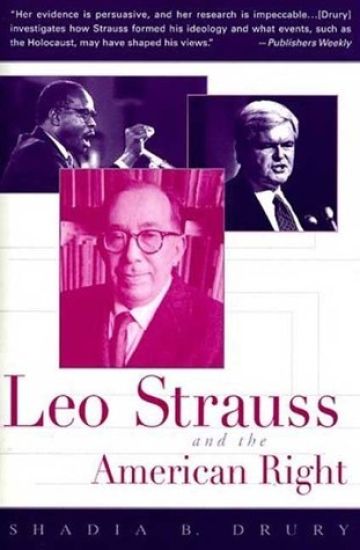
Leo Strauss and the American Right

Leo Strauss and the American Right

Shadia B. Drury

Palgrave Macmillan
1999
nidottu
In 1980 Ronald Reagan was elected President of the United States for his first term and the conservative revolution that was slowly developing in the United States finally emerged in full-throated roar. Who provoked the conservative revolution? Shadia Drury provides a fascinating answer to the question as she looks at the work of Leo Strauss, a seemingly reclusive German Jewish emigr?nd scholar, who was one of the most influential individuals in the conservative movement. Strauss influenced the work of Irving Kristol and Gertrude Himmelfarb, as well as Chief Justice Clarence Thomas and Speaker of the House Newt Gingrich.
Leo The African

Leo The African

Amin Maalouf

Little, Brown Book Group
1994
pokkari
'Leo the African' is based on the true life-story of Hasan al-Wazzan, the 16th-century traveller and writer who came to be known as Leo Africanus, or Leo the African. This is a story of pirates, slave-girls and princesses, in a world in a state of religious flux.
Understanding the Gospel of Jesus Christ according to Leo Tolstoy
During the last 15 or so years of Leo Tolstoy's life, he more concentrated on his interpretation of the Gospels and Jesus' life as applicable to the Russian family, society and state of his era. They would also summarize his ideology from his decades of Bible study. This volume is a compilation of some of his compositions of this era. The first is Exposition of Christ's Teaching for Children, a Sunday School level instruction divided into 52 chapters of Jesus' life and teachings, that Tolstoy compiled for the peasant children of his estate school. Then is his Christian Teaching, aimed primarily for adults. It deals with the sins of the era and creating a better society. Next is the Gospels in Brief, Tolstoy's paraphase of the Gospels in chronological order, and which formed the bases for the children's lessons. The final two are Love One Another and Believe in Yourself, that Tolstoy wrote for the young audience. Daniel H. Shubin has translated much of Tolstoy and other Russian writers into English.
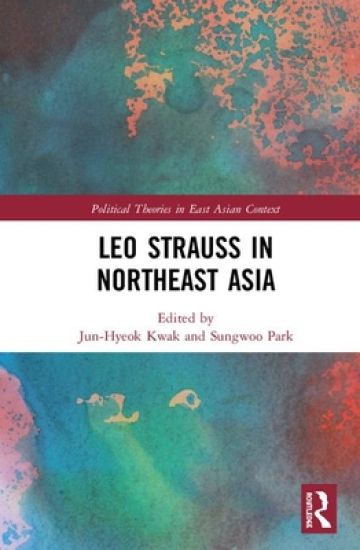
Leo Strauss in Northeast Asia
This book analyzes the reception of Leo Strauss and his political philosophy in Northeast Asia. By juxtaposing the central idea of Strauss’s political philosophy with the question of modernity, the contributors explore the eclectic adaptations of Strauss in Northeast Asian countries as a philosophical appropriation across cultures.Examining how Strauss’s philosophy was first introduced in Northeast Asia, the book sheds light on the similarities and differences in experiences, challenging the dominant approach which attributes various receptions of Strauss in Northeast Asia solely to sociopolitical circumstances. This book also seeks to move beyond a China-centric approach to investigate the possible transcultural appeals of Strauss’s political philosophy by exploring the cases of Japan and South Korea.Appealing to a wide network of scholars and practitioners in East Asia engaged in rethinking cultural particularities, this volume will be attractive to upper-level undergraduate students, graduate students, and advanced researchers in political philosophy, political theory, and Asian politics.
Leo the Great

Leo the Great

Bronwen Neil

Routledge
2009
sidottu
Pope Leo I’s theological and political influence in his own time (440-461) and beyond far outweighs the amount of attention he has received in recent scholarship. That influence extended well beyond Rome to the Christian East through his contribution to preparations for the Council of Chalcedon and its outcome. For this he was alternately praised and vilified by the opposing parties at the Council. Leo made his views known through letters, and a vast number of homilies. While so many of these survive, Leo and his works have not been the subject of a major English-language socio-historical study in over fifty years. In this brief introduction to the life and works of this important leader of the early church, we gain a more accurate picture of the circumstances and pressures which were brought to bear on his pontificate. A brief introduction surveys the scanty sources which document Leo’s early life, and sets his pontificate in its historical context, as the Western Roman Empire went into serious decline, and Rome lost its former status as the western capital. Annotated translations of various excerpts of Leo’s letters and homilies are organised around four themes dealing with specific aspects of Leo’s activity as bishop of Rome: Leo as spiritual adviser on the life of the faithful Leo as opponent of heresy the bishop of Rome as civic and ecclesiastical administrator Leo and the primacy of Rome.Taking each of these key elements of Leo’s pontifical activities into account, we gain a more balanced picture of the context and contribution of his best-known writings on Christology. This volume offers an affordable introduction to the subject for both teachers and students of ancient and medieval Christianity.
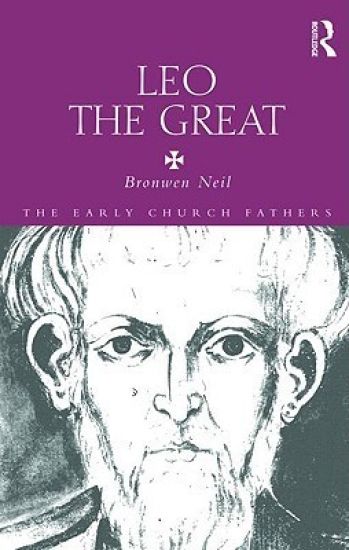
Leo the Great

Leo the Great

Bronwen Neil

Routledge
2009
nidottu
Pope Leo I’s theological and political influence in his own time (440-461) and beyond far outweighs the amount of attention he has received in recent scholarship. That influence extended well beyond Rome to the Christian East through his contribution to preparations for the Council of Chalcedon and its outcome. For this he was alternately praised and vilified by the opposing parties at the Council. Leo made his views known through letters, and a vast number of homilies. While so many of these survive, Leo and his works have not been the subject of a major English-language socio-historical study in over fifty years. In this brief introduction to the life and works of this important leader of the early church, we gain a more accurate picture of the circumstances and pressures which were brought to bear on his pontificate. A brief introduction surveys the scanty sources which document Leo’s early life, and sets his pontificate in its historical context, as the Western Roman Empire went into serious decline, and Rome lost its former status as the western capital. Annotated translations of various excerpts of Leo’s letters and homilies are organised around four themes dealing with specific aspects of Leo’s activity as bishop of Rome: Leo as spiritual adviser on the life of the faithful Leo as opponent of heresy the bishop of Rome as civic and ecclesiastical administrator Leo and the primacy of Rome.Taking each of these key elements of Leo’s pontifical activities into account, we gain a more balanced picture of the context and contribution of his best-known writings on Christology. This volume offers an affordable introduction to the subject for both teachers and students of ancient and medieval Christianity.
Leo Strauss and the Invasion of Iraq
The political philosophy of Leo Strauss has been the subject of significant scholarly and media attention in recent years, particularly in the context of the decision to invade Iraq in 2003. Allegations that a group of Strauss-inspired Neo-conservatives intervened in the foreign policy establishment of the US in order to realise the policy of 'regime change' began to emerge soon after the invasion, and unanswered questions remain a decade later.This book addresses these claims, focusing specifically on a group of Straussians active in the spheres of intelligence production, think tanks, and the media during the period from the 9/11 attacks to the invasion in 2003. Such an examination is intended not simply to identify and expose their activities promoting the policy of 'regime change' in Iraq during this period, but also to challenge them and the Straussian logics underpinning them. Utilising the thought of Jacques Derrida, the book enacts a deconstructive challenge to Strauss’ political philosophy which unsettles the fundamental assumptions it relies upon. In doing so, it exposes the securitising imperative underpinning Straussian thought and the Straussian interventions. It thereby simultaneously addresses crucial issues in political theory and contemporary foreign policy studies, while asserting that these dimensions of international politics can and should be dealt with in conjunction with each other.This book would be of interest to students and scholars of Global Politics, Political Theory, Security Studies and US Foreign Policy, and those outside the academy interested in Neo-conservatism and the 2003 invasion of Iraq.
Leo Melamed

Leo Melamed

Leo Melamed

John Wiley Sons Inc
1996
sidottu
Acclaim for Leo Melamed Escape to the Futures "A well-written, fascinating memoir of a remarkable man of many parts, who arrived in the United States at age 9, fleeing the Holocaust. Almost single-handedly, he transformed a minor commodity exchange into the leading futures market in the world. His influence was and remains worldwide." —Milton Friedman Senior Research Fellow Hoover Institution, Stanford University "There are only a few people who have revolutionized big portions of the business world. Warren Buffett did it in investing, Bill Gates in software. Leo Melamed, author of this book, is in that same league. He truly revolutionized futures trading in the United States, and in the world. This book tells how." —Ambassador Clayton Yeutter Past President of the Chicago Mercantile Exchange Former U.S. Trade Representative "A grizzled old Merc trader once assured me that nobody ever lost by being long on Leo. Why that's so, this endlessly fascinating personal history makes clear. It shows how an immigrant boy, after surviving unimaginable horrors, drew on the 'elan, combativeness, and sophisticated conviction' learned from his equally remarkable father to build the CME and to lay the foundations of the modern, Chicago-based, financial services industry." — Merton H. Miller 1990 Nobel Laureate Emeritus Professor University of Chicago Graduate School of Business "Leo tells it all. To say there would not have been a financial futures industry without Leo is probably only a slight exaggeration!!!" — John Damgard President Futures Industry Association "Escape to the Futures tells the remarkable story of a young boy's escape from the Nazis and the impact of his life on the financial markets of the world. It also serves as yet another poignant reminder of the immeasurable losses —in the arts, sciences, professions, and everyday life—humanity suffered because of the Holocaust." — Benjamin Meed President American Gathering of Jewish Holocaust Survivors He is one of the most powerful figures in the world of finance—a visionary who pioneered the modern futures industry and launched the International Monetary Market (IMM). Yet, Leo Melamed was not born to wealth and influence. His is an extraordinary rags-to-riches tale of intelligence, drive, savvy, timing, and the overpowering force of a uniquely charismatic personality. Now the inside story of the remarkable life and career of Leo Melamed is revealed in this long-awaited autobiography. A Holocaust survivor, Leo Melamed had barely begun the first grade in 1939 when he and his parents fled their native Poland one step ahead of the oncoming Nazi juggernaut. Crossing Siberia en route to a brief stay in Japan—just months before Pearl Harbor—the family arrived in the United States to begin life anew. They settled in Chicago, where young Leo became a product of the inner city and embraced his new country and its culture. Seeking part-time employment while attending law school, Leo Melamed answered a classified ad that would change his life. Hired by what he presumed was a law firm named Merrill, Lynch, Pierce, Fenner & Bean, he found himself on the floor of the Chicago Mercantile Exchange. "I was Alice stepping through the Looking Glass into a world of not just one Mad Hatter, but hundreds. The shouting among the traders, the movement of their bodies and hands, captivated me like nothing before . . . there was a life force on that floor that was magical and exciting, and though I didn't understand what was going on, I wanted to be a part of it." Leo Melamed became much more than just a part of it. From modest beginnings as a pork belly trader, he led the Chicago Merc for the next quarter of a century, introducing finance to an industry that was the exclusive domain of agriculture. As his reputation as a financial genius grew, so did the tales of his larger-than-life personality. In Leo Melamed: Escape to the Futures, you'll meet the man behind the legend. Written with the assistance of award-winning journalist Bob Tamarkin, this enthralling memoir deftly weaves intimate personal details with behind-the-scenes accounts of some of the most momentous financial events of our century—including Leo's role as advisor to the White House after the Hillary Rodham Clinton cattle futures trading episode. You'll read fascinating accounts of his dealings with political powerhouses like Bob Dole, Tip O'Neill, Dan Rostenkowski, and others. Offering penetrating insights into the workings of a multibillion dollar industry, this is a story that has as much to say about human nature as it does about the nature of today's markets. Hailed as both hero and tyrant, Leo Melamed is undeniably one of the most colorful and intriguing personalities of our time. This intimate, revealing personal account is not to be missed.
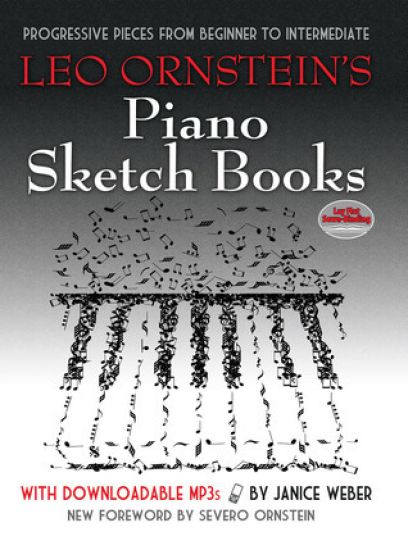
Leo Ornstein's Piano Sketch Books

Leo Ornstein's Piano Sketch Books

Leo Ornstein; Severo Ornstein

Dover Publications Inc.
2014
nidottu
Leo Ornstein's Piano Sketch Books brings together re-prints of Vol. I and Vol. II of Leo Ornstein's original Piano Sketch Book, first published between 1939 and 1945.Beginning pianists will rejoice in this collection of original, fun-to-play pieces by the noted American composer. The melodies featured in Leo Ornstein's Piano Sketch Books provide an interesting and positive musical experience while building technical skills and sight reading. The songs start simply and incrementally, adding more complexity as students progress through the book.Virtuoso pianist Janice Weber provides additional guidance, and the collection comes with a separate MP3 download for each of the eighty-three pieces.This book includes My Little Boat Is Sailing, Let's Go Skating, The Lonely Cowboy, The Viking Song and many other playful tunes.
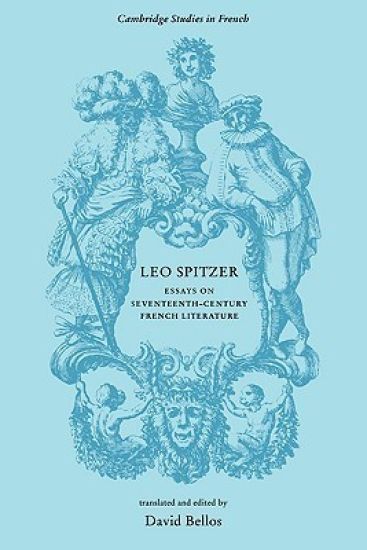
Leo Spitzer

Leo Spitzer

Cambridge University Press
2009
pokkari
The undisputed master of stylistic criticism, Leo Spitzer combined phenomenal learning in historical and comparative linguistics with brilliant and original critical insight. He was born in Vienna in 1887. He studied Romance Philology at the Universities of Vienna and Paris and then taught at Vienna, Bonn, Marburg and Cologne. After escaping from Germany in 1933, he taught briefly at Istanbul and then at The Johns Hopkins University in Baltimore. He died in 1960. He was the author of over 800 books, articles, reviews and notes on the language and literatures of France, Spain, Italy, Portugal, Romania, Germany, England and America from the Middle Ages to the twentieth century. This translation brings together for the first time in any language all of Spitzer's work on the literature of seventeenth-century France, including 'Racine's classical piano' (1928) and 'Saint-Simon's portrait of Louis XIV' (1928). Each of the essays demonstrates in practical rather than theoretical terms the essential unity of literary and linguistic study. David Bellos's introduction sets Spitzer's method of textual and stylistic interpretation in its historical context and sketches out the career of this supremely knowledgeable reader for whom knowledge was less important than understanding.
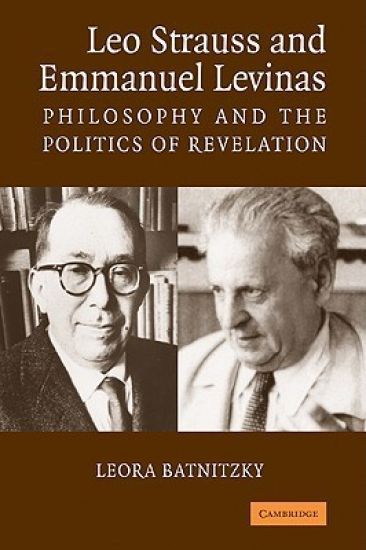
Leo Strauss and Emmanuel Levinas

Leo Strauss and Emmanuel Levinas

Leora Batnitzky

Cambridge University Press
2007
pokkari
Leo Strauss and Emmanuel Levinas, two twentieth-century Jewish philosophers and two extremely provocative thinkers whose reputations have grown considerably, are rarely studied together. This is due to the disparate interests of many of their intellectual heirs. Strauss has influenced political theorists and policy makers on the right while Levinas has been championed in the humanities by different cadres associated with postmodernist thought. In Leo Strauss and Emmanuel Levinas: Philosophy and the Politics of Revelation, first published in 2006, Leora Batnitzky brings together these two seemingly incongruous contemporaries, demonstrating that they often had the same philosophical sources and their projects had many formal parallels. While such a comparison is valuable in itself for better understanding each figure, it also raises profound questions in the debate on the definitions of 'religion', suggesting ways that religion makes claims on both philosophy and politics.
Leo Strauss and the Theologico-Political Problem

Leo Strauss and the Theologico-Political Problem

Meier Heinrich

Cambridge University Press
2006
pokkari
This book, by one of the most prominent interpreters of Leo Strauss's thought, was the first to address the problem that Leo Strauss himself said was the theme of his studies: the theologico-political problem or the confrontation with the theological and the political alternative to philosophy as a way of life. In his theologico-political treatise, which comprises four parts and an appendix, Heinrich Meier clarifies the distinction between political theology and political philosophy and reappraises the unifying center of Strauss's philosophical enterprise. The book is the culmination of Meier's work on the theologico-political problem. It will interest anyone who seeks to understand both the problem caused by revelation for philosophy and the challenge posed by political-religious radicalism. The appendix makes available for the first time two lectures by Strauss that are immediately relevant to the subject of this book and that will open the way for future research and debate on the legacy of Strauss.
Leo Strauss and the Theologico-Political Problem

Leo Strauss and the Theologico-Political Problem

Heinrich Meier

Cambridge University Press
2006
sidottu
This book, by one of the most prominent interpreters of Leo Strauss's thought, was the first to address the problem that Leo Strauss himself said was the theme of his studies: the theologico-political problem or the confrontation with the theological and the political alternative to philosophy as a way of life. In his theologico-political treatise, which comprises four parts and an appendix, Heinrich Meier clarifies the distinction between political theology and political philosophy and reappraises the unifying center of Strauss's philosophical enterprise. The book is the culmination of Meier's work on the theologico-political problem. It will interest anyone who seeks to understand both the problem caused by revelation for philosophy and the challenge posed by political-religious radicalism. The appendix makes available for the first time two lectures by Strauss that are immediately relevant to the subject of this book and that will open the way for future research and debate on the legacy of Strauss.
Leo Strauss and Emmanuel Levinas

Leo Strauss and Emmanuel Levinas

Leora Batnitzky

Cambridge University Press
2006
sidottu
Leo Strauss and Emmanuel Levinas, two twentieth-century Jewish philosophers and two extremely provocative thinkers whose reputations have grown considerably, are rarely studied together. This is due to the disparate interests of many of their intellectual heirs. Strauss has influenced political theorists and policy makers on the right while Levinas has been championed in the humanities by different cadres associated with postmodernist thought. In Leo Strauss and Emmanuel Levinas: Philosophy and the Politics of Revelation, first published in 2006, Leora Batnitzky brings together these two seemingly incongruous contemporaries, demonstrating that they often had the same philosophical sources and their projects had many formal parallels. While such a comparison is valuable in itself for better understanding each figure, it also raises profound questions in the debate on the definitions of 'religion', suggesting ways that religion makes claims on both philosophy and politics.