Kirjojen hintavertailu. Mukana 12 358 298 kirjaa ja 12 kauppaa.

Kirjahaku

Etsi kirjoja tekijän nimen, kirjan nimen tai ISBN:n perusteella.

1000 tulosta hakusanalla Letitia Sweitzer

Radiant Coloring Book For Women

Radiant Coloring Book For Women

Letitia Owens

Lulu.com
2023
pokkari
Welcome to our coloring book for women who are lively, energetic, strong, free-spirited, radiant, and resilient This coloring book celebrates the unique spirit and energy of women who embrace life with strength, resilience, and a fierce sense of self.
The Night I Saw the Light of Jesus Christ
The long-awaited Story of Letitia Marshall about her spiritual experiences is finally out I wrote this book to encourage people to never give up on seeking their life purpose. We were created with a purpose and that purpose is to seek the Lord, our God with all your heart, soul, and mind and let nothing stand in your way. This book is about finding my Savior Jesus Christ. He touched me one night as I saw His light come across my face. I thought I knew Jesus by going to church and always talking to Him but sadly, I didn't know Him like I should have known Him. Jesus talks to us in a still voice. I heard Jesus speaking to me but I didn't know until I saw things. When you pray you need to look also because Jesus will answer but you need to be looking out for His answers. He came into my life at my weakest time. Jesus didn't scold me for my past, He was coming to save me so He flashed things in my face through time. He was trying to get my attention so He finally got my attention. I got a little scared because when I started seeing things move around I started hearing Him talk more to me and I started listening and looking at what He was showing me.
Elementary Algebra

Elementary Algebra

Letitia Rebekah Odell

Palala Press
2018
pokkari
This work has been selected by scholars as being culturally important, and is part of the knowledge base of civilization as we know it. This work was reproduced from the original artifact, and remains as true to the original work as possible. Therefore, you will see the original copyright references, library stamps (as most of these works have been housed in our most important libraries around the world), and other notations in the work.This work is in the public domain in the United States of America, and possibly other nations. Within the United States, you may freely copy and distribute this work, as no entity (individual or corporate) has a copyright on the body of the work.As a reproduction of a historical artifact, this work may contain missing or blurred pages, poor pictures, errant marks, etc. Scholars believe, and we concur, that this work is important enough to be preserved, reproduced, and made generally available to the public. We appreciate your support of the preservation process, and thank you for being an important part of keeping this knowledge alive and relevant.
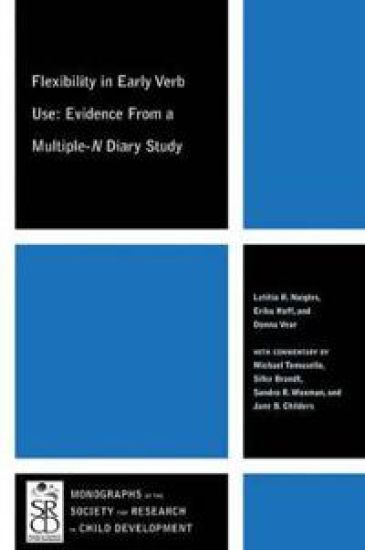
Flexibility in Early Verb Use

Flexibility in Early Verb Use

Letitia R. Naigles; Erika Hoff; Donna Vea

Wiley-Blackwell (an imprint of John Wiley Sons Ltd)
2009
nidottu
Flexibility and productivity are hallmarks of human language use. Competent speakers have the capacity to use the words they know to serve a variety of communicative functions, to refer to new and varied exemplars of the categories to which words refer, and in new and varied combinations with other words. When and how children achieve this flexibility—and when they are truly productive language users—are central issues among accounts of language acquisition. The current study tests competing hypotheses of the achievement of flexibility and some kinds of productivity against data on children’s first uses of their first-acquired verbs. Eight mothers recorded their children's first 10 uses of 34 early-acquired verbs, if those verbs were produced within the window of the study. The children were between 16 and 20 months when the study began (depending on when the children started to produce verbs), were followed for between 3 and 12 months, and produced between 13 and 31 of the target verbs. These diary records provided the basis for a description of the pragmatic, semantic, and syntactic properties of early verb use. The data revealed that within this early, initial period of verb use, children use their verbs both to command and describe, they use their verbs in reference to a variety of appropriate actions enacted by a variety of actors and with a variety of affected objects, and they use their verbs in a variety of syntactic structures. All 8 children displayed semantic and grammatical flexibility before 24 months of age. These findings are more consistent with a model of the language learning child as an avid generalizer than as a conservative language user. Children’s early verb use suggests abilities and inclinations to abstract from experience that may indeed begin in infancy.