Kirjojen hintavertailu. Mukana 11 342 296 kirjaa ja 12 kauppaa.

Kirjahaku

Etsi kirjoja tekijän nimen, kirjan nimen tai ISBN:n perusteella.

1000 tulosta hakusanalla Luke Strongman

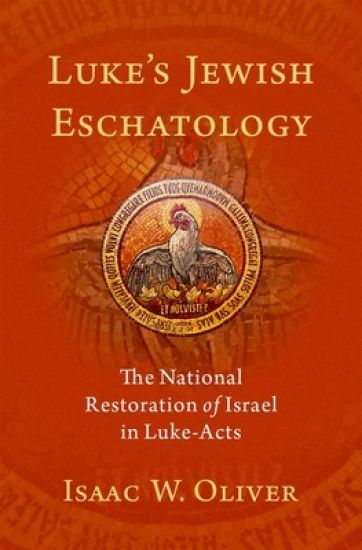
Luke's Jewish Eschatology

Luke's Jewish Eschatology

Isaac W. Oliver

Oxford University Press Inc
2021
sidottu
Luke, the eponymous author of the gospel that bears his name as well as the book of Acts, wrote the largest portion of the New Testament. Luke is generally thought to be a gentile. This book addresses a question raised by Jesus's disciples at the very beginning of Acts: "Lord, will you at this time restore the kingdom to Israel?" The question is freighted with political and national significance as it inquires about the restoration of political sovereignty to the Jewish people. This book investigates Luke's perspective on the salvation of Israel in light of Jewish restoration eschatology. It situates Luke-Acts in the aftermath of the destruction of the Second Temple in 70 CE. The author of Luke-Acts did not write the Jews off but still awaited the restoration of Israel. Luke conceived of Israel's eschatological restoration in traditional Jewish terms. The nation of Israel would experience liberation in the fullest sense, including national and political restoration. Luke's Jewish Eschatology builds upon the appreciation of the Jewish character of early Christianity in the decades after the Holocaust, which has witnessed the reclamation of the Jewishness of the historical Jesus and even Paul.

Luke And The Cheese Of Hope

Luke And The Cheese Of Hope

Shivani Panneri; Chithra Anoop

Tellwell Talent
2022
pokkari
When Luke and Blake enter the magnificent Dream World, everything goes horribly wrong. The Dream World's most sacred artifact, the Cheese, is missing Will Luke and Blake be able to retrieve the Cheese in time? Or will they be stuck in the Dream World forever? Follow Luke and Blake on the journey for their missing artifact as they venture out into the deep, dark depth of this unsolved case . . .
Luke for Everyone

Luke for Everyone

Tom Wright

SPCK Publishing
2014
nidottu
Tom Wright's guide to Luke, which includes a wealth of information and background detail, provides real insights for our understanding of the story of Jesus and its implications for the reader. His clear style is accessible to new readers of the Bible, as well as to those who are further on. His exciting new translation brings to life, passage by passage, the immediacy and drama of Luke's gospel. Tom Wright has undertaken a tremendous task: to provide guides to all the books of the New Testament, and to include in them his own translation of the entire text. Each short passage is followed by a highly readable discussion with background information, useful explanations and suggestions, and thoughts as to how the text can be relevant to our lives today. A glossary is included at the back of the book. The series is suitable for group study, personal study, or daily devotions.
Luke Bible Study Guide plus Streaming Video

Luke Bible Study Guide plus Streaming Video

Lisa Harper

HarperChristian Resources
2023
nidottu
Winner of the 2024 ECPA Christian Book Award for Best Bible Study — OVER 100,000 COPIES SOLD!Perfection Not Required. . .Many of us believe that we aren’t good enough to meet other people’s expectations. Maybe you can’t wrap words around why, but lurking beneath the surface of the carefully curated façade you present in public, it’s there. Being missed and marginalized by others moves us to assume we’re not quite good enough for God either.The great news woven throughout the Gospel according to Luke is that perfection is not a prerequisite for a deep and personal relationship with Jesus. In fact, this riveting account reveals that Jesus is especially fond of ragamuffins in need of a safe place to lean in and linger! Join Lisa Harper in this Bible study of a literary masterpiece that doesn’t celebrate the elite, but embraces the outliers, outcasts, and overlooked!This study guide has everything you need for a full Bible study experience, including:The study guide itself—with discussion and reflection questions, video notes, and a leader's guide.Personal study of Scripture and context.Scripture memory cards and coloring pages.An individual access code to stream all eight video sessions online. (You don’t need to buy a DVD!) Sessions and Video Run Times:Outliers, Outcasts, and the Outrageous Mercy of God (26:00)Worship in the Waiting (25:00)Uphill Glory (29:00)Gut-Level Compassion (27:00) The Tender Heart of Obedience (32:00)A Beautiful Unbending (31:00)A Most Radical Restoration (31:00)A Tale of Two Rooms (31:00) Streaming video access code included. Access code subject to expiration after 12/31/2028. Code may be redeemed only by the recipient of this package. Code may not be transferred or sold separately from this package. Internet connection required. Void where prohibited, taxed, or restricted by law. Additional offer details inside.—Beautiful WordTM Bible Study Series—What book of the Bible do you turn to for wisdom about the situation you find yourself in? Where do you go for words of comfort when you’re feeling overwhelmed, lost, or frustrated in life?The Beautiful WordTM Bible Study series makes the Bible come alive in such a way that you know where to turn no matter where you find yourself on your spiritual journey. Featuring celebrated authors and teachers like Lisa Harper, Margaret Feinberg, and Jada Edwards, each guide is a creative and illuminating journey through one book of the Bible.
Luke---Acts

Luke---Acts

Zondervan
2007
sidottu
Continuing a Gold Medallion Award-winning legacy, the completely revised Expositor's Bible Commentary puts world-class biblical scholarship in your hands.A staple for students, teachers, and pastors worldwide, The Expositor's Bible Commentary (EBC) offers comprehensive yet succinct commentary from scholars committed to the authority of the Holy Scriptures. The EBC uses the New International Version of the Bible, but the contributors work from the original Hebrew and Greek languages and refer to other translations when useful.Each section of the commentary includes:An introduction: background information, a short bibliography, and an outlineAn overview of Scripture to illuminate the big pictureThe complete NIV textExtensive commentaryNotes on textual questions, key words, and conceptsReflections to give expanded thoughts on important issuesThe series features 56 contributors, who:Believe in the divine inspiration, complete trustworthiness, and full authority of the BibleHave demonstrated proficiency in the biblical book that is their specialtyAre committed to the church and the pastoral dimension of biblical interpretationRepresent geographical and denominational diversityUse a balanced and respectful approach toward marked differences of opinionWrite from an evangelical viewpointFor insightful exposition, thoughtful discussion, and ease of use—look no further than The Expositor's Bible Commentary.
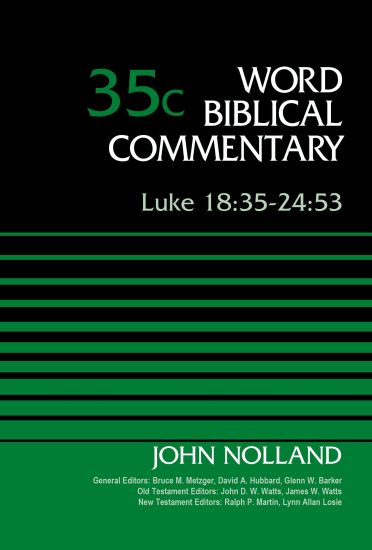
Luke 18:35-24:53, Volume 35C

Luke 18:35-24:53, Volume 35C

Nolland John

Zondervan
2015
sidottu
The Word Biblical Commentary delivers the best in biblical scholarship, from the leading scholars of our day who share a commitment to Scripture as divine revelation. This series emphasizes a thorough analysis of textual, linguistic, structural, and theological evidence. The result is judicious and balanced insight into the meanings of the text in the framework of biblical theology. These widely acclaimed commentaries serve as exceptional resources for the professional theologian and instructor, the seminary or university student, the working minister, and everyone concerned with building theological understanding from a solid base of biblical scholarship.Overview of Commentary OrganizationIntroduction—covers issues pertaining to the whole book, including context, date, authorship, composition, interpretive issues, purpose, and theology.Each section of the commentary includes:Pericope Bibliography—a helpful resource containing the most important works that pertain to each particular pericope.Translation—the author’s own translation of the biblical text, reflecting the end result of exegesis and attending to Hebrew and Greek idiomatic usage of words, phrases, and tenses, yet in reasonably good English.Notes—the author’s notes to the translation that address any textual variants, grammatical forms, syntactical constructions, basic meanings of words, and problems of translation.Form/Structure/Setting—a discussion of redaction, genre, sources, and tradition as they concern the origin of the pericope, its canonical form, and its relation to the biblical and extra-biblical contexts in order to illuminate the structure and character of the pericope. Rhetorical or compositional features important to understanding the passage are also introduced here.Comment—verse-by-verse interpretation of the text and dialogue with other interpreters, engaging with current opinion and scholarly research.Explanation—brings together all the results of the discussion in previous sections to expose the meaning and intention of the text at several levels: (1) within the context of the book itself; (2) its meaning in the OT or NT; (3) its place in the entire canon; (4) theological relevance to broader OT or NT issues.General Bibliography—occurring at the end of each volume, this extensive bibliographycontains all sources used anywhere in the commentary.
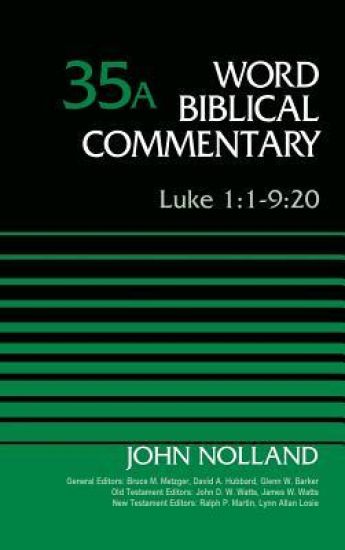
Luke 1:1-9:20, Volume 35A

Luke 1:1-9:20, Volume 35A

John Nolland

Zondervan
2016
sidottu
The Word Biblical Commentary delivers the best in biblical scholarship, from the leading scholars of our day who share a commitment to Scripture as divine revelation. This series emphasizes a thorough analysis of textual, linguistic, structural, and theological evidence. The result is judicious and balanced insight into the meanings of the text in the framework of biblical theology. These widely acclaimed commentaries serve as exceptional resources for the professional theologian and instructor, the seminary or university student, the working minister, and everyone concerned with building theological understanding from a solid base of biblical scholarship.Overview of Commentary OrganizationIntroduction—covers issues pertaining to the whole book, including context, date, authorship, composition, interpretive issues, purpose, and theology.Each section of the commentary includes:Pericope Bibliography—a helpful resource containing the most important works that pertain to each particular pericope.Translation—the author’s own translation of the biblical text, reflecting the end result of exegesis and attending to Hebrew and Greek idiomatic usage of words, phrases, and tenses, yet in reasonably good English.Notes—the author’s notes to the translation that address any textual variants, grammatical forms, syntactical constructions, basic meanings of words, and problems of translation.Form/Structure/Setting—a discussion of redaction, genre, sources, and tradition as they concern the origin of the pericope, its canonical form, and its relation to the biblical and extra-biblical contexts in order to illuminate the structure and character of the pericope. Rhetorical or compositional features important to understanding the passage are also introduced here.Comment—verse-by-verse interpretation of the text and dialogue with other interpreters, engaging with current opinion and scholarly research.Explanation—brings together all the results of the discussion in previous sections to expose the meaning and intention of the text at several levels: (1) within the context of the book itself; (2) its meaning in the OT or NT; (3) its place in the entire canon; (4) theological relevance to broader OT or NT issues.General Bibliography—occurring at the end of each volume, this extensive bibliographycontains all sources used anywhere in the commentary.
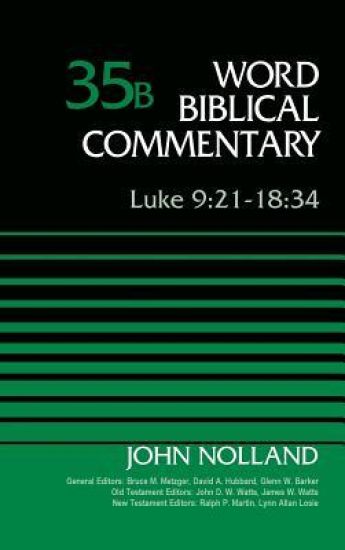
Luke 9:21-18:34, Volume 35B

Luke 9:21-18:34, Volume 35B

Nolland John

Zondervan
2016
sidottu
The Word Biblical Commentary delivers the best in biblical scholarship, from the leading scholars of our day who share a commitment to Scripture as divine revelation. This series emphasizes a thorough analysis of textual, linguistic, structural, and theological evidence. The result is judicious and balanced insight into the meanings of the text in the framework of biblical theology. These widely acclaimed commentaries serve as exceptional resources for the professional theologian and instructor, the seminary or university student, the working minister, and everyone concerned with building theological understanding from a solid base of biblical scholarship.Overview of Commentary OrganizationIntroduction—covers issues pertaining to the whole book, including context, date, authorship, composition, interpretive issues, purpose, and theology.Each section of the commentary includes:Pericope Bibliography—a helpful resource containing the most important works that pertain to each particular pericope.Translation—the author’s own translation of the biblical text, reflecting the end result of exegesis and attending to Hebrew and Greek idiomatic usage of words, phrases, and tenses, yet in reasonably good English.Notes—the author’s notes to the translation that address any textual variants, grammatical forms, syntactical constructions, basic meanings of words, and problems of translation.Form/Structure/Setting—a discussion of redaction, genre, sources, and tradition as they concern the origin of the pericope, its canonical form, and its relation to the biblical and extra-biblical contexts in order to illuminate the structure and character of the pericope. Rhetorical or compositional features important to understanding the passage are also introduced here.Comment—verse-by-verse interpretation of the text and dialogue with other interpreters, engaging with current opinion and scholarly research.Explanation—brings together all the results of the discussion in previous sections to expose the meaning and intention of the text at several levels: (1) within the context of the book itself; (2) its meaning in the OT or NT; (3) its place in the entire canon; (4) theological relevance to broader OT or NT issues.General Bibliography—occurring at the end of each volume, this extensive bibliographycontains all sources used anywhere in the commentary.
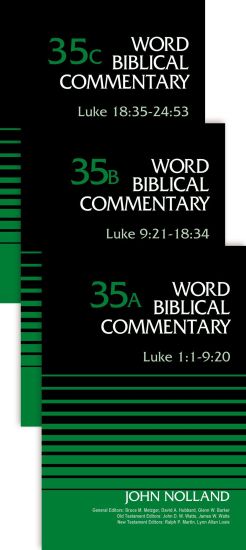
Luke (3-Volume Set---35A, 35B, and 35C)
The Word Biblical Commentary delivers the best in biblical scholarship, from the leading scholars of our day who share a commitment to Scripture as divine revelation. This series emphasizes a thorough analysis of textual, linguistic, structural, and theological evidence. The result is judicious and balanced insight into the meanings of the text in the framework of biblical theology. These widely acclaimed commentaries serve as exceptional resources for the professional theologian and instructor, the seminary or university student, the working minister, and everyone concerned with building theological understanding from a solid base of biblical scholarship. Overview of Commentary Organization Introduction—covers issues pertaining to the whole book, including context, date, authorship, composition, interpretive issues, purpose, and theology. Each section of the commentary includes: Pericope Bibliography—a helpful resource containing the most important works that pertain to each particular pericope. Translation—the author’s own translation of the biblical text, reflecting the end result of exegesis and attending to Hebrew and Greek idiomatic usage of words, phrases, and tenses, yet in reasonably good English. Notes—the author’s notes to the translation that address any textual variants, grammatical forms, syntactical constructions, basic meanings of words, and problems of translation. Form/Structure/Setting—a discussion of redaction, genre, sources, and tradition as they concern the origin of the pericope, its canonical form, and its relation to the biblical and extra-biblical contexts in order to illuminate the structure and character of the pericope. Rhetorical or compositional features important to understanding the passage are also introduced here. Comment—verse-by-verse interpretation of the text and dialogue with other interpreters, engaging with current opinion and scholarly research. Explanation—brings together all the results of the discussion in previous sections to expose the meaning and intention of the text at several levels: (1) within the context of the book itself; (2) its meaning in the OT or NT; (3) its place in the entire canon; (4) theological relevance to broader OT or NT issues. General Bibliography—occurring at the end of each volume, this extensive bibliographycontains all sources used anywhere in the commentary.
Luke Skywalker and the Shadows of Mindor: Star Wars Legends
Emperor Palpatine and Darth Vader are dead. The Empire has been toppled by the triumphant Rebel Alliance, and the New Republic is ascendant. But the struggle against the dark side and the Sith Order is not over. Luke Skywalker, Princess Leia, Han Solo, Lando Calrissian, and their faithful comrades have had little time to savor victory before being called on to defend the newly liberated galaxy. Powerful remnants of the vanquished Empire, hungry for retaliation, are still at large, committing acts of piracy, terrorism, and wholesale slaughter against the worlds of the fledgling New Republic. The most deadly of these, a ruthless legion of black-armored Stormtroopers, do the brutal bidding of the newly risen warlord Shadowspawn. Striking from a strategically advantageous base on the planet Mindor, they are waging a campaign of plunder and destruction, demolishing order and security across the galaxy-and breeding fears of an Imperial resurgence. Another reign of darkness beneath the boot-heel of Sith despotism is something General Luke Skywalker cannot, and will not, risk. Mobilizing the ace fighters of Rogue Squadron-along with the trusty Chewbacca, See-Threepio, and Artoo-Detoo-Luke, Han, and Leia set out to take the battle to the enemy and neutralize the threat before it's too late. But their imminent attack on Mindor will be playing directly into the hands of their cunning new adversary. Lord Shadowspawn is no freshly anointed Sith Chieftain but in fact a vicious former Imperial Intelligence officer-and Prophet of the Dark Side. The Emperor's death has paved the way for Shadowspawn's return from exile in the Outer Rim, and mastery of ancient Sith knowledge and modern technology has given him the capability to mount the ultimate power play for galaxy wide dominion. Dark prophecy has foretold that only one obstacle stands in his way, and he is ready-even eager-for the confrontation. All the classic heroes, all the explosive action and adventure, all the unparalleled excitement of Star Wars come breathlessly alive as the adventures of Luke Skywalker continue.
Luke Wadding, the Irish Franciscans, and Global Catholicism
This book explores the endeavors and activities of one of the most prominent early modern Irishmen in exile, the Franciscan Luke Wadding. Born in Ireland, educated in the Iberian Peninsula, Wadding arrived in Rome in 1618, where he would die in 1657. In the "Eternal City," the Franciscan emerged as an outstanding theologian, a learned scholar, a diplomat, and a college founder. This innovative collection of chapters brings together a group of international scholars who provide a ground-breaking analysis of the many cultural, political, and religious facets of Wadding’s life. They illustrate the challenges and changes faced by an Irishman who emerged as one of the most outstanding global figures of the Catholic Reformation. The volume will attract scholars of the early modern period, early modern Catholicism, and Irish emigration.
Luke the Priest

Luke the Priest

Rick Strelan

Routledge
2019
nidottu
This book focuses on the authority and status of the author of Luke-Acts. What authority did he have to write a Gospel, to interpret the Jewish Scriptures and traditions of Israel, to interpret the Jesus traditions, and to update the narrative with a second volume with its interpretation of Paul and the other apostles who appear in the Acts narrative? Rick Strelan constructs the author as a Jewish Priest, examining such issues as writing and orality, authority and tradition, and the status and role of priests. The analysis is set within the context of scholarly opinion about the author, the intended audience and other related issues.
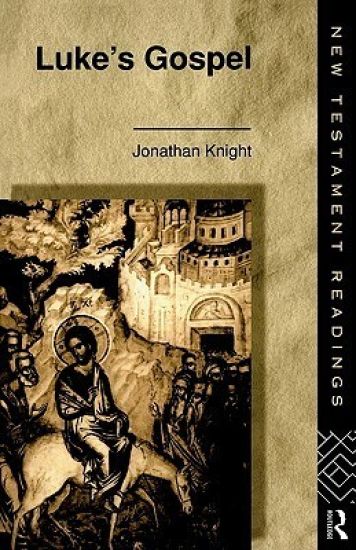
Luke's Gospel

Luke's Gospel

Jonathan Knight

Routledge
1998
nidottu
Luke's Gospel provides a comprehensive and schematic reading of Luke's Gospel, one of the most important books detailing the life and works of Christ, in six main parts. Knight introduces the Gospel and the narrative theory on which the Gospel rests. He offers a detailed, chapter-by-chapter exposition of the Gospel and also alternative perspectives, such as feminism and deconstruction. He considers the principal motifs of the Gospel, particularly the theme of the temple, which has been previously overlooked in Luke scholarship, arguing that Jesus pronounces the present temple forsaken by God to introduce himself as the cornerstone of the eschatological temple. Finally, he examines earlier readings of Luke's Gospel.Jonathan Knight presents an accessible and jargon-free introduction to the Gospel and makes a valuable addition to the New Testament Readings series.
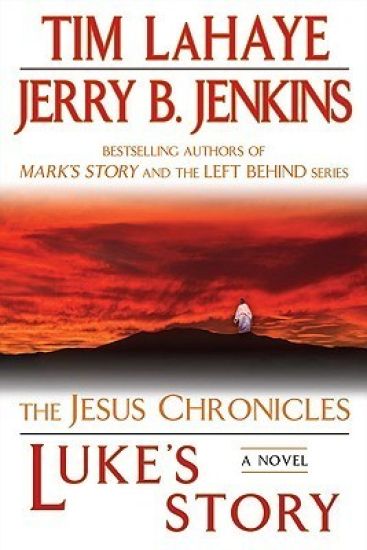
Luke's Story

Luke's Story

Tim LaHaye; Jerry B. Jenkins

Penguin USA
2010
pokkari
Millions of readers made the Left Behind series bestsellers. Now the third in the authors' bestselling Jesus Chronicles is available in trade paperback. This biblically inspired novel, third in the bestselling Jesus Chronicles, tells the story of Luke-the Gospel writer whose belief was built on the power of faith alone. Luke, who hadn't met Jesus, is skeptical of His miracles, until events in his own life irreversibly change him. Pledging himself to Christ, he begins a Gospel based on the conversion stories of believers and interviews with those who knew Him best—the disciples who spent three years with Jesus and, most important, His mother, Mary. The result would be a Scripture rich in the miraculous stories of the Lord's divinity, intended to appeal to women, nonbelievers, and the disenfranchised-and that would speak to the heart of Christians all over the world.
Luke and the Law

Luke and the Law

S. G. Wilson

Cambridge University Press
2005
pokkari
The theme of law in Luke's Gospel has rarely been discussed, and then only tangentially in studies concerned with recovering Jesus' view of the law. The evidence of Acts has received considerably more attention, but almost always in the context of a comparison with Paul's view of the law or a reconstruction of the historical events which lie behind the narrative of Acts. A notable exception is J. Jervell's essay on 'The Law in Luke - Acts' in which he argues that Luke presents a consistent and conservative view of the law, viz. that the Church, as the renewed Israel, is committed to the law, Jewish-Christians being obliged to keep the whole of it and Gentile Christians those parts relevant to them. He thus disagrees with Conzelmann, who argues that the apostolic decree freed the Church once and for all from its previous obligation to the law.