Castle Rackrent, a short novel by Maria Edgeworth published in 1800, is often regarded as the first historical novel, the first regional novel in English, the first Anglo-Irish novel, the first Big House novel and the first saga novel. It is also widely regarded as the first novel to use the device of a narrator who is both unreliable and an observer of, rather than a player in, the actions he chronicles. Kirkpatrick suggests that it "both borrows from and originates a variety of literary genres and subgenres without neatly fitting into any one of them". William Butler Yeats pronounced Castle Rackrent "one of the most inspired chronicles written in English"............... The Absentee is a novel by Maria Edgeworth, published in 1812 in Tales of Fashionable Life, that expresses the systemic evils of the absentee landlord class of Anglo-Irish and the desperate condition of the Irish peasantry. Just before coming of age, Lord Colambre, the sensitive hero of the novel, finds that his mother Lady Clonbrony's attempts to buy her way into the high society of London are only ridiculed, while his father, Lord Clonbrony, is in serious debt as a result of his wife's lifestyle. His mother wishes him to marry an heiress, Miss Broadhurst, who is a friend of Grace Nugent. However, Colambre has already fallen in love with his cousin, Grace Nugent, who lives with the family as a companion to Lady Clonbrony. Worried that his mother will pressure him into a marriage with someone he does not love, Colambre decides to leave the London social scene and visit his ancestral home in County Wicklow in Ireland.................... Maria Edgeworth (1 January 1768 - 22 May 1849) was a prolific Anglo-Irish writer of adults' and children's literature. She was one of the first realist writers in children's literature and was a significant figure in the evolution of the novel in Europe. She held advanced views, for a woman of her time, on estate management, politics and education, and corresponded with some of the leading literary and economic writers, including Sir Walter Scott and David Ricardo. Early life: Maria Edgeworth was born at Black Bourton, Oxfordshire. She was the second child of Richard Lovell Edgeworth (who eventually fathered 22 children by four wives) and Anna Maria Edgeworth; Maria was thus an aunt of Francis Ysidro Edgeworth. She spent her early years with her mother's family in England, until her mother's death when Maria was five. When her father married his second wife Honora Sneyd in 1773, she went with him to his estate, Edgeworthstown, in County Longford, Ireland........... 'Chris' Hammond (1860-1900) was one of the most productive illustrators of the 1890s. Best known as an interpreter of classic fiction, she embellished texts by Jane Austen, Maria Edgeworth, W. M. Thackeray, George Eliot and a number of others, as well as contributing to Cassell's Magazine, The Quiver, and St Pauls..... Anne Isabella, Lady Ritchie, n e Thackeray (9 June 1837 - 26 February 1919), was an English writer. She was the eldest daughter of William Makepeace Thackeray. She was the author of several novels which were highly regarded in their time, and a central figure in the late Victorian literary scene. She is perhaps best remembered today as the custodian of her father's literary legacy, and for her short fiction placing traditional fairy tale narratives in a Victorian milieu. Her 1885 novel Mrs. Dymond contains the earliest English-language use of the well-known proverb "give a man a fish and you feed him for a day; teach a man to fish and you feed him for life".............
This work has been selected by scholars as being culturally important, and is part of the knowledge base of civilization as we know it. This work was reproduced from the original artifact, and remains as true to the original work as possible. Therefore, you will see the original copyright references, library stamps (as most of these works have been housed in our most important libraries around the world), and other notations in the work.This work is in the public domain in the United States of America, and possibly other nations. Within the United States, you may freely copy and distribute this work, as no entity (individual or corporate) has a copyright on the body of the work.As a reproduction of a historical artifact, this work may contain missing or blurred pages, poor pictures, errant marks, etc. Scholars believe, and we concur, that this work is important enough to be preserved, reproduced, and made generally available to the public. We appreciate your support of the preservation process, and thank you for being an important part of keeping this knowledge alive and relevant.
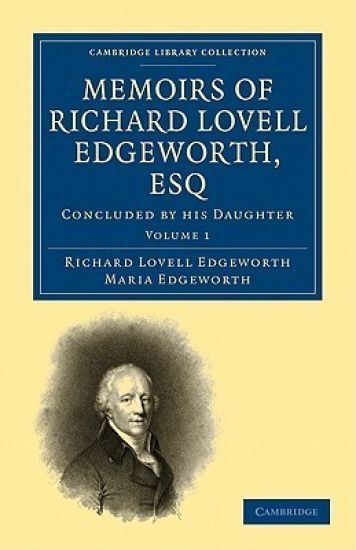
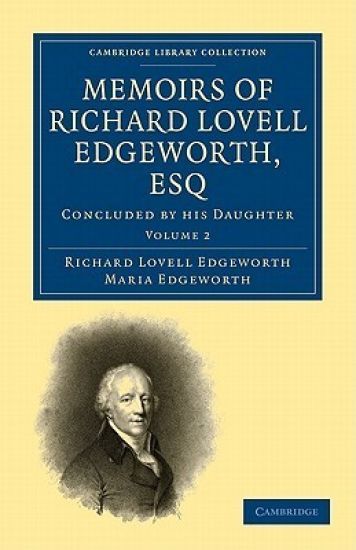
Richard Lovell Edgeworth (1744–1817) was a noted Irish educationalist, engineer and inventor. This two-volume autobiography, begun in 1808, was completed by his novelist daughter Maria, and published in 1820. Edgeworth's interest in education is evidenced by his reflections about how his childhood shaped his character and later life. Volume 1, written by Edgeworth himself and covering the period to 1781, reveals that his interest in science began early; he was shown an orrery (a moving model of the solar system) at the age of seven. As a young man, Edgeworth attended university in Dublin and Oxford, studied law, and eloped while still in his teens. He experimented with vehicle design, winning several awards, and was introduced by Erasmus Darwin to the circle of scientists, innovators and industrialists later known as the Lunar Society of Birmingham. In 1781 Sir Joseph Banks sponsored his election to the Royal Society.
Richard Lovell Edgeworth (1744–1817) was a noted Irish educationalist, engineer and inventor. This two-volume autobiography, begun in 1808, was published in 1820. Edgeworth had abandoned the project in 1809, having covered the period to 1781, and it was completed after his death by his eldest daughter, a successful novelist. Maria Edgeworth and her father had co-authored educational works, and the experience of helping her father run their estate during her teens had provided material for her novels. Volume 2 of these memoirs was wholly written by her, though it contains excerpts from Richard's correspondence. It recounts how, after his third marriage, the growing family returned to Ireland, and focused first on domestic and educational concerns. Richard became involved in Irish politics and the newly founded Royal Irish Academy but continued to publish essays on scientific and mechanical topics, as well as influential (though controversial) works on education.
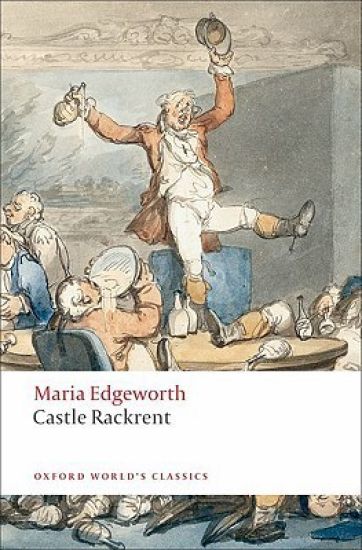
Thady Quirk, devoted steward to the decaying estate of the Rackrent family, narrates a riotous story of four generations of a dying dynasty in Castle Rackrent (1800). Thady will defend his masters to the end, but eventually his naivety and blind loyalty cause him to ignore the warning signs as the family's excesses lead them to ruin. This volume also includes Ennui, the entertaining 'confessions' of the Earl of Glenthorn, a bored, spoiled aristocrat. Desperate to be free from 'the demon of ennui', Glenthorn's quest for happiness takes him through violence and revolution, and leads to intriguing twists of fate. Both novels offer a darkly comic and satirical exposé of the Irish class system, and a portrait of a nation in turmoil.
During the 1790s, with Ireland in political crisis, Maria Edgeworth made a surprisingly rebellious choice: in Castle Rackrent, her first novel, she adopted an Irish Catholic voice to narrate the decline of a family from her own Anglo-Irish class. Castle Rackrent's narrator, Thady Quirk, gives us four generations of Rackrent heirs - Sir Patrick, the dissipated spendthrift; Sir Murtagh, the litigating fiend; Sir Kit, the brutal husband and gambling absentee; and Sir Condy, the lovable and improvident dupe of Thady's own son, Jason. With this satire on Anglo-Irish landlords Edgeworth pioneered the regional novel and inspired Sir Walter Scott's Waverly (1814). She also changed the focus of conflict in Ireland from religion to class and boldly predicted the rise of the Irish Catholic Bourgeoisie. ABOUT THE SERIES: For over 100 years Oxford World's Classics has made available the widest range of literature from around the globe. Each affordable volume reflects Oxford's commitment to scholarship, providing the most accurate text plus a wealth of other valuable features, including expert introductions by leading authorities, helpful notes to clarify the text, up-to-date bibliographies for further study, and much more.
'It is singular, that my having spent a winter with one of the most dissipated women in England should have sobered my mind so completely.' Maria Edgeworth's 1801 novel, Belinda, is an absorbing, sometimes provocative, tale of social and domestic life among the English aristocracy and gentry. The heroine of the title, only too conscious of being 'advertised' on the marriage market, grows in moral maturity as she seeks to balance self-fulfilment with achieving material success. Among those whom she encounters are the socialite Lady Delacour, whose brilliance and wit hide a tragic secret, the radical feminist Harriot Freke, the handsome and wealthy Creole gentleman Mr Vincent, and the mercurial Clarence Hervey, whose misguided idealism has led him into a series of near-catastrophic mistakes. In telling their story Maria Edgeworth gives a vivid picture of life in late eighteenth-century London, skilfully showing both the attractions of leisured society and its darker side, and blending drawing-room comedy with challenging themes involving serious illness, obsession, slavery and interracial marriage.
Based on Baldwin & Cradock’s Tales And Novels Of Maria Edgeworth (1832-1833), this edition is accompanied by annotations. "Backgrounds and Contexts" focuses on the importance of the author, the influence of events on her writing and the book’s impact on the novel. "Criticism" is thematically organised. A chronology and bibliography are included.

![Thirty Thousand; Or Who's the Richest? a Comic Opera, in Three Acts, Etc. [Based on Maria Edgeworth's Tale "The Will."]](/covers/9781241052331.jpg)